
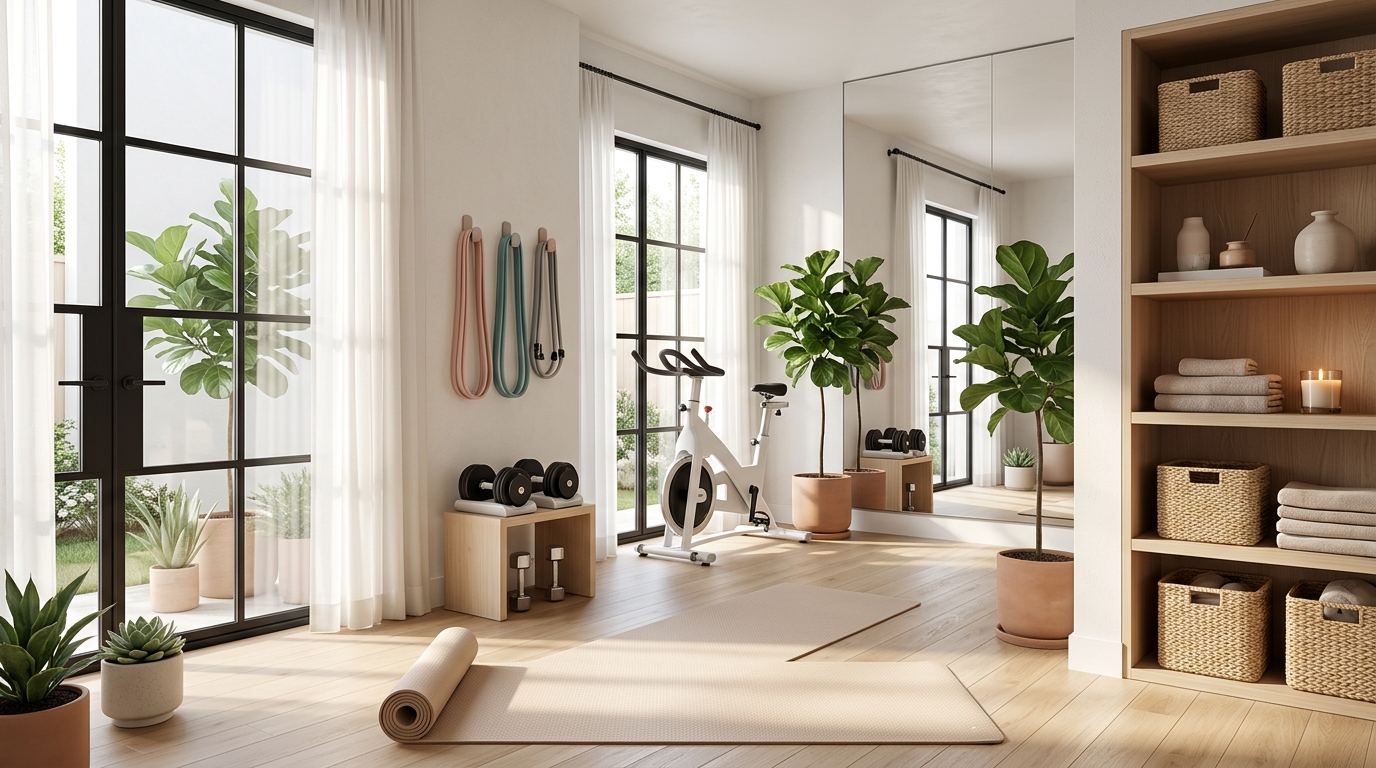
A home gym built specifically around how women train and what women actually need from a workout space looks completely different from a generic gym setup and functions significantly better for it. The equipment priorities are different, the space design is different, and the environment itself plays a much larger role in training consistency than most gym setup advice acknowledges. These 21 home gym ideas for women cover everything from equipment selection to room design to the small details that make the difference between a gym you use every day and one you walk past on the way to the couch.
Every idea here is grounded in real training needs rather than in assumptions about what women want from a workout space. Below are 21 ideas that help you build a home gym that genuinely supports your training.
1. Prioritize a High Quality Yoga and Stretching Mat
A thick, high density yoga mat is the foundational piece of equipment in a home gym built around the kind of training most women actually do: yoga, pilates, stretching, floor work, bodyweight training, and mobility sessions that require a surface that is comfortable, grippy, and large enough to move on freely. A standard thin yoga mat is adequate for a yoga class where you are focused on the practice rather than on the discomfort of your knees on a hard floor but a 6mm or thicker mat makes floor based training genuinely comfortable for extended sessions.
Manduka PRO, Liforme, and Lululemon The Mat all produce high quality yoga mats in the 5mm to 6mm thickness range with grip surfaces that hold position during dynamic movements without bunching or sliding. Choose a mat that is long enough for your full height to lie on comfortably, at least 72 inches for most women, and wide enough for side lying exercises, at least 24 inches wide. A mat in a color that you genuinely like looking at makes a meaningful difference to how often you roll it out.
2. Build a Dedicated Barre or Ballet Barre Station
A wall mounted ballet barre in the home gym provides the anchor point for barre workouts, balance training, stretching, and the kind of low impact high repetition lower body work that barre fitness has popularized as one of the most effective and most joint friendly training modalities available. A wall mounted barre takes up zero floor space, costs significantly less than a freestanding version, and provides a more stable support surface for training than a portable barre that shifts during use.
Single and double ballet barre wall mounting systems are available from specialty dance supply companies and Amazon at prices from forty to one hundred fifty dollars depending on material and length. Install the barre at a height between hip and waist level for the most versatile use across barre workouts, stretching, and balance training. A barre station with a full length mirror beside it creates the most functional and most motivating barre training zone available in a home gym at very low combined cost.
3. Invest in a Set of Hip Thrust Equipment
Hip thrust training is one of the most effective lower body and glute development exercises available and it requires a specific setup that most generic home gym advice overlooks: a hip thrust pad, a barbell or a specialized hip thrust machine, and a bench or box at the correct height to support the upper back during the movement. A freestanding hip thrust machine from brands like Bells of Steel or a simple combination of a standard barbell, a hip thrust pad, and an adjustable bench provides the complete hip thrust setup within a modest equipment footprint.
The hip thrust pad, a thick padded sleeve that fits over the barbell to protect the hip bones during loaded hip thrusts, is the most important and least expensive component of a hip thrust setup at around twenty to forty dollars from Amazon or Rogue. The pad makes loaded hip thrust training comfortable enough to train consistently at the weights needed to produce meaningful training results. Without the pad, hip thrust training becomes painful at higher loads and training frequency drops as a result.
4. Add a Pilates Reformer or Megaformer
A pilates reformer in a home gym provides one of the most comprehensive low impact full body training systems available in a single piece of equipment. The reformer accommodates hundreds of exercise variations that develop strength, flexibility, coordination, and postural quality simultaneously and the spring resistance system provides progressive load that suits training at every experience level from complete beginner to advanced athlete. A home pilates reformer from BASI Systems, Balanced Body, or Peak Pilates represents a significant investment but delivers a training tool with a functional breadth that no other single piece of equipment approaches.
A foldable reformer from brands like AeroPilates provides the essential reformer training experience in a format that stores against the wall when not in use, which suits a small home gym where the reformer footprint during use would otherwise permanently occupy a significant portion of the training floor. The foldable reformer delivers approximately 80 percent of the training versatility of a full studio reformer in a format that recovers its floor space between sessions.
5. Choose Colorful or Aesthetically Designed Equipment
The equipment in a home gym that you find beautiful and that you enjoy looking at contributes to the training environment quality and the training motivation in ways that utilitarian black iron equipment does not. Kettlebells in matte color options, resistance bands in a coordinated color palette, a yoga mat in a color that energizes you, and dumbbells in a finish that you find visually appealing all make the gym a more inviting environment and training motivation research consistently shows that the visual quality of the training environment directly affects training frequency and training enjoyment.
Kettlebell Kings, Onnit, and Yes4All all produce kettlebells in color options beyond the standard black cast iron. Lululemon, Manduka, and Alo Yoga produce yoga mats and training accessories in considered colorways that suit a gym designed with aesthetic intention. The choice of visually appealing equipment is not a superficial vanity. It is a training environment investment that pays returns in motivation and consistency that the same equipment in an unappealing finish does not.
6. Install Adjustable Cable Columns or a Functional Trainer
A functional trainer with dual adjustable cable columns provides the most versatile resistance training tool available for the kind of training that produces the aesthetic and functional results most women train toward: glute cable kickbacks, cable pull throughs, face pulls, cable lateral raises, cable rows, and the full range of cable isolation exercises that dumbbells and barbells cannot effectively replicate. The adjustable pulley height of a functional trainer accommodates exercises from floor level to overhead in a single compact machine footprint.
REP Fitness FT-100 and Inspire FTX Functional Trainer are both well regarded home functional trainer options at price points significantly below commercial cable machines while delivering comparable exercise versatility. A functional trainer in a home gym oriented toward the training goals most women prioritize, glute development, upper back strength, shoulder stability, and core training, provides more training variety per square foot than any other resistance training equipment at a similar price point.
7. Create a Mood Enhancing Lighting Setup
The lighting in a home gym affects training motivation more directly than most gym design advice acknowledges. Bright cool white lighting energizes and suits high intensity training sessions. Warmer dimmed lighting suits yoga, stretching, and recovery sessions. A home gym with adjustable lighting that can shift between these two modes provides the right environment for every training modality without the compromise of a single fixed lighting option that suits some sessions well and others poorly.
Smart bulbs from Philips Hue or Govee in a ceiling fixture combined with a warm LED strip light along the base of the wall or behind equipment create a gym lighting system that can be adjusted from bright training light to ambient recovery light in seconds from a phone or a voice command. The ability to set the lighting mood before a training session makes the transition into the gym environment more intentional and more motivating than walking into the same flat overhead lighting for every type of workout.
8. Add a Dedicated Sound System
Music is the most consistently effective training motivator available and a dedicated sound system in the home gym that delivers genuinely good sound quality makes every training session better regardless of the training modality. The difference between training to music through phone speakers and training to music through a quality Bluetooth speaker or a wired speaker system is the difference between music as background noise and music as a genuine contributor to training energy and enjoyment.
A Sonos One, a JBL Charge, or a pair of bookshelf speakers connected to a small amplifier in the gym corner all provide the sound quality that makes music a genuine training tool rather than a background accompaniment. Mount the speaker on a wall bracket at head height for the best sound distribution across the training area and connect it to a playlist or a streaming service curated specifically for the training modality of each session. A gym with great sound is a gym you want to spend time in and that desire is one of the most powerful drivers of training consistency available.
9. Use Pastel or Warm Neutral Wall Colors
The wall color of a home gym affects the energy of the space in ways that are felt during every training session even when they are not consciously noticed. Most commercial gym advice defaults to motivational red or energetic yellow for gym wall colors but research on color psychology in training environments suggests that these high stimulation colors suit high intensity training for short sessions rather than the varied training modalities and longer session durations that characterize how most women train at home. Warm neutrals, soft dusty roses, warm whites, and muted sage greens create a training environment that is inviting for sessions of varying intensity and duration without the aggression of primary color gym aesthetics.
Sherwin Williams Antique White, Benjamin Moore Pale Rose, and Farrow and Ball Mizzle are all wall colors that create a gym environment with a warm, inviting quality that suits a training space used for yoga, pilates, barre, and strength training equally well. The wall color of the gym should make you want to enter the room and stay in it and the colors that produce that response in a feminine home gym context are consistently in the warm neutral rather than the high stimulation range of the color spectrum.
10. Include a Full Length Three Panel Mirror
A three panel or full width mirror along one wall of the home gym provides form feedback during training from multiple angles simultaneously and creates the most significant spatial expansion effect of any single addition to a home gym environment. The three panel configuration allows you to see your profile and three quarter view during exercises where a single flat mirror provides only the frontal view, which is the least useful angle for form assessment in exercises like squats, deadlifts, hip thrusts, and lunges where the lateral profile is the most informative view of the movement pattern.
Three panel mirror systems from specialty mirror suppliers and home improvement stores can be installed on a single wall using mirror clips and appropriate wall anchors for a total mirror width of six to eight feet that covers the most important training wall of the gym from near floor height to above head height. The mirror installation transforms the perceived size of the gym space and the training quality feedback it provides is immediately apparent in the first training session after installation.
11. Add a Smart Mirror or Interactive Training Screen
A smart mirror that displays workout classes, training programs, and real time form feedback while functioning as a standard mirror when not in active use brings the guided training experience of a boutique fitness studio into the home gym without requiring a separate screen or a separate device. Mirror, Tempo, and Lululemon Studio all produce smart mirror systems that provide live and on demand classes in yoga, pilates, barre, strength training, and cardio with instructor led guidance and real time feedback on form and intensity.
The smart mirror format suits a home gym for women particularly well because it provides the social and instructional quality of a group fitness class in the private, convenient environment of a home gym. The social motivation component of group fitness, often cited as the primary driver of attendance consistency in commercial gym settings, is replicated through live class participation on the smart mirror and the privacy of the home environment removes the self consciousness that prevents many women from training at their full capacity in a commercial gym context.
12. Create a Recovery Corner with Massage Tools
A dedicated recovery corner in the home gym with a foam roller, a massage gun, a set of lacrosse balls, and a stretching strap organized on a small shelf or wall hooks gives the recovery component of training a defined physical space that communicates its importance as part of the training program rather than as an optional afterthought. Recovery work done in the gym immediately after training is consistently more thorough and more effective than recovery work attempted later in the day in a different room and a well equipped recovery corner makes the transition from training to recovery seamless.
Theragun, Hyperice, and TriggerPoint all produce massage and recovery tools at the quality level appropriate for consistent daily use. A massage gun on a charging stand, a foam roller on wall hooks, and a set of lacrosse balls in a small bowl on the shelf beside the mat create a complete recovery station that occupies under three square feet of wall space and serves the most neglected and most important component of any training program.
13. Use a Tension Rod Curtain to Section Off the Gym
A tension rod curtain across the gym doorway or across the opening of an alcove home gym separates the training space from the adjacent living area without any permanent installation and creates the psychological threshold between domestic life and training time that improves focus and training consistency. The curtain is a softer and more aesthetically considered boundary than a door and it allows air circulation between the gym and the rest of the home during training while providing the visual separation that makes the gym feel like a distinct environment.
Choose a curtain in a fabric and color that suits the aesthetic of the home gym and the adjacent room. A linen curtain in a warm neutral creates a soft, considered division that suits a home gym with a warm, feminine aesthetic. A heavier cotton curtain in a coordinating color provides more visual separation and more acoustic dampening between the gym and the living space during training. The tension rod installation requires no tools and no wall damage and the curtain can be removed or changed without any trace of its presence.
14. Install a Scent Diffuser for Training Atmosphere
Scent is the most direct sensory pathway to mood and energy state and a scent diffuser in the home gym that delivers an energizing essential oil blend, peppermint, eucalyptus, citrus, or rosemary, during training creates a multi sensory training environment that commercial gyms with their institutional cleaning product smell never achieve. The association between a specific training scent and the training mental state becomes reinforced over time so that the scent itself begins to trigger the mental shift into training mode before the first exercise begins.
A simple ultrasonic diffuser from Vitruvi or InnoGear positioned in the gym corner costs under fifty dollars and the essential oils that produce the most research supported energizing effect, peppermint and citrus, cost around ten to fifteen dollars per bottle and last for months of regular use. Run the diffuser for thirty minutes before training begins so the scent is established in the room when training starts rather than building during the session.
15. Hang Motivational Art That Actually Resonates
Art in a home gym should do genuine motivational work rather than serving as decoration that the eye passes over after the first few days of training in the space. Choose art with words, imagery, or a visual quality that genuinely resonates with your specific training goals and your specific relationship with training rather than generic gym motivation posters with stock phrases that apply to everyone and therefore inspire no one in particular.
A print of a woman whose physical capacity you admire, a quote from an athlete or a thinker whose perspective on training reflects your own values, or a piece of abstract art in colors that energize you are all more effective motivational art choices for a home gym than the standard hustle culture posters that decorate most gym spaces. Society6, Minted, and Etsy both carry art prints in the range of styles and subjects that suit a thoughtfully designed feminine home gym from bold typographic prints to painterly abstracts to photography that speaks specifically to the training experience.
16. Add a Hydration Station
A dedicated hydration station in the home gym, a small table or shelf beside the training area with a large water bottle or a water dispenser, a set of electrolyte packets, and a small towel folded neatly beside them, makes the hydration component of training automatic rather than something that requires interrupting the training session to go to the kitchen. Consistent hydration during training affects performance, recovery, and energy more directly than almost any other training environment factor and removing every friction from the hydration habit improves training quality immediately.
A large insulated water bottle from Hydro Flask or Stanley in a color that suits the gym aesthetic, positioned at the same spot before every training session, becomes a training ritual object that contributes to the pre training routine of setting up the environment for the session ahead. The ritual quality of setting out the water bottle and the towel before training begins is part of the psychological transition into training mode that the home gym environment needs to cultivate through deliberate habit rather than the automatic social cues that a commercial gym environment provides.
17. Use a Training Journal Displayed in the Gym
A physical training journal displayed on a small shelf or desk in the home gym provides a tangible record of training progress that the gym environment makes visible and accessible during every session. Writing training data by hand in a journal before and after each session creates a relationship with the training program that a phone app cannot replicate because the physical journal is present in the gym as a training object rather than existing in a device that also contains every other distraction in your life.
Leuchtturm1917, Moleskine, and specialty training journals from Volt Athletics and Renaissance Periodization all produce journal formats suited to different training styles and programming approaches. Display the journal on the gym shelf with a good pen beside it so the barrier to writing training data is as low as possible. A training journal with six months of consistent entries is one of the most motivating objects in a home gym because the evidence of consistent effort is visible every time the journal is opened.
18. Create a Post Workout Refresh Station
A small post workout refresh station in or adjacent to the home gym with a clean towel, a face mist, a dry shampoo, a hand cream, and a small mirror creates a transition ritual between training and the rest of the day that makes the home gym experience feel more complete and more considered than simply stopping training and walking back into the house. The post workout refresh station is a detail borrowed from boutique fitness studio design where the quality of the post training experience is understood as a driver of training consistency alongside the quality of the training experience itself.
A small floating shelf with a basket holding the refresh essentials, a hook for a fresh towel, and a small round mirror mounted above it creates a post workout station that costs under thirty dollars in materials and five minutes to assemble. The existence of the station makes the end of the training session feel like the completion of a considered ritual rather than the abrupt transition from exercise to domestic activity that most home gym training sessions currently end with.
19. Design the Gym Around Your Most Consistent Training
The most important home gym idea for women is the same foundational principle that applies to any effective gym design but is particularly important in a feminine home gym context where the range of possible training modalities is wide and the temptation to build a gym that accommodates every possible workout is strong: design the gym specifically and completely around the training you actually do most consistently rather than around the training you intend to do or the training you do occasionally.
A woman who trains consistently in yoga and pilates with occasional strength work needs a large clear floor, a quality mat, a reformer if budget allows, and a set of light to medium dumbbells. A woman who strength trains consistently with occasional yoga needs a rack, a barbell, plates, adjustable dumbbells, and a mat in the corner. A woman who does primarily cardio and barre needs a cardio machine, a wall barre, a mirror, and a clear floor. Each of these gyms is completely different and completely right for the person it was designed for and the gym that is designed specifically for your actual training will always serve you better than one built around a general idea of what a complete gym should contain.
Final Thoughts
A home gym built specifically around how you train, what you find beautiful, and what makes you want to show up every day is a completely different environment from a generic gym setup and its effect on training consistency reflects that difference. The ideas above address every dimension of the feminine home gym from equipment selection to aesthetic design to the sensory environment details that commercial gym advice consistently overlooks.
Start with the flooring, the mirror, and the equipment your specific training program requires and add the environment and aesthetic details from there. A home gym that feels genuinely yours, that reflects your training values and your aesthetic sensibility, is the gym you will use consistently and these 21 home gym ideas for women give you everything you need to build exactly that.