
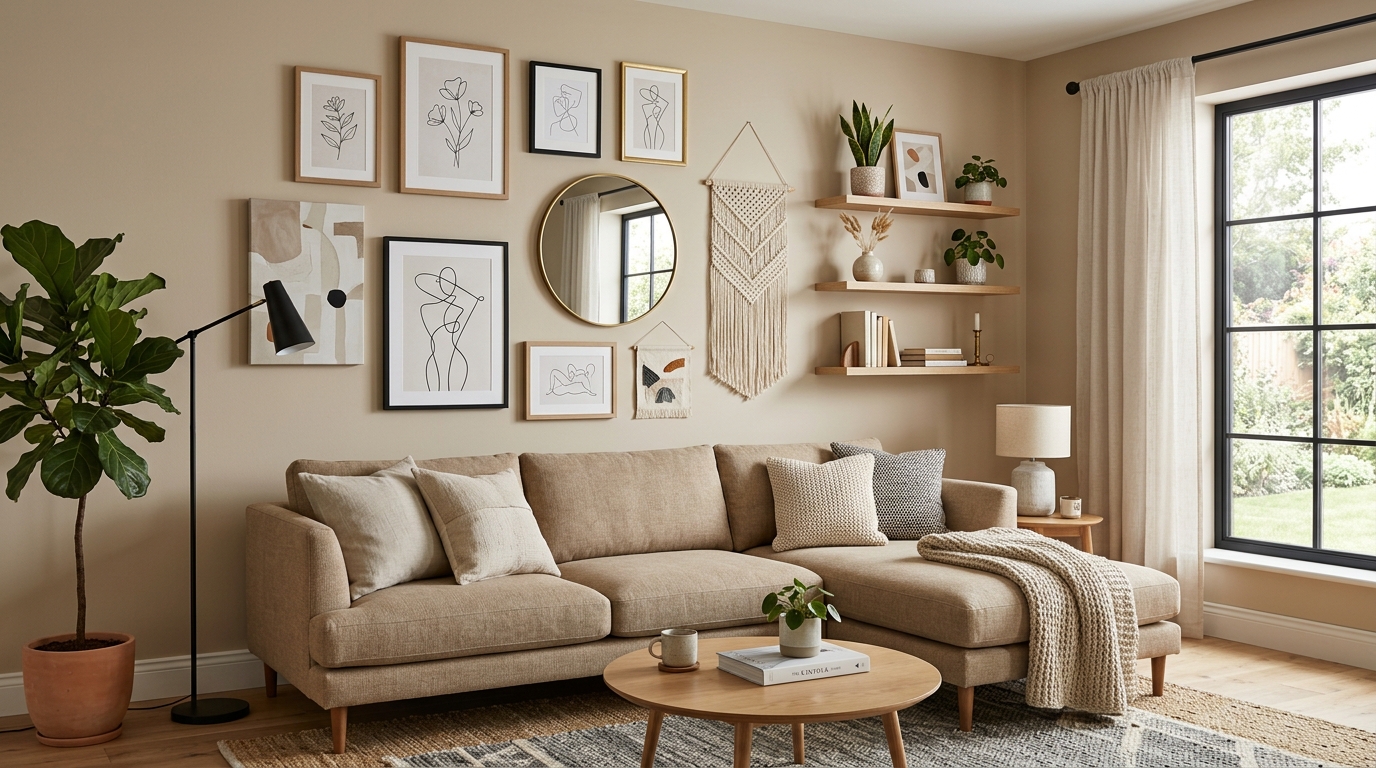
A living room wall that has nothing on it is not minimalist. It is just unfinished. There is a difference between a wall that is intentionally bare as a design choice and a wall that is empty because nobody has gotten around to doing anything with it yet, and most people can feel that difference the moment they walk into a room. The wall behind your sofa, the one above the fireplace, the long stretch between two doorways — these surfaces set the tone for the entire space.
These wall decor ideas for living room styling focus entirely on what goes on the walls: gallery arrangements, mirrors, shelves, DIY art, and surface treatments that work within a real budget. No furniture decisions, no lighting purchases, no pillow swaps. Just the walls, done well, for less than most people expect to spend.
You will find 23 ideas here, each one a distinct approach to a living room wall. Some require a drill and an afternoon. Some require nothing more than scissors and a frame. Start with the wall that bothers you the most and work outward from there.
1. Build a Gallery Wall Using Frames You Already Own
Before buying a single new frame, pull every frame out of every room in the house and lay them on the floor together. Most households own more frames than they realize, scattered across bedrooms, hallways, and closets in ones and twos where they do not amount to much. Grouped together on one living room wall, those same frames become a proper gallery arrangement without spending anything at all.
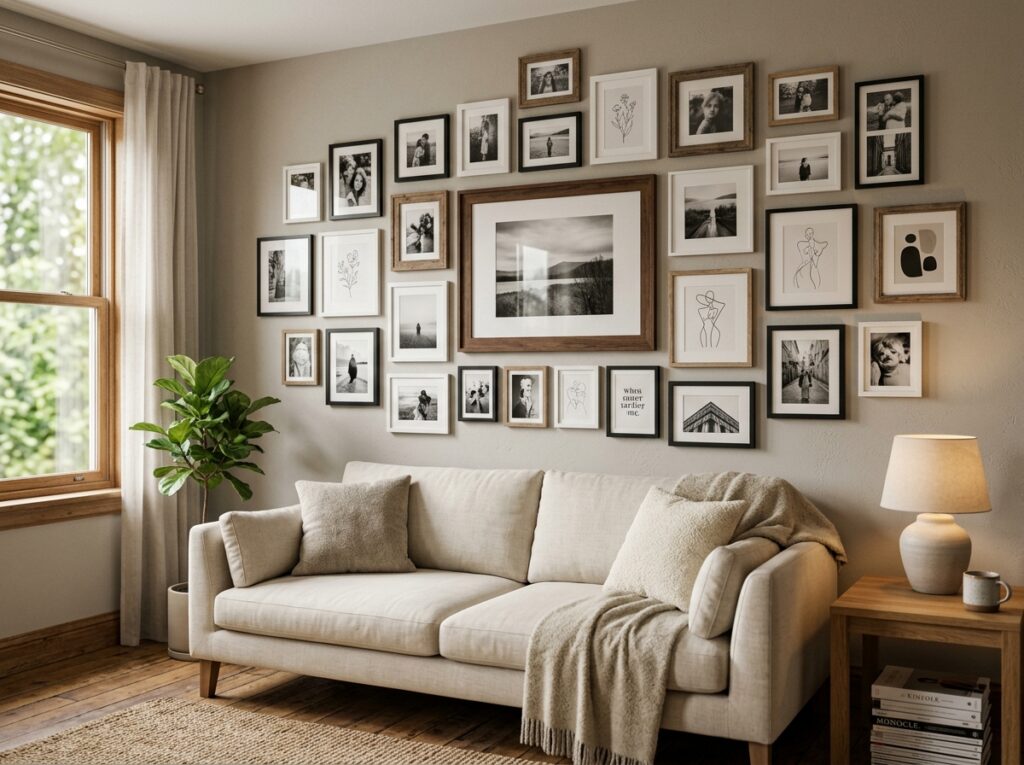
Mix the sizes deliberately. Place the largest frame slightly off-center as the anchor and build outward from there, alternating horizontal and vertical orientations. Keep 2 to 3 inches between frames throughout the arrangement for a clean, considered look. What goes inside the frames matters less than how the frames relate to each other on the wall. Black and white photographs, simple line drawings, pages torn from a coffee table book, or even plain colored paper cut to size all work as fill until you find art you love.
2. Hang a Single Large Mirror as a Focal Point
A single large mirror on a living room wall does more visual work than almost any other wall decor decision. It reflects light back into the room, makes the space feel deeper than it is, and gives the wall a finished, intentional quality that a piece of art of the same size would also achieve but at significantly higher cost. A good mirror at a reasonable price is one of the best investments in living room wall decor available.
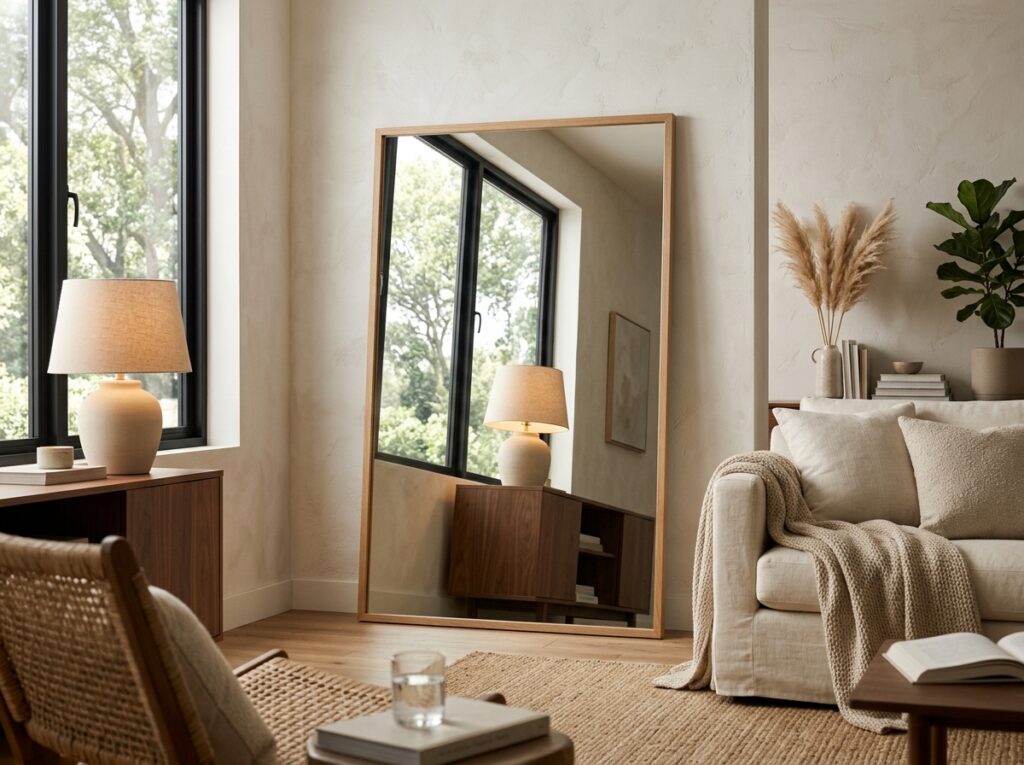
Look for mirrors in the 30 by 40 inch range or larger for a wall that needs a true focal point. The IKEA NISSEDAL in black or white, the Target Threshold Arched Full Length Mirror, and the Threshold Studio McGee Round Mirror are all well-proportioned options under 100 dollars that photograph well and hold up in a living room context. Lean a large mirror against the wall rather than hanging it if the weight feels like too much to anchor properly, and position it to reflect a window or a lamp for maximum light return.
3. Wall Decor Ideas for Living Room Walls Include a DIY Printable Art Set
Printable art downloaded from Etsy and printed at a local print shop or through an online service like Mpix costs a fraction of what framed wall art sells for in stores. A set of three coordinating prints in sizes like 8 by 10, 11 by 14, or 18 by 24 inches downloaded from a single Etsy shop and printed on matte cardstock creates a cohesive, polished wall arrangement for under 30 dollars total including printing.
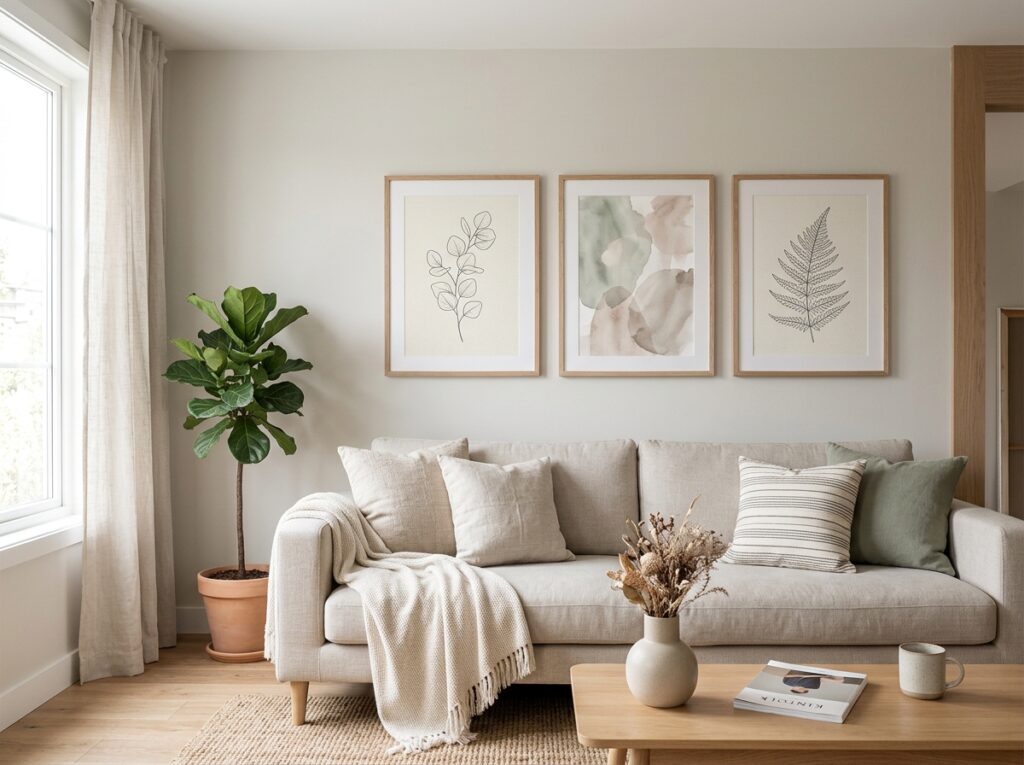
Search Etsy for printable art in the aesthetic that suits your room: botanical line drawings, abstract watercolor shapes, typography prints, or minimalist photography. Download the files, upload them to Mpix or Walgreens Photo for printing, and frame them in matching frames from IKEA or the Target Threshold line. The result looks identical to art purchased in a gallery at a price that makes it easy to change out seasonally if the mood shifts.
4. Create a Floating Shelf Display Wall
Three floating shelves mounted at staggered heights on a living room wall create a display surface that holds framed art, small sculptures, books, plants, and objects in an arrangement that reads more layered and alive than framed art alone. The shelves add depth to the wall and give the display room to breathe and change over time without requiring new nail holes every time something shifts.
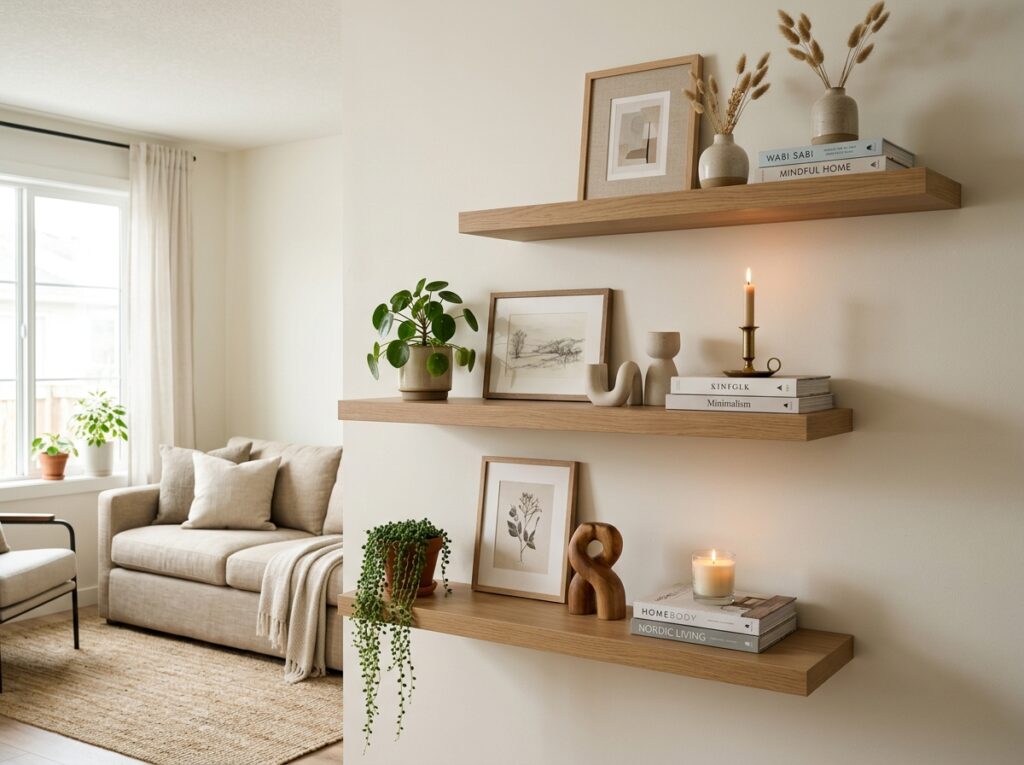
Mount three shelves of the same depth but varying lengths at heights that feel natural when standing in the room, roughly 60 inches, 72 inches, and 50 inches from the floor in a staggered arrangement. IKEA Lack shelves cost almost nothing and hold up well for light to medium display weight. Style each shelf with a mix of tall and short objects, one or two small framed prints leaning against the wall, and at least one plant on each level to add organic texture to the arrangement.
5. Frame Fabric or Wallpaper Samples as Inexpensive Wall Art
Fabric swatches and wallpaper samples are designed to be visually compelling and they are often available for free or near-free from fabric stores, home decor shops, and wallpaper sample services. A large fabric swatch in a bold botanical print or a geometric pattern, stretched over a canvas frame or mounted flat in a deep shadow box frame, makes a genuinely striking piece of living room wall art for almost no money.
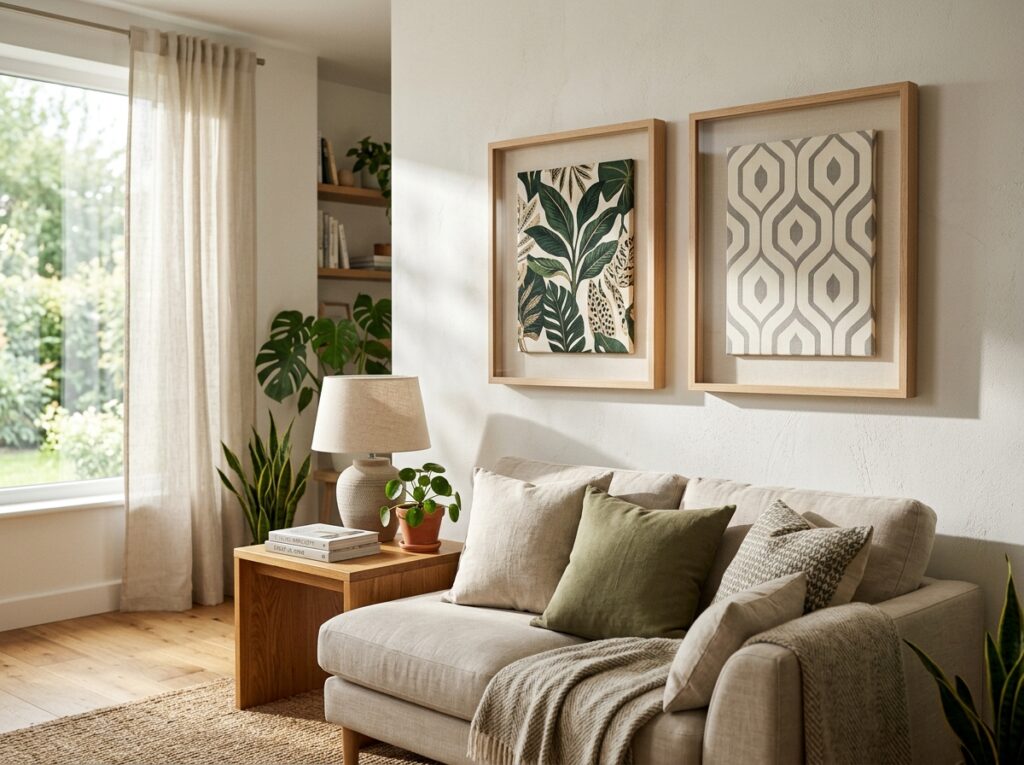
Spoonflower sells fabric swatches with some of the most beautiful surface patterns available anywhere, and a fat quarter of fabric costs about 4 to 8 dollars. Cut it to the size of the frame, pull it taut over a stretched canvas or mount it flat with double-sided tape behind a glass frame, and hang it as you would any other piece of art. Choose a pattern that picks up a color already present in the room so the piece feels connected to the space rather than dropped in randomly.
6. Hang a Macrame Wall Hanging Above the Sofa
A macrame wall hanging above the sofa fills a large horizontal surface with texture, warmth, and handcrafted character that framed art of the same size rarely achieves. The natural cotton fibers add a softness to the wall that changes the whole feeling of the room, and because macrame is neutral in color, it works with nearly any existing palette without requiring the room to change around it.
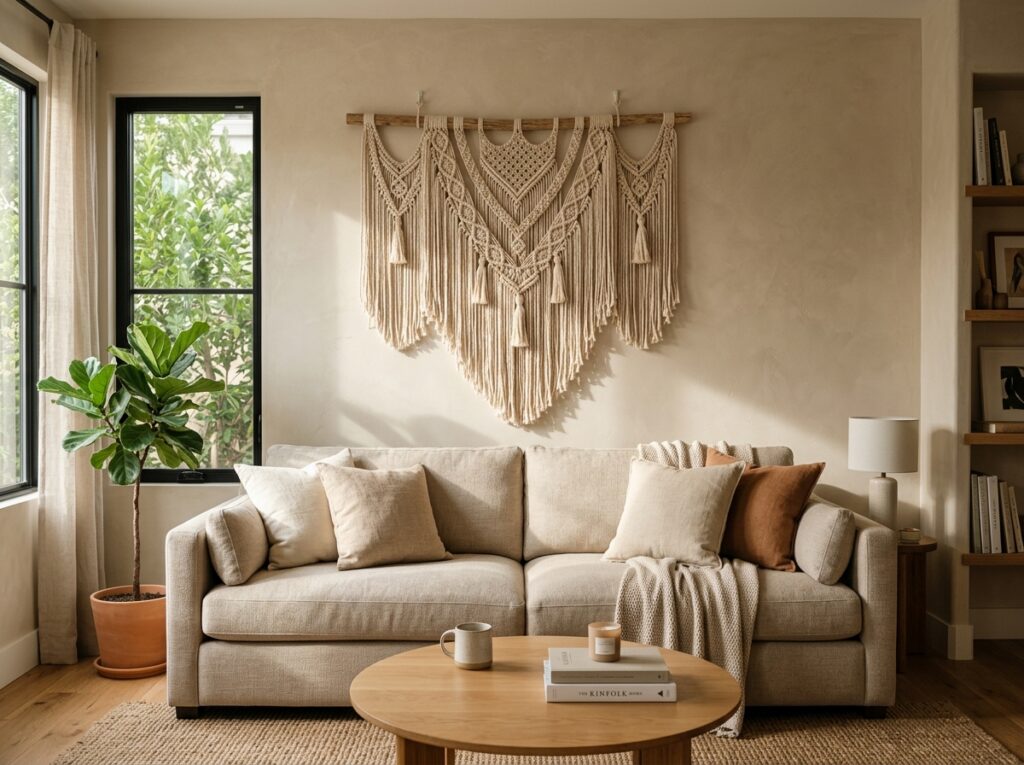
Look for handmade macrame pieces on Etsy rather than mass-produced versions from large home decor chains. The difference in quality and visual depth is significant. For a sofa that is around 84 inches wide, a macrame piece between 36 and 48 inches wide sits proportionally well above it without trying to span the full width, which would look crowded rather than intentional. Mount it on a wooden dowel using a simple cup hook in the wall.
7. Install a Picture Ledge for an Easily Changeable Art Display
A picture ledge is a shallow shelf with a small lip at the front that holds framed art upright without any hanging hardware. Frames lean against the wall on the ledge and can be swapped, rearranged, and updated without touching the wall again after the initial installation. For someone who wants a gallery-style display that stays flexible, a picture ledge is one of the most practical wall solutions available.
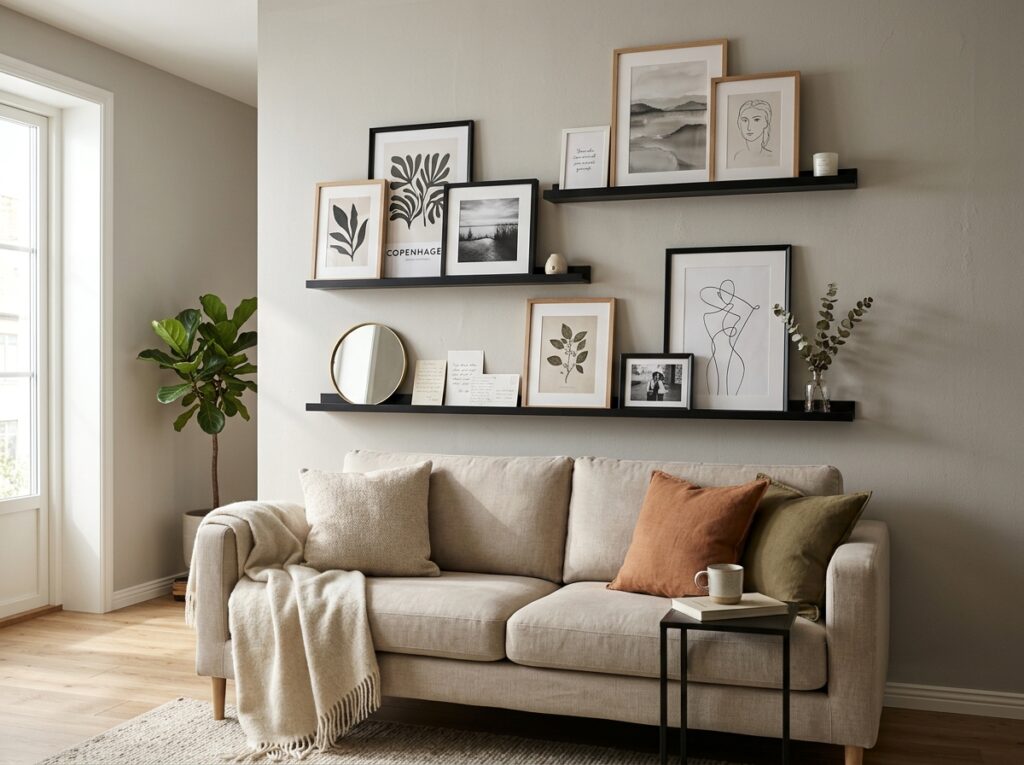
The IKEA MOSSLANDA picture ledge at 55 inches costs about 15 dollars and holds multiple frames in a single run. Install two or three ledges at different heights to create a layered display, or use one long ledge low on the wall behind the sofa for a modern, architectural look. Lean frames of different sizes in front of each other for depth, mixing framed prints with small mirrors, postcards in simple clips, and a dried stem or two propped between frames.
8. Wall Decor Ideas for Living Room Budgets Include Peel-and-Stick Wallpaper on One Accent Wall
A full roll of peel-and-stick wallpaper applied to a single living room wall creates an accent surface that changes the entire character of the room at a cost of 40 to 80 dollars for most standard wall sizes. Unlike traditional wallpaper, peel-and-stick versions remove cleanly from most painted surfaces without damaging the wall, which makes this approach both renter-friendly and reversible.
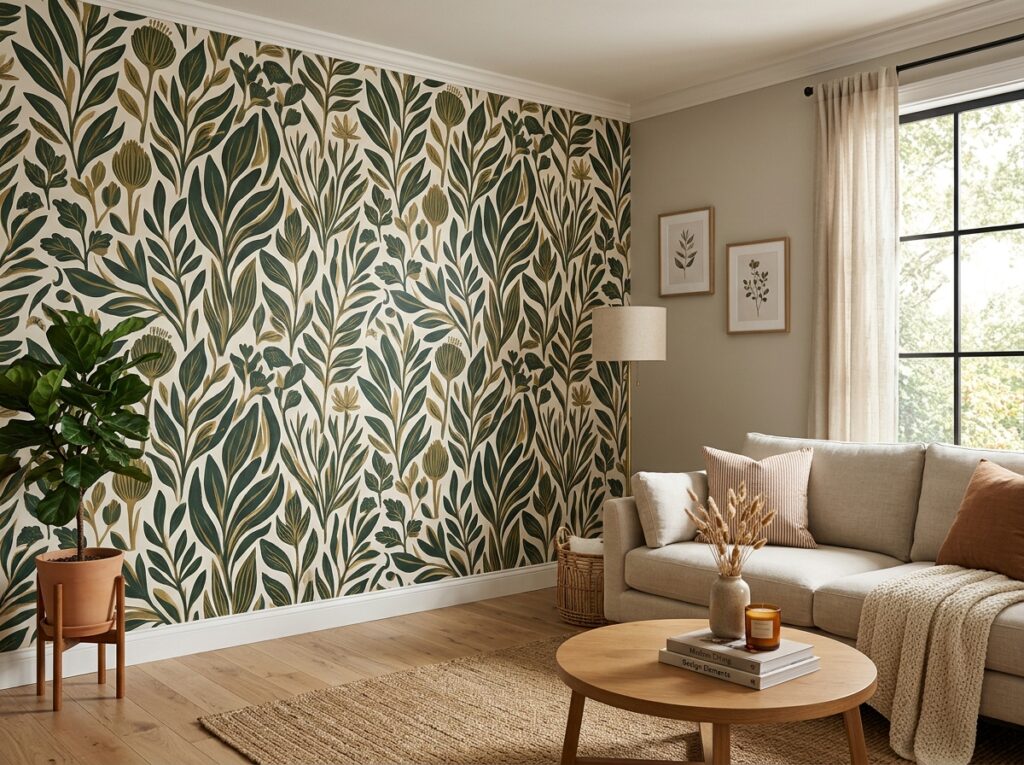
Chasing Paper, Tempaper, and Rifle Paper Co. all produce peel-and-stick wallpaper in patterns that range from bold botanical prints to subtle geometric textures to simple linen-look solids. Measure the wall carefully before ordering and add 10 percent extra to account for pattern matching and trimming. Apply from the top down with a squeegee or a credit card to smooth out air bubbles as you go. The finished result looks permanent and considered from across the room.
9. Make a DIY Botanical Print Wall Using Pressed Leaves and Frames
Pressed leaves and botanicals arranged in simple clip frames or inexpensive black frames create a cohesive wall art series for almost no cost. The materials come from the yard, a local park, or a garden center, and the pressing process takes about a week between the pages of a heavy book. The finished pieces have a quiet, natural quality that purchased botanical prints try to replicate at much higher prices.
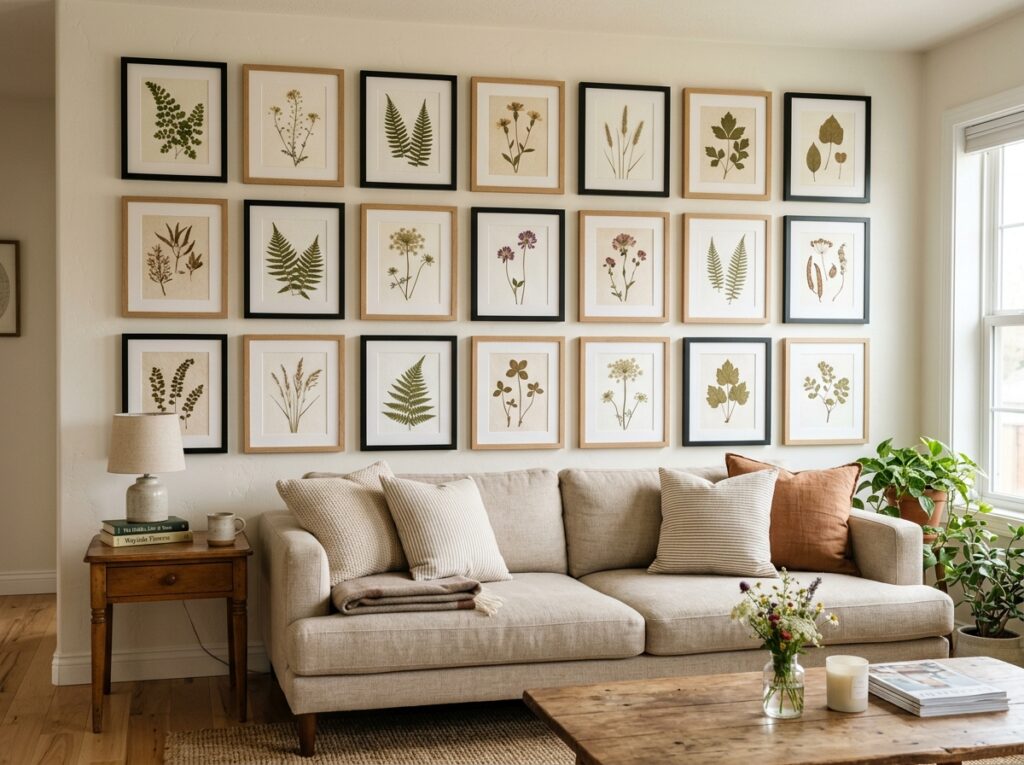
Collect leaves, ferns, grasses, and small wildflowers with interesting shapes. Press them flat between two sheets of parchment paper inside a heavy book for 7 to 10 days. Once fully dried and flat, arrange them on a piece of white or cream cardstock slightly smaller than your frame and secure with a tiny dot of clear craft glue. Frame and hang as a set of three to six pieces in matching frames for a unified wall display.
10. Hang a Woven Rattan or Wicker Wall Piece
A woven rattan or wicker wall piece adds a tactile, organic element to a living room wall that photographs beautifully and suits a wide range of interior styles from bohemian to coastal to modern farmhouse. Unlike flat art, the three-dimensional weave texture catches light differently throughout the day and gives the wall a quality that changes subtly depending on the time and the angle.
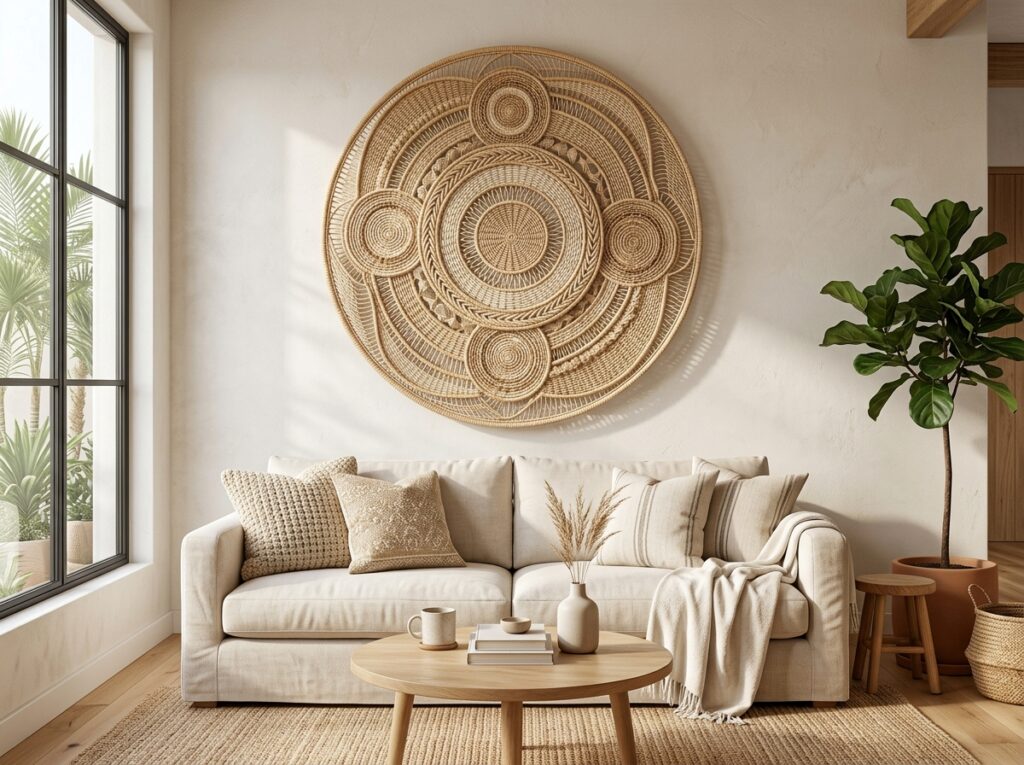
Large woven wall pieces from brands like Serena and Lily and World Market come in sizes between 24 and 48 inches in diameter and mount on a single nail or picture hook. Smaller rattan pieces in sets of three at staggered sizes work well grouped together on a narrower wall section. Choose a natural undyed rattan color for the most versatile option, or look for pieces with a bleached or whitewashed finish for a lighter, more coastal-leaning look.
11. Print and Frame a Custom Map of a Meaningful Place
A custom map print of a city, a neighborhood, or a location that holds personal meaning makes a piece of living room wall art that is genuinely unique and costs very little to produce. Mapiful, Grafomap, and Printmaps all let you customize a map of any location in the world, adjust the color scheme to suit your room, add a text label, and download a high-resolution file for printing at home or at a print shop.
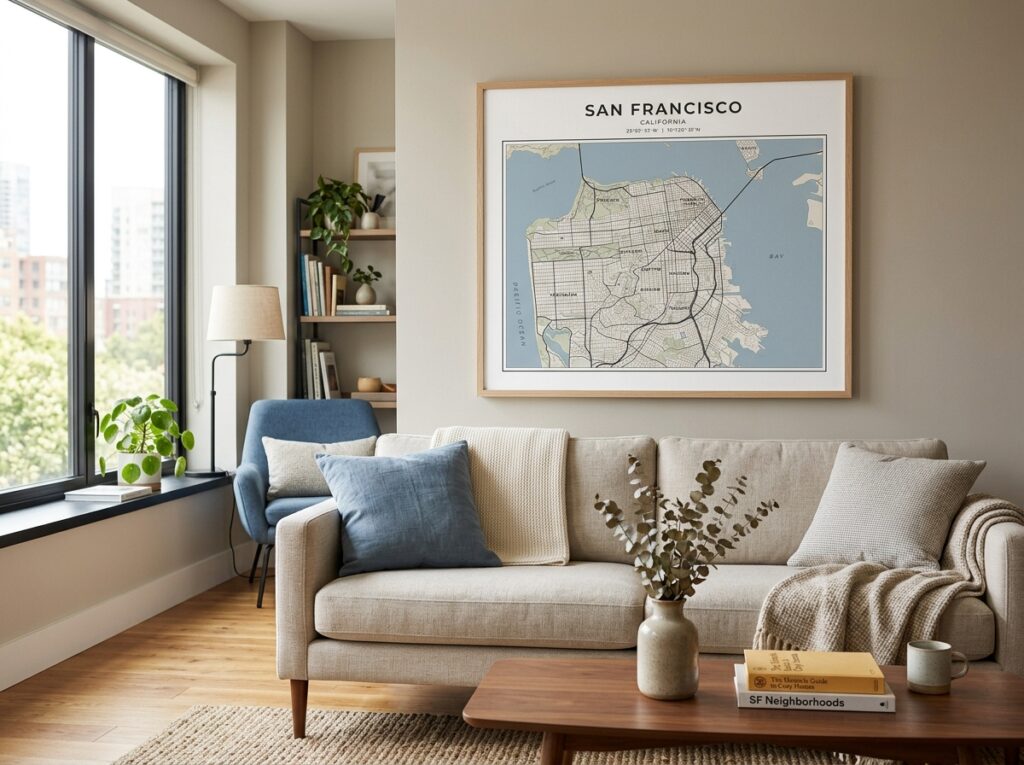
A 16 by 20 inch custom map print costs about 5 to 10 dollars to download and another 10 to 20 dollars to print and frame depending on where you take it. The finished piece occupies a full section of wall, looks considered and personal, and gives any visitor an immediate conversation point. Choose a color palette that pulls from the room’s existing tones so the map reads as part of the design rather than an isolated travel souvenir.
12. Create a Symmetrical Pair of Framed Art Pieces Above a Console
Two identical or near-identical framed pieces hung symmetrically above a console table or fireplace create a formal, balanced wall arrangement that reads finished and considered without requiring any gallery-style arrangement skills. Symmetry does the compositional work automatically. You simply hang both pieces at the same height, the same distance from the center, and step back.
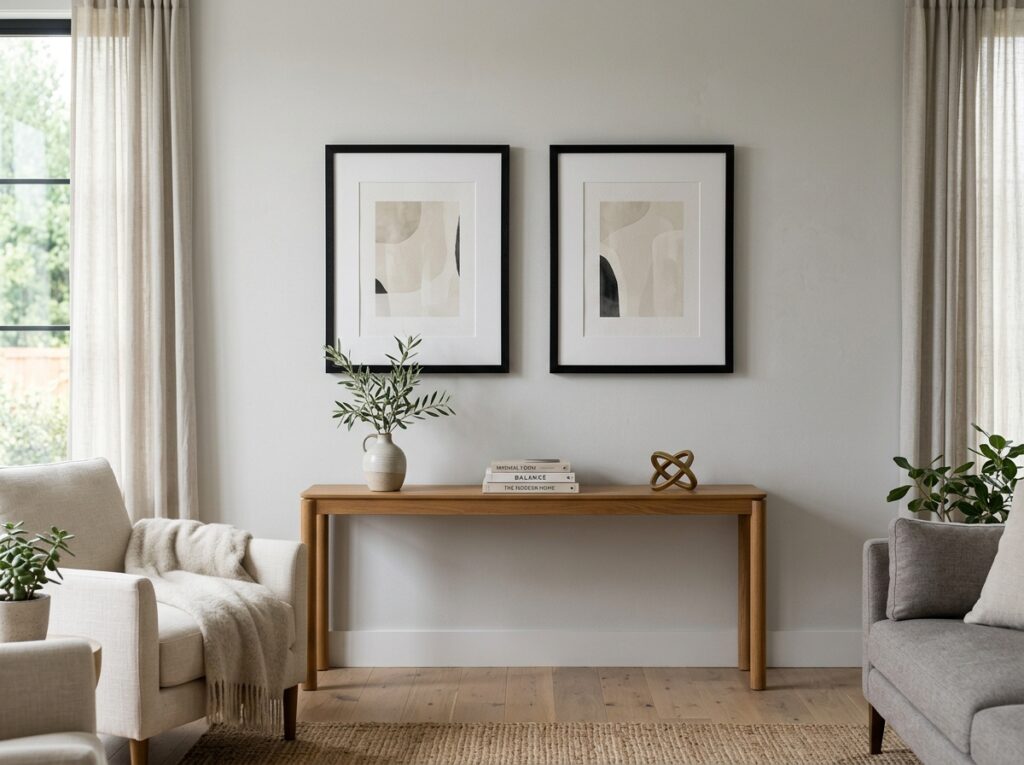
The pair does not need to be expensive. Two prints from the same Etsy shop in the same size and frame create a proper matched set. Two mirrors in matching frames work equally well and add the reflective quality that a single mirror provides but distributed across a wider wall section. Keep the frames identical in finish even if the content inside them differs slightly. Matching frames create the visual cohesion that makes the arrangement read as a decision rather than a coincidence.
13. Wall Decor Ideas for Living Room Spaces Work Well with a DIY Abstract Canvas
An abstract painting on canvas requires no artistic training and costs about 15 to 25 dollars in materials. The result, when done with some intention around color choice, reads as the kind of original art that costs hundreds of dollars in a gallery. The key is choosing a color palette before picking up the brush and sticking to it throughout the painting rather than adding colors impulsively.
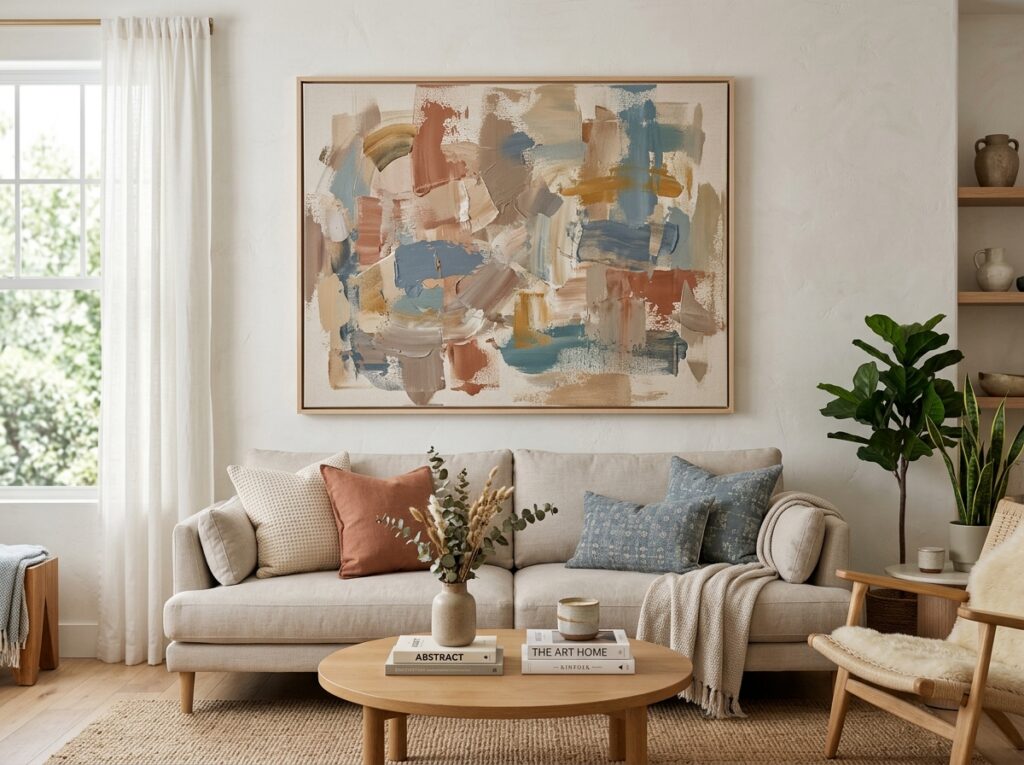
Buy a stretched canvas in the largest size that suits the wall, typically 24 by 36 or 30 by 40 inches for a living room focal wall. Choose two or three acrylic paint colors that appear in the room already, plus white for mixing. Apply the paint in loose, gestural strokes using a wide palette knife or a foam roller rather than a brush for a more contemporary look. Let layers dry between applications and stop before the canvas feels overworked. Lean it against the wall before hanging to evaluate it from the distance you will see it from daily.
14. Hang a Series of Vintage Plates as a Wall Display
A collection of decorative plates hung on a living room wall is one of the oldest wall decor traditions in home design and it is experiencing a genuine revival in contemporary interiors. The appeal is texture and dimension. Plates occupy the wall in a way that flat art does not, and a mix of sizes, patterns, and finishes creates a display that looks collected over time rather than purchased as a set.
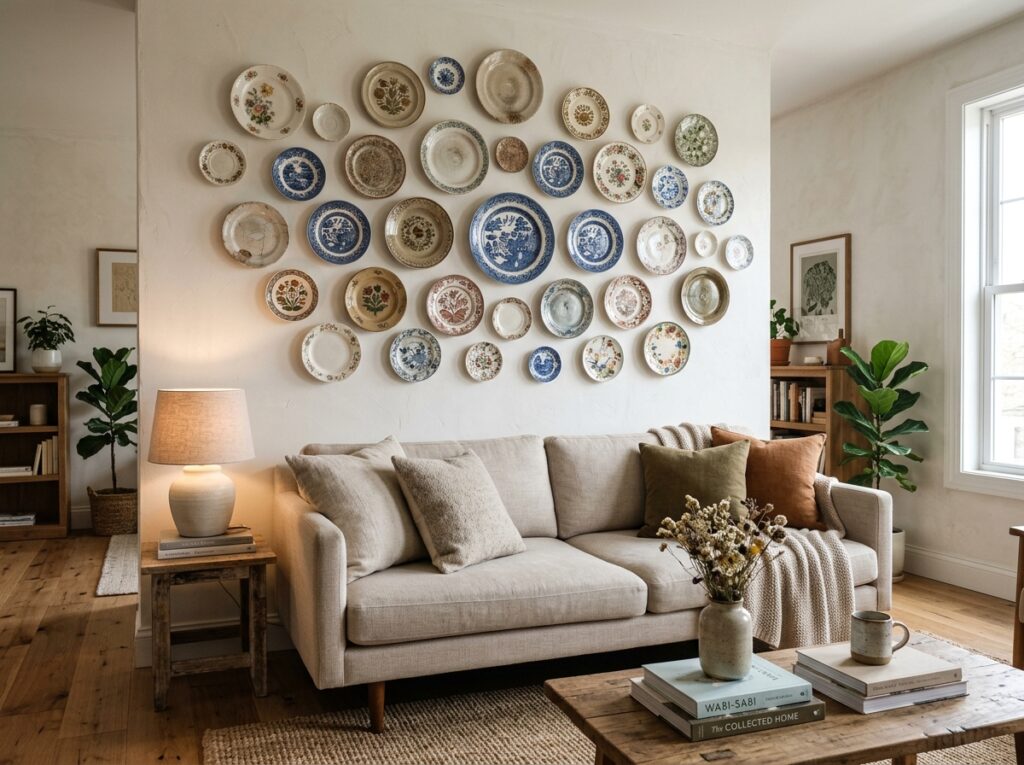
Source vintage plates from thrift stores, estate sales, and antique markets for 1 to 5 dollars each. Look for plates with interesting patterns, unusual colors, or distinctive shapes rather than plain white, which reads as dinnerware rather than decor. Hang them using adhesive plate hangers that attach to the back of each plate with a water-activated adhesive and hold securely without drilling through the plate. Arrange the grouping on the floor first before committing any nails to the wall.
15. Apply a DIY Limewash Paint Finish to One Wall
A limewash paint finish applied to a single living room wall creates a textured, aged surface that looks like plastered stone and adds more visual depth to the room than any piece of art of the same square footage. It is not wallpaper and it is not a standard paint color. It is a finish that changes the physical quality of the wall surface and makes the whole room feel more architectural and considered.
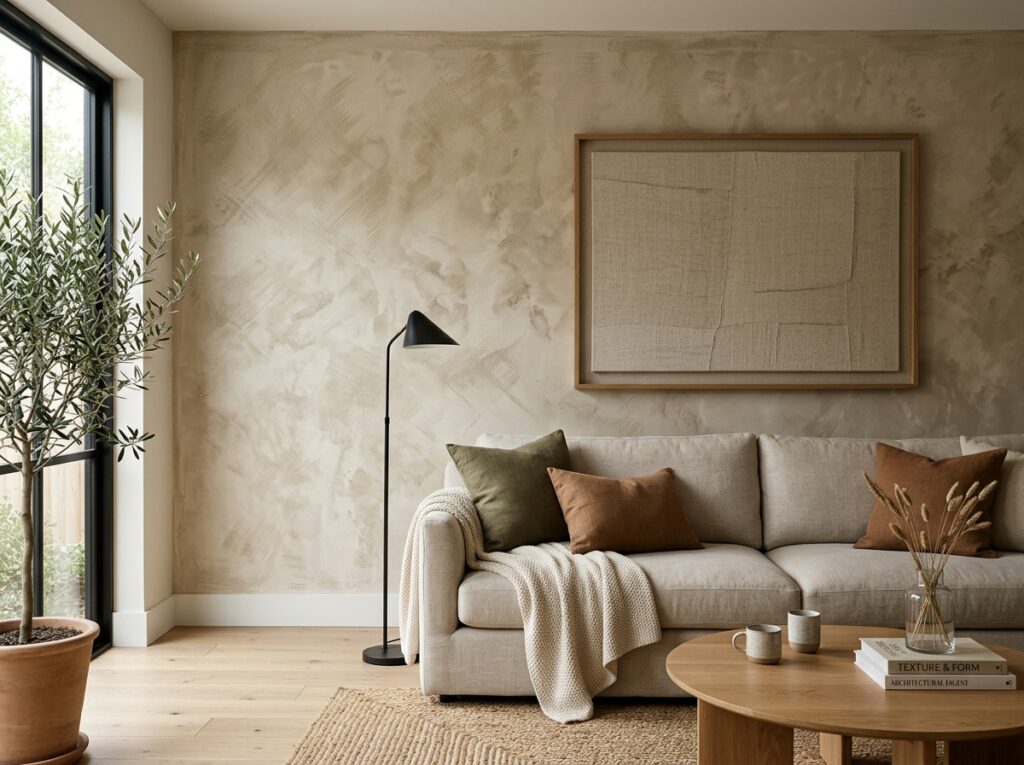
Portola Paints Roman Clay and Sherwin-Williams Lime Wash are both purpose-made products that apply with a brush in a specific crosshatch technique to build up layers of texture. A single wall in a standard living room requires about one quart of product, which costs 35 to 50 dollars. Watch the application technique video from the paint brand before starting because the method is different from standard wall painting, and the texture builds correctly only when the layering sequence is followed properly.
16. Frame Children’s Artwork in Matching Frames for a Personal Gallery
Children’s drawings and paintings, framed in matching frames and hung as a cohesive series, read as intentional art rather than refrigerator decoration. The key is the framing. The same drawing that looks casual pinned to a board looks considered and even sophisticated when mounted in a clean white mat and a simple black frame. The framing does not change the art. It changes how the eye reads it.
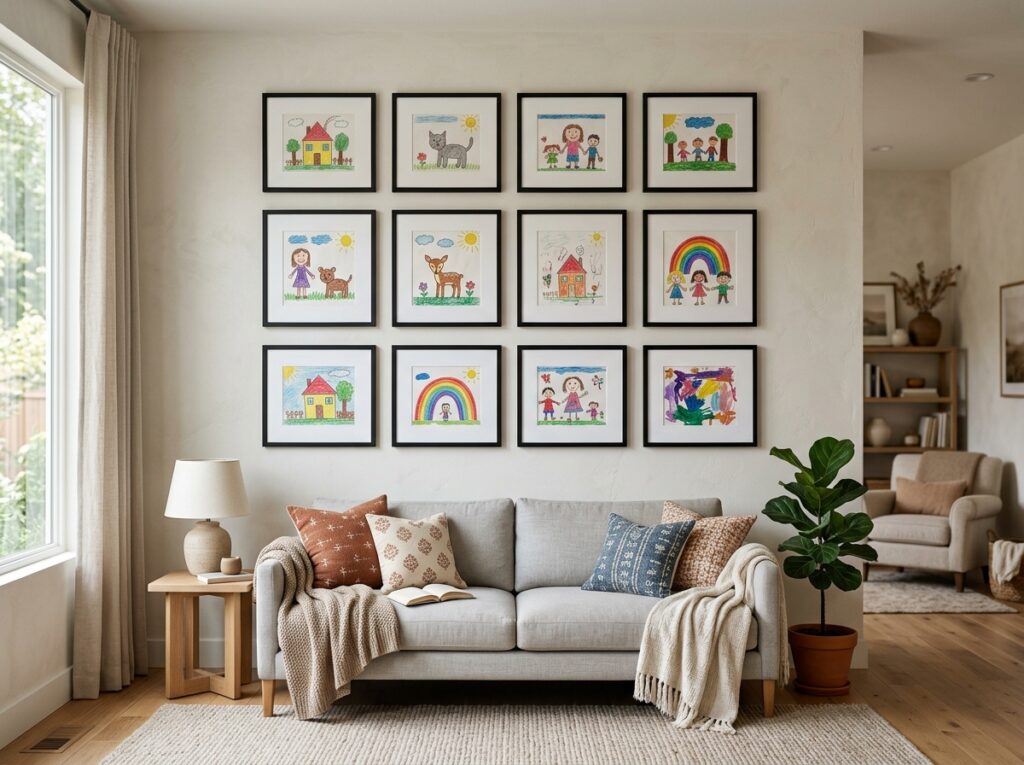
Use a consistent frame size throughout the series, 8 by 10 or 11 by 14 works well, and mat each piece in white or cream to standardize the proportions. Hang the framed pieces in a grid arrangement with even spacing between them. Rotate the art seasonally as new pieces are made and keep the frames. The gallery updates itself over time and the wall always has something personal and genuinely original on it.
17.Hang Black and White Photography as a Triptych
Three photographs p rinted in black and white and hung in a horizontal triptych arrangement create a clean, editorial wall display that suits almost any living room palette because black and white prints contain no color to conflict with the room’s existing tones. The triptych format gives the wall a sense of sequence and movement that a single large print does not have.
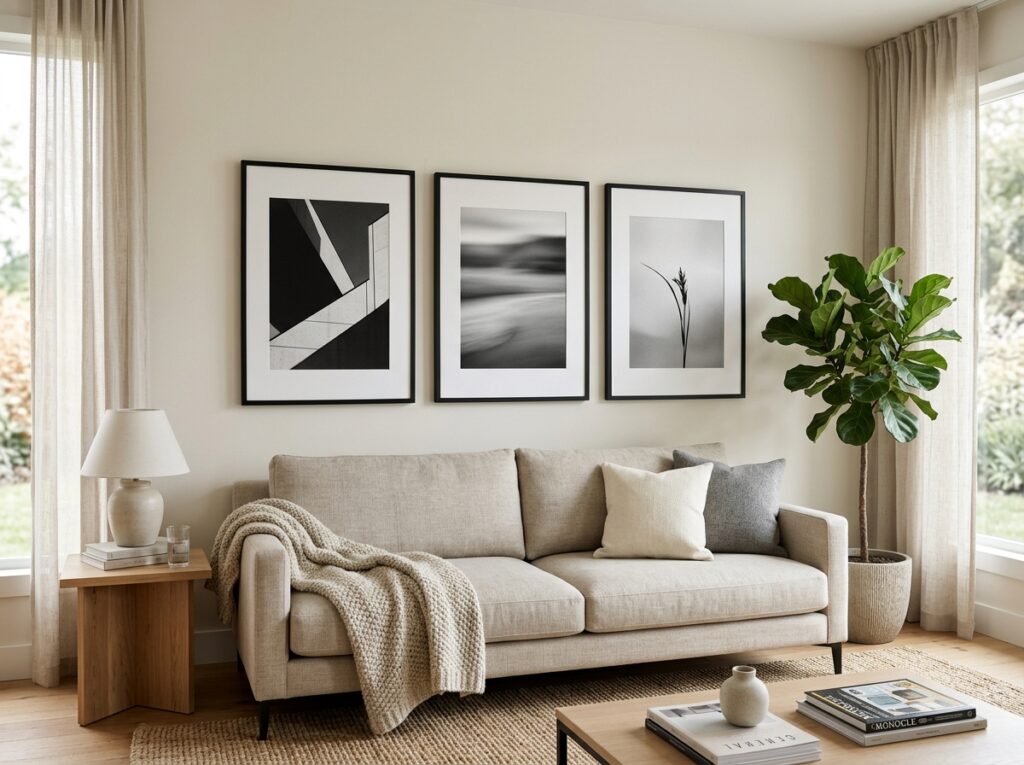
Print all three images at the same size, typically 8 by 10 or 11 by 14 inches, through a service like Mpix or Artifact Uprising for the best print quality. Frame them in identical thin black or natural wood frames without mats for the most contemporary look, or add white mats for a more classic gallery feel. Space the three frames 2 to 3 inches apart horizontally and hang them so all three share the same center line.
18. Install Open Wall Shelves and Style Them as Art
Open shelves on a living room wall function as both storage and display surface, but when styled with enough intention they read primarily as a visual element rather than a practical one. The shelf itself becomes the wall decor and the objects on it become the art. This is one of the most flexible wall solutions available because the display can evolve continuously without touching the wall again.

Use shelves with enough depth to hold books upright, typically 10 to 12 inches deep, and install them at a height that allows the objects on them to be seen clearly from a seated position in the room. Style each shelf with a combination of books arranged by color, a small framed print leaning against the wall, a plant, and one or two sculptural objects with interesting silhouettes. Edit the shelves every few months to keep the display from becoming stale.
19. Make a Grid of Identical Small Frames
A grid of 9 or 12 identical small frames hung in perfect rows and columns creates a graphic, architectural wall statement that is more visually bold than a loose gallery arrangement and easier to execute because the spacing rules are simple. All the frames are the same size, the same finish, and hung with equal gaps between them. The grid does the design work.
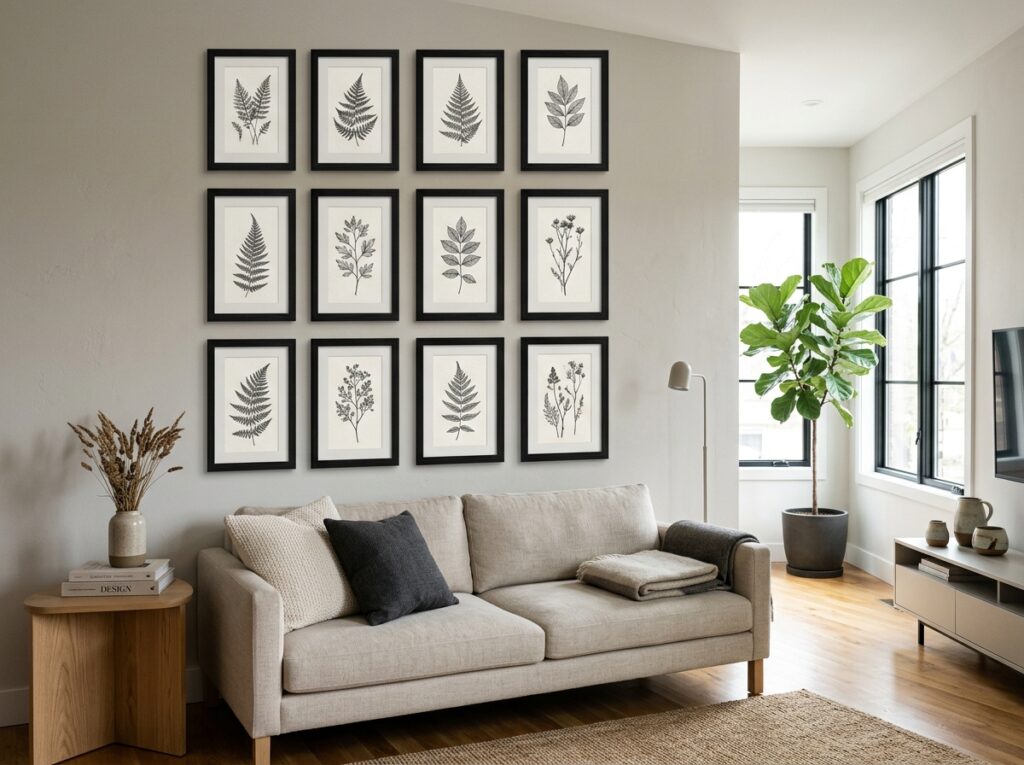
Use 5 by 7 or 4 by 6 inch frames in matte black, white, or natural wood. Fill them with a consistent series of images: all black and white portraits, all botanical illustrations, all abstract color blocks in a shared palette, or all photographs from a single trip or time period. The consistency of content combined with the regularity of the grid gives the wall a gallery-level intentionality that looks expensive and takes about two hours to hang.
20. Hang a Bamboo or Wooden Ladder on the Wall as a Display Structure
A flat wooden or bamboo ladder mounted horizontally on a living room wall with the rungs facing outward becomes a wall-mounted display structure that holds art prints clipped to the rungs, small plants hung from the rungs by twine, trailing vines draped across the rungs, and lightweight objects tucked between the rails. It is three-dimensional, organic, and genuinely different from anything flat on a wall.
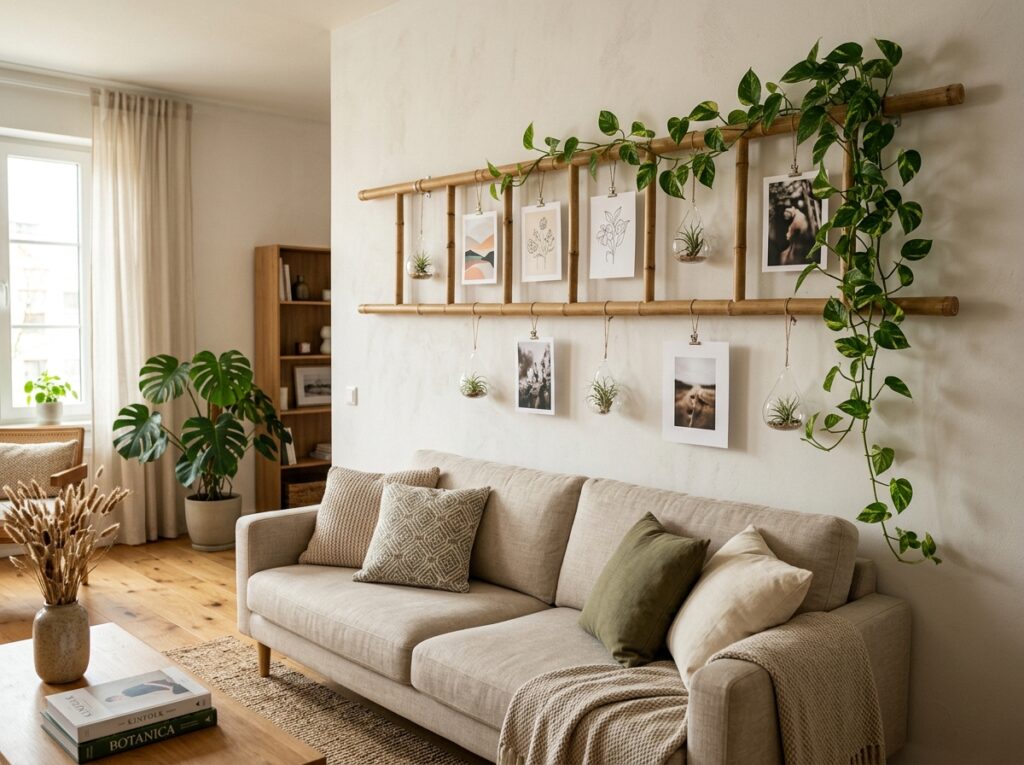
Source a bamboo ladder from a garden supply store or a wooden decorative ladder from a home decor shop for 20 to 40 dollars. Mount it flat against the wall using two picture hooks positioned to catch the outer rails. Style it with clip-on art prints changed seasonally, small air plants in glass terrariums hung by thin wire, and a trailing pothos draped across the top rung and allowed to cascade downward.
21. Use Vinyl Wall Decals for a Low-Cost Graphic Statement
Vinyl wall decals apply directly to a painted wall surface, remove without damaging the paint, and create a graphic, printed quality that is impossible to achieve with standard art or framed pieces. For a budget living room wall, a well-chosen decal in the right scale can completely change the character of the space for under 30 dollars.
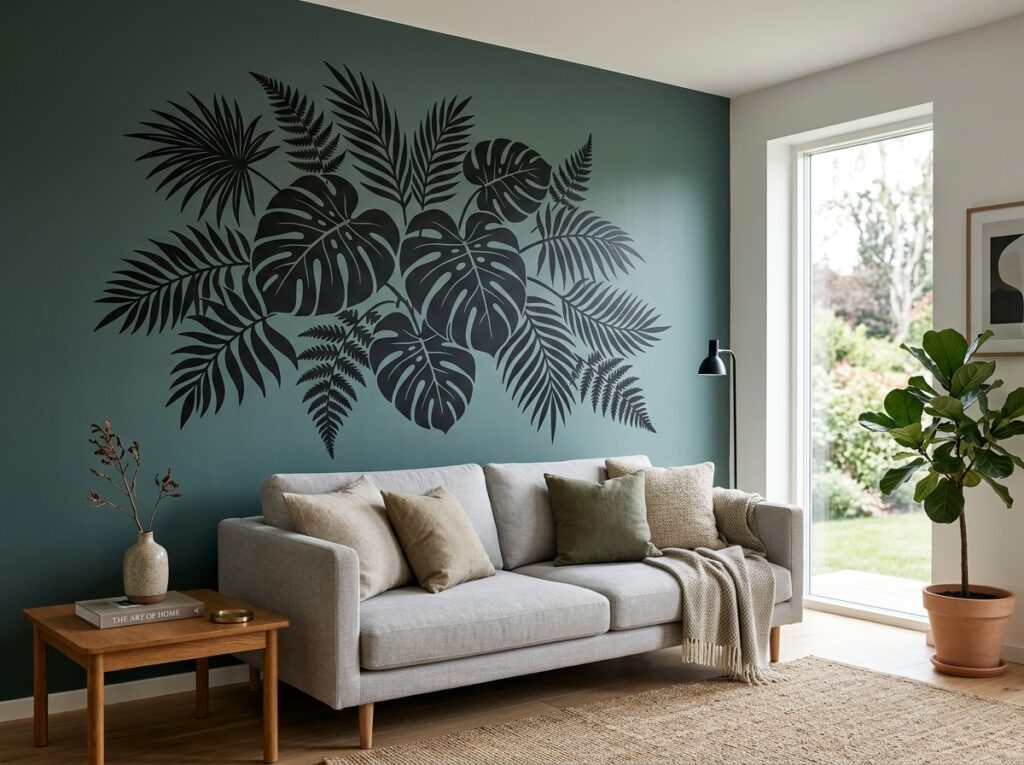
Choose decals from Etsy sellers who offer custom sizing so the scale can be matched to the specific wall rather than forcing a standard size into the space. Abstract shapes, botanical silhouettes, simple geometric patterns, and large-scale typography all work well as living room wall decals. Apply to a clean, dry wall surface using the application tape included with the decal, working from the center outward to prevent air bubbles. Removal is as simple as peeling slowly from a corner.
22. Wall Decor Ideas for Living Room Accent Walls Include Shiplap Panels
Painted shiplap panels applied to a single living room wall add architectural texture that turns a flat surface into a feature. The horizontal lines of the boards create a strong directional quality that makes the wall read as designed rather than standard, and at a per-board cost of 1 to 3 dollars at most lumber yards, a full accent wall in shiplap comes in well under the cost of most alternative wall treatments.

Use 1 by 6 inch pine boards cut to the width of the wall and install them horizontally from floor to ceiling with a small consistent gap between each board, typically achieved by using a nickel as a spacer. Paint the finished wall in a single color that suits the room, either matching the rest of the walls for a subtle texture effect or going one to two shades darker for a more dramatic accent. Behr Premium Plus in a flat finish produces the most authentic, shadow-catching result on textured shiplap surfaces.
23. Hang an Oversized Clock as a Statement Wall Piece
An oversized wall clock in the 24 to 36 inch diameter range functions as both a practical object and a substantial piece of living room wall decor. It fills a section of wall that would otherwise require a large framed piece, it has a three-dimensional presence that flat art does not, and because it reads as a functional item, it never feels like the room is trying too hard to decorate itself.
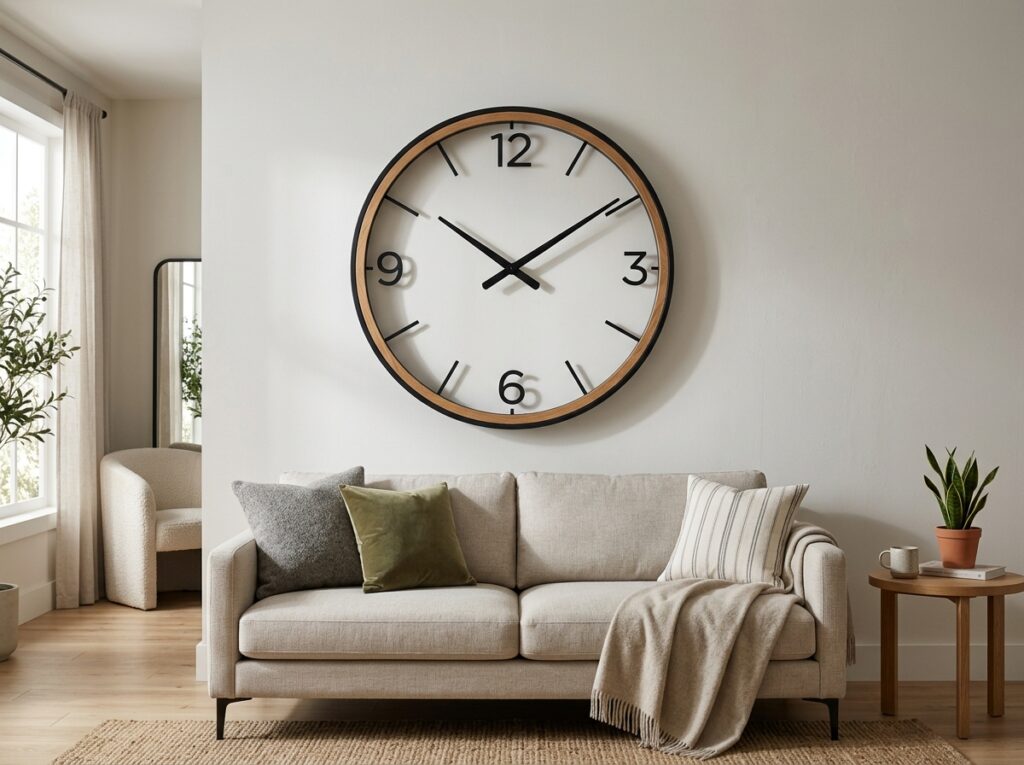
Look for oversized clocks in industrial metal finishes, natural wood, or matte black at HomeGoods, TJ Maxx, or through Wayfair for 40 to 80 dollars. The Umbra Ribbon Wall Clock and the large-format metal clocks from the Wayfair Trent Austin Design line are both well-proportioned for a living room focal wall. Hang the clock centered on the wall with enough surrounding space that it reads as the primary element rather than one item among many competing for attention.
Final Thoughts
A living room wall does not need an expensive art collection or a designer budget to look finished and intentional. It needs one or two decisions made with enough confidence that the wall reads as considered rather than assembled from whatever was available.
Start with the largest, most visible wall in the room. That one surface sets the tone for everything else. Fix it with the idea that fits your skill level and your current budget, and the rest of the room will orient itself around it naturally. These wall decor ideas for living room spaces are most useful not as a list to complete but as a reference to return to each time a wall in the room still feels unresolved.