
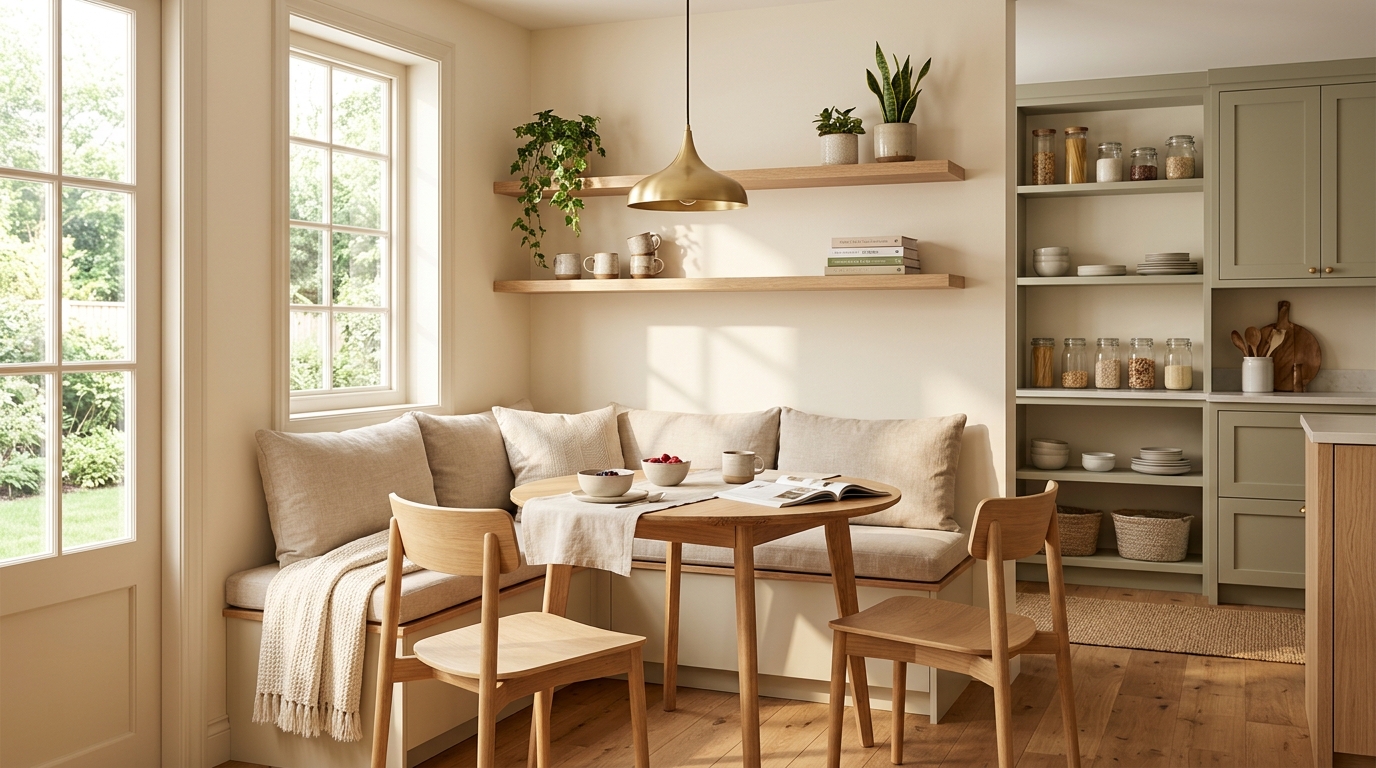
These breakfast nook ideas for small spaces focus on everything that makes a nook work: bench configurations that fit tight corners and window recesses, small tables sized correctly for two to four people without overwhelming the space, and nook lighting that defines the zone and makes it feel distinct from the kitchen around it. Nothing here crosses into dining room territory or kitchen organization. Just the nook itself, built and styled to be the most used and most loved spot in the kitchen.
You will find 25 ideas here, each one a distinct approach to a specific nook challenge or opportunity. Some ideas require building. Some require only rearranging what is already there. All of them make the corner of a small kitchen feel like it was always supposed to be a place worth sitting in.
Build a Corner Bench with Under-Seat Storage
A corner bench built into the tightest corner of the kitchen creates a nook where there was previously nothing but an awkward angle and two walls meeting without purpose. The corner configuration seats more people than a straight bench of equivalent length because both walls are used, and the under-seat storage turns the bench base into one of the most useful storage zones in the kitchen.
Frame the bench from 2 by 4 lumber with a plywood seat top at 18 inches from the floor and build the base as a series of hinged lid compartments or pull-out drawers depending on how the storage will be used. Face the bench with painted beadboard panels for a cottage-quality finish that costs very little in materials. Cover the seat top with a 2-inch foam cushion cut to fit and wrapped in a durable indoor-outdoor fabric from Sunbrella or Waverly in a stripe or solid that suits the kitchen’s palette. The finished corner bench costs about 150 to 250 dollars in materials and provides seating for four people in a footprint that would otherwise hold nothing useful.
Use a Round Pedestal Table to Maximize Seating in Minimal Space
A round table on a pedestal base seats more people per square foot than any other table shape because there are no legs at the corners to avoid and no apron frame limiting how close chairs can be pulled in. In a small breakfast nook where the table dimensions are tight, the round pedestal is almost always the right choice.
Look for a round pedestal table between 36 and 42 inches in diameter, which comfortably seats two to four people depending on the chair size. The Pottery Barn Aaron Pedestal Dining Table in white at 36 inches, the Article Seno Dining Table in oak at 42 inches, and the CB2 Cast Aluminum Pedestal Table at 36 inches all deliver the right proportions for a small nook without the corner leg problem that makes rectangular tables frustrating in tight arrangements. Pair the table with chairs that stack or tuck fully under the table surface so the nook clears when it is not in use.
Breakfast Nook Ideas for Small Spaces Include a Bay Window Bench Seat
A bay window that juts out from the kitchen or eating area is one of the most natural nook opportunities available in a home because the recessed space is already defined and the natural light from three sides makes it the most pleasant spot in the room to spend time. A bench seat built across the width of the bay turns that architectural feature into a dedicated nook without any structural change to the home.
Build the bench to span the full width of the bay at 18 inches deep and 18 inches high, which gives comfortable seat depth and the standard seat-to-floor height. Add a hinged lid to the bench top for under-seat storage and frame the sides with vertical trim that matches the window casing to make the bench look like it was installed at the same time as the window. A small round or rectangular table centered in the bay at standard dining height of 30 inches completes the nook. The bay window creates the sense of a separate room within the kitchen that makes breakfast there feel genuinely different from sitting at a counter.
Hang a Pendant Light Directly Above the Nook Table
A pendant light hung directly above the nook table is the single lighting decision that defines the breakfast nook as a distinct zone within the larger kitchen or eating area. Without overhead lighting specific to the nook, the space reads as a corner with a bench. With a pendant centered above the table, it reads as a place.
Choose a pendant that suits the nook’s scale and the kitchen’s style. A rattan pendant in a natural weave for a warm, organic nook. A schoolhouse globe pendant in black for a more structured, graphic quality. A woven wicker drum shade for a relaxed, beachy feel. The Mitzi Mia Pendant in aged brass, the Visual Comfort Darlana Rattan Pendant, and the Rejuvenation Schoolhouse Pendant in matte black all produce the right focused pool of light for a small nook table at a ceiling height of 30 to 34 inches above the table surface.
Add Wainscoting or Beadboard to the Nook Walls
Wainscoting or beadboard paneling applied to the walls of a breakfast nook at bench height creates a visual boundary that distinguishes the nook from the surrounding kitchen walls and gives the space an architectural identity it cannot achieve with paint alone. The paneling adds a cottage or farmhouse quality that reads as considered and finished rather than painted and left.
Apply 4-inch-wide beadboard panels from Home Depot or Lowe’s vertically from the floor to a height of 36 to 42 inches on the walls behind and beside the nook bench. Cap the top edge with a simple chair rail molding in the same paint color as the paneling. Paint the paneling in a tone different from the upper wall, white paneling with a soft sage upper wall, cream paneling with a warm greige above, or natural wood paneling with a painted white wall above. The two-tone treatment gives the nook a defined vertical division that reads as a design choice rather than a renovation.
Choose Bistro Chairs for a Nook with a Small Footprint
A breakfast nook built around a small table in a tight kitchen cannot accommodate chairs with arms, deep seats, or any bulk that pushes the table outward or blocks the walking path around the nook. A bistro chair with a compact footprint, a slightly angled back, and legs that tuck fully under the table solves all of these problems in a single furniture choice.
The Fermob Luxembourg Bistro Chair in oatmeal or dark green is the gold standard for this application and weathers beautifully even used indoors. The Crate and Barrel Wicker Bistro Chair, the Pottery Barn Outdoor Bistro Chair in white, and the Article Luft Chair in bent plywood all provide the compact footprint and light weight that a small nook table requires. Look for chairs with a seat width under 18 inches and legs that angle only slightly outward from the seat corners, which keeps the chair’s floor footprint as close to the seat dimensions as possible.
Use Built-In Bench Seating on One Side with Chairs on the Other
A nook with a built-in bench along the wall on one side and moveable chairs on the opposite side combines the space efficiency of fixed seating with the flexibility of chairs that can be moved elsewhere in the kitchen when extra counter space is needed. The bench anchors the nook against the wall and the chairs add seats without requiring wall clearance behind them.
Position the bench against the wall furthest from the kitchen traffic path so the chair side faces the kitchen and the seated view looks outward into the room. A bench 16 inches deep provides comfortable seating depth with a cushion and takes up only 16 inches of floor space against the wall. Paired with a table that is 24 to 30 inches wide on the chair side, the total nook depth from wall to chair front is typically under 54 inches, which fits most kitchen corners without blocking any doorway or appliance access.
Breakfast Nook Ideas for Small Spaces Work Best with Cushions in Outdoor Fabric
Bench cushions in standard upholstery fabric stain, flatten, and wear quickly in a kitchen nook that gets daily use from adults, children, and the occasional spilled coffee. Cushions in outdoor-grade fabric resist stains, clean with a damp cloth, maintain their shape through years of use, and are available in patterns and solids that read as interior quality rather than patio furniture.
Sunbrella fabric in a woven stripe or a solid warm neutral is the most durable option for a nook cushion that will genuinely hold up. A custom cushion from Cushion Source or Comfort Works in Sunbrella fabric at the exact bench dimensions runs between 60 and 120 dollars depending on the size and the cushion thickness. For a standard bench length under 48 inches, a 3-inch foam cushion wrapped in a Sunbrella cotton canvas in natural, slate blue, or warm terracotta reads as interior quality and cleans completely with soap and water.
Install a Small Shelf Above the Nook for Display and Function
A small shelf mounted on the wall above the bench seat at 60 to 72 inches from the floor gives the nook a dedicated display zone for objects that make the space feel personal and considered without crowding the table surface below. A small plant, a ceramic object, a stack of books with interesting spines, and a small framed print arranged on the shelf tell the nook’s story visually and separate it from the kitchen around it.
Use a shelf between 24 and 36 inches wide that spans the width of the bench below it. The West Elm Floating Shelf in white oak, the Target Brightroom Floating Wall Shelf in natural, and the Wayfair Laurel Foundry Display Shelf in white all mount cleanly into wall studs and hold the display weight of typical nook shelf objects without visible bracket hardware. Keep the shelf display edited to five or six objects with deliberate space between groups so it reads as styled rather than crowded.
Paint the Nook a Different Color from the Rest of the Kitchen
A breakfast nook painted in a tone distinct from the surrounding kitchen walls reads as a separate zone within the space, which is the most important visual quality a nook can have in an open kitchen plan. The color change does not need to be dramatic. It needs to be perceptible enough that the nook reads as a defined area rather than as a corner of the kitchen.
Apply the nook color to the walls that the bench sits against, typically two walls meeting in a corner, and leave the kitchen walls in their existing color. A warm sage on the nook walls with white kitchen walls. A dusty terracotta on the nook walls with a greige kitchen. A deep navy on the nook walls with a light gray kitchen. The nook color appears on the nook walls only and stops at the edge of the bench or the door frame of the kitchen. Benjamin Moore Newburyport Blue, Sherwin-Williams Aged Sage, and Behr Dusty Miller are all tones worth considering for this treatment.
Add Wicker or Rattan Chairs for Texture and Lightness
Rattan and wicker chairs at a breakfast nook table add organic texture to a small space without the visual weight that upholstered chairs or solid wood chairs bring. The open weave of rattan lets the eye pass through the chair rather than stopping at it, which makes the nook feel lighter and airier than solid seating in the same dimensions.
The Serena and Lily Palms Chair in natural rattan, the World Market Abaca Woven Seagrass Chair, and the Wayfair George Oliver Wicker Accent Chair all deliver the right organic, light quality for a breakfast nook in a small kitchen. Choose natural undyed rattan or a whitewashed finish for the most versatile option that suits both warm and cool kitchen palettes. The open weave also makes rattan chairs significantly easier to keep clean than upholstered seating, which matters in a kitchen environment where food contact is constant.
Breakfast Nook Ideas for Small Spaces Often Use a Drop-Leaf Table
A drop-leaf table solves the specific problem of a nook that needs to accommodate two people on an ordinary morning and four people on a weekend without permanently occupying the full footprint of a four-person table. With both leaves raised, it seats four. With one leaf raised, it seats two comfortably. With both leaves down, it takes up almost no floor space and the kitchen around it functions normally.
The Crosley Furniture Dropleaf Table in white or black cherry finish provides a compact collapsed footprint of about 12 inches deep that expands to 36 inches with both leaves raised. The Linon Home Décor Drop Leaf Table in a warm espresso finish and the Homelegance Rectangular Drop Leaf Table both deliver the same functionality at accessible prices. Position the table with its leaves down against the bench and raise one or both leaves when a meal is happening, then return them when the kitchen needs its clearance back.
Use Floor-to-Ceiling Curtains to Frame the Nook
Floor-to-ceiling curtain panels flanking the sides of a breakfast nook create a visual frame that makes the nook feel like a dedicated room within the kitchen, which is the quality that separates a truly charming nook from a bench with a table beside it. The curtains do not need to close. They need to hang on either side of the nook as a permanent framing element that defines the space architecturally without any structural change.
Mount two curtain rods on either side of the nook at ceiling height, one on each wall at the outer edge of the nook zone. Hang one panel on each rod and let the panels fall to the floor in a straight drop without pulling back or tying. Choose a fabric in a tone close to the wall color so the curtains read as part of the wall rather than as an added decoration: linen in natural or ivory on white or cream walls, a soft cotton in warm gray on gray walls. The H&M Home Linen Blend Curtain Panel and the Threshold Linen Curtain in natural at Target are both well-proportioned for this application at accessible prices.
Build a Nook with Under-Bench Drawers for Kitchen Storage
A breakfast nook bench with pull-out drawers built into the base rather than hinged lids provides easier access to stored items because drawers are accessible without lifting cushions or standing up from the bench, and they hold items in separated categories that hinge-lid storage does not naturally provide. In a small kitchen where storage is always limited, the nook bench base is one of the most valuable underutilized storage zones available.
Build the bench base from 3/4 inch plywood with two or three pull-out drawer boxes on full-extension slides for smooth, reliable opening under the full weight of seated people above. Face each drawer front with painted solid wood in the same finish as the kitchen cabinetry so the bench reads as a continuation of the cabinet design rather than a separate piece of furniture. Use the drawers for table linens, extra kitchen towels, seasonal table accessories, and the items that currently have no good home in the existing kitchen storage.
Add a Small Chalkboard or Framed Menu Board to the Nook Wall
A small chalkboard or framed menu board mounted on the wall at the nook adds a functional and visual element that is specific to the breakfast nook context and gives the space a café quality that reads as intentional and charming. A weekly menu, a grocery list, a short quote, or a simple decorative chalk drawing on the board changes regularly and keeps the nook feeling current and alive rather than static.
Use a framed chalkboard between 12 by 16 and 16 by 20 inches mounted at eye level from the bench seated position. The VIZ-PRO Chalkboard in a thin wood frame and the Quartet Classic Chalkboard in a mahogany frame both provide a clean, writable surface that accepts chalk markers for a more polished look than traditional chalk. Mount it on the most visible wall within the nook, typically the wall that faces the kitchen entry, so it reads as part of the nook’s identity rather than a background detail.
Choose a Tulip-Style Table Base for Maximum Leg Room
A table on a single central pedestal base, particularly a tulip-style base with a flared foot, provides more leg room per seat than any other table base configuration because there are no legs at the corners creating obstacles for knees and feet. In a tight breakfast nook where every inch of seated comfort matters, the tulip base is the most practical choice for the table structure.
The Saarinen Tulip Table is the original and still the most refined version, available in reproductions from multiple furniture sources at prices between 300 and 800 dollars. The Article Ceres Dining Table on a tulip base in white at 36 inches diameter delivers the same functional benefit at a significantly lower price. The CB2 Odyssey Dining Table on a white tulip base provides a contemporary version that suits a modern kitchen nook. All three eliminate the leg obstacle entirely and allow four people to sit comfortably at a table that might otherwise accommodate only three with conventional base styles.
Breakfast Nook Ideas for Small Spaces Get Charm from Mismatched Chairs
A nook with a built-in bench on one side and two or three mismatched chairs on the other side reads as collected and personal in a way that a matched set cannot achieve. The chairs do not need to be identical. They need to share one common element, the same finish, the same height, or the same material family, so the mismatch reads as curated rather than accidental.
Paint two different chair styles in the same color: a ladder-back wooden chair and a Windsor chair both in the same matte black or the same soft sage read as a matched pair despite their different forms. Or choose chairs in the same material family: a rush seat chair and a caned seat chair both in a natural wood tone share enough material vocabulary to read as intentional. Source mismatched chairs from estate sales, thrift stores, or the Facebook Marketplace free section and paint them to coordinate. The cost is minimal and the charm is genuine.
Use Banquette Seating with a Rectangular Table Along One Wall
A banquette is a straight bench installed along a single wall with a rectangular table pulled up against it and chairs on the open side. It is the breakfast nook configuration that fits most easily into an existing kitchen without requiring a corner or a bay window because it needs only one wall and a clear floor area in front of it. The banquette uses the wall space efficiently and the table pulls away to allow entry and exit from the bench side.
Build or source the banquette bench at 18 inches deep and 18 inches high, long enough to seat two to three people side by side with comfortable shoulder spacing of about 24 inches per person. A 60-inch bench seats two adults comfortably with room between them or three children. Pair it with a rectangular table 24 to 30 inches wide on the open side so the total nook depth from wall to chair front stays under 54 inches. Pottery Barn’s Benchwright Dining Table in a 48-inch length, the West Elm Emmerson Reclaimed Wood Table at 48 inches, and the Article Madera Table at 60 inches all provide the right proportions for a standard banquette setup.
String a Small Light Fixture Low Over the Table for Intimacy
The height at which a pendant or chandelier hangs above a breakfast nook table determines the quality of the space at that table. A fixture hung too high produces overhead lighting that does not distinguish the nook from the kitchen around it. A fixture hung at 28 to 30 inches above the table surface creates a pool of warm, focused light that makes the nook feel intimate and distinct from whatever is happening in the rest of the kitchen.
Use a small pendant or a mini chandelier sized to the table rather than the room. A 12 to 18-inch diameter fixture above a 36-inch round table is the right proportion. A fixture 24 inches in diameter or larger overwhelms a nook table and reads as a dining room chandelier placed in the wrong context. The Mitzi Giselle Mini Chandelier in aged brass, the Visual Comfort Darlana Small Lantern Pendant, and the Rejuvenation Utility Mini Pendant in matte black all produce the right intimate quality at the right scale for a small breakfast nook table.
Paint the Bench and Table the Same Color for a Built-In Look
A nook where the bench and table are painted the same color reads as designed and built-in even when neither piece was professionally installed. The color continuity between the two pieces creates a visual unity that suggests they were conceived as a single piece of furniture rather than assembled from separate purchases. White is the most common treatment, but it works equally well in any solid matte tone.
Sand any existing finish from wood surfaces and apply two coats of Benjamin Moore Advance Interior Paint in a satin finish, which produces a hard, smooth surface that holds up to daily table use without chipping or peeling the way flat paint does on furniture. Choose a color within the kitchen’s existing palette: a soft sage that pulls from the tile backsplash, a warm cream that matches the upper cabinets, or a crisp white that contrasts a darker kitchen floor. The matching color treatment costs the price of a quart of paint and produces a cohesive nook that reads as installed.
Add a Small Potted Herb Plant as a Permanent Nook Table Centerpiece
A small potted herb plant on the breakfast nook table as a permanent centerpiece is one of the most useful, lowest-cost, and most naturally charming table styling choices available for a nook specifically because it belongs in a kitchen environment in a way that cut flowers or a decorative bowl do not. Basil, thyme, and rosemary all grow well in a small pot on a table near a window and their fragrance adds a sensory quality to the nook that no other table object provides.
Use a single terra cotta pot between 4 and 6 inches in diameter sitting on a small saucer so water drainage does not mark the table. The plant should be small enough that it does not block the sightline across the table between seated people, which means keeping the total height under 10 inches. Replace the plant when it becomes too large or begins to look worn, which typically happens every two to three months with regular harvesting. The running cost is the price of a pot of herbs from the garden center, which is usually under five dollars.
Build Nook Seating into a Kitchen Island End
A kitchen island with one end extended and lowered to bench height creates a built-in breakfast nook configuration that uses the island itself as one side of the seating arrangement. The island end becomes the bench, a separate small table fits against it, and chairs on the open side complete the nook without requiring any additional wall space or separate bench construction.
Extend the island end by 18 to 24 inches beyond the main island body at a height of 18 inches from the floor, which is standard bench seat height. Cap the extension with the same countertop material as the main island for visual continuity or use a butcher block end in a contrasting tone for a deliberate material distinction. A round pedestal table pulled up against the lowered end with two chairs across from it creates a proper two to four person nook that reads as intentionally designed and maximizes the usefulness of an island that might otherwise only have a counter-height eating bar.
Use a Settee Instead of a Bench for an Upholstered Nook
A settee is an upholstered loveseat-scale bench with a defined back and sometimes arms, and it brings a living room quality to a breakfast nook that a plain wood bench cannot match. In a kitchen corner that is large enough to accommodate the extra depth of an upholstered back, a settee creates a genuinely comfortable and visually distinctive nook that reads as the most considered spot in the home.
Choose a settee between 48 and 60 inches wide in a fabric that cleans easily, either a performance fabric like Sunbrella’s upholstery range or a tight-weave linen that wipes clean with a damp cloth. The Joss and Main Colette Settee in a neutral linen, the Wayfair Birch Lane Heritage Wood Settee in a performance velvet, and the Article Soma Loveseat Bench in a durable woven fabric all provide the right upholstered quality for a nook without the delicate materials that make kitchen seating impractical. Position the settee against the wall on the side closest to the window so the seated view faces the kitchen.
Breakfast Nook Ideas for Small Spaces Benefit from a Corner Window Seat
A corner where two windows meet creates one of the most naturally charming nook opportunities in any home because the L-shaped window configuration floods the seating area with light from two directions and makes the corner the brightest, most pleasant spot in the room. A cushioned L-shaped bench built across the two window sills turns that architectural intersection into a nook without any other furniture addition beyond a small table in front of it.
Build the bench at window sill height or at standard 18-inch seat height, whichever aligns better with the window proportions of the specific windows involved. A bench at window sill height reads as a continuation of the architectural trim and gives the seated person a higher vantage point over the room. A bench at standard seat height reads more as furniture than architecture. Either works depending on the aesthetic direction of the kitchen. Add cushions in a performance fabric and a small low table centered in the L-angle and the corner becomes the most sought-after seat in the house at every breakfast.
Final Thoughts
A breakfast nook works because it makes eating at home feel like an occasion rather than a routine. The small scale of it, the bench that holds you against the wall, the pendant light low above the table, the corner that is specifically yours at eight in the morning with a coffee, that combination of physical specificity and warmth is something a dining table in the middle of a room never quite replicates.
Start with the bench because that single piece establishes the nook as a real thing rather than a plan. Get the seat height right, cushion it in something that cleans easily, and everything else in these breakfast nook ideas for small spaces follows naturally from the moment you sit down in it and realize the corner has become a place.