
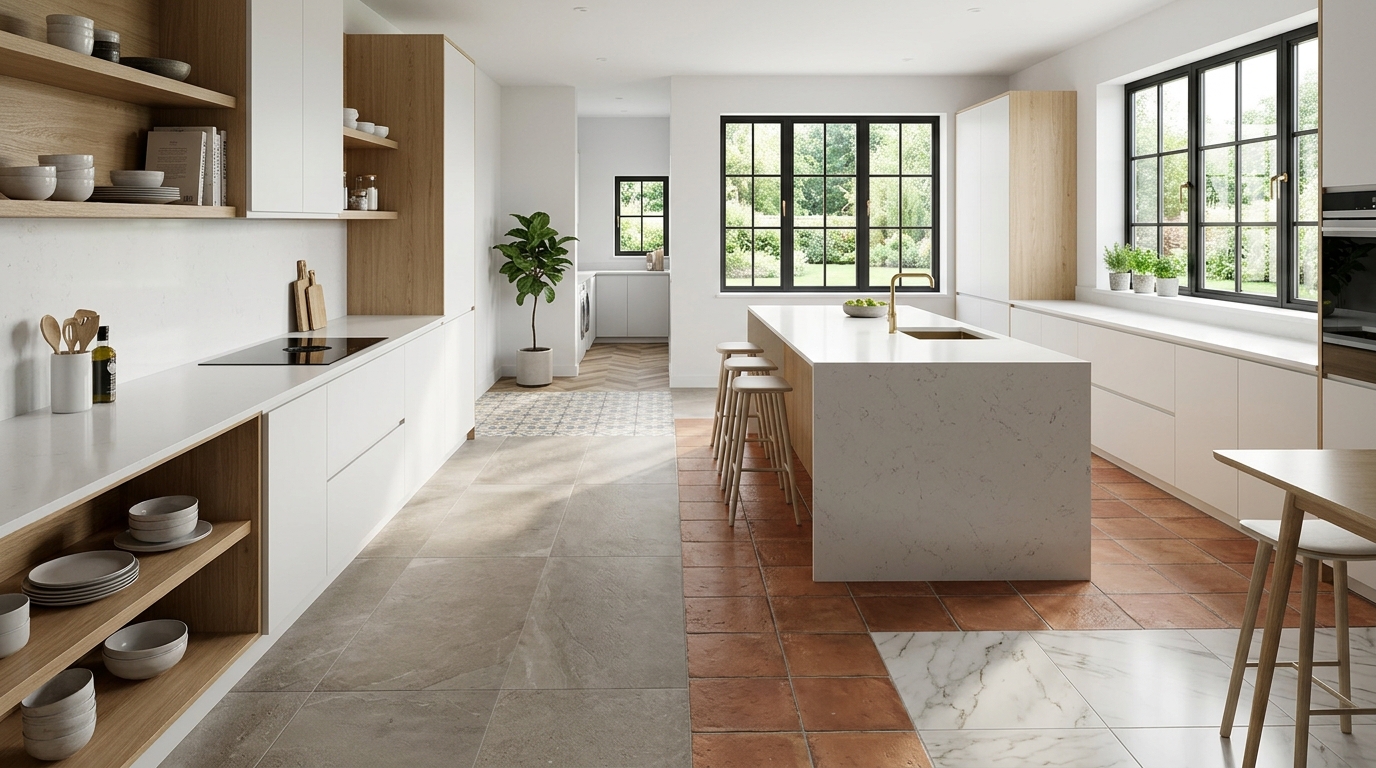
Kitchen flooring is the surface that takes more abuse than any other surface in the home and the one that most completely determines the kitchen’s overall aesthetic direction. The floor connects every cabinet, every appliance, and every wall surface into a unified visual field, which means a floor chosen without reference to the rest of the kitchen reads as an interruption rather than a foundation.
These kitchen flooring ideas tile focus on the specific tile choices that work in a kitchen setting: the sizes and formats that read correctly at room scale, the patterns that photograph well and hold their quality over years of foot traffic, the grout decisions that determine how the floor reads from daily standing height, and the specific tile collections from major manufacturers that deliver on the promise of their samples. No hardwood comparisons, no vinyl alternative guides. Just tile, chosen correctly for a kitchen floor.
You will find 26 ideas here, each one a distinct kitchen floor tile approach. Some are format decisions. Some are pattern choices. Some are about the grout rather than the tile. All of them give the kitchen floor the consideration it deserves as the room’s most foundational visual decision.
1. Use Large Format Porcelain Tiles for a Clean Modern Floor
Large format porcelain tiles at 24 by 24 inches or 24 by 48 inches on a kitchen floor create the cleanest, most open visual field available in any tile format because fewer grout lines across the floor surface means the eye reads the tile as a continuous plane rather than a pattern of individual units. Large format tile is the floor choice most associated with contemporary and modern kitchen design.
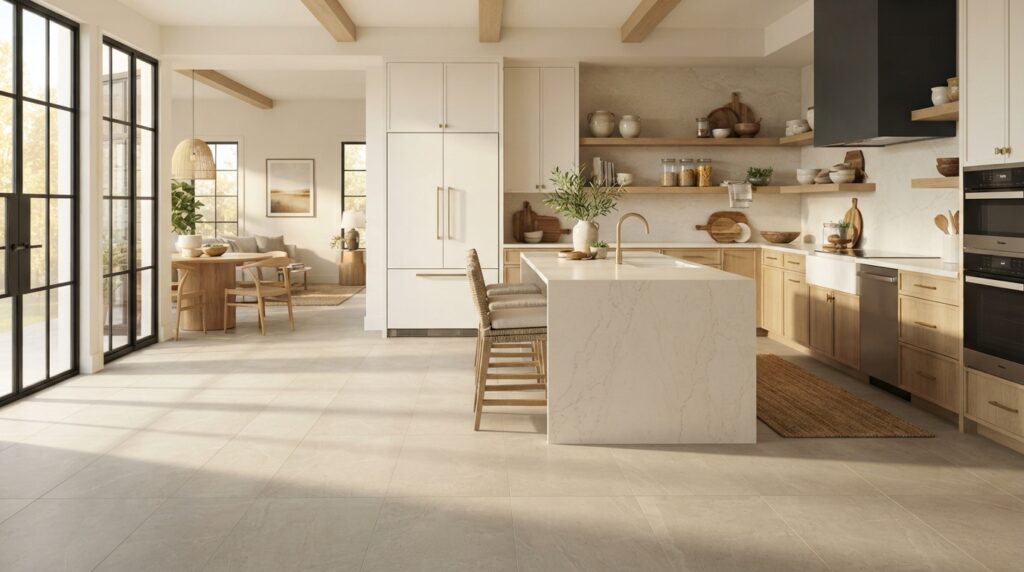
Choose a large format porcelain in a matte or satin finish rather than polished, which shows every footprint and scuff mark within hours of installation. The Daltile Modern Dimensions collection in a warm gray or concrete tone, the MSI Stacked Stone Ledger Panel in large format, and the Floor and Decor Emser Tile large format porcelain collections all provide quality large format options at accessible price points. Large format tile requires a perfectly flat substrate for proper installation since any high spots in the floor become visible as lippage between tiles.
2. Lay Classic Black and White Hex Tile for a Timeless Pattern
Black and white hex tile on a kitchen floor is one of the most historically durable design decisions available because the pattern has been used continuously in residential kitchens since the early 20th century and has never read as dated in that time. A kitchen with a black and white hex floor reads as intentionally designed regardless of what era the rest of the design belongs to.
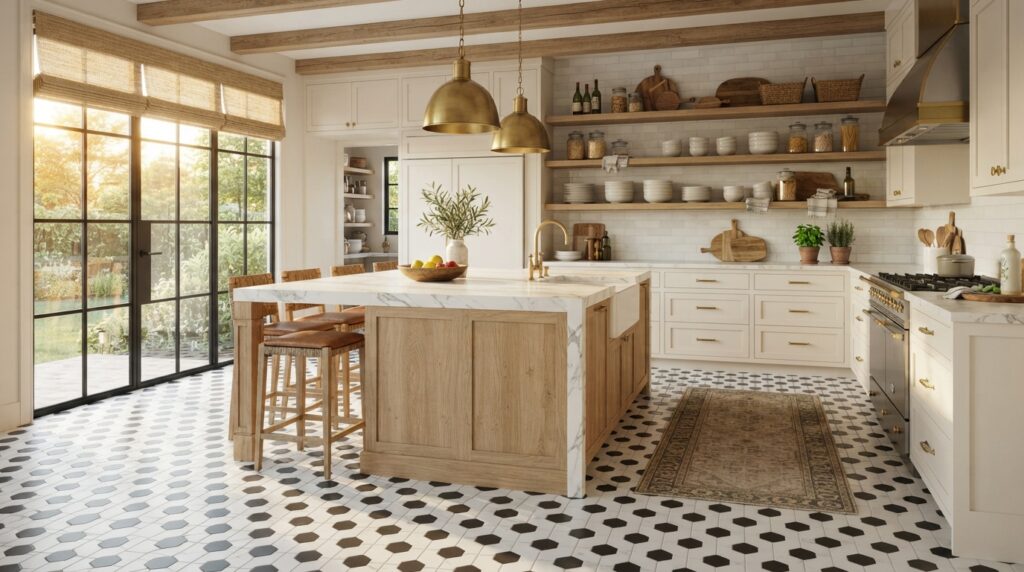
Use 1-inch or 2-inch hex tiles in a black and white pattern available as pre-mounted mesh sheets from Daltile, American Olean, or the Merola Tile collection at Home Depot. The mesh mounting makes installation significantly faster than individual tile placement. Use a white non-sanded grout at 1/16-inch joints for the sharpest visual result. The grout color decision matters significantly in hex tile: white grout makes the black tiles read as the pattern element. Gray grout reduces the contrast and makes the floor read as more neutral overall.
3. Kitchen Flooring Ideas Tile Include Encaustic Cement Tiles
Encaustic cement tiles in a geometric pattern on a kitchen floor create the most visually complex and specifically artisan floor surface available in any tile category. The cement body of encaustic tiles produces a matte, slightly porous surface that reads as genuinely handmade from the variation in color depth that occurs naturally in the cement pigment process.
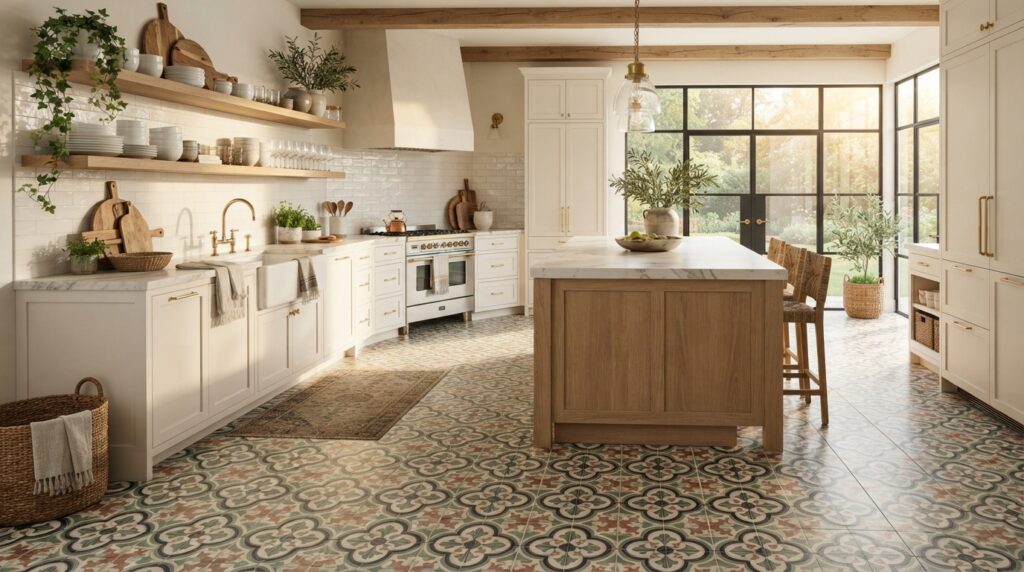
Choose encaustic cement tiles from Cement Tile Shop, Granada Tile, or Clé Tile in patterns with a color palette that suits the kitchen cabinet and wall color direction. Encaustic tiles require sealing before grouting and again after grouting with a penetrating sealer to prevent staining in a kitchen environment. The material cost for encaustic cement tile runs 10 to 25 dollars per square foot, which is significantly higher than ceramic or porcelain alternatives, but the visual quality of the finished floor reads as genuinely exceptional.
4. Install White Subway Tile in a Herringbone Pattern
White subway tile in a herringbone layout on a kitchen floor creates a directional, graphic surface that reads as more complex and more specifically designed than the same tile in a standard running bond pattern. The 45-degree herringbone angle introduces movement to the floor plane that leads the eye through the kitchen rather than simply covering the surface uniformly.
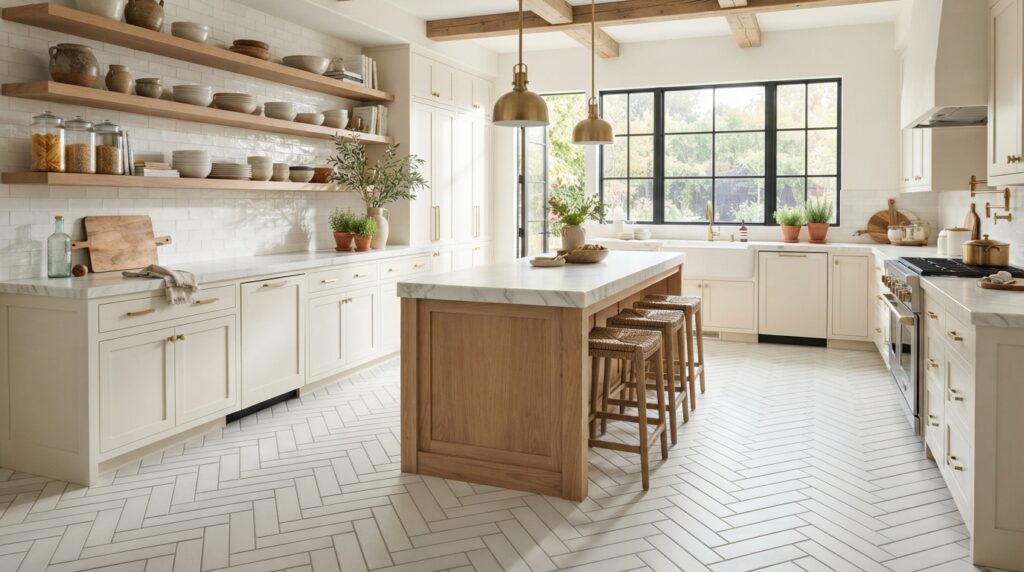
Use 3 by 6-inch white ceramic subway tile for the most classic herringbone result. The Daltile Rittenhouse Square 3 by 6 in white and the American Olean Bright White Subway Tile both provide the right ceramic quality at accessible prices for a kitchen floor herringbone application. Grout with an unsanded grout in a medium gray for the most graphic herringbone result. A white grout makes the pattern nearly invisible at floor viewing distance. A dark grout makes the individual tile outlines the dominant visual element.
5. Choose Slate-Look Porcelain for a Natural Texture
Slate-look porcelain tile produces the warm, organic surface quality of natural slate without the maintenance requirements of real stone in a kitchen floor application. Porcelain in a slate-look format is fully sealed at manufacture, which means it resists the staining and etching that natural slate is susceptible to in a kitchen cooking environment.
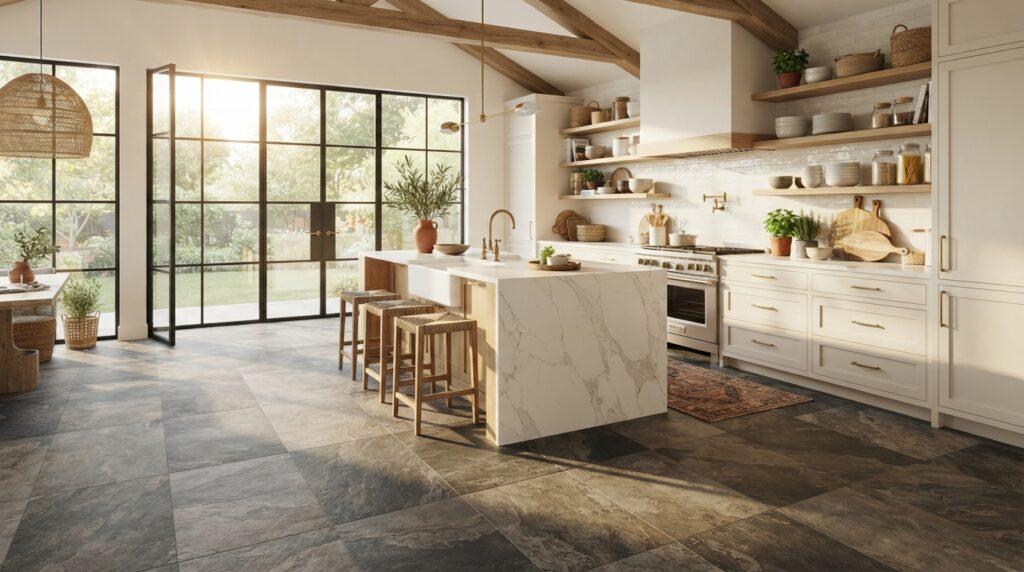
The MSI Montauk Black Slate-Look Porcelain, the Daltile Slate Attache in a warm charcoal tone, and the Floor and Decor Slate Collection in their natural variance format all provide the right surface texture and color variation that makes slate-look porcelain read as genuinely stone-like. Use a gray unsanded grout in a tone that matches the mid-range of the tile’s natural variation so the grout reads as part of the stone surface rather than as a visible line separating the tiles.
6. Kitchen Flooring Ideas Tile Use a Brick-Pattern Red Clay Tile
Red or terracotta clay tiles in a brick-pattern layout on a kitchen floor read as the most warmly Mediterranean and specifically aged floor surface available in any tile category. The warm red-orange tones of natural terracotta clay and the slightly irregular surface of fired clay tiles give the kitchen floor a specifically warm, earthy quality that no glazed ceramic or porcelain replicates.
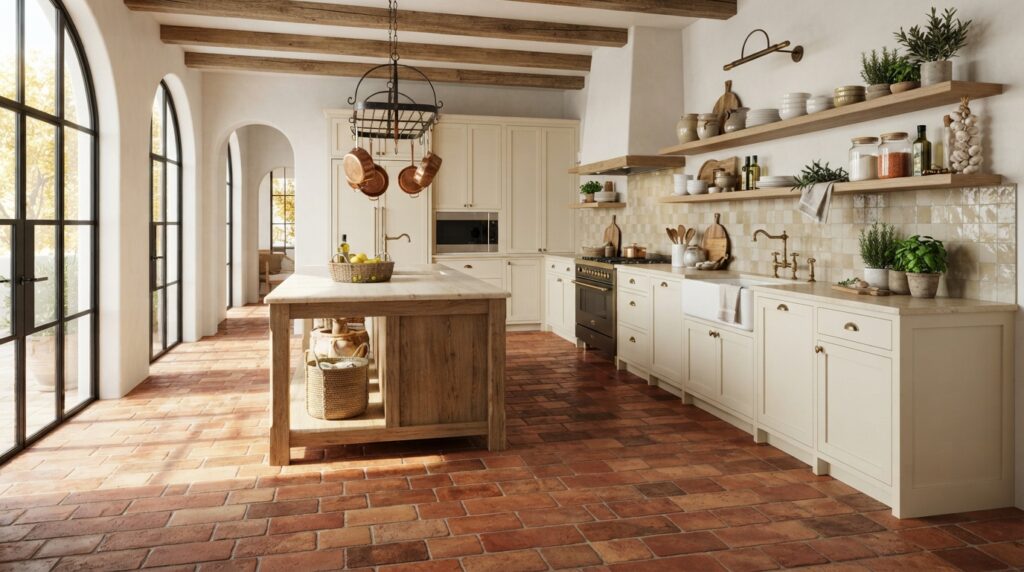
Natural terracotta tiles from Saltillo Tile, Mexican imports available through specialty tile suppliers, and the reproduction terracotta from Country Floors all provide the right clay quality and warm color range. Seal natural terracotta tiles before and after grouting and annually thereafter with a penetrating sealer specifically rated for porous clay tile in kitchen applications. The unsealed terracotta absorbs kitchen grease permanently within weeks of installation.
7. Lay a Wood-Look Porcelain Plank for Warmth Without Maintenance
Wood-look porcelain tile in a plank format at 6 by 36 inches or 8 by 48 inches provides the warm, directional quality of a hardwood floor at the durability and moisture resistance of ceramic tile in a kitchen environment. Modern wood-look porcelain has improved significantly in its realism and the best current products are distinguishable from real wood only at very close examination.
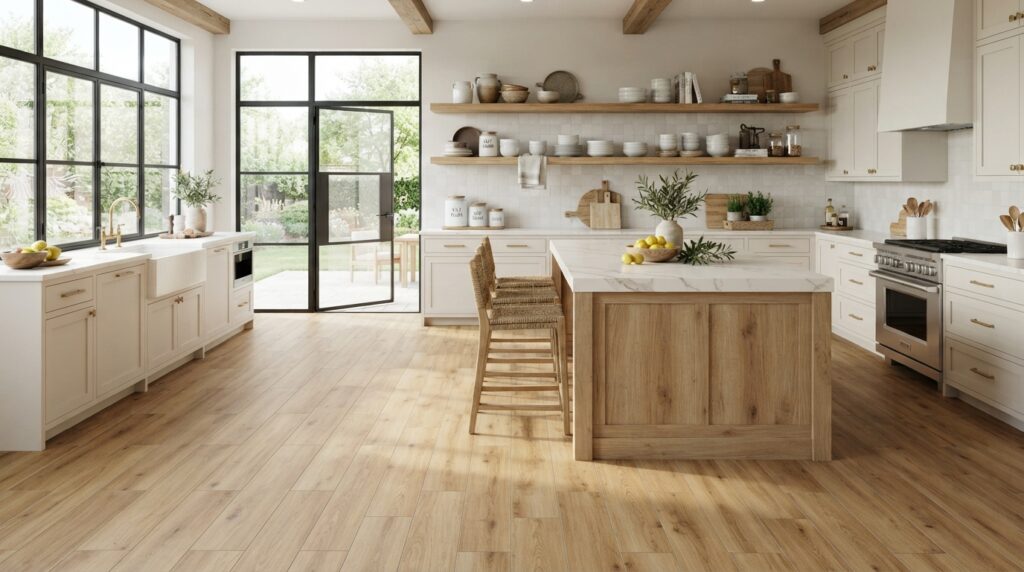
The Daltile Emerson Wood collection in a warm oak tone, the MSI Woodstone collection in their distressed finish, and the Floor and Decor Aged Wood Plank collection all provide realistic wood-look porcelain plank tiles in multiple color directions from pale blonde to deep walnut. Lay in a staggered joint pattern with varied end-joint spacing rather than uniform spacing for the most realistic wood-look installation result. Use an unsanded grout in a tone matching the wood’s lightest grain color for the least intrusive joint line.
8. Use Marble-Look Porcelain for a Luxurious Kitchen Floor
Marble-look porcelain in a large format provides the visual luxury of a natural marble floor at a fraction of the material cost and without the maintenance requirements of genuine marble in a kitchen environment where acidic spills are frequent and regular sealing would be required for real stone. The best marble-look porcelain reads convincingly as real marble from the normal standing viewing distance of a kitchen.
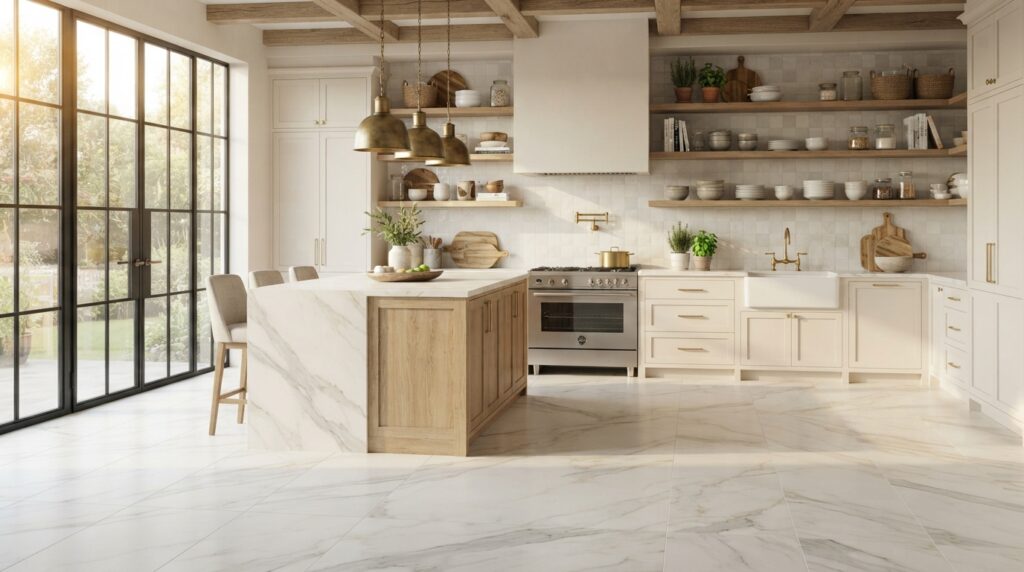
The Emser Tile Kase collection in Bianco Carrara tone, the Daltile Marble Attache in Whitewave, and the MSI Calacatta Gold porcelain in a large format all provide the right white and gray veining that makes marble-look porcelain read as genuinely stone-like. Use a white or very light gray unsanded grout at the narrowest possible joint width to maintain the seamless marble surface appearance across the full floor area.
9. Kitchen Flooring Ideas Tile Include a Checkerboard Floor
A black and white checkerboard tile floor in a kitchen creates the most graphic and specifically designed floor pattern available in a two-color tile format. The checkerboard references the traditional kitchen floors of mid-century American diners and European farmhouse kitchens and reads as both classic and specifically bold as a floor choice.
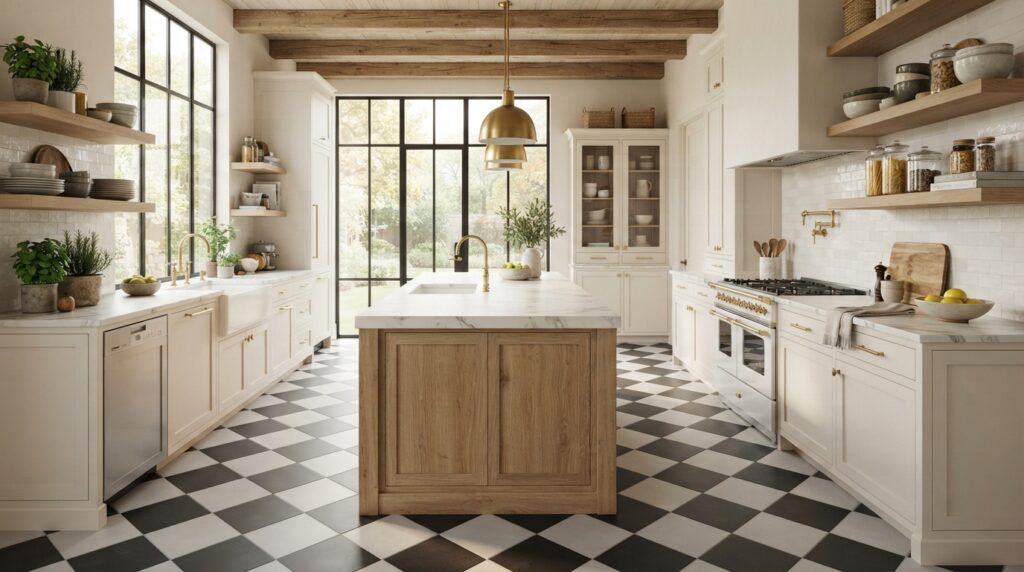
Use 12 by 12-inch tiles in a true matte black and a true matte white for the most graphic checkerboard result. The Daltile Keystones 12 by 12 in black and white, the American Olean Matte Black and White 12-inch Tile, and the Floor and Decor Black and White Matte 12-inch Tile all provide the right contrast level. Lay in a diagonal orientation with the tiles rotated 45 degrees to the room’s axis for the most traditional checkerboard pattern. The diagonal layout requires cutting triangular half-tiles at all the room’s perimeter edges.
10. Install Zellige-Style Handmade Tile for a Moroccan Kitchen
Zellige-style handmade ceramic tiles with their characteristic slight warping, varied glaze depth, and irregular edges create the most specifically artisan and specifically non-Western kitchen floor available. The visual movement of a zellige floor comes from the way each tile’s slightly irregular surface catches light differently from its neighbors, creating a floor that reads as continuously alive.
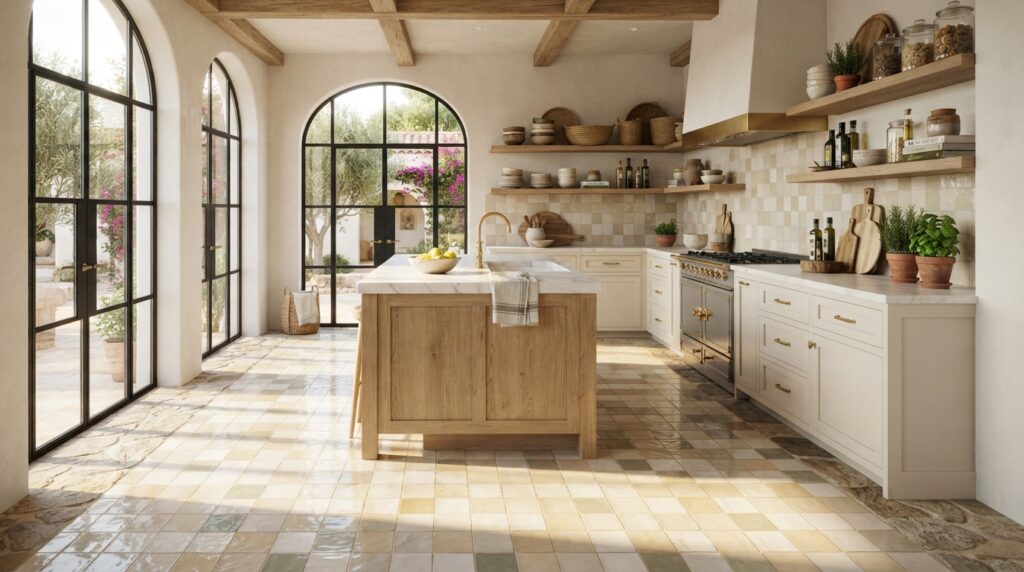
Genuine Moroccan zellige tile is available through specialty tile importers including Cle Tile, Mercury Mosaics, and Tabarka Studio at premium prices that reflect the handmade production process. Reproduction zellige-style tiles from Fireclay Tile and the Granada Tile zellige collection provide similar visual qualities at lower price points. Grout with a tight joint at 1/16 inch in a color that complements the glaze tone rather than contrasting sharply with it.
11. Kitchen Flooring Ideas Tile Use Penny Round Mosaic
Penny round mosaic tile in a matte white or a warm cream tone on a kitchen floor creates a surface with the most fine-grained texture available in a tile format. The small round tile produces a floor that reads as soft and almost textile-like from standing height despite being a ceramic surface. White penny round floors are the kitchen floor associated most specifically with European bakeries and heritage cafe interiors.
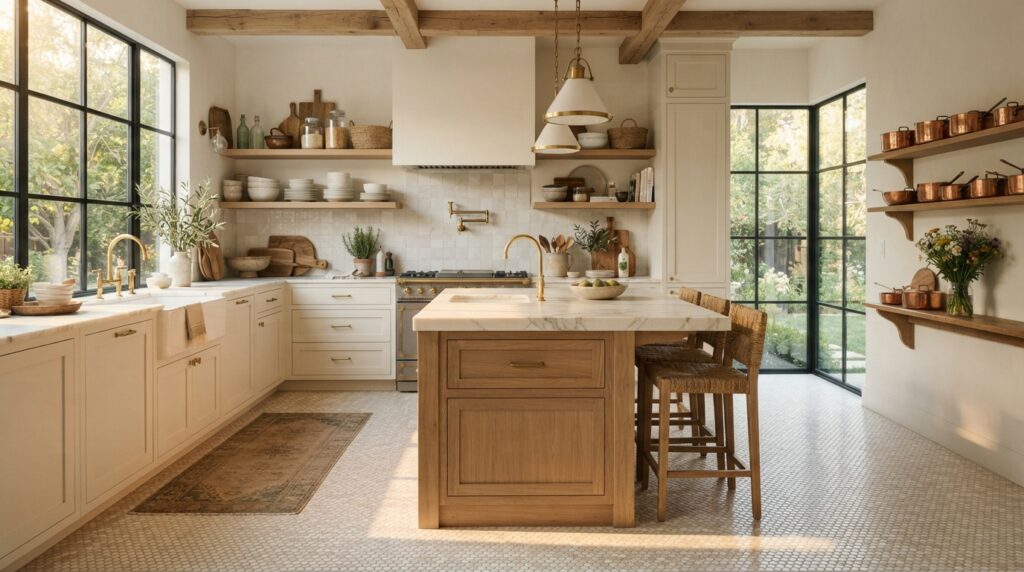
Use 3/4-inch or 1-inch penny round tiles on mesh backing from the Daltile Color Wheel collection in matte white or the Merola Tile Metro Penny Round in warm cream. Apply to a properly prepared and flat substrate with a non-sanded tile adhesive. Grout with an unsanded white or off-white grout at the tightest possible joint for the most unified floor surface appearance. A penny round floor requires more grout per square foot than any other tile format, which means the grout color selection has an outsized impact on the floor’s overall tone.
12. Choose Concrete-Look Porcelain for an Industrial Kitchen
Concrete-look porcelain tile in a mid-gray or warm greige tone provides the industrial aesthetic of a polished concrete floor without the cracking and sealing requirements of real concrete in a residential kitchen setting. The best concrete-look porcelain reads as poured concrete from any normal viewing distance and suits modern, industrial, and loft-style kitchens specifically.
The Daltile Concrete Connection series in a warm gray tone, the MSI Beton collection in their smooth finish format, and the Emser Tile Cosmopolitan in a light concrete tone all provide the right surface quality for a kitchen concrete-look floor. Use a matching tone unsanded grout at the narrowest possible joint width to maintain the seamless poured-concrete surface appearance. The grout line in a concrete-look floor should be virtually invisible so the floor reads as a single continuous surface.
13. Kitchen Flooring Ideas Tile Include a Basketweave Pattern
A basketweave tile pattern created from small rectangular tiles surrounding a single square center tile creates a kitchen floor with a specifically classic and crafted quality that reads as Victorian or Edwardian in its reference period. The basketweave is one of the most complex-looking kitchen tile patterns achievable with standard tile shapes because the interlocking rectangular and square combination reads as woven rather than simply laid.
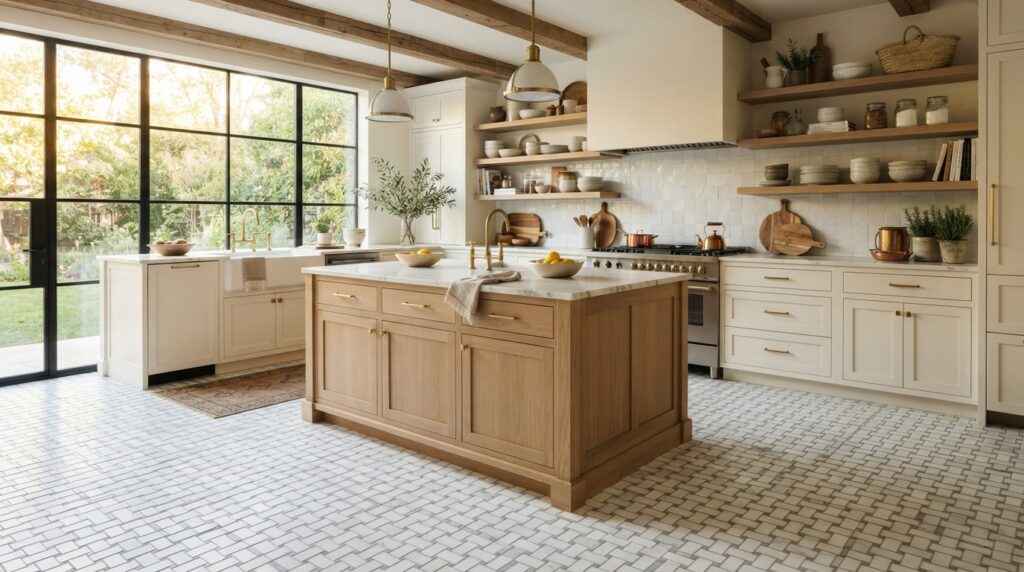
The Merola Tile Mayfair Basketweave Tile in white and gray, the Daltile Keystones Basketweave in black and white, and the American Olean Mosaics Basketweave collection all provide pre-mounted mesh basketweave panels that install as single sheets rather than requiring individual tile placement. Use a dark grout in a basketweave to emphasize the woven pattern quality. A light grout reads as more neutral but reduces the interlocking visual effect that makes the basketweave pattern distinctive.
14. Use Blue and White Delft-Pattern Tile for a Dutch-Inspired Kitchen
Blue and white Delft-pattern ceramic tiles on a kitchen floor create the most specifically Dutch and specifically historic kitchen floor available in any tile category. The hand-painted blue floral and pictorial motifs on a white ceramic body reference four centuries of Dutch ceramic production and give the kitchen a floor that reads as genuinely collected rather than selected from a current catalog.
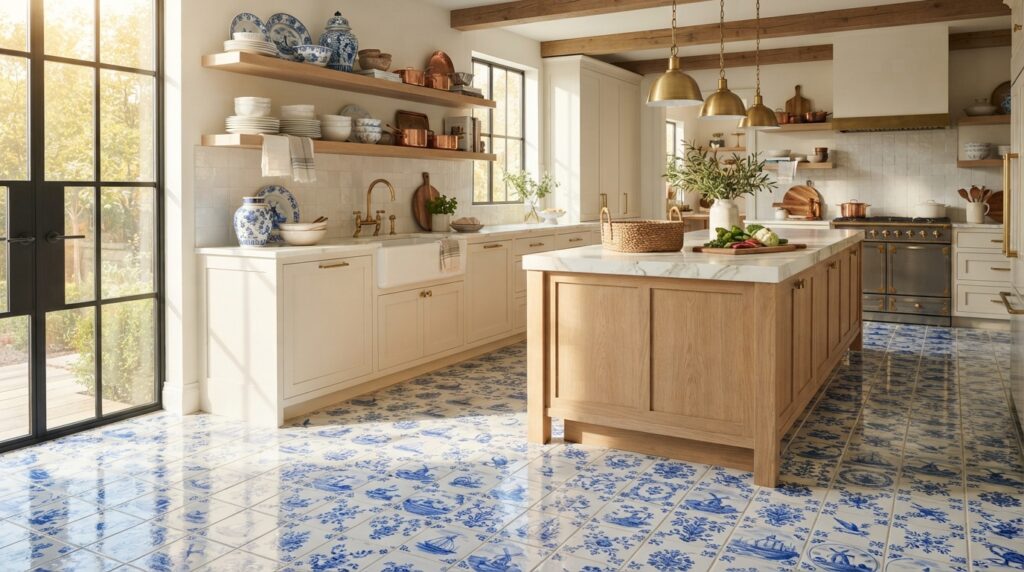
Genuine Delft tiles from Royal Delft and Makkum in the Netherlands are available through specialty tile importers at significant premium pricing. High-quality reproduction Delft-pattern tiles from Merola Tile, Country Floors, and online specialty retailers provide the same visual character at accessible prices. Lay with a white unsanded grout at the tightest joint width for the most seamless surface appearance. A blue or gray grout would compete with the tile’s own blue pattern and should be avoided.
15. Kitchen Flooring Ideas Tile Feature a Geometric Cement Tile Border
A decorative geometric cement tile border installed at the perimeter of a kitchen floor with a plain field tile inside creates a framed floor composition that reads as an architectural detail rather than a uniform surface covering. The border treatment references the decorative floor compositions of early 20th-century kitchens and gives the room a designed quality that no single tile used throughout achieves.
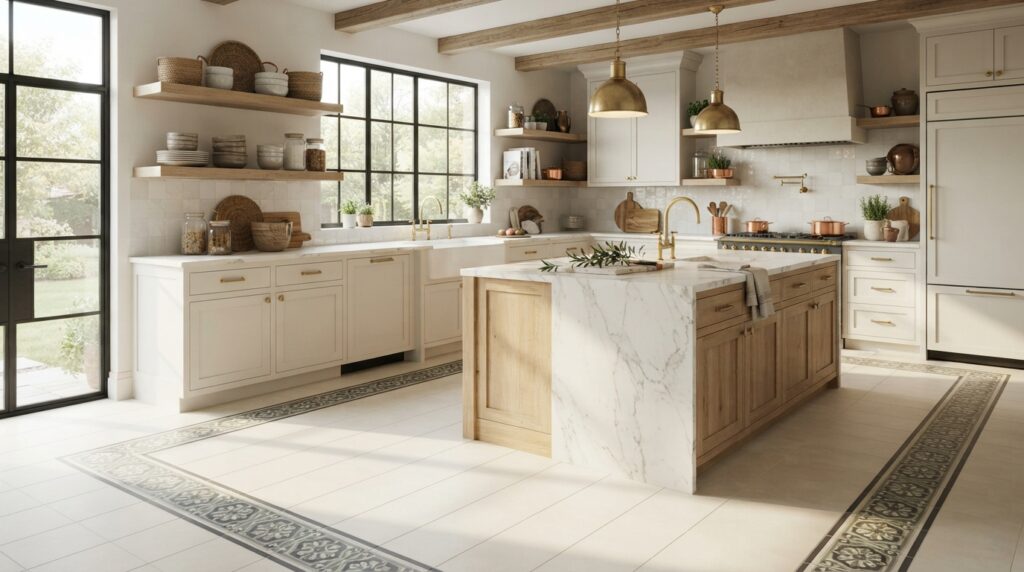
Use a 4-inch wide border tile in a geometric or floral pattern from the Cement Tile Shop or Granada Tile and pair it with a plain 12 by 12-inch field tile in a complementary color pulled from the border pattern’s palette. Install the border first at the perimeter walls and fill the field area with the plain tile, maintaining consistent grout joint width throughout. The grout color should suit both the border and the field tile simultaneously.
16. Choose Warm Beige Travertine-Look Porcelain
Travertine-look porcelain in a warm beige and cream tone provides the Mediterranean warmth of natural travertine stone without the filling, sealing, and maintenance that real travertine requires in a kitchen floor application. Modern travertine-look porcelain captures the characteristic warm veining and slight texture variation of the natural stone convincingly.
The Emser Tile Travertino in a warm cream tone, the MSI Tuscany Beige Travertine-Look porcelain, and the Daltile Sandstone Attache in a travertine-like warm beige all provide the right color depth and surface variation for a Mediterranean-inspired kitchen floor. Grout with a matching beige unsanded grout that reads as a natural extension of the tile’s warm tone rather than as a visible line between the tiles.
17. Kitchen Flooring Ideas Tile Include a Starburst Mosaic Medallion
A starburst or sunburst mosaic medallion tile inset into a kitchen floor at the center of the room or at the entry threshold creates a focal feature in the floor composition that reads as specifically architectural and specifically custom. A single medallion changes the floor from a surface covering to a composed floor design.
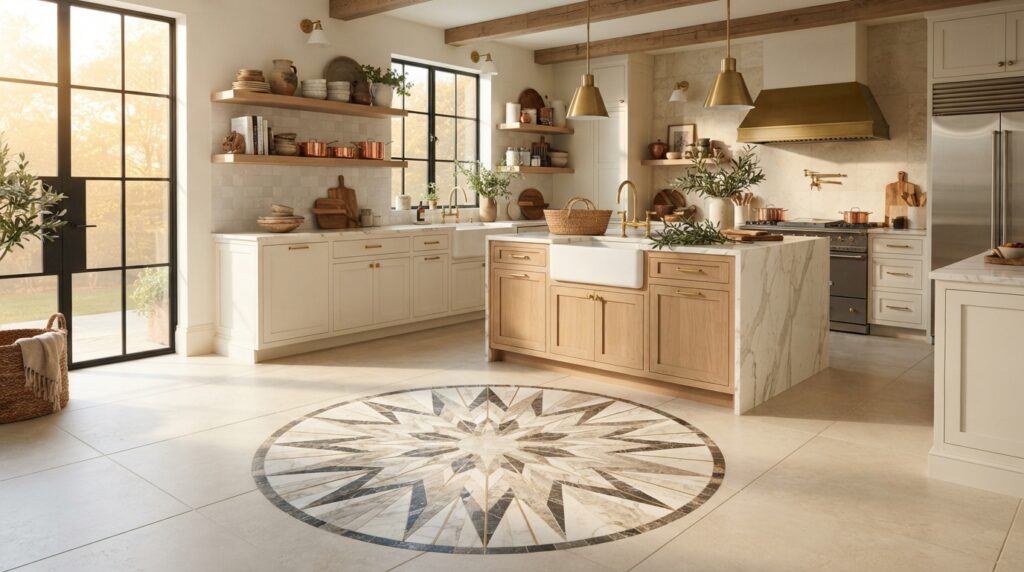
Custom mosaic medallions are available from stone and tile fabricators who produce them in natural stone, porcelain, or glass mosaic at sizes from 18 to 48 inches in diameter. The Artistic Tile medallion collection and the Marble Systems custom floor medallion program both provide high-quality options in a range of design styles from traditional starburst to contemporary geometric. The medallion is installed after the field tile is complete, cutting out the field tile to the exact medallion dimension and setting the medallion as the final element.
18. Use Handmade Quarry Tile for a Spanish or Mediterranean Kitchen
Quarry tile in an unglazed red or buff clay body provides the most durable and most specifically Mediterranean kitchen floor available in a fired ceramic tile category. Quarry tile is the floor material of Spanish colonial kitchens, Italian farmhouses, and Provencal country houses and it reads as genuinely old and genuinely regional in a way that most manufactured tiles cannot achieve.
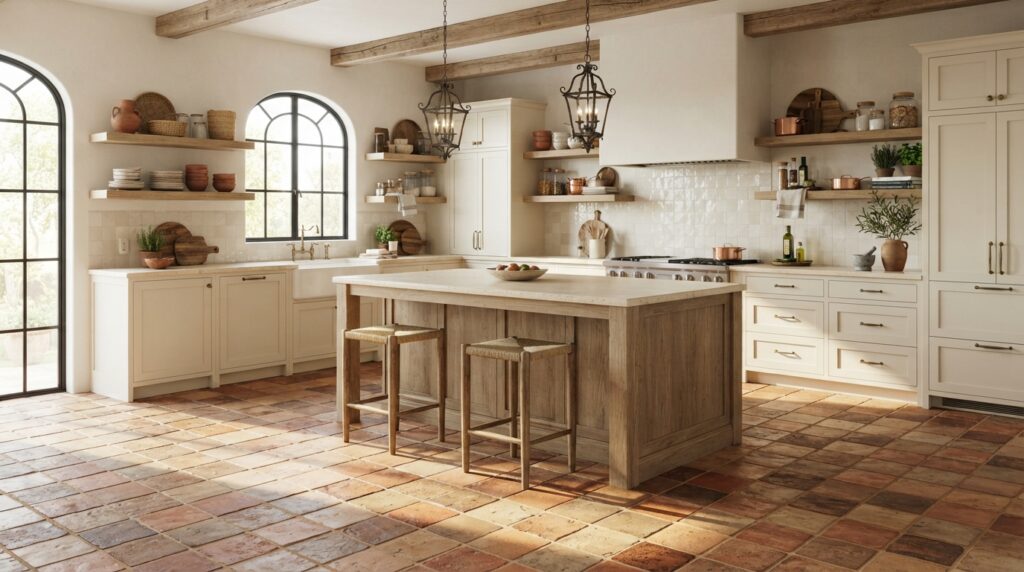
The American Olean Quarry Tile in a warm red body, the Daltile Quarry Tile in their standard 6 by 6 format, and specialty imports from Mexican and Spanish tile producers through Country Floors all provide the right unglazed clay quality. Seal with a penetrating tile and grout sealer before grouting and apply a topical sealer after grouting for kitchen grease resistance. The unsealed quarry tile surface absorbs kitchen oils and becomes permanently stained within weeks.
19. Kitchen Flooring Ideas Tile Use a Wide Plank Natural Stone Look
Wide plank format tiles at 12 by 48 inches or 16 by 48 inches in a natural stone look, whether limestone, sandstone, or granite appearance, create the most architecturally significant kitchen floor available in a porcelain tile format because the wide plank dimension reads as specifically premium and specifically designed from any viewing angle.
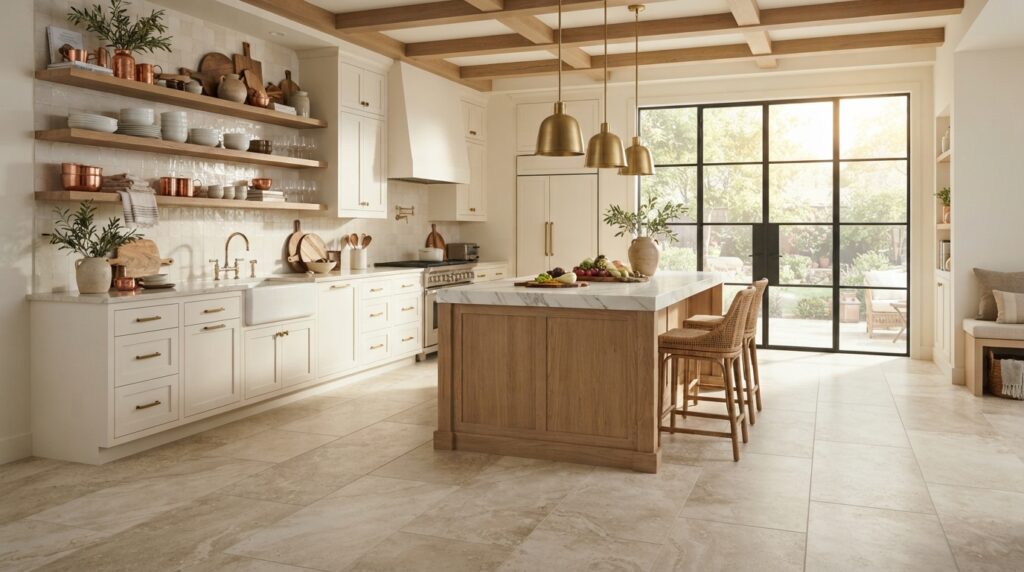
The Daltile Limestone Attache in a wide plank format, the MSI Highland Park Arched in a 12 by 48 format, and the Emser Tile Transitions collection in their longer plank dimension all provide the right scale and natural variation for a wide plank kitchen floor. Install with a 1/16-inch grout joint in an unsanded grout matching the tile’s mid-tone for the most seamless large-scale surface result.
20. Choose Dark Charcoal Tile for a Dramatic Kitchen Floor
A dark charcoal or near-black tile floor in a kitchen with white or light-colored cabinets creates the most graphically dramatic floor-to-cabinet contrast available and gives the kitchen a high-end, deliberate quality that light floors with light cabinets cannot achieve. A dark floor in a light kitchen reads as confident and specifically chosen rather than as a neutral default decision.
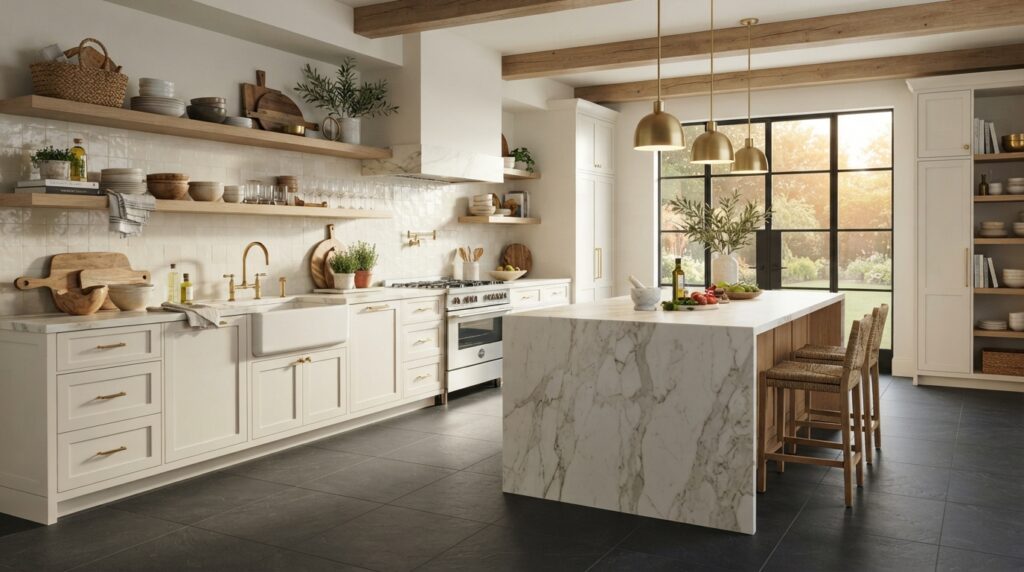
The Daltile Vibe in Cosmic Black, the MSI Metro Dark Gray in a large format, and the Emser Tile Logic in a dark charcoal matte finish all provide the right depth of dark tone for a kitchen floor that reads as dramatically designed rather than simply dark. Use a matching dark grout in the same tone family as the tile so the grout lines disappear into the floor surface rather than creating a visible grid pattern across the dark field.
21. Kitchen Flooring Ideas Tile Include a Classic Limestone Floor
Natural limestone tile in a honed finish on a kitchen floor provides the warmest, most organic natural stone floor available in a matte surface format. Honed limestone in a warm cream or pale gray tone reads as specifically European and specifically aged in a way that manufactured tiles reach toward but rarely achieve. The natural variation in limestone surface color and fossil detail makes every installation unique.
Jerusalem Gold limestone, Jurastone limestone in a warm beige, and Travertine Navona in a honed finish all provide the right natural stone quality for a kitchen floor installation. Seal natural limestone thoroughly with a penetrating stone sealer before and after grouting and reseal annually in a kitchen environment where acidic cleaners and food spills are common. Avoid acidic cleaners including vinegar-based products on any natural limestone surface.
22. Install Arabesque Tile in a Neutral Tone for a Subtle Pattern
Arabesque-shaped tile, also called lantern or ogee tile, in a soft gray or warm cream tone on a kitchen floor creates a floor pattern with a specifically Moorish architectural reference that reads as subtle and sophisticated rather than bold and thematic when kept to a single neutral color. The pattern shape does the design work without the color contrast making the floor visually loud.
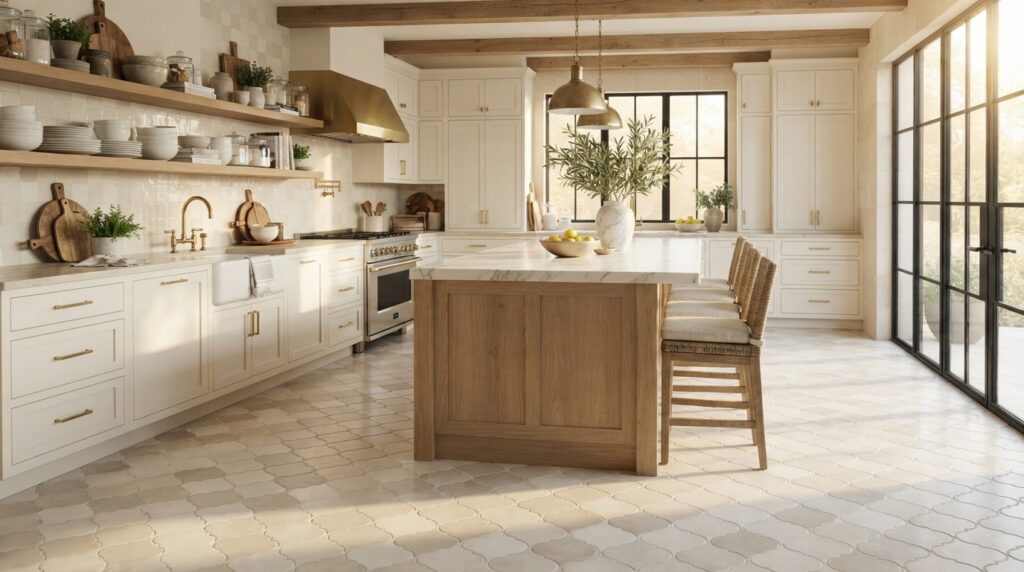
The Merola Tile Arcade Arabesque in white, the Cle Tile Arabesque collection in a warm putty tone, and the Fireclay Tile Arabesque in their matte glaze finish all provide the right arabesque shape quality in neutral tones. Grout with a tone matching the tile body for a tone-on-tone result where the pattern reads as a subtle texture rather than a high-contrast graphic. The subtle arabesque floor suits transitional and traditional kitchens where the floor needs to read as designed without dominating the overall room composition.
23. Use Outdoor-Rated Porcelain for an Indoor-Outdoor Kitchen
Outdoor-rated porcelain tile with a slip-resistant surface texture installed on both the interior kitchen floor and the connected outdoor patio or deck creates a continuous floor plane that visually expands both spaces and signals an indoor-outdoor kitchen design intention. The continuous tile plane across the threshold makes the transition between indoor and outdoor feel deliberate rather than abrupt.
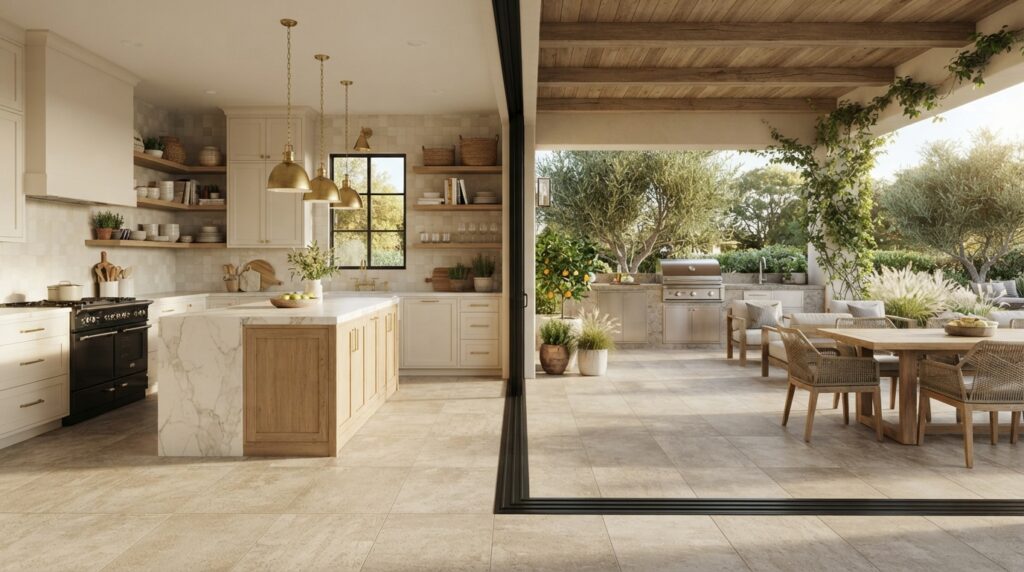
Choose a porcelain rated for both indoor and outdoor use with a slip coefficient of friction of at least 0.6 for wet outdoor conditions. The Daltile Exterior Collection, the MSI Arterra Pavers in their indoor-outdoor format, and the Porcelanosa Prada collection in a through-body porcelain that suits both applications all provide the right technical and aesthetic quality for a continuous indoor-outdoor floor application.
24. Kitchen Flooring Ideas Tile Use a Diagonal Lay for Visual Expansion
Any standard square tile laid at a 45-degree diagonal to the kitchen’s primary axis reads as a larger format than the same tile laid straight because the diagonal orientation makes the full tile diagonal dimension, rather than the tile’s side dimension, the primary scale reference visible from the kitchen entry. A 12 by 12-inch tile laid on the diagonal reads as a 17-inch tile from normal viewing distance.
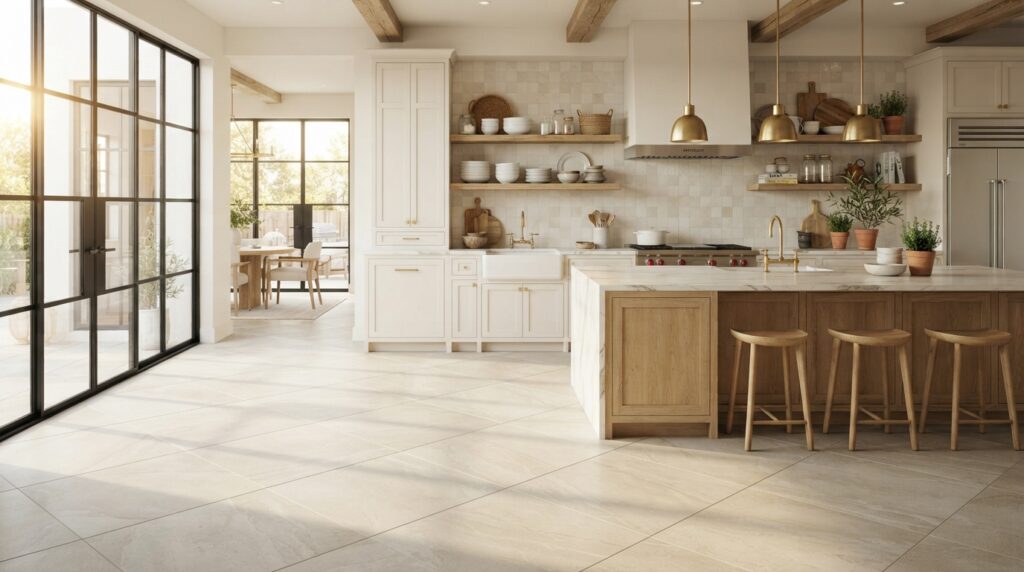
The diagonal lay works best in a square or near-square kitchen plan where the tile’s diagonal orientation does not conflict awkwardly with any dominant architectural axis. In a galley kitchen, a straight lay parallel to the long axis creates a more harmonious directional read. In a square kitchen with equal wall lengths, the diagonal lay creates the most expansive apparent floor scale available from any standard square tile format without increasing the actual tile size.
25. Choose a Through-Body Porcelain for Commercial Kitchen Durability
Through-body porcelain tile, meaning porcelain where the color and pattern runs through the full depth of the tile body rather than existing only as a surface glaze, is the most durable kitchen floor tile available because chipping and wear do not expose a different-colored body beneath the surface pattern. Through-body porcelain reads identical whether it is new or ten years old.
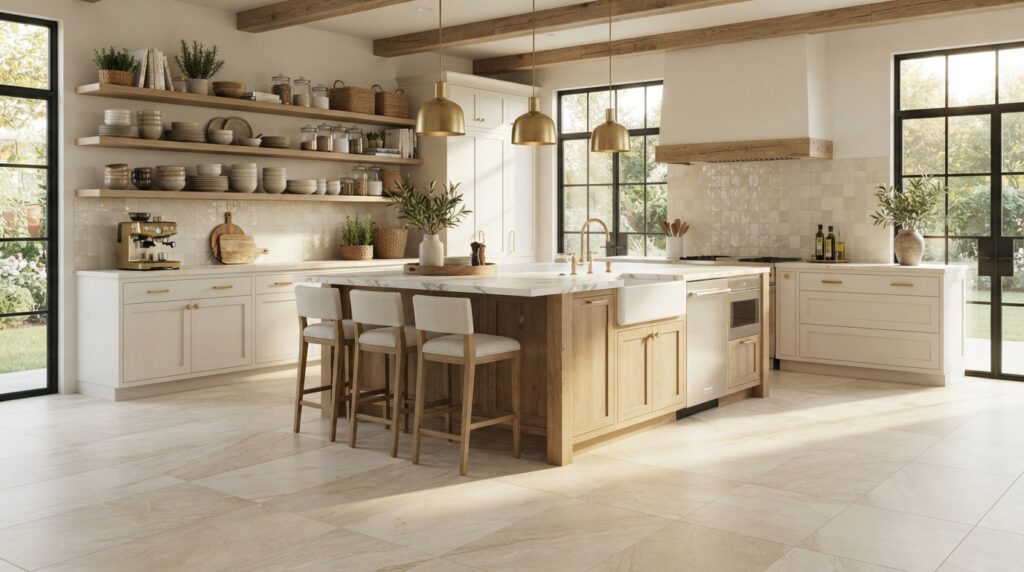
The Daltile Perpetuo series in a full-body format, the MSI through-body porcelain collections, and the Porcelanosa through-body technical porcelain range all provide the right commercial-grade durability in formats and colors appropriate for residential kitchen floor applications. Through-body porcelain is typically available in large format sizes that suit a commercial-quality floor aesthetic in a residential kitchen environment.
26. Finish with the Right Grout Color for Any Kitchen Tile Floor
The grout color is the single most consequential decision in any tile floor installation and the one most frequently made last, which leads to the most regret. Grout covers between 10 and 20 percent of any tile floor’s visible surface area. The wrong grout color makes the right tile selection read incorrectly, and the right grout color makes an average tile selection look significantly better than it actually is.
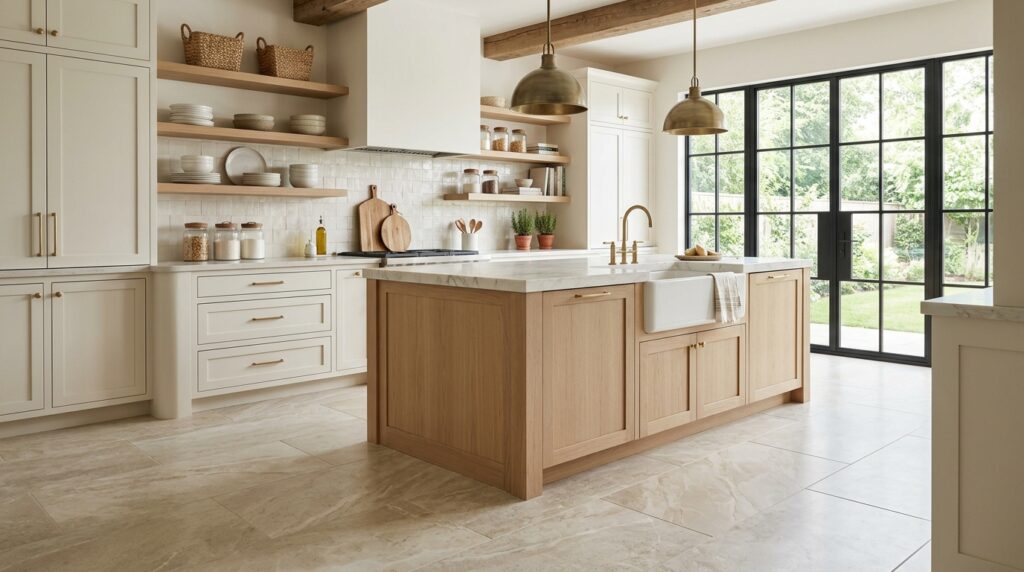
Dark grout on light tile emphasizes the tile pattern by making each individual tile visible as a distinct element in the design. Light grout on dark tile creates a high-contrast grid that reads as louder than the tile alone would suggest. Matching grout, meaning grout in the same tone as the tile’s mid-range color, reads as the most seamless and most sophisticated result in almost every kitchen tile application. The Laticrete SpectraLOCK Epoxy Grout provides the most consistent color and stain resistance of any kitchen grout product available and does not require sealing after installation.
Conclusion
A kitchen tile floor is a 20-year decision in most households. The tile that reads as fresh and considered today will still be in place when the cabinets have been painted three times and the countertops have been replaced. Choosing it as a long-term commitment rather than as a trend purchase is the discipline that leads to kitchen floors people are still happy with a decade later.
Start with the grout color decision rather than ending with it, because the grout choice determines the visual character of any tile more than the tile itself in most kitchen flooring applications. These kitchen flooring ideas tile give you the full range of what is possible from a heritage hex pattern to a large-format modern porcelain, and the right choice is always the one that reads as the logical foundation for the specific kitchen it belongs to.