
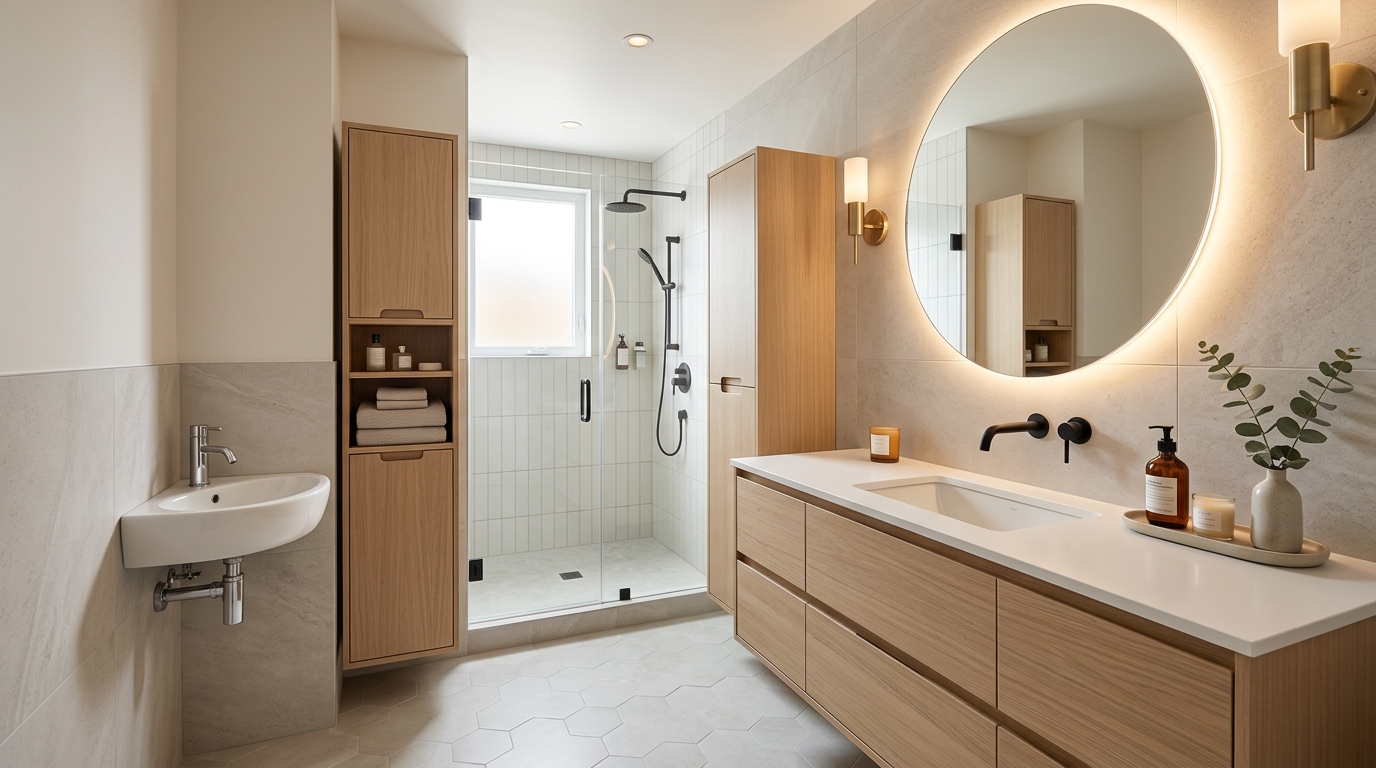
A vanity takes up more visual and physical space in a small bathroom than almost anything else, which means the wrong choice can make a tight room feel even tighter, while the right one can make it feel surprisingly open. Small space vanities are not just smaller versions of standard ones, they often work differently entirely, in shape, mounting, and storage.
This article focuses on vanity types and configurations specifically suited to small bathrooms, covering options that save floor space, fit awkward layouts, or simply make the room feel less cramped.
Below are twenty one ideas for choosing or designing a vanity that works with a small bathroom rather than against it.
1. Wall-Mounted Vanity to Free Up Floor Space
A vanity mounted directly to the wall, with no legs or base touching the floor, visually and physically frees up the area beneath it. This makes the floor appear to extend further than it actually does, which is one of the simplest ways to make a small bathroom feel larger. The space underneath can also serve a purpose, holding a small basket or simply staying empty for easier cleaning, since there is no base cabinet collecting dust or blocking a mop.
This option works particularly well in bathrooms where every square foot of visible floor matters, since even a few inches of floor showing beneath the vanity changes the perceived size of the room. It also makes the room easier to clean, since a mop or vacuum can pass underneath without obstruction, which keeps the floor looking tidier with less effort.
2. Corner Vanity for Awkward Layouts
A vanity designed specifically for a corner installation, with a triangular or angled cabinet shape, makes use of a space that standard rectangular vanities cannot fit into efficiently. This is especially useful in bathrooms with an irregular footprint, where a rectangular vanity would either leave gaps or simply not fit at all. Corner vanities typically have a smaller countertop area than standard ones, so choosing fixtures and accessories sized appropriately for that reduced space matters more here than it would with a larger vanity.
This option works well when the rest of the bathroom’s fixtures, the toilet and shower or tub, occupy the more usable wall space, leaving only a corner available for the sink. Positioning the corner vanity so the door opens away from it also helps avoid any conflict between the cabinet and the door swing.
3. Pedestal Sink Instead of a Full Vanity
A pedestal sink eliminates the cabinet entirely, leaving just the sink basin and a slim column supporting it. This is one of the most space efficient options available, since the footprint is often just the width of the sink itself, and the open area around it makes the whole room feel less enclosed. The tradeoff is storage, since a pedestal sink offers none, which means storage needs to be addressed elsewhere in the bathroom, through shelving or a separate cabinet.
This option suits bathrooms where floor space is at such a premium that even a small vanity cabinet would feel obstructive, particularly in powder rooms or half baths used briefly rather than for getting ready each day. Pairing it with a wall mounted mirror that has a small shelf can help offset the lack of built in storage.
4. Floating Vanity with Open Storage Underneath
A floating vanity with an open shelf or cubby beneath the main cabinet combines the space saving benefit of wall mounting with some additional storage, typically for items like baskets, a small stool, or rolled towels. The open section underneath also adds a layered look to the vanity, since it creates a visual gap between the cabinet and the floor while still providing function.
This option works well for households that need a bit more storage than a fully open pedestal sink offers, without the bulk of a standard floor to cabinet vanity. Styling the open shelf with one or two baskets, rather than leaving it empty or overly full, keeps the area looking intentional rather than like extra storage that got tacked on.
5. Narrow Single-Drawer Vanity
A vanity with just one drawer, rather than multiple stacked drawers or double doors, keeps the cabinet’s depth and width to a minimum while still providing some storage for everyday items like toothbrushes or skincare products. The single drawer format also tends to look cleaner and less bulky than a vanity with multiple drawer fronts, since there are fewer lines breaking up the cabinet’s surface.
This option suits very narrow bathrooms where even a few extra inches of vanity depth would interfere with the door swing or walking space. A single deep drawer, divided internally with small organizers, can still hold a surprising amount despite the vanity’s overall slim profile.
6. Vessel Sink on a Slim Console Table
A vessel sink, which sits on top of the counter rather than being recessed into it, paired with a slim console table instead of a boxy cabinet, creates a vanity that feels more like a piece of furniture than built in storage. Console tables typically have open legs, which contributes to the same visual openness as a floating vanity, while the vessel sink adds a bit of height and presence on top.
This combination works particularly well in bathrooms aiming for a more decorative, less utilitarian look, where the vanity itself becomes a design feature rather than just a fixture. A small basket or tray placed on the lower shelf of the console table can provide just enough storage without crowding the open legs.
7. Vanity with a Rounded Front Edge
A vanity with a curved or rounded front corner, rather than a sharp square edge, can make a real difference in tight bathrooms where the vanity sits close to a doorway or walking path. The rounded edge softens the transition and reduces the chance of bumping into a hard corner, which matters more in small spaces where people pass close by regularly.
This detail also makes the vanity feel slightly less boxy overall, even if the dimensions are otherwise standard. This option is worth prioritizing specifically in bathrooms where the vanity is positioned close to the door swing or another fixture, since the rounded edge directly addresses a common pain point in small layouts.
8. Compact Vanity with an Offset Sink Bowl
A vanity where the sink bowl sits toward one side of the counter, rather than centered, leaves more usable counter space on the other side, even within a narrow overall width. This asymmetry can make a small countertop feel more functional, since the area beside the sink becomes a real spot to set down items rather than just empty space around the bowl.
The offset design also allows for a slightly larger faucet or accessory area on the side with more counter space, without needing to widen the vanity itself. This option works well for anyone who uses the counter for getting ready, since even a small additional strip of usable surface makes a noticeable difference in daily function.
9. Vanity Sized to Fit Under a Window
In bathrooms where a window sits low on the wall, a vanity custom sized to fit beneath it, rather than positioned elsewhere, makes use of a wall section that might otherwise be hard to furnish. The vanity’s height needs to clear the window sill, which often results in a slightly shorter cabinet, and the depth may also need to be adjusted depending on how far the sill projects into the room.
This placement also means the vanity benefits from natural light directly above it, which is useful for tasks like applying makeup or shaving. This option requires more custom planning than a standard vanity placement, but it solves a layout challenge that many small bathrooms with low windows face.
10. Slimline Vanity with Storage Built into the Mirror Cabinet
When the vanity cabinet itself is kept minimal, shifting additional storage into a mirrored cabinet above the sink balances out the loss of space below. The mirrored cabinet typically has shelves for smaller items, while the vanity below stays slim, which keeps the floor area around the sink feeling open even though overall storage capacity does not shrink.
This approach distributes storage vertically rather than concentrating it all at floor level, which can make the room feel less bottom heavy overall. This combination works particularly well in bathrooms where floor space is more limited than wall space, since the storage moves to where the room actually has room to spare.
11. Vanity with Sliding Cabinet Doors
Sliding doors on a vanity cabinet eliminate the need for door swing clearance, which matters in bathrooms where a standard cabinet door would hit the toilet, the tub, or another fixture when opened. This door style also tends to have a more streamlined, modern appearance, since there are no hinges or handles protruding from the cabinet’s face.
This option is particularly useful in bathrooms with a tight footprint where the vanity sits directly across from another fixture, since sliding doors remove one more spatial constraint from the layout. The track for sliding doors does take up a small amount of internal cabinet space, which is worth factoring in when planning what will be stored inside.
12. Open-Leg Vanity to Create Visual Space
A vanity with visible legs, rather than a solid base or full panel sides, lets light and floor space show through underneath, similar in effect to a floating vanity but with a more traditional furniture look. This style often suits bathrooms with a more classic or transitional design, where a fully wall mounted vanity might feel too modern for the rest of the room.
The open legs also make the vanity easier to clean around, since there is no enclosed base collecting dust or moisture in the corners. Choosing legs in a slim profile, rather than thick turned posts, keeps the overall effect light rather than heavy.
13. Vanity with a Single Tall Cabinet Beside the Sink
Rather than spreading storage across the full width of the vanity, concentrating it into one tall, narrow cabinet beside the sink leaves the rest of the vanity area open or slim. This vertical storage approach uses height rather than width, which matters in bathrooms where floor space is the limiting factor rather than wall space.
The tall cabinet can hold items that would otherwise need a separate linen closet, towels, cleaning supplies, or extra toiletries, stacked vertically rather than spread across shallow drawers. This configuration works well in bathrooms with enough ceiling height to make a tall cabinet feel proportional rather than overwhelming next to a smaller sink area.
14. Corner Pedestal Sink for Tight Bathrooms
A pedestal sink designed specifically for corner installation combines the minimal footprint of a standard pedestal with a shape that fits into an unused corner, similar to a corner vanity but without any cabinet at all. This option is about as space efficient as bathroom sinks get, often fitting into corners too small for almost any other fixture.
This works best in very small powder rooms or half baths, where the sink’s primary function is quick handwashing rather than serving as a daily grooming station. A small wall mounted shelf nearby can provide a spot for soap and a hand towel without adding any additional floor footprint.
15. Vanity with a Built-In Cutout for a Hamper
A vanity designed with an open cutout section, sized to hold a pull out hamper or laundry basket, integrates a function that would otherwise need its own floor space elsewhere in the bathroom. This works particularly well in small bathrooms that double as the main bathroom for a bedroom, where laundry collection and bathroom storage often compete for the same limited space.
The cutout can also be used for other purposes, like a small trash bin or extra towel storage, if a hamper is not needed in that particular bathroom. Either way, the dedicated cutout keeps that item from sitting loose on the floor, which helps a small bathroom feel less cluttered overall.
16. Light-Colored Vanity to Open Up the Room
A vanity in a light tone, white, pale wood, or soft gray, reflects more light than a dark one, which can make the area around it feel more open even if the actual dimensions stay the same. This effect is especially noticeable in bathrooms without much natural light, where a dark vanity can visually anchor the room and make it feel smaller and heavier than it actually is.
Pairing a light vanity with a similarly light countertop reinforces this effect, avoiding a strong contrast that would draw attention back to the vanity’s footprint. A light vanity also tends to show less visual bulk against light walls, helping the cabinet blend into the room rather than standing out as a solid block.
17. Vanity with a Mirrored Cabinet Door
A vanity cabinet with a mirrored front, rather than a solid wood or painted door, doubles as both storage and a mirror, eliminating the need for a separate mirror mounted on the wall above. This is particularly useful in very small bathrooms where wall space is limited and a separate mirror would compete with other elements like a light fixture or shelving.
The mirrored surface also reflects light back into the room, contributing to the same light expanding effect as light colored finishes elsewhere. Keeping the area around the mirrored cabinet relatively uncluttered helps the reflection stay clean rather than busy.
18. Stacked Storage Tower Beside a Small Vanity
When the vanity itself is kept deliberately minimal, a narrow storage tower installed beside it picks up the slack, providing drawers or shelves in a vertical column that takes up very little floor space. This separates the sink area from the storage area visually, which can make the vanity itself feel less bulky even though the bathroom’s overall storage capacity stays the same or increases.
This combination works well when the vanity is wall mounted or has open legs, since the storage tower can sit flush against it without crowding the sink area. Choosing a tower in the same finish as the vanity helps the two pieces read as one coordinated unit rather than two separate additions.
19. Vanity with a Rectangular Trough Sink for Two Faucets
In small bathrooms shared by two people, a single rectangular trough style sink with two faucets allows two people to use the vanity at once without needing the width of two separate sink basins. This setup saves significant counter space compared to a double vanity, while still addressing the practical need for simultaneous use during busy mornings.
The single basin also simplifies the plumbing and countertop design compared to installing two separate sinks side by side, which can also reduce both material costs and installation complexity. This option works especially well in shared bathrooms where mornings tend to be the busiest, most time sensitive part of the day.
20. Vanity with a Built-In Outlet for Charging Devices
A vanity with an outlet integrated into the cabinet or countertop, sometimes within a drawer, provides a spot to charge devices like electric toothbrushes or razors without a cord crossing the counter or hanging visibly. This small detail keeps the counter surface clearer, which matters more in small bathrooms where every inch of visible counter space affects how organized the room looks.
This feature requires planning during installation, since it involves electrical work, but it solves a small daily annoyance that many bathrooms otherwise leave unaddressed. Keeping the outlet inside a drawer also means cords stay hidden while devices charge, rather than sitting out on the counter.
21. Vanity Top Extended Slightly Beyond the Cabinet for More Counter Space
A countertop that overhangs the cabinet below by an inch or two on one or both sides creates a bit of extra usable surface without increasing the cabinet’s footprint, which stays the same size. This small overhang can be enough to fit a soap dispenser or small tray that would otherwise crowd the main counter area directly around the sink.
This adjustment works with almost any vanity style and is one of the simplest ways to gain a little extra function from a cabinet that is already sized for the space. Even a modest overhang of an inch can make the difference between a counter that feels cramped and one that feels workable.
Conclusion
Choosing a vanity for a small bathroom comes down to more than just picking a smaller version of a standard size. The shape, mounting style, and how storage is distributed all affect how the room feels, sometimes more than the actual square footage the vanity occupies.
Whether the priority is maximizing floor space with a wall mounted or pedestal option, or finding smart ways to fit in storage through vertical towers or built-in cutouts, the right vanity choice often solves more than one problem in a small bathroom at once. A vanity that fits the space well tends to disappear into the room rather than dominate it, which is usually the goal in a bathroom where every inch counts.