
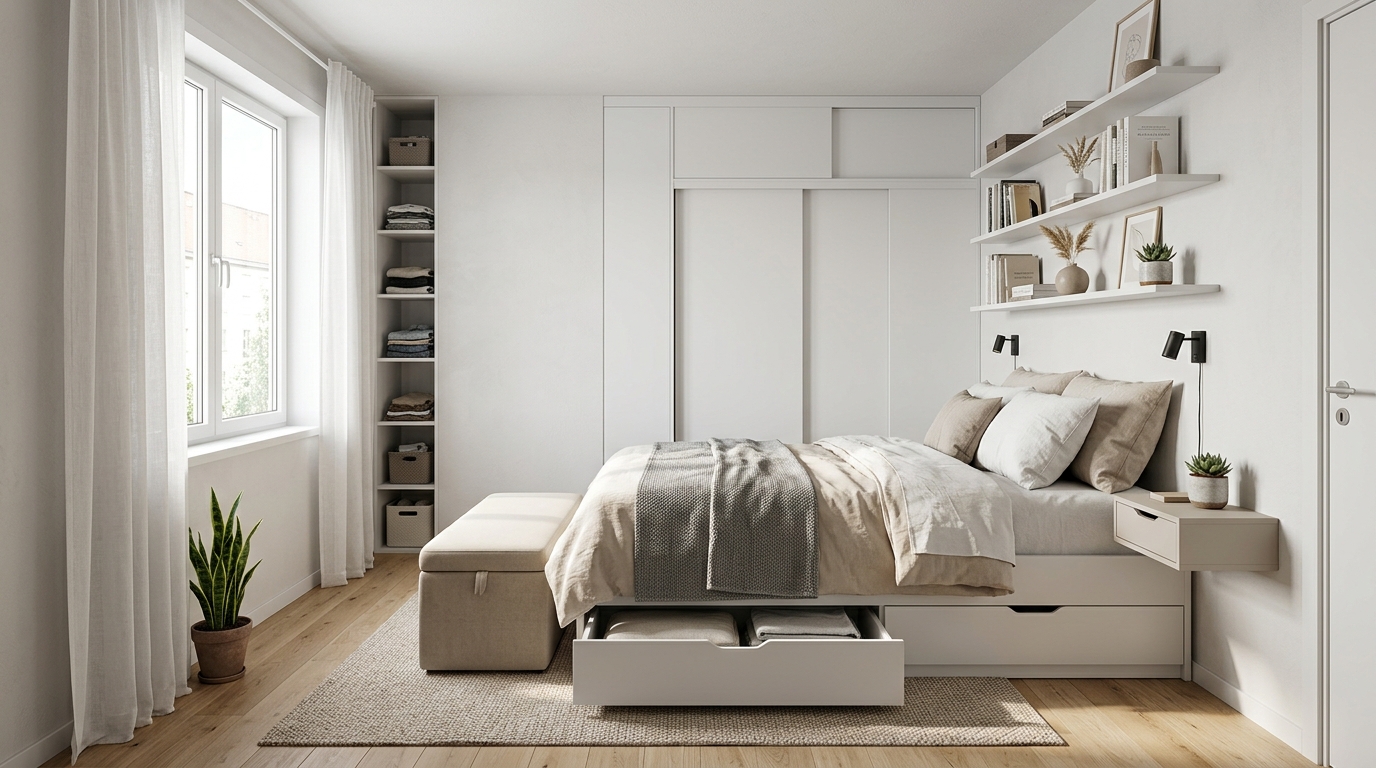
A small bedroom often has the same storage demands as a larger one, clothing, linens, books, accessories, but far less room to handle them. The result is usually one of two extremes, an overflowing dresser and closet, or a constant cycle of decluttering that never quite catches up.
This article focuses on storage solutions designed specifically for small bedrooms, covering the spots and approaches that work when floor space is tight. Below are twenty three ideas for fitting more storage into a small bedroom without making the room feel even more crowded.
1. Under Bed Storage with Rolling Drawers
The space beneath the bed is often the largest unused storage area in a small bedroom, and rolling drawers designed to fit there turn that empty void into substantial, accessible storage. These drawers slide out smoothly without requiring you to lift the bed or get on the floor, making the storage practical for regular use.
This works particularly well for items used seasonally or less frequently, like extra bedding, off season clothing, or shoes that are not in current rotation. Choosing drawers with handles or pulls that match the rest of the bedroom keeps the storage from looking utilitarian, while the rolling mechanism ensures the storage stays usable rather than becoming a hard to reach pile of forgotten things.
2. Headboard with Built In Shelves
A headboard that includes shelves built directly into its structure provides storage exactly where it is needed, beside the bed, without requiring a separate nightstand. The shelves can hold books, a lamp, a phone, or small decor, replacing the function of a nightstand entirely.
This works particularly well in bedrooms where there is not enough room on either side of the bed for traditional nightstands, since the storage moves vertically into the headboard area instead. Built-in headboard shelves also tend to feel more integrated and less cluttered than freestanding nightstands stacked with items, since the structure itself defines where things go and how the space is organized.
3. Wall Mounted Shelves Above the Bed
Floating shelves mounted on the wall above the bed make use of vertical space that almost always sits empty. These shelves can hold books, framed photos, a small plant, or storage baskets, adding both function and visual interest to the wall behind the bed.
This works particularly well when the shelves are sized and spaced to match the width of the bed, creating a sense of frame around the headboard area. Hanging shelves high enough that they do not interfere with sitting up in bed, and choosing brackets sturdy enough to support whatever you plan to store, ensures the shelves remain both safe and useful over time.
4. Tall Narrow Bookcase in an Unused Corner
A tall, narrow bookcase in a corner of the bedroom uses vertical space efficiently while taking up minimal floor footprint. The height provides multiple shelves of storage, while the narrow width fits into corners that might otherwise stay empty.
This works particularly well for books, decor, and items that benefit from being on display rather than hidden in drawers. Choosing a bookcase with closed lower shelves or baskets for items you want hidden, combined with open upper shelves for things you want to see, balances visual openness with practical storage, making the piece function on multiple levels at once.
5. Over the Door Hooks for Hanging Items
Hooks mounted on the back of the bedroom door turn an otherwise unused surface into a spot for hanging robes, bags, scarves, or jewelry. This vertical storage costs nothing in floor space and uses an area that almost always goes unused.
Over the door organizers with pockets take this idea further, providing compartments for smaller items like accessories, socks, or skincare products. Either option works well in small bedrooms because the back of a door is essentially free real estate, available in nearly every room and requiring no permanent installation if removable hooks are used.
6. Bed Frame with Built In Storage
A bed frame designed with built-in storage, drawers along the sides or a lift up base revealing storage beneath, builds significant storage into a piece of furniture that the bedroom already needs. The storage capacity often rivals a full dresser, hidden within the bed’s footprint.
This works particularly well for clothing, bedding, or any items that benefit from being stored flat. A lift up base in particular provides a single large storage compartment ideal for bulkier items, while side drawer beds offer easier access for things used more regularly. Either option turns the bed itself into a major storage piece without taking up any additional space.
7. Wall Mounted Floating Nightstand
A floating nightstand mounted directly to the wall, with no legs or base touching the floor, provides the function of a nightstand while freeing up the floor space underneath. This makes the room feel less crowded and also makes cleaning easier.
This works particularly well in bedrooms where every visible square foot of floor matters, since the floating design lets the floor flow continuously beneath the nightstand. Adding a small shelf below the main surface, or storage drawers within the floating piece, makes the nightstand functional rather than purely decorative, providing storage without sacrificing the visual openness.
8. Vertical Closet Organizers
A closet organizer that adds shelves, hanging rods at different heights, and dividers turns a small closet into a much more efficient storage space. The vertical divisions help fit more clothing into less width, while shelves above and below provide spots for items that do not need to hang.
This works particularly well when the closet’s natural layout leaves a lot of unused vertical space, which is common in older homes or apartments with builder grade closets. Customizing the closet’s interior, even with simple modular systems from places like The Container Store, often doubles the practical storage capacity without changing the closet’s footprint at all.
9. Hanging Shoe Organizer Used for Accessories
A hanging shoe organizer, mounted on a closet rod or the back of a door, can hold far more than shoes. The clear or fabric pockets work well for accessories like belts, scarves, socks, or jewelry, keeping small items visible and organized in a compact vertical space.
This works particularly well when the organizer is dedicated to one category of items, rather than serving as a catch all, since the consistent contents make finding things quick and easy. The vertical orientation means a single organizer can replace several small drawer dividers or accessory holders, freeing up drawer space for clothing or other items.
10. Bench at the Foot of the Bed with Hidden Storage
A bench placed at the foot of the bed, with a lift up seat revealing storage inside, combines seating with significant hidden storage in a single piece. The storage compartment can hold extra blankets, off season clothing, or anything else that needs a home but does not need daily access.
This works particularly well in bedrooms where the foot of the bed often sits as unused floor space, turning that area into both a functional seating spot and substantial storage. Choosing a bench that matches the bed in style or wood tone helps it feel integrated, while the hidden storage keeps the room looking organized without revealing what is tucked away inside.
11. Pegboard Wall for Customizable Storage
A pegboard mounted on a bedroom wall provides flexible, reconfigurable storage that can adapt as needs change. Hooks, small shelves, and clips arranged across the pegboard hold everything from accessories to small decor, with the layout adjustable whenever items move or change.
This works particularly well in bedrooms with limited closet space, since the pegboard provides a visible spot for items that otherwise might pile up on a dresser or chair. Choosing a pegboard finish that suits the room’s overall style, painted to match the wall, stained wood, or even fabric covered, keeps it from looking too industrial while still providing all the practical flexibility.
12. Hooks and Rails Above the Headboard
A row of hooks or a slim rail mounted on the wall above the headboard provides a spot for hanging bags, jewelry, or small decor items. This uses wall space that often goes unused, just above the head of the bed where nothing else typically goes.
This works particularly well when the items hung from the hooks have visual appeal, like a few woven bags or a small string of fairy lights, since they become part of the room’s decor as well as functional storage. Spacing the hooks evenly and choosing a finish that complements other hardware in the room helps the installation look intentional rather than ad hoc.
13. Stackable Storage Bins Under the Bed
When custom rolling drawers are not feasible, stackable storage bins under the bed provide a flexible, lower cost alternative. Clear bins let you see what is inside without pulling them out, while labeled opaque bins keep the contents private but still organized.
This works particularly well for items you do not need to access frequently, since the bins do not slide out as easily as drawers on wheels. Choosing bins that fit your specific bed height ensures they slide in and out without scraping, and stacking matching bins keeps the under bed area looking organized rather than chaotic, even when it holds a significant amount of stored items.
14. Slim Rolling Cart for Mobile Storage
A narrow rolling cart with multiple tiers fits into tight spaces between furniture and provides movable storage that can shift as needed. The wheels make it easy to roll the cart out for full access, then push it back when not in use.
This works particularly well as bedside storage in rooms where a traditional nightstand will not fit, or as extra storage for items that move between rooms. The slim profile slides into spots that fixed furniture cannot reach, and the multiple levels provide more storage capacity per square foot than a flat surface alone would offer.
15. Hanging Closet Shelves for Folded Items
Fabric shelves that hang from a closet rod provide vertical storage for folded items like sweaters, jeans, or t-shirts, items that traditionally take up flat dresser drawer space. Hanging shelves turn vertical closet space into folded storage without requiring built in shelving.
This works particularly well when dresser space is limited or nonexistent, since the closet absorbs storage functions that would otherwise need dedicated furniture in the room. Each shelf compartment holds enough for a category of clothing, and the soft fabric construction means the shelves collapse flat when not in use, taking up almost no space if removed.
16. Wall Mounted Jewelry Display
A wall mounted jewelry organizer, with hooks for necklaces and bracelets and small holders for earrings and rings, keeps jewelry visible, organized, and off other surfaces. This works far better than a jewelry box in a small bedroom, since you can actually see and reach everything quickly.
This works particularly well when the display itself is attractive enough to function as wall decor, since the jewelry adds color and texture to an otherwise blank wall. Mounting it near a vanity or mirror puts it within easy reach during your morning routine, while keeping a category of small items contained that would otherwise scatter across the dresser or bathroom counter.
17. Multi Function Storage Ottoman
A storage ottoman that doubles as a seat, footrest, or even a side table provides storage and additional function in a single piece. The lift up top reveals hidden storage inside, while the upholstered surface serves as seating or a soft surface for other uses.
This works particularly well in small bedrooms where every piece of furniture needs to earn its place by serving multiple purposes. Choosing an ottoman in a fabric and color that ties into the room’s overall scheme integrates it as both decor and function, while the hidden storage keeps the small room looking less cluttered by absorbing items that would otherwise sit out in the open.
18. Curtain Covered Storage Area
In rooms without a traditional closet, hanging a curtain across a corner or along one wall creates a hidden storage area behind it. The curtain conceals shelves, hanging clothes, or storage bins, providing the function of a closet without permanent construction.
This works particularly well as a temporary solution in rental bedrooms or as an addition to a bedroom that needs more closed storage than the existing closet provides. Choosing a curtain fabric that complements the room’s other textiles, like the bedding or window curtains, helps the storage area feel like an intentional design feature rather than a temporary fix or unfinished wall.
19. High Shelves Near the Ceiling
A shelf or two installed near the ceiling, running along one or more walls, provides storage that takes advantage of the highest, most underused space in any room. The shelves hold items rarely needed but still worth keeping, like off season decor or rarely used keepsakes.
This works particularly well in bedrooms with higher ceilings, where the high shelves do not interfere with daily activity below. Styling the shelves with baskets that hide the contents, in materials like seagrass or jute, keeps the storage looking intentional rather than cluttered, while the height makes the shelves visible as decor as well as storage.
20. Slim Drawer Dressers Instead of Wide Ones
A tall, narrow dresser with multiple slim drawers provides similar overall storage capacity to a wider, shorter dresser, while taking up less floor space. The vertical orientation works well in tight rooms where horizontal floor space is at a premium.
This works particularly well in bedrooms with enough ceiling height to make a tall dresser feel proportional rather than tippy or out of scale. Anchoring a tall dresser to the wall is also a good idea for safety, especially in households with children or pets, but the vertical storage strategy itself is one of the more efficient uses of limited floor space available.
21. Storage Behind a Folding Screen
A folding screen positioned across a corner of the bedroom hides storage behind it, whether that is a stack of bins, a small shelving unit, or even a clothing rack. The screen provides instant concealment without requiring built in walls or doors.
This works particularly well in bedrooms that double as workspaces or have visible storage that needs to disappear during sleep. Choosing a folding screen with some visual interest, woven panels, fluted wood, or a fabric pattern, ensures the screen itself contributes to the room’s decor rather than just being a functional divider, balancing utility with style.
22. Magnetic Strips for Small Metal Items
A magnetic strip mounted to a wall, the inside of a closet door, or the side of a dresser holds small metal items like hair clips, tweezers, or scissors, keeping them visible and organized without occupying drawer space. The vertical storage is compact and easy to access.
This works particularly well for items that tend to get lost in drawers, where small metal pieces sink to the bottom and become hard to find. The magnetic strip keeps everything immediately visible and within reach, while the small footprint means it can fit in spots too narrow for any other type of storage solution, making efficient use of every available inch.
23. Drawer Dividers to Maximize Existing Drawers
Drawer dividers turn a single chaotic drawer into multiple organized sections, effectively doubling or tripling the practical capacity of existing dresser drawers. The dividers separate categories, like socks in one section, underwear in another, and accessories in a third, making everything easier to find.
This works particularly well when the dresser space available is fixed and cannot easily be expanded, since the dividers improve how that fixed space is used rather than requiring new furniture. Adjustable dividers that can be reconfigured as needs change are especially useful, since the optimal division of a drawer’s space often shifts over time as what gets stored there changes.
Conclusion
A small bedroom does not have to feel cramped, and the right storage choices can make a tight space feel surprisingly organized and spacious. The general principle is to use vertical space, hidden compartments, and multi-function furniture rather than adding more standalone storage pieces that compete for floor space.
Starting with the biggest unused areas, under the bed, the wall above the headboard, the back of the door, the corners, and addressing each one with a targeted solution tends to make a bigger difference than buying a new dresser ever would. The goal is a bedroom storage setup that keeps everything in its place without making the small room feel even smaller, just calmer and more functional.