
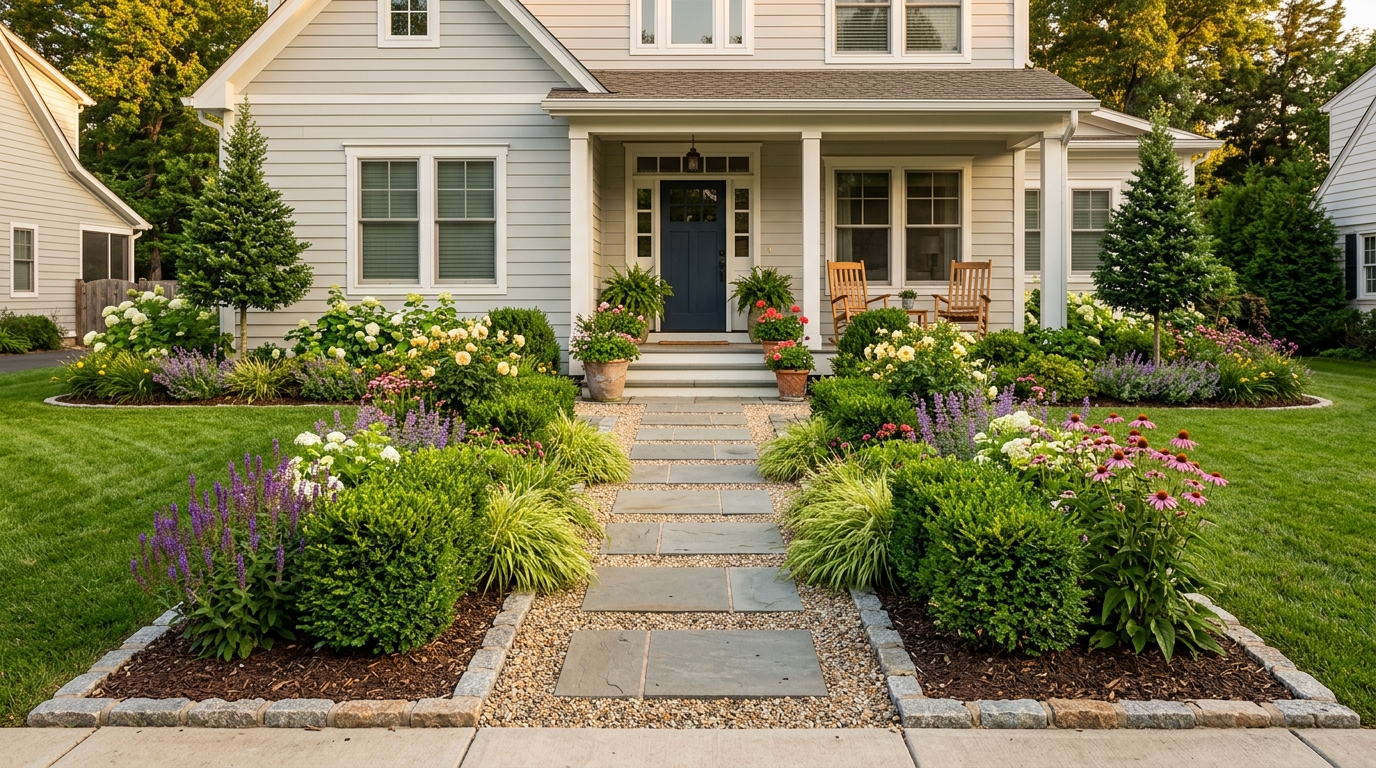
The front of your house is the first thing anyone sees and a well thought out garden makes the difference between a home that gets noticed and one that gets passed by. You do not need a landscape designer or a big budget to make it happen. These 22 garden ideas for the front of your house will give you practical, good looking options that work in real yards with real time constraints.
Most of these ideas cost very little to pull off and some of them can be done in a single afternoon. Whether you have a wide open front yard or a narrow strip between the sidewalk and your door, there is something here that will work for your space. Below are 22 ideas that will transform the front of your house into something worth slowing down for.
1. Plant a Defined Garden Bed Along the Foundation
A garden bed running along the front of your house ties the structure to the ground and makes the whole exterior look more intentional. Edge it cleanly with a metal or plastic lawn edger and fill it with a layered planting: tall shrubs at the back, medium perennials in the middle, and low growing ground cover or annuals at the front. The layering creates depth and makes a narrow bed look significantly fuller than it actually is.
Mulch the bed with a two to three inch layer of dark brown or black mulch after planting to suppress weeds, retain moisture, and give the whole bed a finished, polished look. Home Depot and Lowe’s both carry bags of mulch at very low prices and the visual difference between a bare soil bed and a freshly mulched one is dramatic.
2. Line the Walkway with Low Flowering Plants
A walkway lined with low growing flowering plants on both sides creates a welcoming path that draws people naturally toward your front door. Lavender, salvia, catmint, and dwarf knock out roses are all excellent choices because they are low maintenance, repeat blooming, and stay compact without constant pruning. Plant them close enough that they will eventually touch and soften the edges of the path as they fill in.
The symmetry of matching plants on both sides of a walkway is a classic garden design move that works on every style of home. If you prefer something less formal, alternate the plant varieties on each side while keeping the color palette consistent and the effect is equally strong without the rigidity.
3. Add a Defined Lawn Edge
This is not a planting idea but it might be the single most impactful thing you can do for the front of your house. A clean, crisp edge between your lawn and your garden beds makes the entire front yard look like it receives professional care regardless of what else is or is not growing in it. Use a manual half moon edger or a powered lawn edger to cut a sharp vertical line along every bed border.
Redefine this edge every few weeks through the growing season to keep it looking intentional. The difference between a blurred, overgrown edge and a sharp clean one is enormous and it costs nothing but a little time and a tool most people already own.
4. Plant a Flowering Tree as a Focal Point
A single well chosen flowering tree in the front yard gives the whole landscape a focal point and a sense of scale that shrubs and perennials alone cannot provide. A crepe myrtle, dogwood, serviceberry, or dwarf magnolia brings seasonal color, year round structure, and genuine visual drama to a front yard without taking over the space.
Plant it slightly off center in the yard rather than directly in front of the house for a more natural, considered composition. Give it enough space to reach its mature size without crowding the house or the walkway. One beautiful tree does more for the front of a house than a dozen mismatched shrubs planted without a plan.
5. Create a Cottage Garden Border
A cottage garden border in the front yard is one of the most charming and forgiving styles you can choose because the slightly wild, abundant quality is part of the look rather than a sign of neglect. Mix perennials like coneflower, black eyed Susan, salvia, and yarrow with annual fillers like cosmos and zinnias for a border that blooms from early summer through fall.
Plant in informal drifts rather than rigid rows and let plants lean into each other as they grow. Deadhead spent blooms regularly to keep new flowers coming and divide clumps every few years to keep the border full and healthy. A cottage garden border improves with age and practically takes care of itself once established.
6. Use Ornamental Grasses for Year Round Interest
Ornamental grasses are one of the most underused plants in front yard gardens. They provide movement, texture, and structure throughout every season, looking their best in late summer and fall when most flowering plants are fading. Karl Foerster feather reed grass, blue oat grass, and dwarf fountain grass are all excellent front yard choices that stay tidy and require almost no maintenance.
Plant them in groups of three for the most natural look or use a single large specimen as an anchor in a mixed border. In winter the dried seed heads catch light and frost in a way that keeps the garden looking alive even when nothing else is. Cut them back hard in early spring and they come back fuller every year.
7. Add a Stone or Brick Garden Path
A secondary path leading from the driveway or sidewalk into a garden bed, around a tree, or toward a garden feature adds depth and dimension to a front yard that a single straight walkway cannot. Use natural stepping stones, tumbled brick, or irregular flagstone set directly into the ground with low growing thyme or creeping phlox planted in the gaps between them.
The path does not need to lead anywhere specific to be effective. A curved stone path that winds through a garden bed and ends at a birdbath or a bench creates a sense of discovery and makes the front yard feel larger and more layered than a flat lawn with a single central walkway ever could.
8. Plant Bulbs for Spring Color
Spring bulbs planted in fall are one of the easiest and most rewarding investments you can make in a front yard garden. Tulips, daffodils, alliums, and hyacinths emerge before most other plants are awake and fill the front of your house with color during the weeks when it is needed most. Plant them in large informal groups rather than single rows for the most natural effect.
Daffodils and alliums are deer resistant which makes them particularly practical for front yards. Layer different varieties that bloom at slightly different times for a succession of color that carries from early spring through late May. The initial investment of a bag of bulbs costs around ten to fifteen dollars and a well planted bulb garden gets better looking every year as the clumps naturalize and multiply.
9. Install a Low Garden Wall or Border Edge
A low stone wall, a row of oversized river rocks, or a simple steel garden edging strip defines your garden beds and gives the whole front yard a sense of structure and intentionality. It draws a clear line between the cultivated garden and the lawn and makes both look better as a result. A low wall also gives you a slightly raised planting area which improves drainage and makes the bed more visible from the street.
Stacked fieldstone walls, dry laid limestone borders, and modern corten steel edging are all strong options depending on the style of your house. Even a simple row of large smooth river rocks from a landscaping supply yard costs very little and immediately elevates the look of any garden bed.
10. Grow Climbing Roses or Vines on a Trellis
A trellis mounted to the front of your house with a climbing rose or flowering vine trained up it adds vertical interest and a softness to the exterior that no other planting achieves. A climbing rose in white, blush, or deep red blooming against painted siding or brick is one of the most classically beautiful things a front garden can offer. Clematis, honeysuckle, and climbing hydrangea are equally strong alternatives depending on your light conditions.
Mount the trellis several inches away from the house to allow air circulation behind the plant and give the stems room to weave through. Train new growth regularly and tie it loosely to the trellis as it extends. Within two to three seasons a well chosen climber will make your house look like it has had a beautiful garden for decades.
11. Create a Rain Garden in a Low Spot
If your front yard has a low area that collects water after rain, turning it into a rain garden is both practical and beautiful. Plant it with moisture tolerant natives like swamp milkweed, blue flag iris, Joe Pye weed, and cardinal flower that can handle both wet and dry periods. The depression channels runoff away from your foundation while the plants filter it naturally before it reaches storm drains.
A rain garden requires some initial soil preparation but once established it is essentially self maintaining and provides habitat for pollinators throughout the growing season. It also solves a drainage problem that would otherwise require expensive grading or drainage work and turns a liability in your front yard into one of its most interesting features.
12. Plant a Pollinator Garden
A pollinator garden in the front yard is one of the most visually dynamic and ecologically meaningful things you can do with the space. Native flowering plants like coneflower, bee balm, anise hyssop, and goldenrod attract bees, butterflies, and hummingbirds throughout the growing season. The movement and life they bring to a front yard makes it feel genuinely alive in a way a purely decorative garden does not.
Plant in a defined bed with a clean mulched edge to keep the informality of the planting from reading as neglect to neighbors or passersby. A small sign identifying it as a pollinator garden is optional but adds context that most people respond to positively. Local native plant nurseries and the Proven Winners brand both carry pollinator focused plant selections that take the guesswork out of plant choice.
13. Use Evergreen Shrubs for Year Round Structure
A front yard garden that looks spectacular in June but dead in January is only doing half its job. Evergreen shrubs give the garden structure and presence throughout every month of the year. Boxwood, holly, dwarf mugo pine, and inkberry are all excellent choices that stay green, require minimal care, and give your foundation planting a backbone that holds the whole design together when perennials and annuals die back.
Use evergreens as anchors at the corners of beds or to frame the front door and fill in between them with seasonal color. The combination of permanent evergreen structure with changing seasonal plantings is the formula behind every front yard garden that looks good year round rather than just during peak bloom season.
14. Add a Birdbath or Garden Sculpture
A birdbath, a simple stone sculpture, or an interesting urn placed in a garden bed or at the end of a path gives the eye somewhere specific to land and adds a sense of intention to the whole front yard. It does not need to be expensive or elaborate. A simple concrete birdbath from a garden center costs around thirty to fifty dollars and immediately becomes a focal point that anchors the surrounding planting.
Keep the scale appropriate to the bed and the yard. A small ornament gets lost in a large space while an oversized piece overwhelms a modest front yard. When in doubt go slightly larger than you think you need since garden ornaments almost always look smaller in the actual space than they did in the store or online.
15. Plant a Hedge for Privacy and Structure
A low to medium hedge along the front property line or driveway edge adds structure, privacy, and a sense of enclosure that makes the whole front yard feel more intentional and designed. A neatly clipped boxwood or privet hedge reads as formal and classic. An informal hedge of knockout roses, spirea, or viburnum reads as relaxed and cottage like. Either approach defines the boundary of your property in a way that a fence cannot quite replicate.
Keep the height of a front yard hedge proportionate to the space. A hedge that is too tall blocks light and creates an unwelcoming, closed off feel. Knee to waist height is usually right for most front yards and gives you the structure and definition without sacrificing the open, welcoming quality that a front garden should have.
16. Use Containers to Flank the Front Door
A pair of large containers on either side of the front door frames the entry and gives you a flexible, changeable planting spot that works in any season. Plant them with a mix of thrillers, fillers, and spillers in summer, swap to ornamental kale, mums, and pumpkins in fall, and fill them with evergreen cuttings and berries in winter. One pair of good quality containers used well throughout the year does more for the front of your house than a dozen smaller pots scattered around the yard.
Choose containers in a material and finish that complement your house exterior. Terracotta, cast stone, and dark glazed ceramic all work well and age beautifully outdoors. Size up more than you think you need since a container that looks large in a store will look modest beside a front door with full scale architecture around it.
17. Plant Groundcover Under Trees
The area under a front yard tree is one of the most commonly neglected spaces in a home landscape. Grass rarely grows well there due to root competition and shade, leaving an awkward bare patch that collects leaves and looks unfinished. Planting it with a shade tolerant groundcover like pachysandra, sweet woodruff, ajuga, or liriope solves the problem permanently and turns an eyesore into one of the more polished details in your front yard.
Edge the groundcover bed in a circle or gentle curve around the base of the tree and mulch between the new plants until they fill in. Within two to three seasons a well chosen groundcover will knit together into a dense, low maintenance carpet that requires almost no attention and looks intentional and considered year round.
18. Build a Simple Raised Front Bed
Raising a front garden bed by eight to twelve inches with a simple timber, stone, or corten steel border gives the planting more presence from the street, improves drainage dramatically, and makes the garden easier to tend without bending. It also adds a layer of visual interest and dimension that a flat in ground bed at the same grade as the lawn cannot provide.
Railroad tie alternatives from a landscaping supplier, natural fieldstone, or modern corten steel edging all make strong raised bed borders for a front yard. Fill with a quality garden mix of topsoil and compost and you will find that plants establish faster, grow more vigorously, and require less supplemental watering than they would in compacted native soil.
19. Add Solar Lights Along the Garden Path
Solar path lights tucked into the edges of a front yard garden bed or spaced along a walkway serve the garden at night the way the plantings serve it during the day. They make the house look welcoming after dark, define the path safely for visitors, and highlight the shapes of your plantings in a way that is genuinely beautiful on a warm evening.
Choose lights with a warm white color temperature rather than the cool blue white that many cheap solar lights produce. Stake style path lights from Amazon or Home Depot cost around twenty to thirty dollars for a set of eight and require no wiring. Position them low enough that they illuminate the ground and the base of plants rather than shining directly into a visitor’s eyes as they walk up.
20. Grow Herbs in the Front Yard
Herb gardens have traditionally been kept in the backyard but there is no rule that says they cannot live in the front. A small formal herb garden in a defined geometric bed near the front door looks beautiful, smells incredible, and is far more practical than a herb garden you have to walk around the house to reach. Rosemary, lavender, sage, and thyme are all ornamental enough to earn a front yard placement.
Edge the bed cleanly and plant in organized groupings rather than mixing everything randomly. A small herb garden with a simple stone or brick border and a few labels on simple wooden stakes looks intentional and charming rather than vegetable gardenish. Lavender in particular is so beautiful in bloom that many people do not even realize it is a culinary herb.
21. Plant for a Long Season of Bloom
A front yard garden that peaks in June and then fades through July and August is a missed opportunity. With a little planning you can have something in bloom from early spring through hard frost by layering plants with different peak seasons. Bulbs carry early spring, perennials take over through summer, late blooming coneflowers and rudbeckia bridge August and September, and asters and ornamental grasses carry through October.
Write down what you have blooming each month and identify the gaps. Then fill those gaps with one or two plants that specifically peak during that window. Within a couple of seasons you will have a front yard garden that always has something interesting happening regardless of when a visitor arrives.
22. Edit and Maintain What You Have
The most beautifully planted front yard garden looks neglected within a season if it is not maintained. Weeding, deadheading, trimming back overgrown plants, replacing anything that has died, and refreshing the mulch each spring are the habits that separate a garden that impresses people from one that just has plants in it.
Set aside thirty minutes once a week during the growing season to walk through the front garden and address anything that needs attention. That small consistent investment keeps the garden looking its best without ever requiring a major rescue operation. A well maintained modest garden will always outperform a neglected elaborate one and the front of your house deserves that level of care.
Conclusion
A front yard garden does not need to be complicated or expensive to be genuinely impressive. The ideas above cover everything from simple edging and mulching to flowering trees and climbing roses, and all of them come back to the same principle: intentional planting, consistent care, and enough restraint to let each element breathe.
Pick two or three of these garden ideas for the front of your house and start there this season. The front of your home is what the whole neighborhood sees every day and a little attention to that space pays returns far beyond what you put into it.