
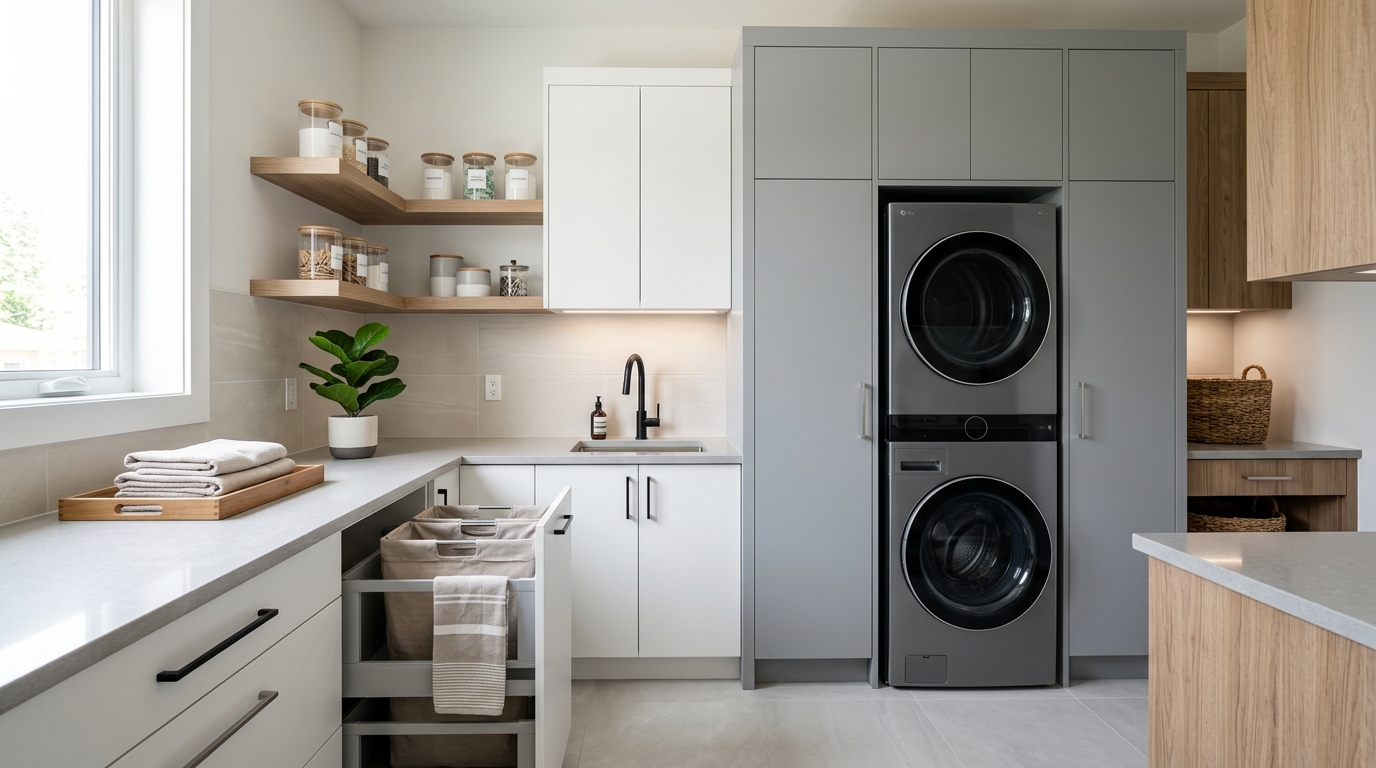
A modern laundry room is not just a utility space with clean lines. It is a room that has been designed with the same intention and the same material quality as the rest of the house, where the appliances are integrated rather than simply placed, the storage is precise rather than accumulated, and the overall experience of doing laundry feels less like a chore and more like using a well designed tool. These 22 modern laundry room decor ideas will show you how to bring that level of considered design to your laundry space regardless of its size or its current condition.
The ideas here lean into the defining qualities of modern design: clean surfaces, intentional materials, concealed storage, and a visual calm that comes from precision rather than from emptiness. Below are 22 ideas that make a laundry room genuinely modern.
1. Choose a Monochromatic Color Scheme
A monochromatic color scheme in a modern laundry room, where the walls, the cabinetry, the appliances, and the accessories all exist within the same color family, creates the visual unity that modern design depends on for its calm, resolved quality. An all white laundry room with white cabinets, white appliances, and white walls reads as clean and precise. An all gray room in varying tones of the same gray reads as sophisticated and considered. An all black laundry room with dark cabinets, matte black hardware, and charcoal walls reads as dramatically modern in a way that no multicolor scheme can replicate.
The monochromatic approach eliminates every decision about color coordination between individual elements and replaces it with a single disciplined choice applied consistently throughout the room. Variation within the scheme comes from material texture and surface quality rather than from color contrast, matte walls against gloss cabinet fronts, smooth appliance surfaces against textured tile, and that textural variation is more refined and more genuinely modern than color variation in a laundry room context.
2. Install Flat Front Cabinetry Floor to Ceiling
Flat front cabinetry in a modern laundry room should extend from the floor to the ceiling without visible toe kicks, without gap above the upper cabinets, and without any decorative molding at the transitions. The continuous vertical surface of flat front cabinetry from floor to ceiling reads as architectural rather than furniture and eliminates the horizontal shadow lines that standard cabinet installation creates at the base and at the top of the cabinet run. That elimination of horizontal breaks is the foundational cabinet decision of a modern laundry room design.
Paint the cabinetry in a matte finish in the same color as the walls for an even more resolved monolithic quality where the cabinet faces disappear into the wall surface rather than reading as distinct objects placed against it. Handle free push to open mechanisms on every door and drawer keep the flat cabinet surface completely uninterrupted. The flat front floor to ceiling cabinet wall in a modern laundry room is the design element that most decisively signals that the room was designed rather than simply equipped.
3. Use Large Format Porcelain Tile on the Floor
Large format porcelain tile in a 24×24 inch or larger format with minimal grout lines creates a laundry room floor that reads as a continuous surface rather than a tiled one. The reduction in visible grout lines as tile format increases is the primary visual quality that large format tiles deliver in a modern context and in a laundry room where cleanliness is the central concern the near seamless quality of a large format tile floor is both visually appropriate and practically superior to smaller tile formats with more grout lines that collect detergent residue and lint.
Choose a tile in a concrete look, a large format plain color, or a subtle stone look in a matte finish rather than a textured or patterned surface. Rectified large format tiles with precision cut edges allow the tightest possible grout joints and suit modern laundry room floor installations better than non rectified tiles. Extend the same tile from the laundry room floor into the adjacent hallway or bathroom without a transition strip if the layout allows for a seamless floor plane that makes both spaces feel larger and more connected.
4. Conceal the Appliances Behind Cabinet Panels
Front loading washer and dryer units installed behind cabinet panel doors that match the surrounding cabinetry exactly create a laundry room where the appliances are present and fully functional but completely invisible when the cabinet doors are closed. The room reads as a wall of cabinetry rather than as a utility room and the reveal of the appliances when the doors are opened produces the same satisfying design moment as an integrated refrigerator in a modern kitchen. This concealment approach is the most definitively modern laundry room treatment available because it refuses to accept the appliances as fixed visual elements of the room.
The panel doors on a concealed washer and dryer configuration require hinges with enough clearance to allow the appliance door to open fully when the cabinet panel door is swung out of the way. Frameless cabinet construction and full overlay panel doors provide the most precise and most seamlessly concealed appearance when closed. The concealed appliance laundry room suits apartment buildings, open plan homes, and any space where the laundry room is visible from a living area and where the visual presence of laundry appliances in that sightline is undesirable.
5. Add a Quartz or Stone Folding Counter
A folding counter in quartz or stone above the washer and dryer or along one wall of the modern laundry room brings the same material quality to the laundry work surface as a kitchen countertop installation in the same material. The smooth, non porous surface of quartz handles the detergent, the water, and the physical demands of laundry use without any special maintenance and the visual quality of a stone or quartz surface in a laundry room signals that the room was designed with the same material seriousness as the rest of the home rather than fitted out with whatever was practical and affordable.
Choose the same quartz or stone used in the adjacent kitchen or bathroom for material continuity throughout the home if the layout of the house allows those surfaces to share a sightline. A consistent countertop material throughout multiple rooms of a home creates a sense of designed coherence that individual room selections, however good each one is individually, cannot replicate. The laundry room quartz counter should be installed at the same height as the kitchen counter, 36 inches, for ergonomic consistency in a space where work is done standing.
6. Use Integrated LED Strip Lighting Inside Cabinets
LED strip lighting integrated into the interior of laundry room cabinets, activated automatically when the cabinet door is opened, illuminates the cabinet contents completely and eliminates the shadow problem that deep cabinet interiors create when lit only by the room’s overhead lighting. Every shelf in every cabinet becomes fully visible the moment the door opens and the contents are legible and accessible without leaning in or pulling items forward to see what is stored behind them.
Govee and Hafele both produce cabinet interior LED systems with door activated switches that install without rewiring using standard power connections. The warm white light inside the cabinet interior creates a quality of organized presentation that suits the modern laundry room aesthetic and that makes the cabinet contents, whatever they are, look considered and organized by the quality of the light they are displayed in. Cabinet interior lighting is one of those details that seems like a luxury until it is experienced daily, at which point the absence of it in any cabinet feels like an oversight.
7. Mount a Stainless Steel or Matte Black Sink
A stainless steel undermount sink in a single basin zero radius format or a matte black composite sink in a similar configuration brings a material precision to the modern laundry room sink area that the farmhouse utility sink specifically rejects. The zero radius corners, the seamless undermount installation, and the consistent metallic or composite surface of a modern sink read as precise and industrial in a way that suits the modern laundry room material vocabulary directly. Pair it with a simple gooseneck faucet in a matching or complementary finish, matte black with a matte black sink, brushed steel with a stainless sink, for a sink area with complete material coherence.
The modern laundry sink should be mounted in the countertop with the same undermount precision used in a modern kitchen installation, with the countertop material overhanging the basin edge completely and no visible mounting rim at the counter surface. The transition from counter to sink basin should read as a counter surface with a void in it rather than as a sink sitting in a counter and that reading depends entirely on the quality of the undermount installation rather than on the quality of the sink itself.
8. Choose Appliances in a Matching Matte Finish
Modern laundry appliances in a consistent matte finish, whether matte white, matte black, or a matte color like the graphite steel or slate gray options available from LG and Samsung, read as designed objects rather than utility appliances when they share the same surface quality and the same color across both the washer and dryer. The matte finish specifically suits a modern laundry room because it eliminates the reflective quality of standard white or stainless appliances that creates visual noise in an otherwise calm, precise room.
LG Studio and Samsung Bespoke both produce washer and dryer pairs in matte color options designed for design conscious home installations. The Bespoke series from Samsung in particular allows panel color customization that can match the appliance finish to the surrounding cabinetry color for an integrated appearance even without the full concealed panel treatment. A matched matte finish appliance pair in a modern laundry room occupies the same visual register as the surrounding cabinetry rather than reading as a separate category of object inserted into the designed room.
9. Install a Full Length Mirror on One Wall
A full length mirror on one wall of a modern laundry room serves a practical function for checking garments before and after washing while also reflecting light and space into what is often a windowless or low light utility room. The mirror surface doubles the apparent depth of the room and reflects the organized cabinetry and the clean surfaces of the modern laundry design back into the space, amplifying the visual quality of the design rather than simply expanding the perceived square footage. A frameless mirror or one in a minimal metal frame in the hardware finish used elsewhere in the room suits the modern aesthetic best.
Mount the mirror on the wall opposite the main light source to maximize the light reflection benefit. In a narrow laundry room a full length mirror on the short end wall creates a sense of depth that makes the room feel significantly less confined without any structural change to the space. The mirror should be as large as the wall section it occupies can accommodate since a mirror that covers most of a wall has a fundamentally different spatial effect than one sized as a decorative object placed on the same wall.
10. Use a Single Accent Color in Accessories Only
A modern laundry room built on a neutral monochromatic base, white cabinetry, gray tile floor, stainless appliances, benefits from a single deliberate accent color introduced through accessories and textiles that gives the room a point of visual interest without compromising the overall calm of the monochromatic scheme. A pair of deep teal storage bins on the open shelf section, a set of terracotta colored laundry bags hanging on a wall hook, or a single navy blue hand towel beside the sink all introduce color into the room at the accessory level where it can be changed easily as preferences evolve without requiring any structural or cabinetry modification.
The accent color should appear in no more than two or three locations in the room and in a consistent tone throughout those locations. A single accent color used consistently in a small number of locations reads as a deliberate design choice. The same color appearing in too many locations or mixed with a second accent color reads as decoration applied without a clear point of view. The discipline of the single accent is what keeps the modern laundry room feeling resolved rather than decorated.
11. Add a Recessed Niche for Detergent Storage
A recessed niche built into the laundry room wall above the washer provides dedicated detergent and supply storage directly at the point of use without adding any depth to the wall surface or any cabinet footprint to the room. The niche is flush with the surrounding wall surface and holds bottles, dispensers, and small accessories within a defined opening that reads as a designed feature of the wall rather than an afterthought storage solution. Tile the interior of the niche in the same tile as the floor or in a contrasting tile that makes the niche read as a deliberate design element.
Size the niche to accommodate the specific containers used for detergent and laundry supplies rather than to a standard dimension that may not suit the actual items stored within it. A niche that fits its contents precisely looks considered and resolved while one with excess space above or beside its contents looks undersized for the application. The recessed niche in a modern laundry room is the equivalent of the shower niche in a modern bathroom and it communicates the same level of design attention applied to the working surfaces of a utility space.
12. Install Sensor Activated Lighting
Sensor activated lighting in a modern laundry room that turns on automatically when someone enters and turns off after a set period of inactivity eliminates the light switch from the room entirely and removes the small but consistent friction of reaching for a switch when hands are full of laundry. The absence of a light switch on the laundry room wall is a subtle detail that registers as a quality of considered design in the same way that other invisible technology details do in a modern home. The room simply responds to presence rather than requiring manual operation.
Motion sensor light switches that replace standard switches and integrate with existing ceiling fixtures are available from Lutron and Leviton at prices starting around thirty dollars per unit. They install in the same electrical box as a standard switch and require no additional wiring. In a laundry room where hands are frequently occupied with laundry baskets, garment piles, and detergent bottles the sensor activation is a genuine functional improvement rather than merely a technology novelty.
13. Use Floating Vanity Style Cabinets
Vanity style wall mounted cabinets that float above the floor rather than sitting on the floor create a laundry room with the same open, light floor plane that a floating bathroom vanity delivers in a bathroom. The visible floor beneath the floating cabinets makes the room feel larger than the same cabinets sitting on the floor and the gap between the cabinet base and the floor provides a practical location for a LED light strip that illuminates the floor beneath the cabinets with a soft ambient glow after dark. The floating cabinet configuration suits front load appliances that also sit on the floor beneath the counter rather than top load machines that require counter access from above.
Wall mounted floating cabinets require adequate wall structure to support the combined weight of the cabinet and its contents and the installation requires locating wall studs or adding blocking between studs during the remodel phase. The structural requirement is the primary practical consideration in a floating cabinet laundry room installation and it is most cost effectively addressed during a broader renovation when wall access is available rather than as a standalone cabinet replacement project.
14. Add a Built In Hamper System
A built in hamper system with pull out fabric lined bins inside a base cabinet section creates concealed laundry sorting storage that disappears completely when the cabinet door is closed. The pull out bin configuration allows sorting by load type within a single cabinet footprint and the fabric lined bins prevent the laundry from sitting against a hard surface that would require cleaning. When the door is closed the hamper cabinet reads as an undifferentiated section of the laundry room cabinetry with no visible sign of the sorting function it contains.
Rev-A-Shelf and Richelieu both produce laundry hamper pull out systems in single and double bin configurations that fit standard base cabinet openings. The bin fabric is removable for washing when it accumulates detergent residue or staining. A built in hamper system in a modern laundry room eliminates the freestanding hamper that most laundry rooms contain and recovers the floor space the hamper occupied while providing a more organized and more hygienic sorting system than an open top hamper basket provides.
15. Install a Tension Rod System for Hanging
A tension rod system spanning the full width of the laundry room at a consistent height, rather than a single rod above the appliances, creates a complete hanging zone that can accommodate a full load of air dry items simultaneously without the visual disorder of garments hanging at different heights and on different supports. Multiple tension rods at the same height within a dedicated section of the laundry room, whether inside a cabinet with open front access or in a dedicated alcove within the room, create a hanging zone that reads as a designed storage feature rather than an improvised solution.
Stainless steel or matte black tension rods sized to the exact width of the hanging zone create a precise, consistent appearance that suits the modern laundry room aesthetic. The rods at a consistent height and spacing within the hanging zone create a rhythm of parallel lines that reads as geometric and considered in the same way that other repetitive elements in modern design, the grout lines of large format tile, the reveal spacing between cabinet doors, create visual order through consistency.
16. Use Concrete or Microcement on the Walls
Microcement applied to the laundry room walls creates a seamless surface without grout lines, without tile transitions, and without the visual interruption of any joint or edge that a tiled surface introduces. The continuous concrete look surface wrapping the laundry room walls creates a monolithic quality that suits modern design at a fundamental level because it eliminates every surface interruption and allows the architecture of the room and the objects within it, the cabinets, the appliances, the sink, to read as the primary visual elements against a continuous neutral background.
Microcement in a warm gray or a cool white in a matte finish suits a modern laundry room better than a textured or highly polished application because the matte surface reads as more considered and less decorative than reflective alternatives. Professional application by a trained microcement installer is necessary for a laundry room where moisture resistance and durability are requirements alongside the visual quality of the finish. Proper sealing with a laundry room appropriate water resistant sealer is essential to the long term performance of a microcement wall surface in a high humidity utility environment.
17. Mount a Retractable Clothesline System
A retractable clothesline system mounted between two walls at the correct height for hanging garments without floor contact creates an air drying solution in a modern laundry room that retracts to a slim wall mounted profile when not in use. The retractable mechanism disappears against the wall completely when the line is wound back in and extends to provide multiple parallel lines across the full width of the room when needed. The precision of the retractable mechanism and the slim profile of the wall mounted housing suit the modern aesthetic better than a permanent fixed line that is always visible regardless of whether it is in use.
Brabantia and Leifheit both produce wall mounted retractable clothesline systems with multiple parallel lines in a single housing unit that mount with four screws and extend to spans of up to six meters. Choose a housing color that matches the hardware finish used elsewhere in the laundry room for material consistency. The retractable clothesline in a modern laundry room makes the air drying function invisible when not needed and fully operational in seconds when it is, which is exactly the quality of considered convenience that modern design at its best delivers.
18. Add Geometric Pattern Through a Single Tile Wall
One wall of geometric pattern tile in a modern laundry room introduces visual interest through pattern and material texture in a way that is controlled and intentional rather than decorative in a general sense. A single tiled wall in a bold hexagon pattern, a large format chevron, or a graphic black and white geometric creates a focal point for the room that makes the clean, neutral surrounding surfaces read as a deliberate contrast rather than as an absence of design decision. The geometric tile wall is the one opportunity in a modern laundry room for pattern and the restraint of limiting it to a single wall is what keeps the room feeling modern rather than busy.
Apply the geometric tile to the wall that is most visible from the laundry room entry so the pattern creates an immediate impression when the room is entered. Keep the grout color close to the tile color for a subtle pattern that reads as texture from a distance and reveals its geometry on closer inspection. A contrasting grout color that emphasizes every grout line suits a bolder graphic approach where the pattern is meant to be read clearly from across the room rather than discovered gradually.
19. Use Smoked Glass on Cabinet Door Inserts
Smoked glass inserts on selected cabinet doors in a modern laundry room reveal the shapes of the organized supplies stored behind them without exposing the full detail of the contents. The slight opacity of the smoked glass suggests organization and order while maintaining a degree of concealment that fully open shelving does not provide. The glass surface also reflects light into the room in a way that solid cabinet doors do not and the combination of transparency, reflection, and partial concealment creates a cabinet door finish with more visual complexity than either fully open or fully closed alternatives.
Use smoked glass on the upper cabinet section that holds glassware, folded linens, or other items with a consistent and organized appearance behind the glass. Keep the lower cabinets and the appliance concealment panels in solid flat front doors so the glass is a selected accent rather than a consistent treatment across all cabinet doors. The contrast between the solid lower doors and the smoked glass upper doors creates a visual differentiation between the storage zones of the room that suits the modern design approach of making functional distinctions visually legible.
20. Install a Wall Mounted Ironing Station
A wall mounted ironing station in a modern laundry room that folds completely flat against the wall surface when closed and opens to a full size ironing board surface when needed keeps the ironing function within the laundry room while occupying no floor space and leaving no visible evidence of its presence when the ironing board is in the closed position. The closed panel of a well designed wall mounted ironing station reads as an undifferentiated section of the wall or cabinetry surface rather than as a concealed appliance, which is the standard of concealment that modern design applies to every functional element that is not in active use.
Hafele and Sektion both produce wall mounted ironing board systems in cabinet widths that integrate into standard cabinetry runs. The iron storage, the spray bottle hook, and the ironing accessories can all be incorporated within the same wall mounted unit so the complete ironing setup is contained in a single wall panel that reveals itself fully when opened and disappears completely when closed. The wall mounted ironing station is the laundry room equivalent of the murphy bed in a small bedroom and it delivers the same quality of functional transformation of a limited space through the application of thoughtful, precise design.
21. Choose Appliances with a Touchscreen Interface
Modern washer and dryer appliances with touchscreen or touch control interfaces in place of rotary knobs and button panels bring the same aesthetic of digital precision to the laundry appliances that smartphone interfaces have established as the standard for consumer electronics. The flat touchscreen panel sits flush with the appliance front without protruding controls that collect lint and detergent residue and the digital interface reads as more consistent with the precision aesthetic of a modern laundry room than the mechanical controls of standard appliances.
LG ThinQ and Samsung Bespoke AI washer and dryer pairs both feature touchscreen or capacitive touch control panels that suit the modern laundry room aesthetic directly. The smart home integration that accompanies these touch control appliances, remote monitoring, cycle notification, and AI optimized wash cycle selection, is an additional modern quality that suits a laundry room designed with the same level of considered precision applied to every other detail of the space.
22. Treat Every Detail as a Design Decision
The most important modern laundry room decor idea is the one that ensures every other idea on this list produces the result it is capable of: treating every detail of the room as a deliberate design decision rather than as a functional default. The hook for the hand towel, the color of the grout, the finish of the sensor light housing, the material of the laundry bin handles, and the spacing between the cabinet doors are all design decisions in a modern laundry room even when they do not feel like significant choices in isolation.
Modern design at its best is the result of consistent attention applied to every detail at the same level of care regardless of the scale of the detail. A modern laundry room where the major surfaces are impeccably designed but the minor details are left to default choices will always feel slightly incomplete because the eye finds the inconsistency even when the mind cannot identify it precisely. Apply the same level of deliberate choice to the smallest decisions in the laundry room as to the largest ones and the cumulative result is a space that feels designed all the way through rather than designed in the areas that seemed to matter and defaulted elsewhere.
Final Thoughts
A modern laundry room is an exercise in applying genuine design intention to a space that most homes treat as purely functional. The ideas above demonstrate that the same principles of material quality, surface precision, and considered concealment that produce a successful modern kitchen or bathroom apply equally well to the laundry room and produce equally compelling results when applied with the same consistency and care.
Start with the foundational decisions, the cabinetry, the tile, and the appliance finish, establish those three elements in relationship to each other before adding anything else, and build the modern laundry room outward from that material core. A modern laundry room designed with genuine intention and executed with precision will make one of the most routine domestic tasks feel significantly more considered and these 22 modern laundry room decor ideas give you everything you need to achieve that quality from the first decision to the last.