
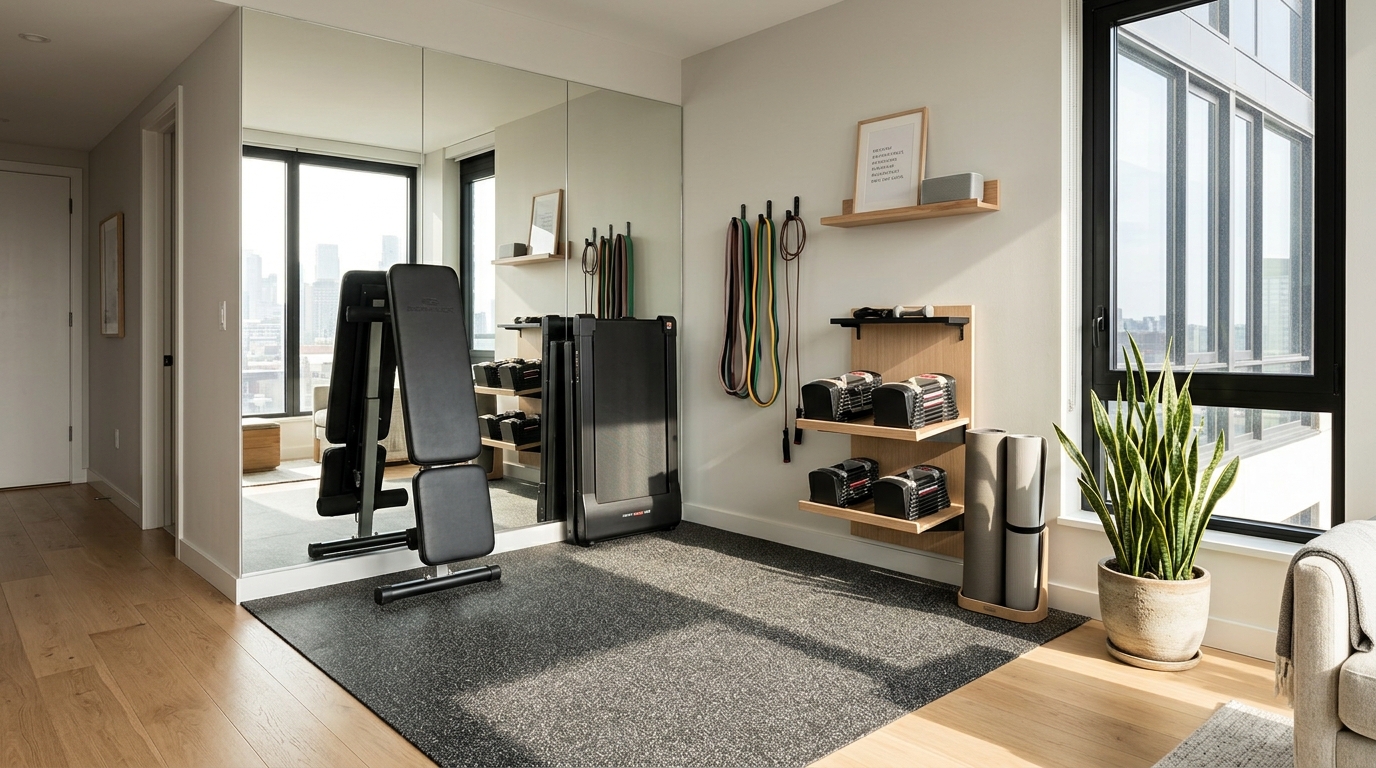
A home gym does not need a dedicated room, a high ceiling, or a budget that rivals a commercial fitness center. Some of the most effective home gyms in existence occupy a corner of a bedroom, half of a garage, or a spare room that was previously used for storage. These 19 small space home gym ideas will show you how to build a functional, well organized workout space in whatever square footage you have available without sacrificing the equipment or the environment that makes consistent training possible.
The ideas here are practical, specific, and grounded in how real people actually train rather than in the idealized gym setups that appear in fitness influencer content. Below are 19 ideas that make a small space home gym genuinely work.
1. Start with Rubber Flooring and Build From There
Rubber flooring is the single most important investment in a small home gym because it protects the floor beneath it, reduces noise, absorbs impact, and defines the boundaries of the gym space within whatever room it occupies. A 3×4 foot rubber mat under a single piece of equipment protects the floor and reduces vibration. A full coverage rubber tile floor across the entire gym area transforms the zone into a dedicated training space that feels completely different from the rest of the room even when the gym shares a floor plan with a garage, a bedroom, or a living room.
Rubber interlocking tiles from Rogue, BalanceFrom, or Amazon in 3/8 inch or 3/4 inch thickness depending on the intensity of the training that will happen on them cover any floor area at a cost of around one to three dollars per square foot. Lay them yourself in an afternoon without adhesive since the interlocking edges hold them in position during normal training use. The rubber floor is the foundation that makes everything else in a small home gym feel intentional and every subsequent equipment purchase looks and functions better on a proper rubber surface than on bare concrete, hardwood, or carpet.
2. Use Wall Mounted Storage for Every Piece of Equipment
Wall mounted storage in a small home gym recovers the floor space that equipment would otherwise permanently occupy and allows the same square footage to function as both a training area and a living area when the workout is finished. Wall mounted dumbbell racks, barbell holders, resistance band hooks, jump rope hangers, and foam roller brackets all move equipment off the floor and onto the wall where it is organized, accessible, and out of the way simultaneously. A wall of organized equipment looks significantly more purposeful and significantly less cluttered than the same equipment piled on the floor or stacked in a corner.
Rubbermaid FastTrack and Gladiator GearWall are both modular wall storage systems that accommodate a wide variety of gym equipment hooks and holders on a single rail system that mounts with a few screws into wall studs. The modular nature of these systems allows you to reconfigure the storage layout as your equipment collection changes without installing new rails. A fully equipped wall storage system in a small home gym is the investment that most transforms the space from a room with gym equipment in it to a room that is organized and designed for training.
3. Choose Adjustable Dumbbells Over a Full Set
A full set of fixed dumbbells ranging from five to fifty pounds requires a dedicated rack that occupies significant floor space in a small home gym. A pair of adjustable dumbbells that replace fifteen to seventeen pairs of fixed weights takes up the floor space of a single pair while providing the full weight range needed for most training programs. Bowflex SelectTech 552s, PowerBlocks, and NUobell adjustable dumbbells all change weight with a dial or a selector mechanism in seconds and store on a compact stand that occupies less than one square foot of floor space.
The investment in a quality pair of adjustable dumbbells is higher than a basic fixed dumbbell set of the same weight range but the floor space recovered by the adjustable format is the most valuable return that investment delivers in a small home gym where every square foot of clear training space contributes directly to the quality and the variety of training possible in the room. A clear floor with one compact dumbbell stand is infinitely more useful than the same floor covered with fixed weight equipment.
4. Mount a Pull Up Bar in a Doorframe or on the Wall
A doorframe pull up bar requires no permanent installation, no tools beyond the doorframe itself, and occupies zero floor and wall space while adding one of the most effective upper body exercises available to the small home gym equipment list. A doorframe pull up bar from Iron Gym or Perfect Fitness installs in seconds by hooking over the door frame and supports body weight training for pull ups, chin ups, and hanging exercises without any modification to the door or the frame. Remove it and store it in a closet in under thirty seconds when the workout is finished.
A wall mounted pull up bar with permanent installation using lag bolts into wall studs provides a more stable and more versatile option for a small home gym where the doorframe option is not practical or where the training load exceeds what a doorframe bar can safely handle. Rogue and Rep Fitness both produce wall mounted pull up stations in minimal footprint designs that provide multiple grip positions for pull up variety within a wall mount that projects only twelve to sixteen inches from the wall surface.
5. Invest in a Foldable Bench
A weight bench is one of the most versatile pieces of equipment in any home gym and in a small space the foldable version delivers the same training functionality as a standard bench at a fraction of the storage footprint. A quality foldable adjustable bench from Rep Fitness, Flybird, or Marcy folds flat against the wall or fits upright in a closet when not in use and sets up in under thirty seconds for training. The adjustable incline positions of a foldable bench provide the variety of pressing angles needed for comprehensive chest, shoulder, and tricep training without requiring multiple fixed benches.
Do not compromise on the quality of a foldable bench in favor of a cheaper model that wobbles during use since instability in a bench during pressing movements is a genuine safety concern rather than merely a comfort issue. Rep Fitness and Flybird both produce foldable benches with solid construction and stable adjustment mechanisms at price points that reflect the engineering required for a safe foldable design. The additional cost of a quality foldable bench over a budget alternative is the investment in both safety and longevity that small gym equipment decisions should always prioritize.
6. Use a Cable Machine Attachment for a Power Rack
A full cable machine in a small home gym occupies a significant floor footprint for a single movement category. A cable pulley attachment that mounts to an existing power rack or squat stand converts the rack into a cable machine without any additional floor space beyond the rack itself. REP Fitness and Rogue both produce cable pulley systems that attach to standard rack uprights and provide the full range of cable exercises, lat pulldowns, cable rows, tricep pushdowns, and cable flyes, within the existing footprint of the rack.
The cable attachment approach exemplifies the multi use equipment philosophy that small home gym design depends on. Every piece of equipment that serves multiple training functions reduces the total equipment footprint required to achieve a comprehensive training program in a small space. A power rack with a cable attachment, a pull up bar, and a band peg provides resistance training from multiple angles within the footprint of a single piece of equipment and that consolidation of function is the foundational design principle of the effective small home gym.
7. Keep One Wall Completely Clear as Training Space
A small home gym needs clear floor space as much as it needs equipment and the discipline of keeping one full wall section of floor completely free of equipment and storage is what makes the difference between a gym that can accommodate a full range of bodyweight training, stretching, yoga, and floor work and one that can only train in the narrow spaces between equipment pieces. The clear wall zone is not wasted space in a home gym. It is the most versatile training surface in the room and it accommodates training modalities that no piece of equipment can replace.
Use the clear wall itself as a training surface for wall supported exercises: handstand practice, wall walks, wall sit holds, and wall assisted stretching all require only the clear floor in front of the wall and the wall surface itself. Keep a full length mirror on this wall if the room allows for it since the mirror doubles the apparent size of the clear training area visually and provides the form feedback during training that a mirrorless gym cannot provide without video recording.
8. Add a Full Length Mirror
A full length mirror in a small home gym does two things simultaneously that are both essential to the quality of the training environment. It provides the visual feedback needed to monitor exercise form during training and it reflects light and space back into the room, making the gym feel significantly larger than its actual dimensions. A small home gym with a full length mirror feels at least twice as large as the same gym without one and the form feedback it provides during resistance training, yoga, and mobility work is a genuine training quality improvement rather than merely an aesthetic addition.
Mount a full length mirror on the clearest wall of the gym using mirror mounting clips rather than adhesive for security. A frameless mirror in a size that covers most of the wall height, at minimum 48 inches wide by 72 inches tall, provides the most useful training feedback and the most significant spatial effect. HomeDepot and Wayfair carry large format frameless mirrors at prices starting around fifty to one hundred dollars for a size appropriate for a home gym installation.
9. Use Resistance Bands as a Space Free Equipment Category
Resistance bands provide progressive resistance training for every major muscle group in a complete training program without occupying any meaningful storage space when not in use. A complete set of loop bands and tube bands with handles covers the full resistance range from light rehabilitation work to heavy strength training and stores in a single small bag or on a row of hooks that take up less than one square foot of wall space. In a small home gym where floor and storage space are the primary constraints, resistance bands are the highest function to footprint ratio equipment available.
Rogue Monster Bands, Serious Steel bands, and WOD Nation tube band sets all provide a comprehensive resistance band system at prices from twenty to sixty dollars for a complete set. Use bands for warm up work, accessory exercises, mobility training, and as progressive resistance additions to bodyweight movements. A pull up with a band for assistance or a push up with a band for added resistance extends the training range of bodyweight movements without adding any equipment footprint to the exercises.
10. Install a Pegboard for Equipment Organization
A pegboard mounted on the gym wall provides the most flexible and the most expandable equipment organization system available for a small home gym. Every piece of small equipment, resistance bands, jump ropes, foam rollers, lacrosse balls, pull up bars, and training accessories of all kinds, can be hung on a pegboard hook in an organized visible arrangement that allows you to find and retrieve any piece of equipment without searching through a bag or a box. The pegboard organization also keeps the floor completely clear of the small equipment clutter that most home gyms accumulate over time.
Paint the pegboard in a color that suits the gym aesthetic rather than leaving it in the natural brown that most hardware store pegboards come in. A white or black pegboard with matching hooks reads as a designed organization system rather than a utilitarian storage solution. Mount it with spacers between the pegboard and the wall so the hooks can be inserted from any angle. The pegboard in a small home gym is the same organizational tool used in workshops and garages for decades and its effectiveness at keeping small equipment organized, visible, and accessible is completely unmatched by any alternative storage approach.
11. Choose a Compact Cardio Machine That Folds
Cardio equipment is typically the largest footprint item in any home gym and in a small space the foldable versions of treadmills, rowing machines, and stationary bikes recover the majority of that footprint when the cardio session is finished. A foldable treadmill from NordicTrack or Horizon Fitness folds to a fraction of its deployed size and stores against a wall. A Concept2 rowing machine separates into two pieces that store vertically in a corner. A foldable stationary bike stores flat against a wall or in a closet between uses.
The Concept2 RowErg rowing machine deserves specific mention because it is both one of the most effective cardio training tools available and one of the most storage efficient large cardio machines in existence. Its two piece design stores in a corner footprint of roughly two square feet and its training quality is equivalent to commercial rowing machines that cost five times as much and occupy ten times the floor space. In a small home gym where every piece of equipment must justify its storage footprint through its training value, the Concept2 rower consistently provides the best return on both dimensions.
12. Use Vertical Space for Heavy Equipment Storage
A barbell stored on the floor occupies seven feet of horizontal space and creates a tripping hazard in a small gym. A barbell stored vertically in a wall mounted holder occupies twelve inches of wall space and zero floor space. The same principle applies to resistance band storage, foam roller storage, and any other elongated piece of gym equipment that is typically stored horizontally but can be stored vertically without affecting its function or its accessibility. Evaluating every piece of equipment for its vertical storage potential is the single most impactful space recovery exercise available in a small home gym.
Vertical barbell holders from Rogue and Rep Fitness mount with four screws into wall studs and hold one to six barbells in a vertical orientation that keeps them off the floor and organized within a narrow wall space. A six barbell vertical holder occupies approximately eighteen inches of wall width and stores barbells that would otherwise occupy forty two square feet of floor space if stored horizontally. The vertical storage investment is one of the most dramatic floor space recovery moves available in a small home gym.
13. Set Up a Dedicated Stretching and Mobility Corner
A dedicated corner of the small home gym equipped with a yoga mat, a foam roller, a lacrosse ball set, and a resistance band specifically for mobility work gives the stretching and recovery component of training its own defined zone within the gym. The dedicated corner communicates that mobility and recovery work is as important as the strength and cardio training that the rest of the equipment supports and the defined zone makes it more likely that stretching and mobility work actually happens rather than being skipped in favor of getting back to the main equipment.
Store the mobility equipment on the wall above the yoga mat zone using hooks and a small shelf so the mat can be rolled out and the tools accessed immediately without setting up the corner at the start of each session. A foam roller bracket, two lacrosse ball hooks, and a resistance band hook above the yoga mat zone requires under one square foot of wall space and keeps the entire mobility toolkit organized and immediately accessible.
14. Add Proper Ventilation and a Fan
Training intensity in a small enclosed space generates heat and humidity rapidly and inadequate ventilation makes the training environment genuinely uncomfortable within minutes of the start of a workout. A high velocity floor fan or a wall mounted fan in the small home gym maintains air movement that makes the training environment tolerable during high intensity training sessions and reduces the buildup of humidity that damages rubber flooring, mirrors, and equipment over time in an inadequately ventilated space.
A Vornado or Lasko high velocity fan positioned at the end of the gym space opposite the primary training zone moves air across the entire training area rather than cooling only the immediate area around the fan. A wall mounted fan on a swivel bracket saves the floor space that a floor fan occupies and keeps the fan position fixed at the optimal height for air movement during standing exercises. Proper ventilation in a small home gym is a training quality and equipment longevity investment that is often overlooked until the gym has been used through a full summer and the consequences of inadequate air movement have become apparent.
15. Use Chalk or Dry Erase Boards for Workout Tracking
A small chalk or dry erase board mounted on the home gym wall serves as a workout log, a program tracker, and a motivational display without requiring a phone or a tablet in the gym environment. Writing the current workout on the board before training and tracking completed sets and reps directly on the board during the session provides the same programming structure as a training app without the screen distraction that a phone in the gym creates. The board also provides a surface for recording personal records and training milestones that makes progress visible in the training environment rather than buried in an app history.
A simple framed chalkboard or a standard dry erase board from an office supply store mounted at eye level on the gym wall costs under twenty dollars and occupies no floor space. The training information written on the board is visible from anywhere in the gym and the physical act of writing sets and reps rather than tapping a screen creates a more deliberate engagement with the training session that most serious athletes find improves both focus and performance.
16. Invest in Quality Lighting
Poor lighting in a small home gym creates a training environment that feels oppressive, makes it harder to monitor exercise form in the mirror, and contributes to the feeling that the gym is a basement utility space rather than a dedicated training environment. Bright, evenly distributed lighting at a color temperature of 4000K to 5000K, which is a neutral to cool white that reads as energizing rather than relaxing, creates the training environment quality that makes a small home gym feel like a professional training space rather than a room with equipment in it.
LED shop lights from commercial lighting suppliers mounted horizontally across the gym ceiling provide the most even and the most cost effective illumination for a small home gym at around thirty to fifty dollars per fixture. Two or three shop lights across the ceiling of a small gym provide more than adequate training illumination and the cool white color temperature of the 5000K option is the most widely preferred in commercial gym environments for its energizing quality. The lighting investment is modest and the improvement in training environment quality it delivers is immediately apparent and consistently appreciated.
17. Create a Defined Entry Point to the Gym
A defined entry point to a small home gym, whether a doorway, a mat transition between the gym floor and the surrounding space, or simply a clear visual threshold that marks the beginning of the training zone, creates a psychological boundary between the gym and the rest of the living space that improves training focus and makes the gym feel more like a dedicated facility than a corner of a room. The psychological impact of crossing a defined threshold into a training environment is real and consistently reported by home gym users as a meaningful contributor to training consistency.
A rubber mat transition strip, a change in flooring material, or simply the edge of the rubber gym floor serves as this threshold effectively. Adding a motivational quote above the entry point, a small sign with the gym name, or a simple design element like a stripe of color on the wall at the entry reinforces the threshold quality and gives the gym a sense of identity and purpose that generic rooms with gym equipment do not possess.
18. Keep the Space Exclusively for Training
A small home gym that doubles as a storage space, an office, a laundry area, or any other domestic function becomes progressively harder to train in as the non gym uses of the space accumulate objects, furniture, and distractions that compete with the training environment quality of the gym. The discipline of keeping the gym space exclusively for training related activities is the single most important maintenance habit in a small home gym and the one that most directly determines whether the gym continues to be used consistently over the long term.
Remove every non gym object from the space and find alternative storage for anything that currently lives in the gym because there is nowhere else to put it. The gym equipment deserves the space it occupies and every non gym object sharing that space reduces the training environment quality and the training motivation that a well organized, purposeful gym space provides. A small space used exclusively for training is a more effective training environment than a large space that also serves other functions because the exclusivity of purpose communicates seriousness of intent every time the space is entered.
19. Design the Gym Around Your Actual Training Program
The most important small home gym idea is also the most obvious and the most consistently ignored: design the gym around the specific training program you actually follow rather than around a general idea of what a gym should contain. A person who trains with barbells and free weights needs a rack, a barbell, plates, and a bench and nothing else. A person who trains with bodyweight and cardio needs a pull up bar, a jump rope, a yoga mat, and a cardio machine. A person who trains with kettlebells needs a set of kettlebells, a rubber floor, and clear space.
Every piece of equipment in a small home gym should be justified by its specific role in the training program it supports. Equipment purchased because it seemed like a good gym addition rather than because it serves a specific training purpose accumulates into clutter that reduces the training environment quality of the gym and the usability of the floor space it occupies. Design the gym around what you actually do and it will be exactly the right gym for you regardless of what it does or does not share with someone else’s idea of a complete home gym setup.
Final Thoughts
A small home gym that is designed with genuine intention around a specific training program and maintained with the discipline of keeping it exclusively for training will always produce better training outcomes than a larger, more expensively equipped gym that was assembled without a clear program or purpose in mind. The ideas above give you the framework for making every decision in the small home gym, from the flooring to the equipment selection to the organization system, in service of the training quality that the gym exists to support.
Start with the rubber floor, the wall storage, and the equipment your specific training program requires and resist the accumulation of additional equipment beyond that starting point until the gym has been used consistently enough to identify genuine gaps in its capability. The best small home gym is always the one that gets used every day and these 19 small space home gym ideas give you everything you need to build a gym that earns that daily use.