
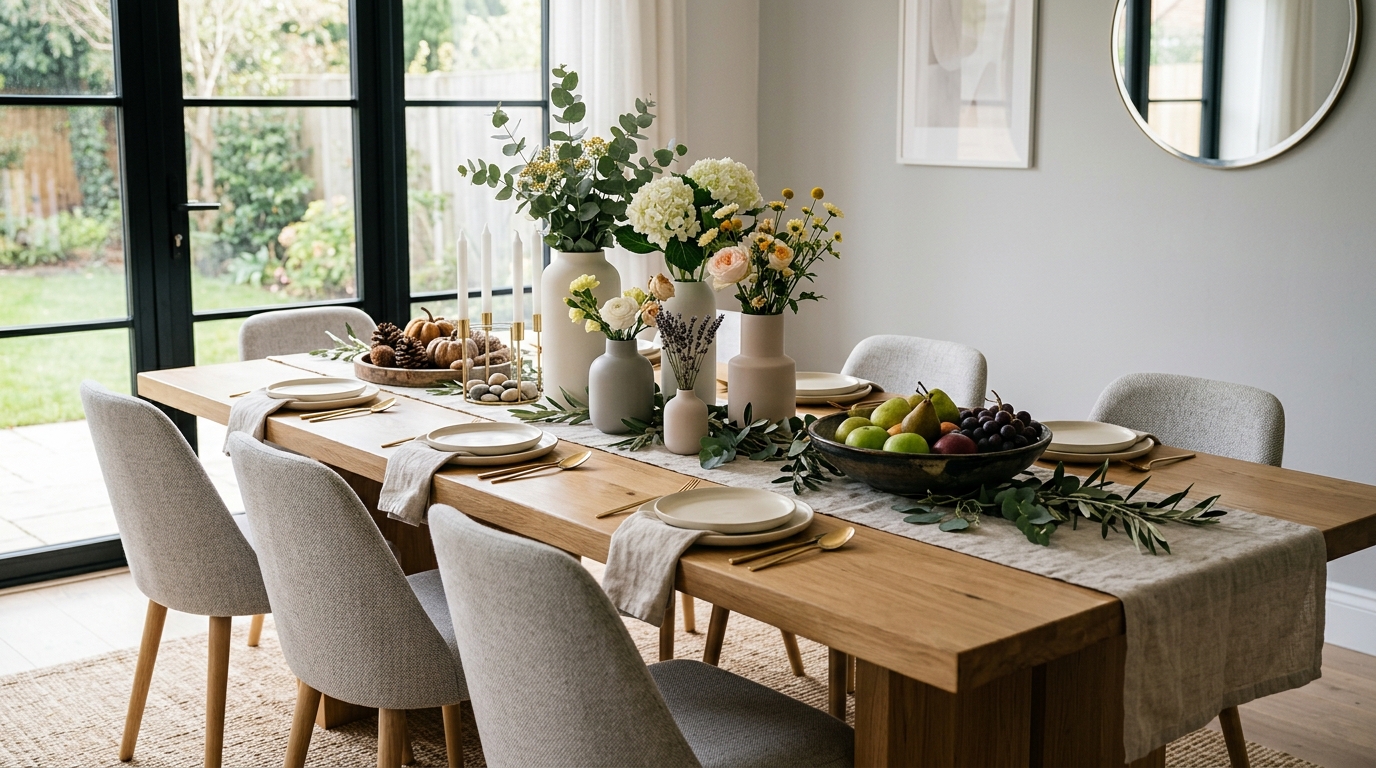
A dining table without a centerpiece looks like a table waiting for something to happen. A dining table with the right centerpiece looks like a table that is already living the way it is supposed to. The difference is not cost. The difference is intention, and a single well-chosen arrangement in the center of the table communicates that someone thought about this room and cared about the experience of being in it.
These centerpiece ideas for dining room table styling focus exclusively on what goes at the center of the table: seasonal arrangements that change with the time of year, floral choices that suit different aesthetics and budgets, and candle configurations that work for everyday use and for entertaining. No lighting fixture advice, no chair or table selection guides. Just the centerpiece itself, styled with specific direction for every approach.
You will find 17 ideas here, each one a distinct centerpiece approach for a different situation, aesthetic, or season. Some cost almost nothing. Some take five minutes to assemble. All of them make the dining table feel considered rather than empty.
1. Build a Long Low Runner Arrangement for a Rectangular Table
A single centered object on a long rectangular dining table looks like a potted plant on a parking lot. The scale is wrong and the eye has nowhere to go after it finds the one element. A long, low runner arrangement that runs along the center third of the table length uses the horizontal dimension of the table correctly and reads as designed rather than placed.
Use a narrow wooden tray, a collection of small vessels at different heights, or a strip of moss as the base for the runner. Group three to five elements along the length: a cluster of pillar candles, a small bunch of stems in a bud vase, a low ceramic bowl, and a scatter of natural objects between each piece. The runner should never extend the full length of the table, which reads as a tablecloth rather than a centerpiece. Two thirds of the table length is the right proportion that reads as abundant without overwhelming the dining surface.
2. Use a Cluster of Three Pillar Candles in Varying Heights
Three pillar candles grouped at varying heights on a round wooden tray or a flat stone slab is the most reliable everyday dining table centerpiece available because it works in any season, in any dining room aesthetic, and at any price level depending on the candle quality chosen. The height variation is the critical detail that prevents three candles of the same height from reading as a matched set rather than an intentional arrangement.
Use one tall pillar at 8 to 9 inches, one medium pillar at 5 to 6 inches, and one short pillar at 3 to 4 inches. Place them in a close cluster offset slightly from each other rather than in a perfectly spaced triangle. Add a few dried rose petals, small stones, or a ring of moss at the base of the candles to ground the arrangement on the tray surface. The Boy Smells Altar Candle, the Anthropologie Pillar Candle in unscented ivory, and the Target Threshold Pillar Candle in natural wax all produce the right quality of warm amber flame for a dining table centerpiece.
3. Centerpiece Ideas for Dining Room Table Settings Use Fresh Peonies in Season
Peonies are the most reliably beautiful cut flower available for a dining table centerpiece because their full, rounded form photographs well, their range of soft pink and cream tones suits almost any dining room palette, and their fragrance adds a sensory layer to the dining experience that no candle or dried arrangement provides. They are available from late spring through early summer at grocery stores and florists at reasonable prices.
Buy peonies one to two days before they are needed, when the buds are still closed and just beginning to open at the edges. Trim the stems at a 45-degree angle under water and place in a vessel with warm water. They open fully within 24 to 48 hours and hold at peak bloom for three to five days. Use a wide-mouth ceramic pitcher, a low glass bowl, or a simple terracotta pot as the vessel. Three to five stems in a compact grouping read as more abundant than the same number spread across a tall, narrow vase.
4. Arrange a Seasonal Harvest Centerpiece for Autumn
The autumn dining table centerpiece works best when it uses actual harvest materials rather than manufactured autumn decor purchased from a craft store. Gourds and mini pumpkins in varying sizes grouped on a wooden tray with dried seed pods, wheat stalks, and fall foliage branches cut from the yard create a genuinely seasonal arrangement that reads as gathered rather than purchased.
Group the gourds and pumpkins in odd numbers: three, five, or seven pieces in varying sizes and a range of natural autumn tones from cream to gold to deep orange. Tuck dried stems of wheat, amaranth, or ornamental grasses between the gourds for height variation. Scatter a few dried oak leaves or maple leaves across the tray surface to connect the arrangement to the floor-level palette. The whole arrangement costs the price of a bag of gourds from a grocery store or a farmers market and a few free elements from the yard.
5. Centerpiece Ideas for Dining Room Table Styling Include a Terrarium
A glass terrarium filled with moss, small stones, and a few succulent plants provides a dining table centerpiece that requires almost no maintenance, changes slowly over time as the plants grow, and reads as considered and organic without the weekly replacement that fresh flowers require. A terrarium in a geometric glass frame or a round glass bowl placed on a natural wood base suits both modern and organic dining room aesthetics.
Use an open terrarium rather than a sealed one for a dining table placement where air circulation matters for the plants’ health. Fill the base with 2 inches of coarse sand or gravel for drainage, then a layer of horticultural charcoal, then a mix of potting soil and coarse sand. Plant with two or three small succulents, a patch of sheet moss, and a few small stones at the surface. The Terrain Glass Geometric Terrarium and the CB2 Glass Bowl Terrarium both provide the right vessel quality for a dining table scale.
6. Use a Single Large Ceramic Vase with Dried Pampas Grass
A single large ceramic vase at 12 to 16 inches tall holding a loose arrangement of dried pampas grass stems provides the most dramatically scaled dining table centerpiece available at one of the lowest ongoing costs, because pampas grass lasts for months without any care and reads as more architectural and intentional than any fresh flower arrangement at the same scale.
Choose a ceramic vase in a matte finish in a neutral tone that suits the dining room palette: warm white, natural stoneware, matte black, or terracotta. Fill with three to five pampas grass plumes at varying heights, allowing the stems to fan outward from the vase opening rather than bunching them tightly together. Keep the arrangement height under 18 inches so it does not block sightlines across the table. The ferm LIVING Ease Vase in dark sand, the CB2 Organic Shape Vase in warm gray, and the Anthropologie ceramic vase collections all provide the right vessel quality for this scale of arrangement.
7. Centerpiece Ideas for Dining Room Table Year-Round Use Faux Flowers Honestly
Faux flowers on a dining table only read well when the quality of the artificial flower is high enough that the eye does not identify them as fake from the seated dining distance of 36 to 48 inches across the table. A low-quality silk flower arrangement reads as neglected. A high-quality foam or paper flower arrangement in a genuine ceramic vessel reads as a considered choice for households that cannot maintain fresh flowers weekly.
Look specifically for high-quality preserved or paper florals from Afloral, Nearly Natural’s higher-end lines, or the Pottery Barn faux florals in their botanical collection. Choose stems with visible texture variation in the petals, realistic color graduation from center to petal edge, and stems that hold natural irregular curves rather than perfectly uniform shapes. Arrange in a vessel with a narrow neck so the stems hold their positions without falling apart, and use a handful of stems rather than a crowded dozen.
8. Create a Candle and Greenery Runner for the Holiday Table
Fresh greenery laid flat along the center of the dining table with pillar candles or votives nestled into it creates the most instantly festive holiday centerpiece available for a fraction of what a florist charges for the same effect. The greenery acts as both the base of the arrangement and the connection between individual candle elements that would otherwise read as separate objects placed in a row.
Gather fresh cedar, pine, eucalyptus, or magnolia branches and lay them loosely along the center third of the table with the stems overlapping rather than arranged end to end. Nestle three to five candles in varying heights directly into the greenery so the branches come up around the base of each candle. Scatter dried orange slices, cinnamon sticks, or small pinecones between the candles for fragrance and visual texture. Replace the greenery every five to seven days as it dries, or use preserved eucalyptus for a version that holds for the full holiday season.
9. Style a Rattan Tray with Collected Objects for Everyday Use
A rattan or wooden tray holding a small collection of everyday objects, a short candle, a small plant, one ceramic object, and perhaps a stack of two coasters, creates a dining table centerpiece that reads as casual, lived-in, and genuinely personal without requiring any floral arrangement or seasonal sourcing. The tray contains the collection visually and prevents the individual objects from reading as things left on the table rather than a deliberate arrangement.
Choose a tray at approximately one third the width of the dining table and no more than 18 inches in length so it occupies the center of the table without becoming a visual barrier across the full width. Keep the objects on the tray to five or fewer, with height variation between the tallest and shortest piece. The World Market Rattan Oval Tray, the Threshold Seagrass Tray at Target, and the CB2 Marble Serving Tray all provide the right base material and proportion for a dining table centerpiece tray application.
10. Centerpiece Ideas for Dining Room Table Settings Use Floating Flowers
A wide, low bowl filled with water and three to five floating flower heads is the simplest fresh floral centerpiece available and one of the most visually elegant because the flat, open water surface adds a reflective element that no vase arrangement provides. Floating flower arrangements work specifically on a dining table because the low height keeps sightlines completely clear across the table at seated eye level.
Cut the stems of garden roses, peonies, dahlias, or camellias to 1 inch below the flower head and float them face-up in a shallow bowl with 2 to 3 inches of water. Add a few floating candles between the flower heads for an evening version that adds a warm flickering light at table level. Use a bowl between 10 and 14 inches in diameter for a standard dining table. The arrangement lasts 24 to 48 hours before the flower heads begin to deteriorate, making it ideal for a dinner party or a special occasion rather than an everyday centerpiece.
11. Stack Books with a Single Vase on Top for an Editorial Look
Two or three coffee table books stacked at an angle with a single slim bud vase on top holding one or two stems creates a dining table centerpiece that reads as editorial, personal, and completely distinct from any floral or candle arrangement. The book stack adds height, a surface for the eye to read as collected rather than staged, and a personal touch that generic centerpieces never achieve.
Choose books with visually appealing covers in colors that suit the dining room palette. A white spine, a deep navy, a warm terracotta, or an illustrated botanical cover all photograph well and read as deliberately selected rather than randomly pulled from a shelf. Stack two books with the largest at the bottom, one at an offset angle on top, and place a 6 to 8-inch ceramic bud vase with one or two stems of eucalyptus, a single garden rose, or a dried lunaria stem on top of the stack. The whole arrangement costs nothing if the books and vase are already in the home.
12. Use Seasonal Citrus in a Low Bowl for a Fresh Spring or Summer Look
A shallow bowl filled with seasonal citrus fruits, lemons, limes, blood oranges, or a mixture of all three, creates a fresh, colorful dining table centerpiece that doubles as a fruit bowl, costs almost nothing, and photographs beautifully in natural light. The citrus centerpiece is specifically appropriate for spring and summer dining tables where something bright and genuinely alive reads better than dried arrangements or heavy candle groupings.
Use a wide, shallow bowl between 10 and 14 inches in diameter and fill it with 8 to 12 pieces of citrus in varying sizes. Mix types for color variation: yellow lemons beside pale green limes beside deep orange blood oranges. Do not arrange them in a perfect mound, which reads as forced. Fill the bowl loosely and let the top fruits sit slightly unevenly. The Terrain Stoneware Bowl in a natural glaze and the CB2 White Ceramic Fruit Bowl both provide the right vessel proportion for a citrus centerpiece at a dining table scale.
13. Centerpiece Ideas for Dining Room Table Holidays Use Taper Candles in a Row
A row of five to seven taper candles in matching candlesticks spaced evenly along the center of the dining table produces one of the most classically elegant holiday centerpiece arrangements available without any floral element required. The linear arrangement of candles suits a formal or transitional dining room specifically and reads as more deliberately ceremonial than a clustered candle grouping.
Use candlesticks in graduating heights so the candles at the center of the row sit slightly taller than those at the ends, which creates a gentle arch across the full arrangement rather than a flat horizontal line. Choose candlesticks in a consistent finish: all brass, all silver, or all matte black for the most cohesive row. The Pottery Barn Taper Candlestick Collection in antique brass, the CB2 Brass Column Candlestick, and the Anthropologie Carved Taper Holder all provide the right candlestick quality for a formal dining table row arrangement.
14. Arrange a Wildflower Mix in a Ceramic Pitcher
A loose bunch of wildflowers or seasonal grocery store flowers arranged in a ceramic pitcher or a ceramic jug reads as the most relaxed, genuinely gathered centerpiece available for casual and cottage-style dining tables. The pitcher form gives the arrangement its character because it references a domestic, kitchen-table informality that a formal vase never achieves, and the looseness of the arrangement reinforces the same casual quality.
Buy a mixed bunch of whatever is freshest at the grocery store or Trader Joe’s on the day it is needed. Do not rearrange the stems into a formal design. Pull the plastic wrapping off and place them directly into the pitcher with enough water to cover the lower stems. Adjust only to remove any stems that point in a direction that takes them outside the visual boundary of the pitcher opening. A cream ceramic pitcher, a blue and white pottery jug, or a terracotta vessel all suit this approach equally well.
15. Centerpiece Ideas for Dining Room Table Spaces Use a Cloche with a Single Object
A glass cloche placed over a single significant object on the dining table creates a centerpiece with a museum-quality, curated presence that reads as decidedly more considered than any standard floral arrangement. What goes under the cloche is the personal decision: a small sculptural bird, a dried moss arrangement, a few pressed flowers on a small tray, a single perfect shell, or a miniature terrarium.
Choose a cloche between 8 and 12 inches tall for a standard dining table placement. The base underneath the cloche matters as much as the object inside it: a round wooden disk, a small marble slab, or a piece of natural slate all provide the right grounded base quality. The Terrain Glass Cloche in a wide dome shape and the CB2 Glass Cloche on a wood base both provide the right vessel quality for a dining table centerpiece application. Replace the object inside seasonally to keep the centerpiece feeling current rather than permanent.
16. Build a Winter White Centerpiece for the Cold Season
A winter centerpiece in an all-white palette, white birch branches, white pillar candles, white berries, and a white ceramic vessel, produces the most visually calm and seasonally specific cold-weather dining table arrangement available. The monochrome white palette reads as deliberate and considered in a way that multi-colored winter arrangements rarely achieve, and it suits dining rooms in any color palette because the white reads as neutral against any background.
Strip the leaves from white birch or silver dollar eucalyptus branches and place them in a tall, narrow white ceramic vase as the height element of the arrangement. Cluster white pillar candles in varying heights at the base of the vase on a white marble slab or a mirrored tray. Scatter faux white berries or small white pinecones around the candle bases. The completely white palette is what makes the arrangement read as a deliberate winter centerpiece rather than a general neutral arrangement that happens to be on a winter table.
17. Centerpiece Ideas for Dining Room Table Year-Round Styling Use Sculptural Branches
A simple arrangement of bare sculptural branches in a tall, heavy ceramic vase provides a dining table centerpiece that works across every season, costs almost nothing to source, and reads as more architectural and considered than most floral arrangements because the organic form of the branch itself is the visual subject rather than the flowers attached to it. Cherry blossom branches in spring, magnolia branches in summer, bare oak branches in winter, and copper-leafed branches in fall all suit this approach.
Cut branches from the yard or source from a florist’s stem section rather than a full arrangement, which significantly reduces the cost. Choose branches with interesting curves, forks, or texture in the bark rather than perfectly straight stems. Place two to three branches in a tall ceramic vase that is heavy enough to balance the visual weight of the branch arrangement without tipping. The single most important detail is the vessel: a vase that reads as too light or too small for the branch it holds undermines the architectural quality the arrangement is trying to achieve.
Conclusion
A dining table centerpiece is not a permanent installation. It is a living expression of the season, the occasion, and what the household values about the experience of gathering around a table. The best centerpieces are the ones that change regularly rather than sitting untouched for six months until they are replaced out of necessity.
Start with whatever is most accessible right now: three candles and a tray, a branch cut from the yard, a handful of grocery store flowers in a ceramic pitcher. The discipline of returning to the table center with something fresh every few weeks is the habit that keeps the dining room feeling considered rather than overlooked. These centerpiece ideas for dining room table styling give you 17 specific starting points, and the right one is the one that suits today rather than an ideal version of the room you are still working toward.