
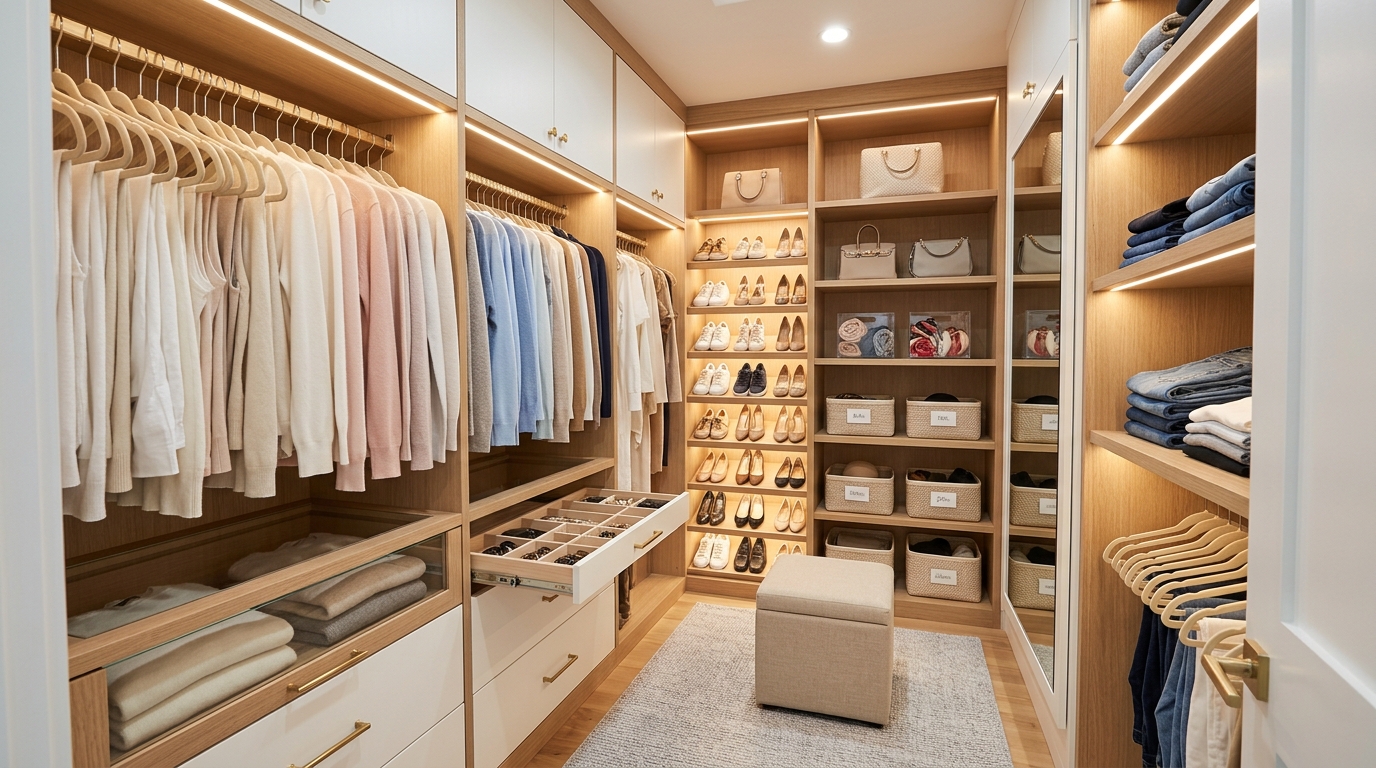
A small walk in closet sits in a strange middle ground, large enough to walk into but often too tight to actually organize well, which leaves it feeling cramped despite the appeal of having a walk in space. Without a thoughtful system, the closet quickly becomes a cluttered pile of clothes, shoes, and accessories competing for the same limited room.
This article focuses on organization ideas specifically for small walk in closets, covering the systems and configurations that make tight spaces work harder. Below are twenty ideas for making the most of a small walk in closet without expanding its actual footprint.
1. Double Hang Rods to Maximize Vertical Space
Installing two hanging rods, one above the other, doubles the hanging capacity for shorter items like shirts, blouses, and folded length pants. Most walk in closets come with a single rod that uses only the upper portion of the wall, leaving valuable vertical space below unused.
This works particularly well when the wardrobe consists primarily of shirts and folded pants rather than long dresses or coats, since shorter items fit comfortably on the lower rod. The upper rod typically sits at standard height, with the lower rod about forty inches below, providing enough clearance for items on both rods to hang without dragging or interfering with each other.
2. Shelves Above the Hanging Rod
Adding shelves above the hanging rod uses the high vertical space that typically sits empty between the top of clothing and the ceiling. These upper shelves work well for items used less frequently, like seasonal sweaters, hats, or storage boxes that hold rarely worn items.
This works particularly well when the shelves are accessible without a step stool for things used occasionally, while less reachable upper shelves hold truly long term storage. Choosing matching storage boxes or baskets for the shelves keeps the visual look organized rather than chaotic, with the uniform containers making the upper portion of the closet feel intentional rather than like a forgotten dumping ground.
3. Built In Drawers for Folded Items
Built in drawers within the closet, replacing or supplementing dresser drawers elsewhere in the bedroom, keep folded clothing organized and contained within the walk in space. The drawers handle items that do not hang well, like sweaters, jeans, and underwear.
This works particularly well in walk in closets where the goal is to consolidate all clothing storage in one location, freeing up bedroom space for other furniture. The built in nature of the drawers also means they fit the closet’s specific dimensions exactly, which freestanding furniture rarely achieves, with the drawers blending into the closet structure rather than appearing as added on storage.
4. Pull Out Shoe Racks
Pull out shoe racks that slide out from beneath hanging clothes or from inside cabinetry make every pair of shoes accessible without bending or rummaging. The sliding mechanism displays shoes at an angle so each pair is visible at a glance.
This works particularly well for daily shoe rotation, where quick selection matters more than maximum storage capacity. Combining pull out racks with stacked traditional shelving in other parts of the closet handles both everyday shoes and less frequently worn pairs, with the pull out option reserved for the shoes most often grabbed during morning routines.
5. Lazy Susan Storage for Accessories
A lazy susan, the same kind used in kitchen cabinets, works equally well in a closet corner for organizing accessories like jewelry, watches, or smaller items that get lost in drawers. The rotating mechanism gives access to items at the back without needing to remove what is in front.
This works particularly well in corner spaces that would otherwise be hard to use effectively, since the lazy susan turns awkward dead corner space into highly accessible storage. Tiered lazy susans with multiple rotating levels multiply the storage capacity vertically, providing organized space for surprising amounts of small items in what would otherwise be unused corner real estate.
6. Hooks Mounted on the Closet Wall
Hooks installed directly on the walls of the closet, in spots not occupied by shelves or hanging rods, provide quick storage for bags, belts, or items grabbed on the way out the door. The hooks use wall space that would otherwise sit empty.
This works particularly well in small walk in closets where every surface needs to contribute to storage, since hooks essentially turn flat walls into functional storage areas. Choosing hooks that complement the closet’s overall finish, brass, black metal, or matte chrome, keeps the practical hardware looking intentional rather than utilitarian, with the items hung from them adding texture and visual interest to otherwise blank walls.
7. Clear Shoe Boxes for Visible Storage
Clear acrylic or plastic shoe boxes keep shoes protected from dust while making each pair instantly visible, which solves one of the main problems with traditional cardboard shoe boxes. The boxes stack neatly on shelves, with every pair identifiable without opening anything.
This works particularly well for special occasion shoes, athletic shoes, or any pairs worn less often, since the protection prevents dust accumulation between uses while the visibility ensures the shoes do not get forgotten. Stacking matching clear boxes also creates a cohesive, organized appearance in the closet, with the uniform containers reading as a deliberate organization choice rather than mismatched accumulated storage.
8. Pull Down Closet Rod
A pull down closet rod, which lowers from a high mounted position to accessible height with a gentle pull, lets you use the upper portion of the closet for hanging clothes without needing a step stool to reach them. The mechanism brings the upper rod within reach when needed.
This works particularly well in closets with high ceilings where the upper space would otherwise be limited to long term storage. The pull down feature unlocks valuable hanging space for clothes worn less frequently, with the rod returning to its high position when not in use, keeping the upper section accessible without taking up the daily reach zone needed for everyday clothes.
9. Mounted Jewelry Organizer Inside the Door
A jewelry organizer mounted on the inside of the closet door turns an otherwise unused surface into dedicated jewelry storage. Hooks for necklaces, slots for earrings, and small compartments for rings keep the entire collection organized and visible.
This works particularly well in small walk in closets where dedicating shelf or drawer space to jewelry would take away from clothing storage needs. The door mounted location also keeps the jewelry near the dressing area, putting it within easy reach during the getting ready routine, while the visible display helps with outfit decisions by making the jewelry options instantly apparent rather than hidden in a box.
10. Tilted Front Shelves for Easy Viewing
Shelves angled slightly downward at the front, often used for shoes or folded items, display contents at a visible angle similar to retail displays. The tilted orientation makes items in the back as visible as those in the front, eliminating the typical problem of forgotten items behind newer ones.
This works particularly well for shelves at lower heights where straight horizontal shelving would require crouching to see what is there. The slight angle solves this without requiring physical effort, while also creating a more visually interesting closet interior, since the tilted shelves break up the typical pattern of straight horizontal lines throughout the storage system.
11. Foldable Step Stool for Upper Access
A foldable step stool tucked into the closet provides quick access to upper shelves without needing to fetch one from elsewhere in the house. The folding design means the stool stores flat against a wall or behind hanging clothes when not in use.
This works particularly well in walk in closets with significant upper storage that needs occasional access, since having the step stool immediately at hand removes one of the main barriers to actually using high storage. Choosing a stool with non slip surfaces and a stable design prevents accidents during use, while the folding feature keeps it from taking up valuable floor space when not actively needed for reaching higher items.
12. Stackable Storage Bins on Closet Shelves
Stackable storage bins on closet shelves create organized vertical storage within the existing shelf system, multiplying capacity without changing the shelving itself. Each bin holds a category of items, like scarves in one, gym clothes in another, swimwear in a third.
This works particularly well when the bins are uniform in color and size, since matching containers look organized regardless of what they actually hold. Labels on the front of each bin make finding specific items easier, with the labeled, matching containers creating a sense of systematic organization that loose items piled on the same shelves rarely achieve, even when they contain exactly the same things.
13. Mirror Mounted Inside the Closet
A full length mirror mounted on the back wall of the closet or inside the closet door provides a place to check outfits without needing to leave the closet area. This eliminates the back and forth between the closet and a bedroom mirror during the getting dressed process.
This works particularly well in walk in closets used as dressing areas, where having a mirror immediately available makes the closet function more like a small dressing room. Positioning the mirror to catch good light, whether from a closet light fixture or from the bedroom window beyond, ensures outfit checking actually works in practice rather than struggling against dim closet lighting that fails to show colors accurately.
14. Built In Hamper in the Closet
A built in hamper within the walk in closet keeps dirty laundry contained at the source, where clothes come off rather than in a separate location across the bedroom. The hamper integrates into the closet structure, taking up less visual space than a standalone hamper would.
This works particularly well when the built in hamper includes multiple compartments for sorting laundry by type or color, streamlining the wash day process. Tilting the hamper out from the wall, or designing it as a pull out drawer, makes adding clothes simple while keeping the dirty laundry hidden, with the entire system integrating laundry management into the closet’s daily function.
15. Belt and Tie Rack Mounted to the Wall
Wall mounted belt and tie racks organize accessories that would otherwise tangle together or take up drawer space disproportionately. Each piece hangs on its own peg or hook, keeping the collection visible and ready to grab.
This works particularly well in small walk in closets where every accessory needs a dedicated spot, since loose belts and ties otherwise consume far more space than their actual size warrants. The wall mounted approach uses vertical space, which is often more available than horizontal drawer or shelf space, while making the entire accessory collection visible at once for quick selection during outfit planning.
16. Color Coordinated Clothes for Visual Order
Arranging clothes by color, light to dark or by color family, creates instant visual order in the closet even without changing the storage hardware. The organized color flow makes finding specific items easier and makes the closet feel less cluttered.
This works particularly well in small walk in closets where visual chaos can quickly make the space feel even smaller than it is, since color coordination provides a sense of intentional design. Color organizing also reveals gaps in the wardrobe and accidentally accumulated duplicates, with the systematic arrangement supporting both daily use and longer term wardrobe decisions about what to keep, replace, or donate.
17. Closet Light with Motion Sensor
A motion sensor light installed in the closet turns on automatically when someone enters, eliminating the fumbling for a light switch that older closets often require. Most closets are dim, and good lighting is essential for finding items quickly and matching outfit colors correctly.
This works particularly well in walk in closets without windows, where natural light contributes nothing and adequate artificial lighting becomes critical. Battery operated motion sensor lights install without electrical work, making this upgrade accessible for renters or homes without existing wiring. The automatic operation also means the closet always has light when needed, without the friction of remembering to flip a switch in a small space.
18. Slim Velvet Hangers Throughout
Slim velvet hangers replace bulky plastic or wood hangers, increasing closet capacity through the simple space savings on each hanger. The non slip texture also keeps clothes from sliding off, which solves an unrelated common problem at the same time.
This works as one of the most cost effective closet improvements available, since replacing hangers is inexpensive and immediately effective. The visual consistency of matching hangers throughout the closet also creates an organized appearance even before other changes are made, with the slim profile allowing significantly more items to hang comfortably in the same horizontal space than thicker hanger styles permit.
19. Hidden Storage Beneath the Closet Floor
In closets with raised floors or appropriate construction, building hidden storage beneath the floor creates additional storage that does not take up any visible space. This option requires custom construction but unlocks storage potential that most closets never consider.
This works particularly well for items rarely needed but worth keeping, like seasonal accessories, special occasion items, or memorabilia. The hidden floor storage stays out of sight entirely, with the closet looking exactly the same on the surface while holding significantly more than its visible space suggests, making it ideal for small walk in closets where every storage opportunity counts and visible clutter must be minimized.
20. Custom Closet System Sized Exactly to the Space
A custom closet system designed and built to the exact dimensions of the small walk in closet uses every inch more efficiently than off the shelf solutions ever can. Custom systems account for angles, slopes, and architectural details that standard products cannot accommodate.
This works particularly well in older homes or apartments where closet dimensions and shapes deviate from the standard sizes that prefabricated closet systems are built around. The custom approach also lets the storage system reflect the specific needs of the household, with the proportions of hanging space, shelving, drawers, and accessory storage tailored to actual wardrobe contents rather than generic assumptions about what most people store.
Final Thoughts
A small walk in closet does not need to feel cramped or chaotic, but making it work well requires thinking about every surface and every dimension intentionally rather than letting the closet evolve haphazardly over time. The most effective approaches typically combine vertical storage, dedicated organization for different categories of items, and good lighting that lets the entire system actually function as designed.
Starting with whatever feels most disorganized right now and addressing that one issue with a specific solution, double rods if hanging space is limited, pull out racks if shoes are scattered, often makes a bigger difference than trying to overhaul everything at once. A small walk in closet that has been organized thoughtfully feels surprisingly spacious, with every item findable and every inch contributing to making the daily routine of getting dressed smoother and more pleasant than fighting against a poorly organized space ever could.