
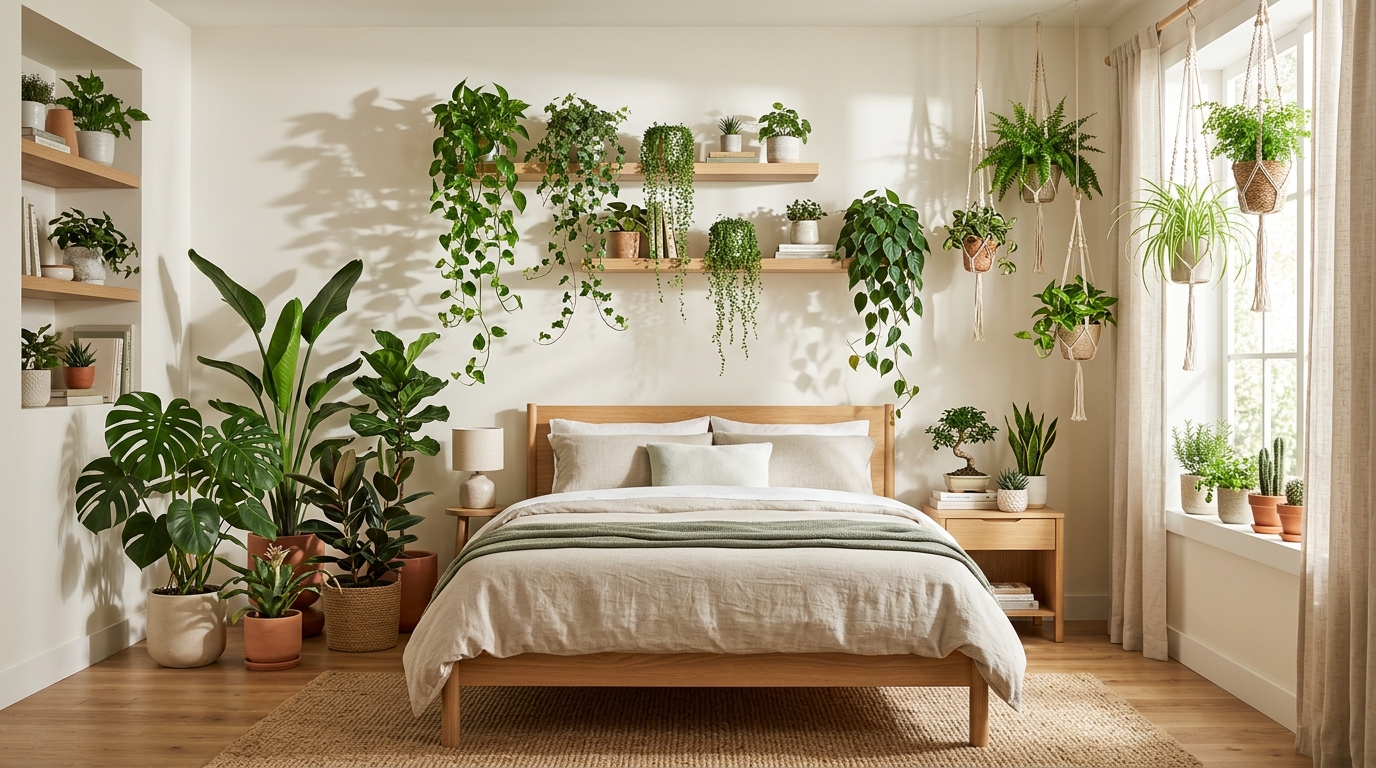
Most people treat their bedroom as the last room in the house to get plants and that is exactly backwards. A bedroom with the right plants is calmer, fresher, and more restful than one without them and the smaller, more personal scale of a bedroom means even a single well chosen plant makes an immediate difference. These 23 indoor plant ideas for bedrooms will show you how to use greenery to make your sleeping space feel genuinely better to be in.
The ideas here work across every bedroom size and every level of plant experience. Below are 23 ways to bring plants into your bedroom in a way that is both beautiful and practical.
1. Place a Peace Lily on the Nightstand
A peace lily on a nightstand is one of the most quietly perfect bedroom plant choices available. The deep green glossy leaves and the occasional white spathe bloom bring elegance and softness to a bedside surface without demanding attention the way a brightly colored plant would. Peace lilies are also one of the few flowering plants that genuinely tolerate the lower light conditions typical of most bedrooms and they are known for their air purifying qualities which suit a sleeping environment particularly well.
Keep the soil consistently moist but not waterlogged and mist the leaves occasionally to maintain the humidity the plant prefers. A peace lily in a simple white ceramic pot on a dark wood nightstand is a combination that works in almost every bedroom aesthetic from minimalist to maximalist and the plant rewards consistent care with glossy, upright foliage that always looks polished.
2. Hang a String of Hearts from a Curtain Rod
String of hearts is one of the most delicate and romantic trailing plants available and a bedroom is exactly the right room for it. The small heart shaped leaves on thin wire like stems create a cascading curtain of greenery that softens a window, a wall corner, or the space above a headboard in a way that feels genuinely intimate and considered. It grows slowly enough that it never becomes overwhelming and quickly enough that you can watch it develop week by week.
Hang it from a curtain rod bracket, a ceiling hook above the window, or a small wall mounted hook beside the bed. The semi succulent nature of the plant means it tolerates some missed waterings without complaint which suits the irregular attention most bedroom plants receive. A mature string of hearts with trails reaching two to three feet creates one of the most beautiful plant displays available in a bedroom at any price point.
3. Set a Lavender Plant on the Windowsill
Lavender in a bedroom serves a dual purpose that no other plant can claim. The fragrance it releases, particularly in the warmth of a sun filled room, has well documented calming and sleep promoting properties and the silvery green foliage and purple flower spikes are visually beautiful in a way that suits a bedroom environment perfectly. A small potted lavender on a sunny windowsill brings fragrance, color, and a gentle sensory quality to the room that purely foliage plants cannot provide.
Lavender needs a south or west facing window with direct sun to thrive indoors so it is not a plant for every bedroom. In the right light conditions however it grows well in a small terracotta pot with well draining soil and minimal watering. Brush the foliage lightly when you pass and the fragrance it releases into the room is one of the most pleasant things a bedroom plant can offer.
4. Use a Dracaena as a Tall Corner Plant
A dracaena in a bedroom corner provides height, structure, and a distinctive silhouette that works in both contemporary and traditional bedrooms. The long strap like leaves in deep green, green and yellow, or the dramatic dark red of Dracaena marginata create a plant form that reads as architectural rather than merely decorative. A tall dracaena in a corner beside a wardrobe or beside the bedroom door fills vertical space without spreading horizontally and tolerates the lower light of an interior bedroom corner better than most tall plants.
Dracaenas are slow growers which is an advantage in a bedroom where a plant that doubles in size every season would quickly outgrow its welcome. Water sparingly, allow the soil to dry out fully between waterings, and avoid placing the plant near heating or air conditioning vents which dry the leaf tips and cause browning. A well maintained dracaena in a sleek pot is a bedroom plant that holds its quality for years with minimal intervention.
5. Create a Small Plant Shelf Above the Desk
A bedroom desk or vanity area benefits enormously from a small floating shelf positioned above it dedicated entirely to plants. Three to five small plant varieties arranged on the shelf bring life and color to the workspace within the bedroom without taking up any desk surface. Compact varieties like peperomia, haworthia, small philodendrons, and mini pothos are all well suited to the scale of a desk shelf and the indirect light typical of a bedroom interior.
Keep the pots small and the plant selection compact so the shelf does not visually overwhelm the desk area below it. A shelf of plants above a desk makes the whole corner feel more intentional and considered and the presence of greenery at eye level while working or applying makeup is one of those small environmental details that improves the quality of time spent in the space in ways that are felt rather than consciously noticed.
6. Try a Calathea for Its Decorative Leaves
Calatheas are the most visually intricate plants available for a bedroom and their preference for lower light and higher humidity makes them unusually well suited to the bedroom environment. The leaves of varieties like Calathea orbifolia, Calathea medallion, and Calathea white star are painted with patterns so precise and complex they look designed rather than grown. A single calathea on a bedroom dresser or bedside table is a plant that earns sustained attention the way a piece of art does.
Calatheas are famously sensitive to tap water chlorine and fluoride which causes brown leaf edges over time. Use filtered or rainwater if possible and keep the plant away from direct sun and dry air sources. The care they require is real but the reward is a plant with foliage so beautiful that most people who see it for the first time assume it must be artificial.
7. Place a Small Cactus Collection on a Sunny Windowsill
A collection of small cacti on a bright bedroom windowsill creates a low maintenance display that suits a bedroom with strong direct sun and an owner who travels frequently or simply forgets to water. Cacti in varying forms, columnar, globular, paddle shaped, and branching, grouped together on a windowsill in terracotta pots create a small desert landscape in miniature that has a spare, graphic quality suited to a contemporary or minimalist bedroom.
Water deeply but infrequently, allowing the soil to dry completely between waterings, and the plants will thrive with almost no additional attention. Avoid placing cacti where they might be accidentally brushed against in the dark since bedroom corridors and doorways where the spine risk is real are not appropriate spots. A windowsill arrangement keeps them in the light they need and out of the traffic paths where contact is likely.
8. Hang a Macrame Plant Hanger Beside the Bed
A macrame plant hanger beside the bed holding a small trailing plant creates a bedside display that takes up no surface space and adds handmade texture to the bedroom wall. A small pothos, a compact spiderwort, or a small hoya in a hanging macrame beside the pillow level brings greenery into the immediate sleeping environment in the most intimate way possible. The organic texture of natural cotton macrame against a painted wall adds warmth and a bohemian softness that suits bedrooms particularly well.
Macrame plant hangers are available on Etsy from a wide range of makers at prices starting around fifteen to twenty five dollars. If your bedroom already has a hook in the wall or ceiling from a previous light fixture or art installation, positioning a macrame hanger there requires no additional hardware. The hanging plant at bed height is one of the most personal and distinctive bedroom plant placements available.
9. Grow a Hoya for Its Waxy Leaves and Fragrant Blooms
Hoyas are among the most rewarding bedroom plants available because they combine beautiful waxy foliage with occasional clusters of intensely fragrant star shaped flowers that perfume the room naturally without any candle or diffuser. Hoya carnosa, Hoya kerrii, and Hoya pubicalyx are all excellent bedroom varieties that trail attractively from a shelf or climb a small trellis inserted into the pot. The fragrance of hoya flowers released in the warmth of a bedroom in full bloom is one of the most pleasant plant experiences available indoors.
Hoyas prefer bright indirect light and infrequent watering which makes them well adapted to the typical bedroom environment. They bloom more readily when slightly pot bound so resist the urge to repot too frequently. A hoya that has been in the same pot for two to three years in good light will reward your patience with flower clusters that bloom repeatedly throughout the growing season and fill the bedroom with fragrance each time.
10. Use Ferns for a Lush Soft Texture
Ferns bring a quality of soft, feathery texture to a bedroom that broad leaved tropical plants cannot provide. The delicate divided fronds of a Boston fern, a kimberly queen fern, or a maidenhair fern create a lushness and a lightness simultaneously that makes the bedroom feel cooler and more serene. Grouped together on a bedroom shelf or displayed individually on a plant stand beside a window, ferns add a layer of organic softness that suits a bedroom environment better than almost any other plant category.
Ferns require consistent moisture and higher humidity than most homes naturally provide which is why they are often recommended for bathrooms. In a bedroom, a pebble tray filled with water placed under the pot or regular misting of the fronds helps maintain the humidity the plant needs. A healthy, full fern in a woven basket planter on a bedroom shelf is one of the most beautiful and lush plant displays available indoors.
11. Place an Aloe Vera on the Bedside Table
Aloe vera is the most practically useful plant a bedroom can contain. The thick fleshy leaves store a gel that treats minor burns, skin irritation, and insect bites on contact, making it the ideal plant for a bedside table where it is immediately accessible when needed. Beyond its practical value, a well grown aloe in an attractive pot has a sculptural, architectural quality that suits a modern or minimalist bedroom and the plant is virtually indestructible with the right care.
Water deeply every two to three weeks and allow the soil to dry out completely between waterings. Aloe prefers bright light so a bedside table near a window is the ideal placement. A mature aloe that has produced offsets around its base can be divided into multiple plants, giving you additional specimens for other spots in the bedroom or throughout the home at no additional cost.
12. Train an Ivy Along a Bedroom Wall
English ivy or Swedish ivy trained along a bedroom wall on small adhesive hooks creates a living wall detail that frames a window, follows a ceiling line, or traces the perimeter of a headboard wall in a way that no artwork or wallpaper replicates. The trailing stems root easily from cuttings so a single purchased plant can eventually provide enough material to fill an entire wall section given enough time and the occasional redirect of a growing stem.
Ivy is one of the most effective air purifying plants available and its trailing, climbing habit makes it uniquely suited to the architectural framing role described here. Keep it away from direct heat sources and mist the foliage regularly to prevent spider mites which are the most common problem with indoor ivy. A bedroom wall traced with growing ivy is one of those plant ideas that seems ambitious but becomes one of the most distinctive and personal features of the room once it fills in.
13. Add a Small Eucalyptus Bundle Above the Headboard
A bundle of fresh or dried eucalyptus hung above the headboard or on the wall beside the bed brings fragrance, color, and a natural organic texture to the bedroom that a potted plant cannot provide in quite the same way. Fresh eucalyptus releases a clean, clarifying scent particularly when the room is warm and the steam from a morning shower drifts through, and the silver green color of the leaves works beautifully against virtually every bedroom wall color.
Refresh the bundle with fresh eucalyptus every two to three weeks or allow it to dry in place for a longer lasting display that gradually transitions from fresh green to a soft silver grey. Eucalyptus bundles from a local florist or Trader Joe’s cost around five to eight dollars and the simple act of hanging a fresh bundle is one of the fastest and most effective ways to make a bedroom smell and feel immediately more considered and serene.
14. Choose a Philodendron Heartleaf for Trailing Softness
The heartleaf philodendron is one of the most adaptable and forgiving trailing plants available for a bedroom. The glossy heart shaped leaves in rich green trail attractively from a shelf, a hanging planter, or a pot placed on top of a wardrobe and the plant grows quickly enough to be visually rewarding while being forgiving enough to survive the inconsistent attention most bedroom plants receive. It tolerates low light better than most trailing plants and recovers quickly from underwatering without permanent damage.
A heartleaf philodendron in a simple ceramic pot on a high shelf with the trails hanging freely down the front creates one of the most effortlessly lush bedroom plant displays available. Unlike pothos which it superficially resembles, the heartleaf philodendron has a slightly velvety texture to the young leaves and a warm bronze tone when new growth emerges that adds an additional layer of visual interest to the display as the plant develops.
15. Use a Bedroom Plant to Soften Hard Corners
Every bedroom has at least one hard architectural corner where two walls meet without any furniture to soften the transition. A plant placed in that corner, whether a tall dracaena, a compact areca palm, or a cluster of smaller plants on a tiered stand, softens the geometry of the room in a way that no decorative object achieves quite as naturally. The organic form of a plant in a hard architectural corner creates a visual ease that makes the whole bedroom feel less rigid and more restful.
The plant does not need to be large to achieve this effect. A medium sized plant in a corner beside the wardrobe or behind the bedroom door fills a dead zone of the room with life and visual interest that would otherwise require a piece of furniture to address. The corner plant is one of those bedroom additions that improves the room immediately without requiring any rearrangement of what is already there.
16. Display a Terrarium on the Dresser
A glass terrarium on a bedroom dresser creates a miniature contained garden that requires almost no maintenance once established and functions as a decorative object as much as a plant display. A closed terrarium planted with moss, small ferns, and miniature tropical plants maintains its own humidity cycle and can go weeks without any watering. An open terrarium planted with small succulents and cacti suits a brighter dresser top and needs only occasional watering.
Glass terrariums in geometric shapes, cylinder forms, and hanging globe styles are all available from West Elm, CB2, and Amazon at a wide range of price points. The contained, curated quality of a well planted terrarium suits a bedroom dresser particularly well because it provides a point of visual interest that does not create any clutter or surface disruption around it.
17. Grow Herbs on a Bedroom Windowsill
A bedroom windowsill with strong direct light is the ideal location for a small collection of culinary herbs that serve the kitchen while also bringing fragrance and living greenery into the sleeping space. Basil, mint, rosemary, and thyme all grow well in small pots on a sunny windowsill and the fragrance they release into the bedroom, particularly when brushed lightly or warmed by afternoon sun, adds a sensory dimension to the room that purely ornamental plants do not provide.
Keep the herb pots small and the collection edited to three or four varieties that you actually use in cooking. A well maintained windowsill herb garden with matching small terracotta pots and simple wooden labels is a bedroom plant display that is both beautiful and genuinely functional, which is a combination that very few other indoor plant arrangements can claim.
18. Try a Chinese Evergreen for Color in Low Light
The Chinese evergreen, Aglaonema, is one of the most underappreciated bedroom plants available. The varieties with pink, red, and cream variegated leaves bring genuine color into a bedroom that receives too little light for most colorful plants to survive. Aglaonema Maria, Aglaonema red Siam, and Aglaonema pink Anyamanee are all varieties with enough leaf color to read as decorative from across the room while tolerating the low to medium light of a typical bedroom interior.
The plant is slow growing, requires infrequent watering, and holds its color well even in conditions that would cause most variegated plants to revert to plain green. A Chinese evergreen in a white ceramic pot on a bedroom shelf or dresser top brings a warmth and color into the room that is genuinely difficult to achieve with other low light tolerant plant options and the maintenance level required to keep it looking its best is appropriate for a bedroom where daily plant attention is rarely realistic.
19. Let a Plant Climb a Small Headboard Trellis
A small trellis or simple wooden frame positioned behind or beside the headboard gives a climbing plant like a pothos, a heartleaf philodendron, or a small monstera something to grow along and creates a living headboard feature that develops and changes over time. The trellis does not need to be large or elaborate. Even a simple bamboo grid or a few wooden dowels arranged in a frame is enough to guide a climbing plant into a headboard adjacent display that frames the sleeping area in greenery.
The plant and trellis combination at the head of a bed creates a bedroom feature that photographs beautifully and that improves with every week of growth. It is the kind of bedroom plant idea that starts small and becomes one of the most distinctive features of the room within a single growing season as the plant fills in and the trailing stems begin to weave through the trellis structure.
20. Use White or Neutral Pots Throughout
A bedroom plant collection that uses consistent pot colors reads as a curated design choice rather than a collection of individual plants assembled over time. White ceramic pots, natural terracotta in consistent sizes, or woven seagrass baskets used throughout the bedroom create a material cohesion that makes even a modest plant collection look considered and deliberate. The variety of plant forms and leaf colors provides all the visual interest needed without the pot choices competing with each other or with the bedroom decor around them.
Choose one pot material or color family and apply it consistently to every plant in the bedroom. The discipline of this single decision improves the overall quality of the plant display immediately and requires no additional plants, no rearrangement, and no additional cost beyond the pots themselves if you are starting fresh or gradually replacing existing pots as plants are repotted.
21. Place a Palm Beside the Wardrobe
An areca palm or parlor palm beside a wardrobe brings a tropical fullness to the bedroom that most other plants cannot match at a similar height. The feathery fronds create a soft, layered silhouette that softens the hard rectangular form of a wardrobe and the overall effect is a bedroom corner that feels significantly more lush and considered than the same corner with the wardrobe standing alone. Both areca and parlor palms tolerate the indirect light of a bedroom interior reasonably well and grow slowly enough to remain appropriately sized for several years.
The areca palm in particular has a reputation for releasing moisture into the air which slightly raises the humidity of the bedroom environment and that quality is genuinely beneficial for both plant health and the comfort of sleeping in a room that tends toward dry air, particularly in winter when heating systems reduce indoor humidity significantly.
22. Try a Succulent Arrangement in a Shallow Bowl
A shallow bowl or tray planted with a tight arrangement of succulent varieties in complementary colors and forms creates a bedroom surface display that reads as a living centerpiece rather than a collection of plants. Use a mix of rosette forming echeverias in dusty pink and sage green, a few small haworthias with their distinctive striped architectural form, and one or two compact sedums to fill the gaps. The tight planting of multiple varieties in a single shallow container creates a miniature landscape quality that individual pots cannot replicate.
Shallow bowls and trays for succulent planting are available at most garden centers and online retailers in ceramic, terracotta, and concrete. Ensure the container has drainage holes and use a fast draining cactus and succulent mix to prevent root rot. The arrangement suits a dresser top, a bedside table with good light nearby, or a bedroom windowsill and requires watering only once every two to three weeks which suits the bedroom environment perfectly.
23. Match Your Plants to Your Bedroom Aesthetic
The most important principle in building a bedroom plant collection is choosing plants that reinforce the aesthetic of the room rather than working against it. A minimalist bedroom in white and warm wood tones is served by a single large architectural plant in a simple ceramic pot. A maximalist bedroom with rich colors and layered textiles benefits from an abundant, varied plant collection in warm toned pots. A romantic bedroom with soft lighting and textural fabrics is the right home for trailing, softly formed plants in delicate hanging planters.
Plants chosen in alignment with the existing aesthetic of the bedroom feel like they belong rather than like additions placed in the room after the design was complete. This alignment between plant choice and room character is the quality that separates a bedroom plant collection that feels designed from one that simply has plants in it and it is achievable at any budget with any level of plant experience simply by looking at the room first and choosing the plant second.
Final Thoughts
A bedroom plant collection does not need to be large or expensive to transform the quality of the space. One or two plants chosen thoughtfully and placed with intention do more for a bedroom than a dozen plants placed without consideration for the room they are in. The ideas above give you a framework for building a bedroom plant display that serves both the aesthetic and the atmosphere of your sleeping space.
Start with a single plant this week, one that suits your light conditions and your level of attention, and place it somewhere in the bedroom where you will see it from the bed. That first plant is always the one that makes you want to add another and the bedroom plant collection worth having always begins exactly that way.