
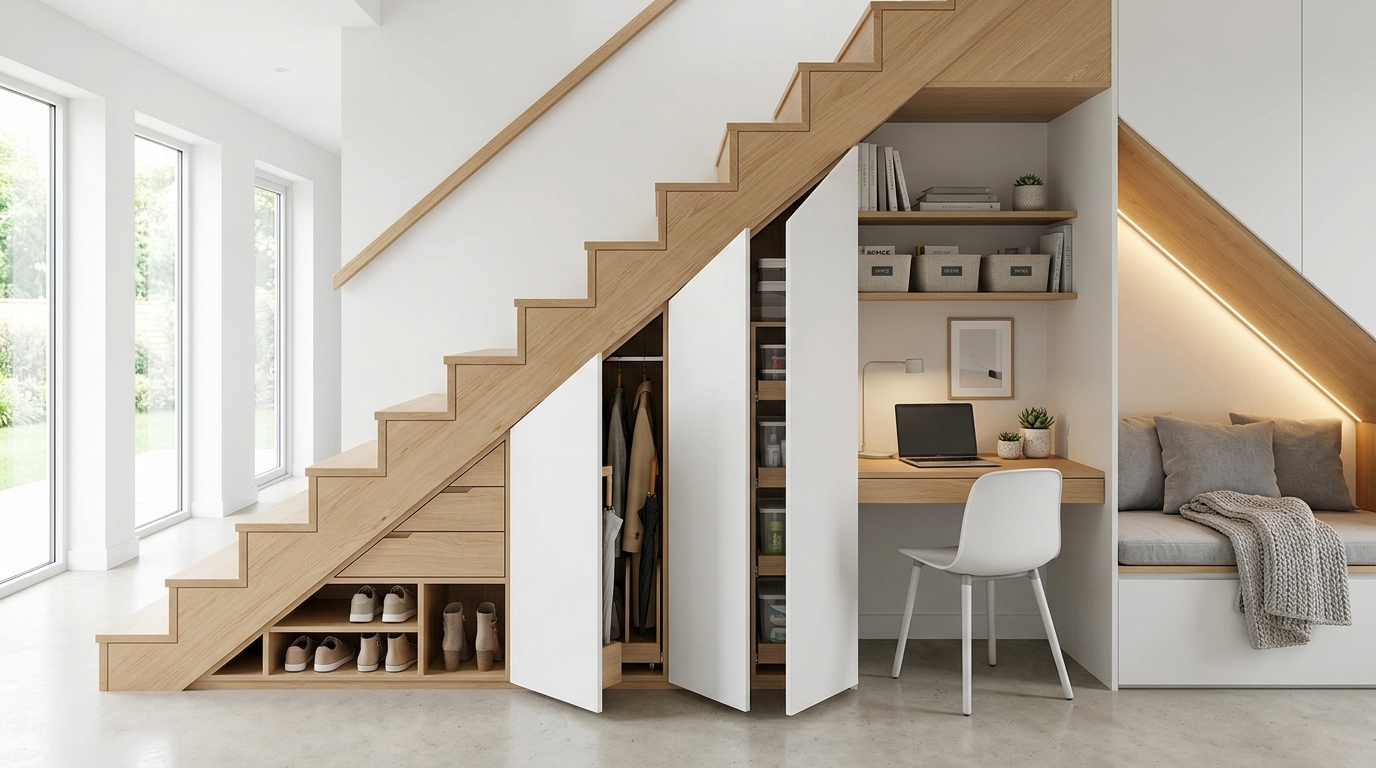
The space under the stairs is the most consistently wasted area in any two-story home. Every house that has stairs has it. Most people use it to store a vacuum cleaner, a few boxes that never get opened, and whatever else has nowhere else to go. That is not a storage solution. That is a corner that collects things.
These under stairs storage ideas focus on exactly what the space under a staircase can become: built-in shelving systems that use the full volume of the triangular space, pull-out drawers and cabinet configurations that make everything accessible, and a properly built under-stairs office that turns wasted square footage into a functional workspace. Every idea here is specific to the under-stairs zone. Nothing crosses over into general home organization or room-specific storage that belongs in other articles.
You will find 23 ideas here, each one a distinct approach to under-stairs storage depending on the configuration of the space, the budget available, and what the household actually needs from that corner of the home. Start with the idea that fits the current under-stairs situation most directly and work from there.
1. Install Open Floating Shelves Along the Full Depth of the Space
The under-stairs space is a triangle that gets taller toward the top of the staircase and shorter toward the base. Open floating shelves installed along the full depth of this triangle use every inch of the available height at each point rather than limiting storage to the lowest, most accessible section. The result is a fully visible, accessible shelving system that holds significantly more than a closed cabinet of the same footprint.
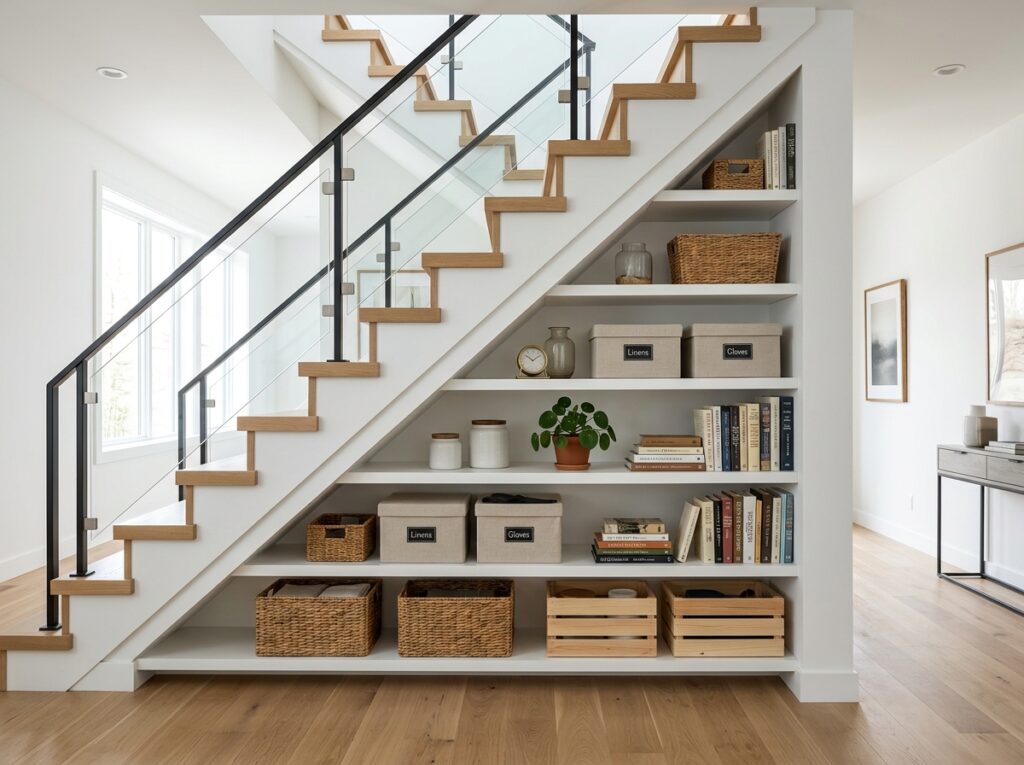
Mount shelves at consistent vertical intervals, typically 12 to 14 inches apart for standard items, from the tallest end of the space toward the shortest. Cut each shelf to the specific width available at that height rather than using uniform shelf lengths, which wastes the depth at each level. Use 3/4 inch birch plywood or MDF for shelf boards and finish with Benjamin Moore Cabinet Coat in white or a tone matching the surrounding walls. The open shelving approach costs far less than a built-in cabinet system and keeps every item visible from outside the space without reaching inside.
2. Under Stairs Storage Ideas That Save Space Start with Pull-Out Drawers
Pull-out drawers built into the closed face of an under-stairs space are the highest-function storage configuration available for this zone because they bring everything to you rather than requiring you to reach into a dark triangular cavity to find what is stored at the back. A pull-out drawer that extends the full depth of the space gives access to every item from a comfortable standing position at the front.
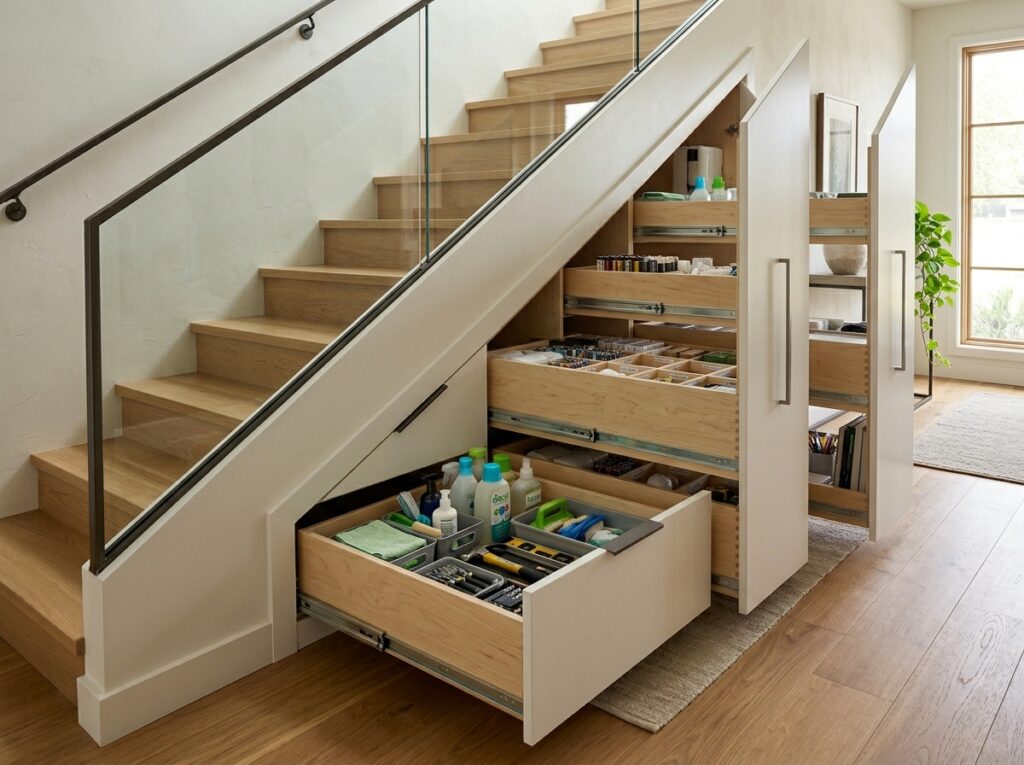
Build the drawer boxes from 3/4 inch plywood with full-extension drawer slides rated for at least 100 pounds per pair from Blum or Accuride. The drawer faces can be painted to match the surrounding trim or wrapped in the same material as adjacent cabinetry for a built-in look. A series of three to five pull-out drawers installed in the tallest section of the under-stairs space provides organized, fully accessible storage for kitchen items, cleaning supplies, household tools, or whatever the household needs most in that area of the home.
3. Build a Custom Under-Stairs Closet with a Bi-Fold Door
Converting the under-stairs space into a proper enclosed closet with a bi-fold door gives the area a finished, purposeful appearance from outside while hiding the storage inside from view. A bi-fold door rather than a swinging door is the right choice because it requires minimal clearance in front of the opening and does not block the hallway or the adjacent floor area when open.
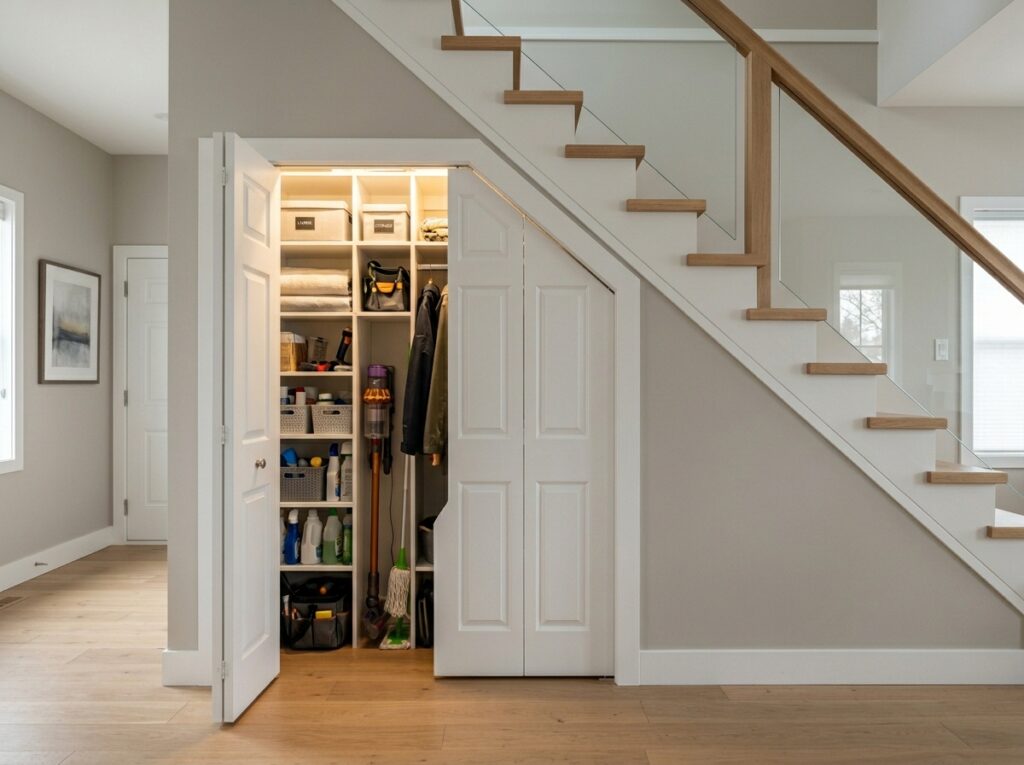
Frame the opening with standard 2 by 4 stud framing and add a standard 24 or 36-inch bi-fold door from Masonite or JELD-WEN in a style that matches the existing interior doors. Finish the interior with painted drywall or painted MDF panel lining to create a clean, organized storage space inside. Add a simple interior light on a motion sensor so the closet interior is always visible when the door opens. The Lutron Caséta Motion Sensor Light Switch installs in the existing junction box and turns the light on automatically the moment the door opens.
4. Create a Built-In Wine Rack in the Sloped Section
The sloped section of the under-stairs space where the ceiling follows the stair angle creates individual triangular cavities between each step that are perfectly sized to hold wine bottles stored horizontally. A built-in wine rack that uses these natural compartments between the stair stringers turns what is typically wasted irregular space into a functional and visually distinctive storage feature.
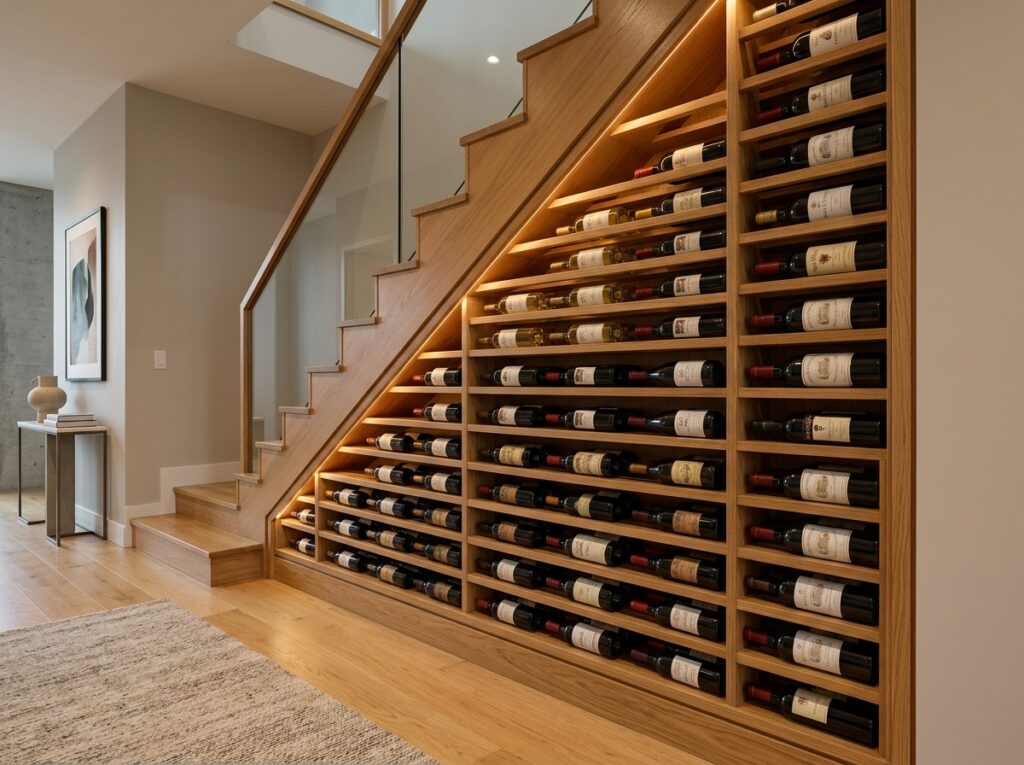
Build the wine rack from 3/4 inch pine or oak boards cut to fit between each pair of stair stringers, with individual bottle slots formed by horizontal dividers spaced 4 inches apart. Finish the wood with Minwax Polyurethane in a clear satin finish for a clean, sealed surface that handles humidity and the occasional spill. A wine rack built into this space holds 24 to 48 bottles depending on the staircase configuration and requires no floor space, no additional furniture, and no visible footprint from the room.
5. Install a Built-In Reading Nook with Bench Storage
The tallest section of the under-stairs space, at the top of the staircase where ceiling height is greatest, accommodates a built-in bench seat with enough headroom to sit comfortably. A reading nook built into this section with a cushioned bench, a small wall-mounted light, and built-in shelving on the adjacent wall turns the under-stairs corner into one of the most personal and charming spots in the home.
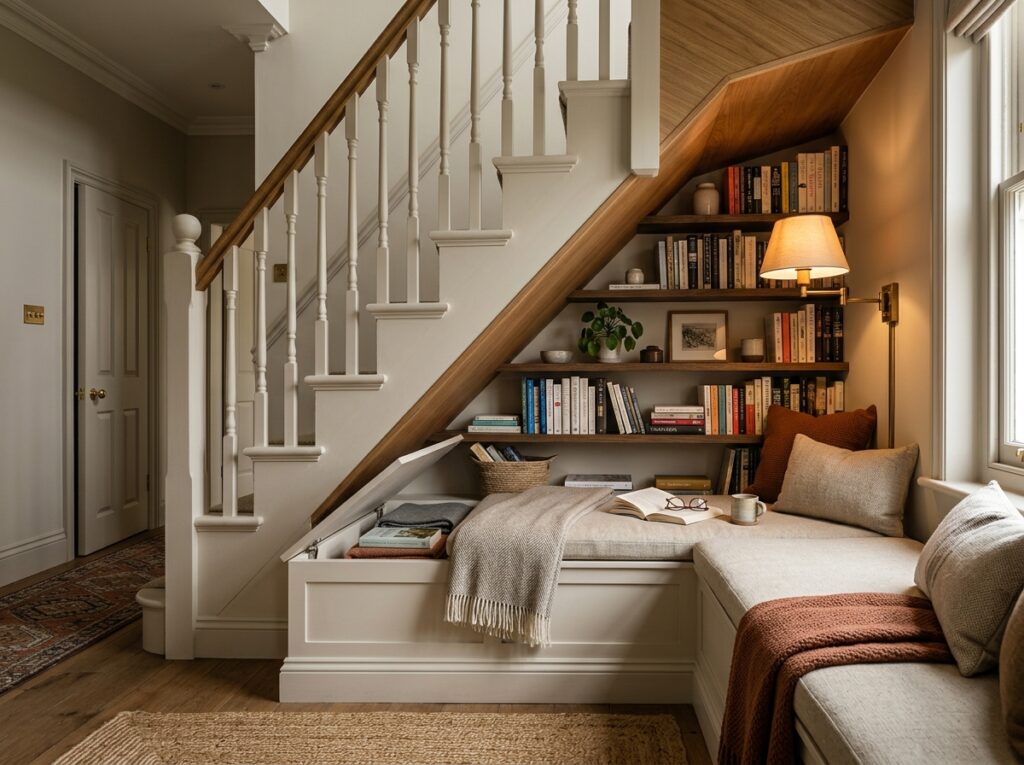
Build the bench at 18 inches high and 20 to 22 inches deep with a hinged lid that opens to reveal storage inside the bench base. Line the back wall with three or four floating shelves for books and small objects. Mount a plug-in swing-arm sconce from Schoolhouse Electric or from the Visual Comfort collection on the wall at reading height, approximately 56 to 60 inches from the floor. The nook requires the tallest section of the under-stairs space, typically at least 6 feet of clearance, and rewards that clearance requirement with a built-in feature that adds genuine character to the home.
6. Use the Space as a Dedicated Shoe Storage Zone
A household with multiple people generates a shoe storage problem that most entryways cannot solve elegantly. The under-stairs space adjacent to the front entry converts directly into a dedicated shoe storage zone that removes footwear from the entryway entirely and gives every pair of shoes a specific, organized home.

Install angled shoe shelves at 15-degree tilts from the horizontal so shoes sit with the toes down and the heels visible, which allows shelves to be spaced closer together vertically than flat shelving. A 12-inch vertical spacing between angled shoe shelves holds standard adult footwear comfortably and fits approximately 5 to 6 pairs of shoes per linear foot of shelf length. The Wayfair Rebrilliant Shoe Shelf system and the ClosetMaid Stackable Shoe Shelf both provide angled shelf configurations that install without custom carpentry for a budget-friendly shoe storage solution in under-stairs spaces with existing enclosure.
7. Under Stairs Storage Ideas Include a Dedicated Pet Zone
The under-stairs space makes a naturally sheltered, defined zone for a dog bed, a cat perch, or a pet feeding station because the sloped ceiling creates an enclosed, den-like quality that many pets seek out instinctively. A dedicated pet zone under the stairs removes the pet’s belongings from the main living areas and gives the animal a space that feels specifically theirs.
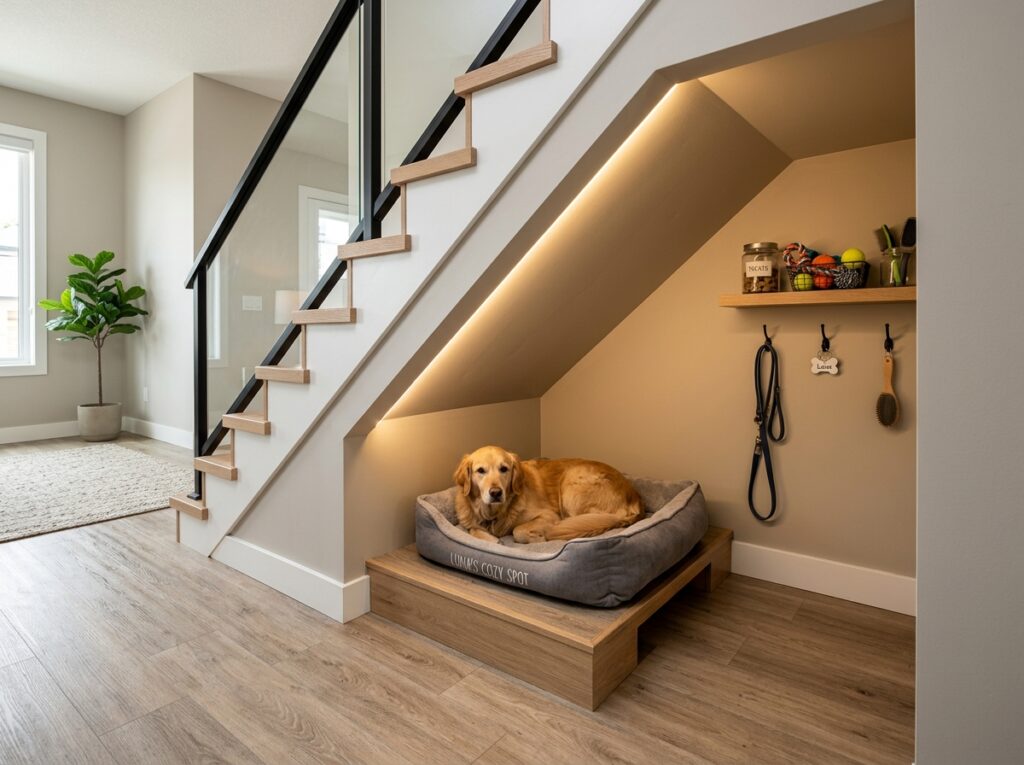
Build a low platform at 6 inches from the floor for the pet bed to sit on, which elevates the sleeping surface slightly for comfort and keeps bedding away from floor drafts. Add a wall-mounted hook for leashes and a small shelf for treats, toys, and grooming supplies. Install a low-wattage LED strip light along the ceiling of the pet zone at 2700K for a warm, calming ambient light. The Feit Electric LED Strip Light from Home Depot in warm white provides the right quality at a low operating cost. Line the floor with an easy-clean surface like luxury vinyl plank over the existing floor for simple maintenance.
8. Build Pull-Out Storage Drawers for Cleaning Supplies
Cleaning supplies stored in a hall closet or under a sink require pulling everything out to find a specific product at the back. Pull-out storage drawers under the stairs dedicated entirely to cleaning supplies give a designated, accessible home to every product in the household without requiring a dedicated cleaning closet or using cabinet space better suited for other purposes.
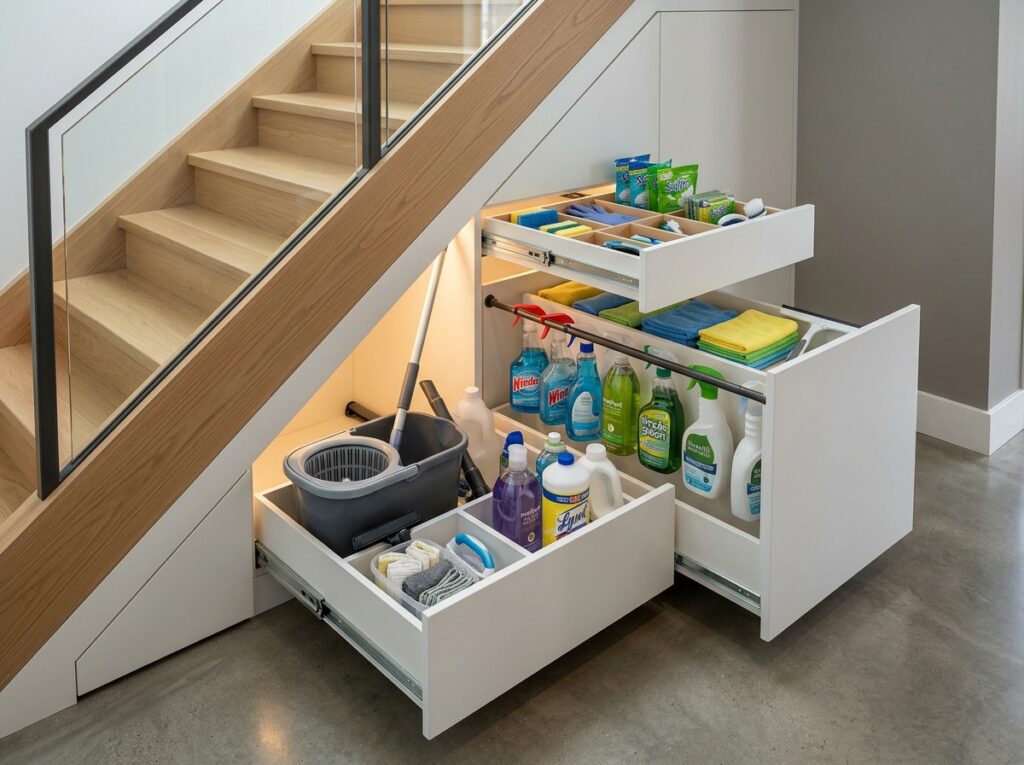
Install three deep pull-out drawers in the enclosed under-stairs section, each about 12 to 14 inches deep, with full-extension slides so the drawer fully clears the cabinet opening. Use the lowest drawer for heavy items like floor cleaners and mop buckets, the middle drawer for spray bottles and cleaning cloths, and the upper drawer for smaller items like sponges, gloves, and refill pouches. Add a tension rod across the width of the middle drawer to hang spray bottles by their trigger handles in a vertical row, which fits twice as many bottles in the same drawer space.
9. Under Stairs Storage Ideas That Save Space Use Every Angled Inch
The angled sections of the under-stairs space that cannot accommodate standard rectangular furniture are the sections most people give up on. Custom-built shelving that follows the slope of the staircase uses every inch of the available volume rather than leaving wedge-shaped gaps at the ceiling line that add up to significant wasted capacity over the full length of the staircase.
Build angled top shelves that follow the exact slope of the stair stringer rather than stopping at a horizontal cut below the angle. The angled top adds storage capacity at each shelf position and eliminates the wasted triangular void between the flat shelf top and the angled ceiling above it. Cut the shelf tops on a miter saw at the exact degree of the stair slope before installation and the fit reads as precisely built rather than improvised. This approach requires accurate measurement of the stair slope angle but adds 15 to 20 percent more usable shelf volume to a standard under-stairs build.
10. Install a Murphy Bed in the Under-Stairs Space for Guest Use
A Murphy bed, also called a wall bed, folds flat against the wall when not in use and deploys to a sleeping surface when needed. In an under-stairs space with enough ceiling height in the tallest section, typically 7 feet or more, a Murphy bed installation turns the storage area into a functional guest sleeping zone that requires zero dedicated bedroom square footage.
The Murphy Bed Depot and Wayfair’s wall bed collection both offer Murphy bed hardware kits that include the fold-down frame, gas lift springs, and mounting hardware for a DIY installation in an existing wall space. The cabinet surrounds the bed frame when it is folded up and reads as built-in storage from outside. This application requires the largest and tallest under-stairs configuration available but produces a home feature with a dramatic return on the space investment. A queen Murphy bed in an under-stairs space measures approximately 65 inches wide and 85 inches tall in the cabinet position.
11. Create Under-Stairs Pantry Storage with Deep Shelving
A kitchen located adjacent to a staircase benefits enormously from converting the under-stairs space into a dedicated pantry with deep shelves for dry goods, canned items, small appliances, and bulk food storage. The triangular space holds more pantry volume than most people expect because the depth at the back of the staircase often exceeds 24 inches, which accommodates deep pantry shelving that a standard pantry closet rarely provides.
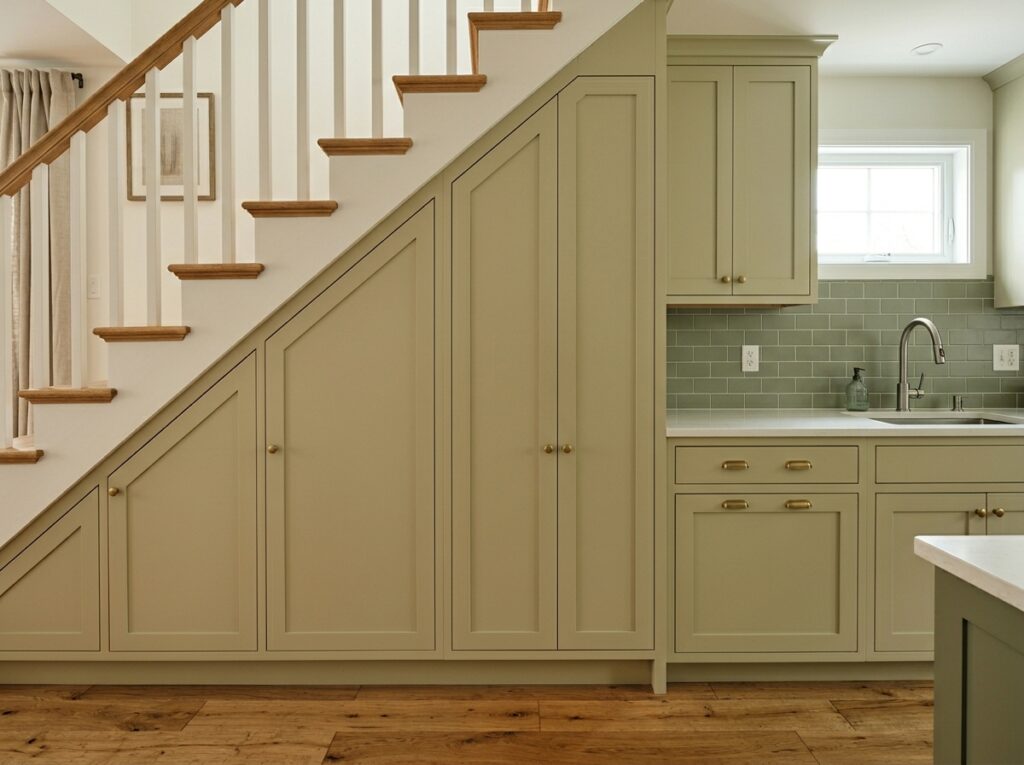
Install shelves at 12-inch vertical intervals with depths that follow the available space at each level. Use the deepest shelves at the lowest level for heavy items like bulk cooking oils, large cans, and small appliances. Use shallower shelves higher up for single-row items like spice jars, boxed goods, and frequently reached items. Face the shelves with a door in the same style as adjacent kitchen cabinetry for a cohesive built-in look. The Thomasville NOUVEAU Cabinet Door from Home Depot in a paint-grade MDF finish paints to match any kitchen cabinet color and produces a professional built-in quality at a DIY price.
12. Build a Home Office Under the Stairs
The area under a staircase with a ceiling height of at least 6.5 feet in the tallest section accommodates a fully functional home office with a desk, monitor, shelving, and seated work position in a footprint that uses space the home was already providing for free. A properly built under-stairs office is one of the most effective space-recovery projects available in a home with stairs.
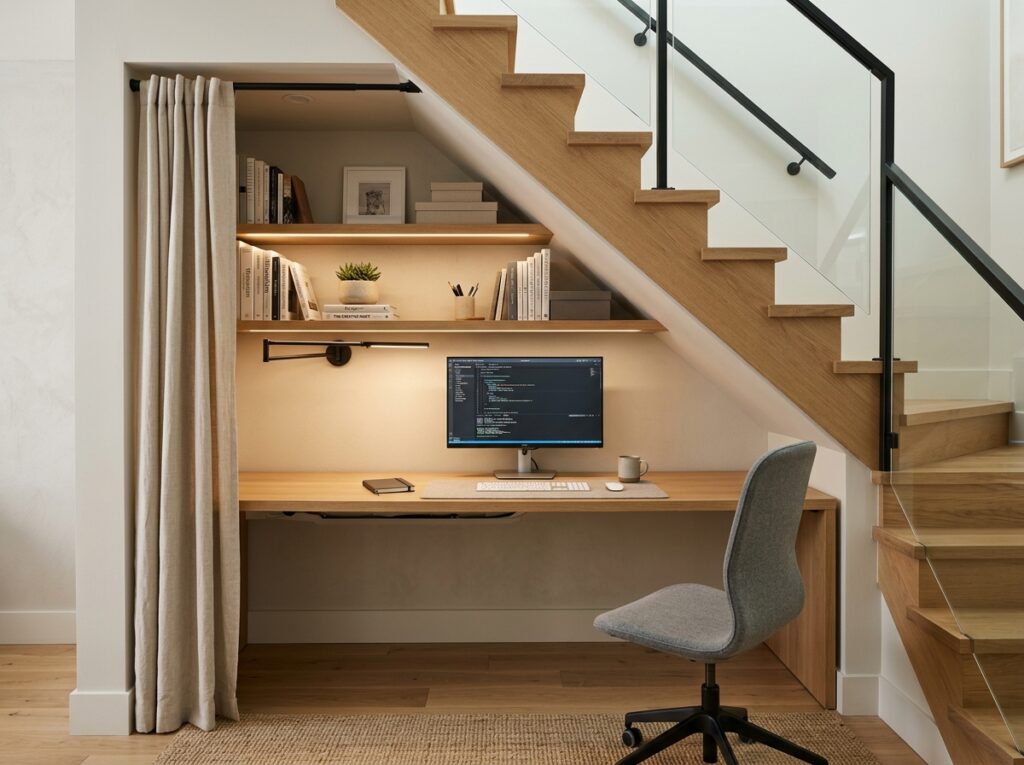
Build or install a desk at 30 inches from the floor spanning the full width of the available space at seated working height. Mount floating shelves above the desk at 18 and 30 inches above the surface for monitor height adjustment options, reference materials, and office supplies. Run a power strip along the back wall with cable management clips so all cables stay organized and off the desk surface. Install an LED desk light from BenQ or TaoTronics directly above the work surface at the correct height for task lighting. Add a simple curtain on a tension rod at the opening if visual separation from the surrounding room is wanted at the end of the workday.
13. Under Stairs Storage Ideas That Save Space Include a Mudroom Zone
A staircase located near the home entry creates the opportunity for a built-in mudroom zone under the stairs with hooks for coats and bags, a bench for sitting while removing shoes, and cubbies for organized storage of each household member’s daily items. The under-stairs mudroom consolidates entry clutter in a defined space and keeps the hallway clear.
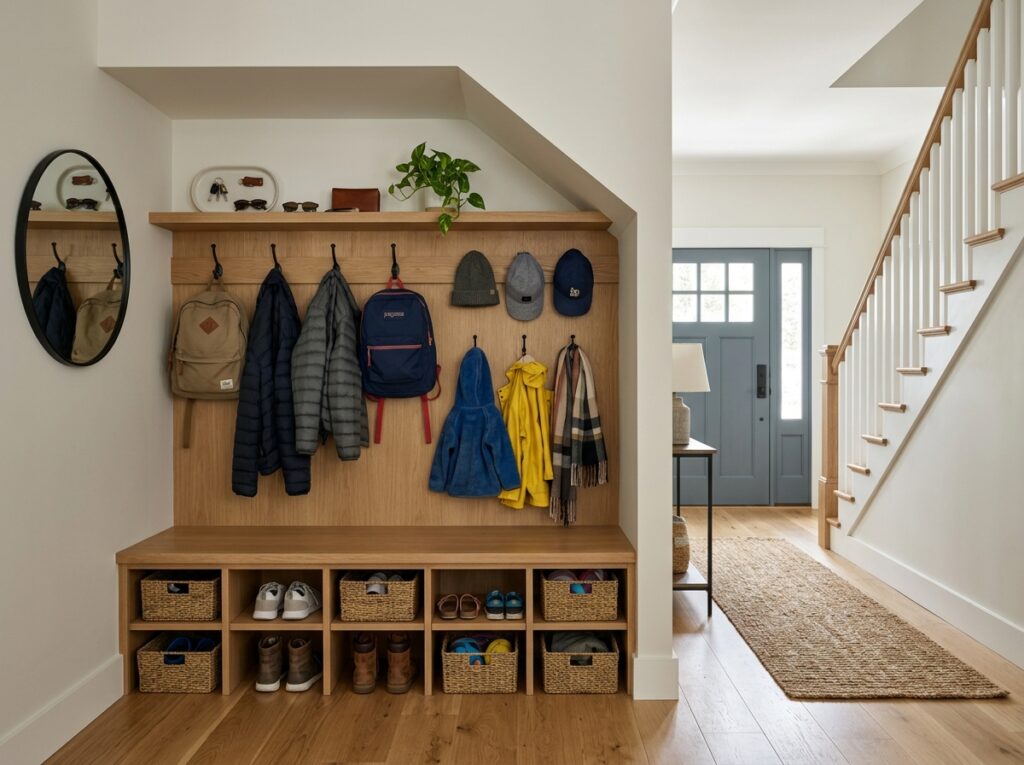
Install a row of heavy-duty hooks at adult and child heights on the back wall of the under-stairs space. Build a bench at 18 inches high across the width of the opening with cubbies below the seat for shoes, bins for hats and gloves, and a basket for miscellaneous items. The bench base cubbies work well with the Threshold Woven Seagrass Basket from Target in a consistent size for each household member. Mount a small shelf above the hooks for items that do not hang, such as sunglasses, keys, and wallets, in a small tray.
14. Install Adjustable Shelving for Maximum Flexibility
Fixed shelves built at specific heights become a limitation the moment the storage needs change, and in a busy household those needs change frequently. Adjustable shelving installed on a track system allows every shelf to be repositioned in 1-inch increments without any tools, which means the under-stairs storage adapts to what is actually being stored rather than requiring the household to adapt to the storage.
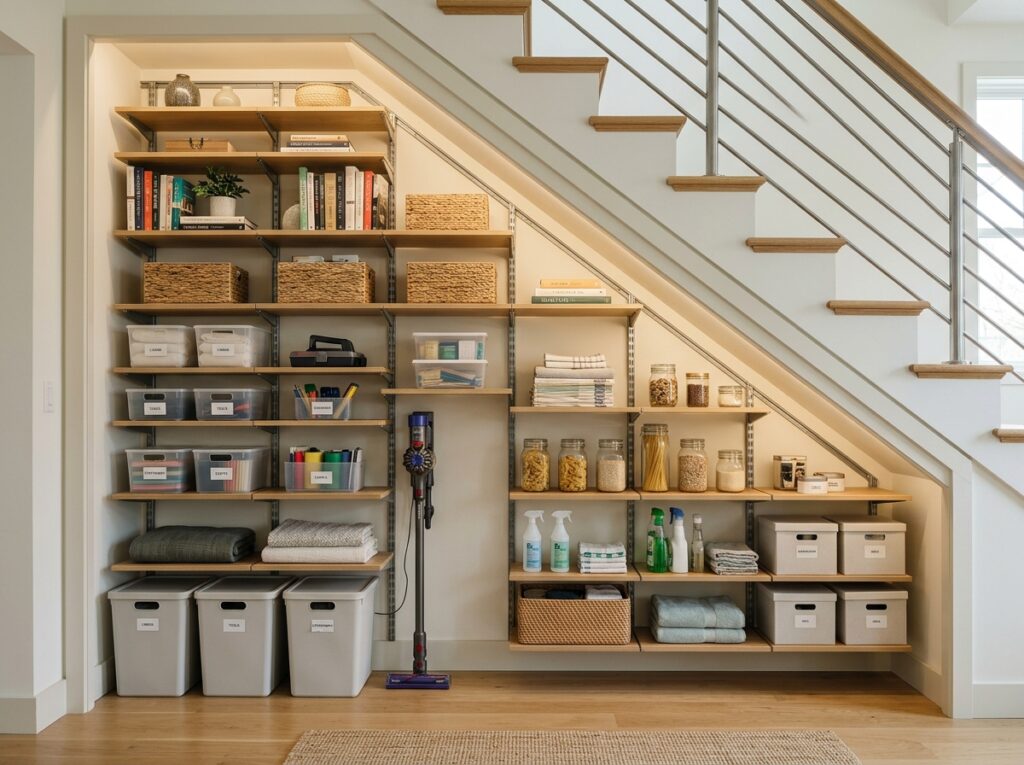
Use the ClosetMaid SuperSlide Shelf Track System or the Elfa Décor Wall-Mounted Shelving from The Container Store for an adjustable system that installs into wall studs and accepts shelf brackets at any position along the vertical track. The track system provides more flexibility than peg-and-hole adjustable shelving because the brackets are truly infinite in their positioning rather than limited to pre-drilled holes. Cover the installed track with a painted MDF frame for a clean, finished appearance that reads as built-in from outside the storage space.
15. Use the Space for a Dedicated Laundry Supply Station
A staircase located near the laundry area of the home converts the under-stairs space into a dedicated laundry supply station that removes detergents, fabric softeners, dryer sheets, and laundry accessories from the laundry room itself, which frees significant cabinet space in the laundry room for other storage needs.
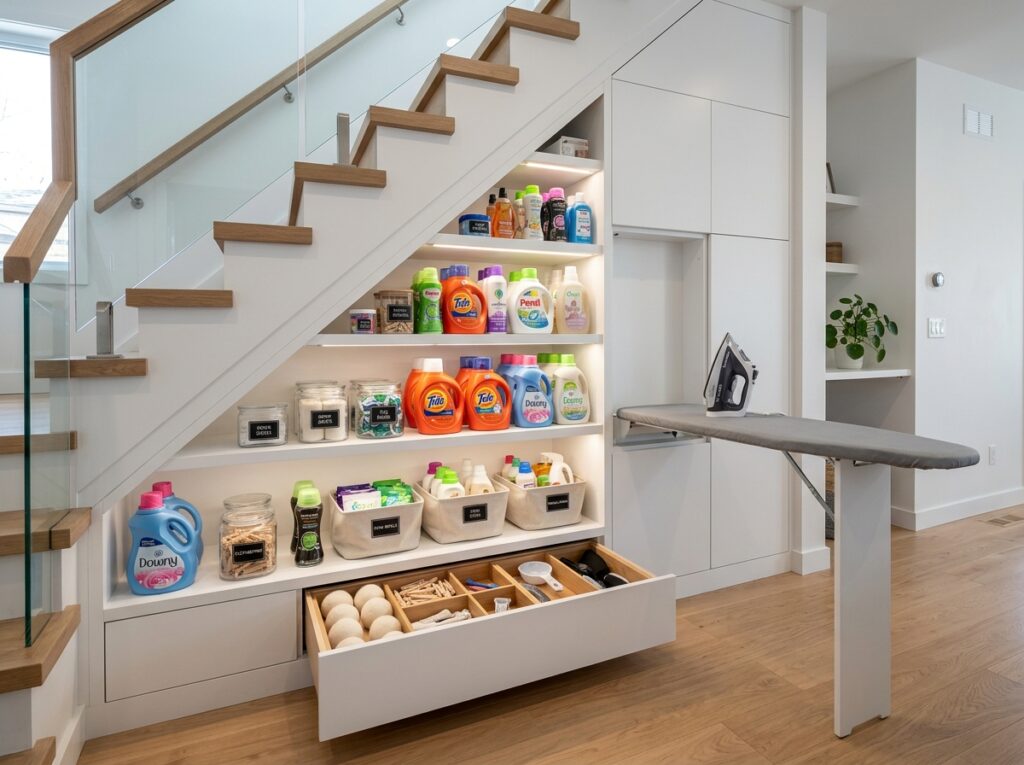
Install deep shelves at 14-inch vertical intervals for standard-sized laundry supply containers. Add a pull-out drawer at the base for dryer balls, clothespins, and small accessories. Mount a fold-down ironing board on the back wall using an in-wall ironing board mount from Organize It or from Rev-A-Shelf that folds completely flat when not in use and provides a full-size ironing surface when deployed. The fold-down ironing board eliminates the freestanding board that currently occupies floor space and stores it invisibly in the wall when not needed.
16. Build a Kids’ Play Area with Toy Storage Under the Stairs
The under-stairs space becomes a children’s play zone that uses the enclosed, scaled-down quality of the triangular space to create a dedicated area sized exactly right for young children. Built-in toy storage on the sides, a low table or play surface at child height, and a defined entry that children pass through to enter the zone gives the play area a distinct identity that makes children want to use it consistently.
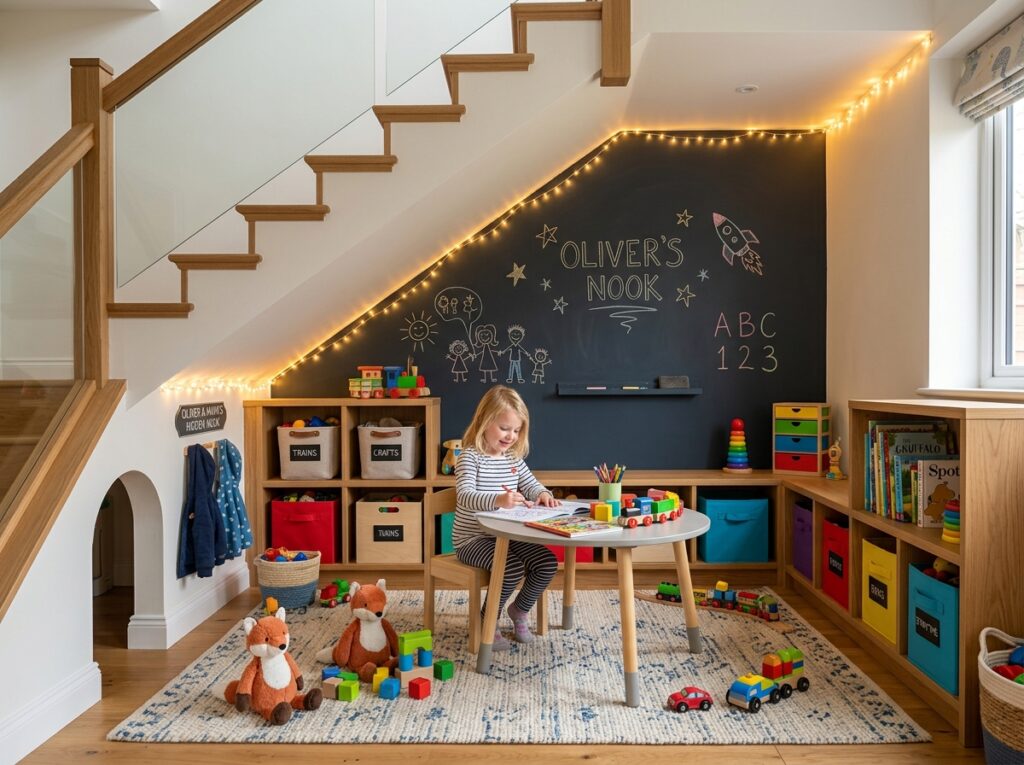
Line the walls with low shelves at 12 to 18 inches from the floor for toy bins, books, and games at child-accessible height. Use the Melissa and Doug Toy Organizer Bins or the Sterilite Stacking Drawers in bright colors for toy storage that children can manage independently. Add a chalkboard panel on the back wall using Rust-Oleum Chalkboard Spray Paint applied to a smooth MDF panel for a drawing surface that keeps chalk and markers off the walls. Install a string of warm LED lights along the ceiling perimeter of the play zone for a magical quality that makes the space feel specifically designed for the child.
17. Under Stairs Storage Ideas Work Well with a Built-In Bar Cabinet
A staircase in or adjacent to a living or dining area creates a natural location for a built-in bar cabinet that uses the under-stairs space for wine storage, spirit bottles, glassware, and bar accessories in a configuration that reads as designed rather than stored. A built-in bar under the stairs becomes a genuine home feature that adds both function and visual character to the entertaining areas of the home.
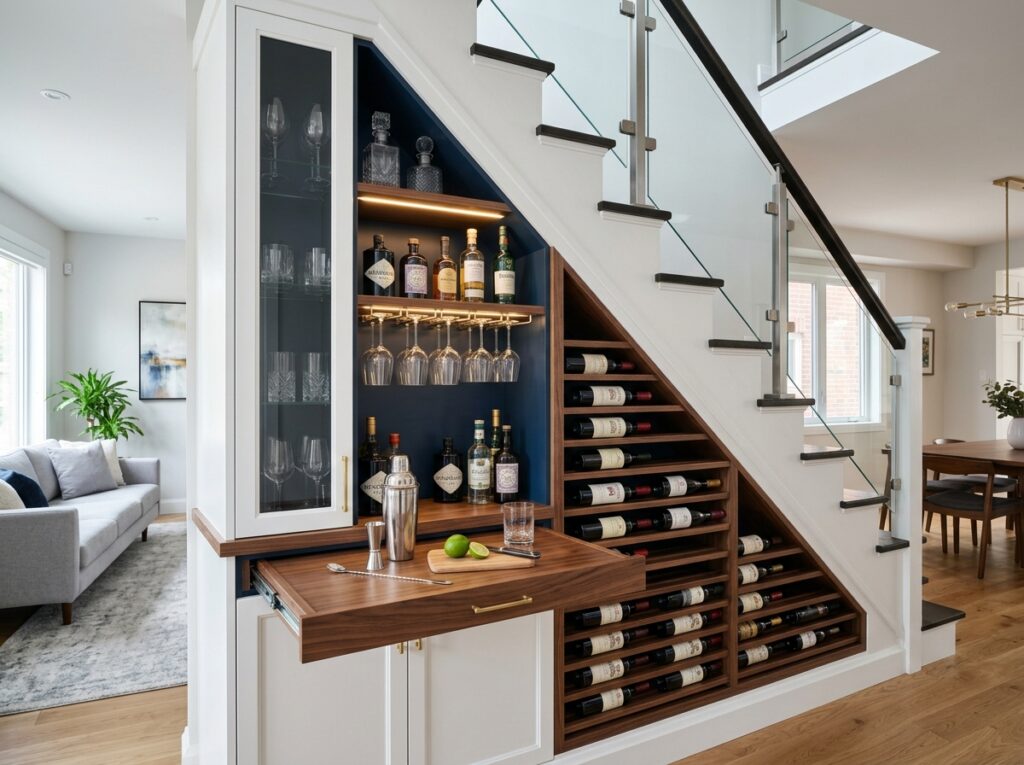
Build the cabinet with a wine rack section in the sloped area following the approach in idea 4, glass storage with dedicated stem holders in the tallest section, and a pull-out counter surface on full-extension slides that provides bar preparation space when extended and tucks fully away when not in use. Finish the interior with a contrasting paint color from the exterior, a deep navy or forest green interior against a white exterior reads as intentional and considered. Add LED strip lighting inside the glass storage section for a display quality that photographs well and shows off the glassware collection.
18. Install a Hidden Safe in the Under-Stairs Wall
The under-stairs wall cavity between the stair stringers provides a natural hidden location for a wall-mounted safe that is accessible from the living areas of the home but invisible to anyone who does not know it is there. A hidden safe under the stairs stores documents, passports, valuables, and emergency cash in a location that is both secure and genuinely out of sight.
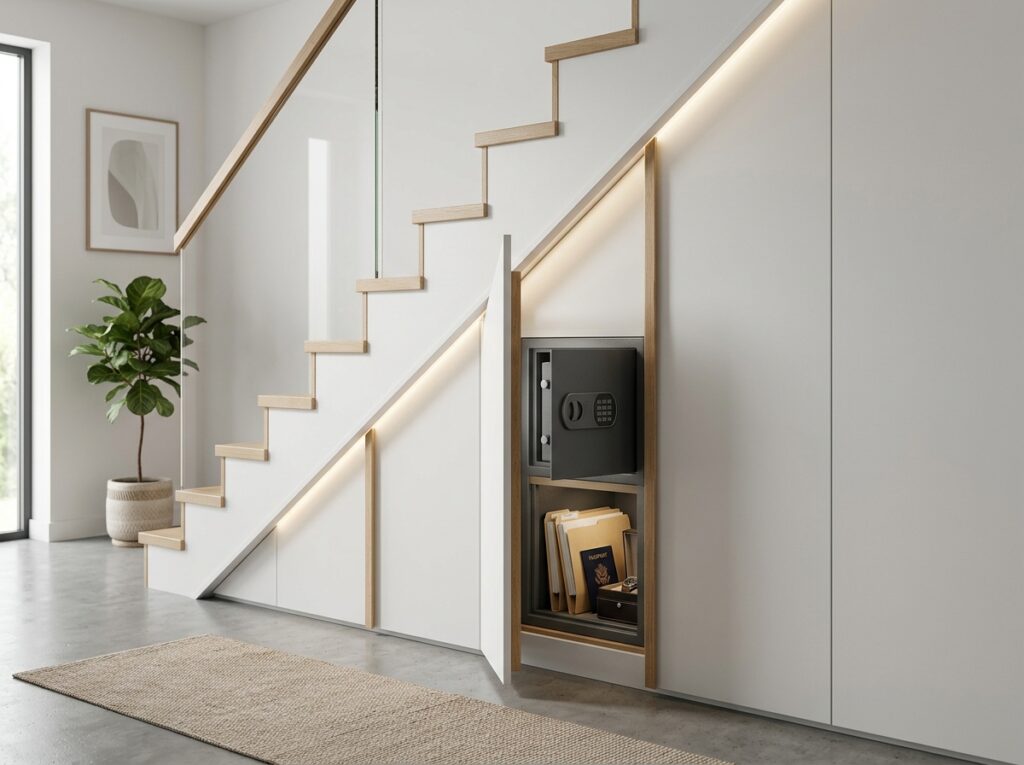
Cut a rough opening in the drywall of the under-stairs wall cavity sized for the specific safe model being installed. The SentrySafe CHW20221 Wall Safe and the First Alert 2087F Wall Safe both install in a standard stud-bay opening at 3.5 inches deep, which fits between standard 2 by 4 studs without any structural modification. Mount the safe on the wall studs through the pre-drilled mounting holes, cover the opening with a hinged picture frame or a removable panel painted to match the surrounding wall, and the safe reads as wall surface rather than storage from any angle outside the staircase.
19. Under Stairs Storage Ideas That Save Space Include a Charging Station
Every household has a phone, tablet, laptop, and assortment of device charging cables that end up on counters, tables, and nightstands without a dedicated home. An under-stairs charging station with organized cable management, individual device slots, and a central power strip gives every device in the household a specific charging location that keeps cables off countertops and devices out of the way when not in use.
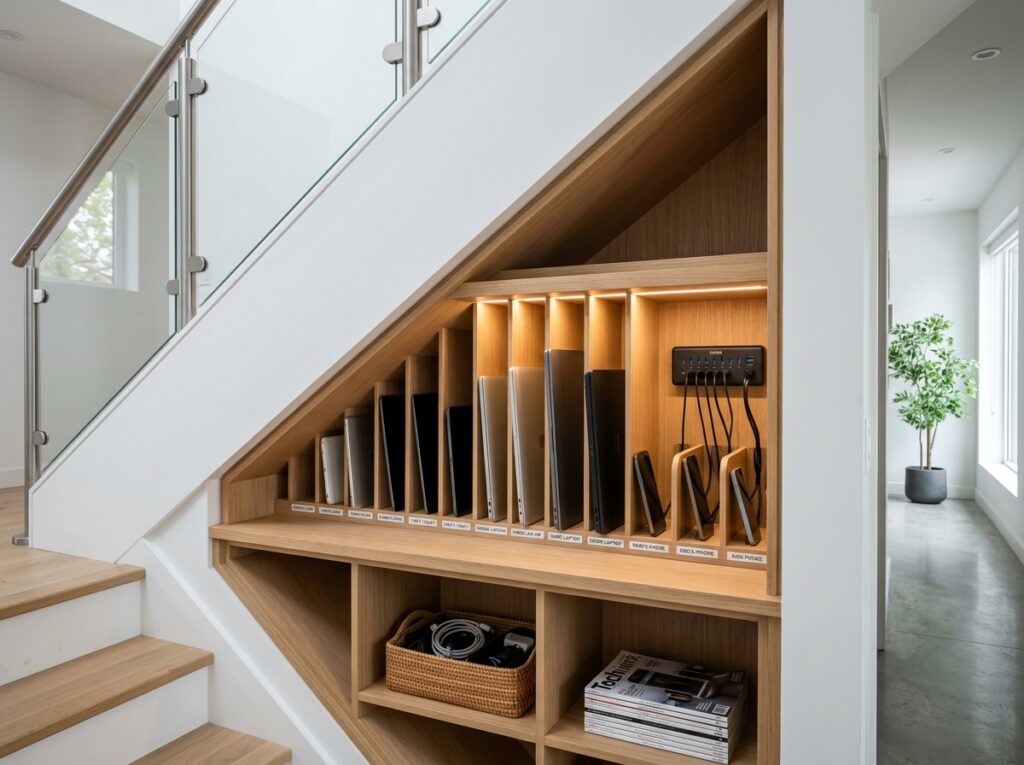
Build a dedicated charging shelf at a comfortable standing height with individual vertical slots for tablets and laptops using thin wood dividers spaced 1.5 to 2 inches apart. Mount a Anker USB Charging Station with 10 ports on the back wall of the shelf and route cables from the station to each device slot. Label each slot with the device name using a Brady label maker. The charging station organizes every device in the household in a single location and eliminates the scattered cable problem from every other surface in the home.
20. Create a Gift Wrapping Station in the Under-Stairs Space
Gift wrapping supplies are one of the most consistently disorganized categories in any household because they are used infrequently but require a large surface when needed and come in formats, rolls of paper, spools of ribbon, boxes of varying sizes, that do not store neatly in standard shelf configurations. A dedicated gift wrapping station under the stairs solves all of these problems in a space that is otherwise difficult to use for anything else.
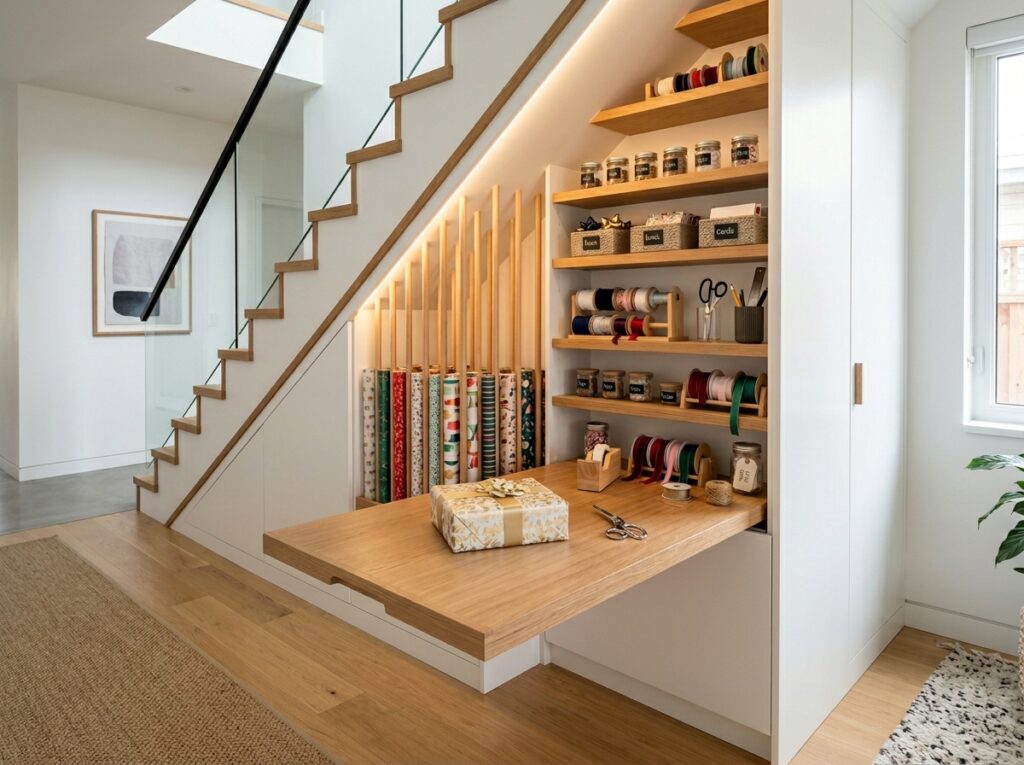
Install a fold-down table surface on full-extension hardware at 36 inches from the floor for the wrapping surface when in use. Mount vertical dowels on the back wall spaced 6 inches apart for rolls of wrapping paper stored upright and accessible by pattern. Add a small shelf for ribbon spools, tape dispensers, scissors, and tags. The Container Store Gift Wrap Organizer and the Wayfair Rebrilliant Wrapping Paper Storage both provide modular systems that work within a custom built-in space. Keep the station closed for the 350 days a year it is not being used and fully functional for the times it is.
21. Build Stepped Display Shelving That Follows the Stair Profile
The underside of a staircase follows a stepped profile of equal risers and treads that creates a naturally geometric shelf pattern when shelves are built to align exactly with each stair step above. Stepped display shelving that mirrors the stair geometry above it gives the under-stairs wall an architectural, designed quality that reads as a professional installation from across the room.
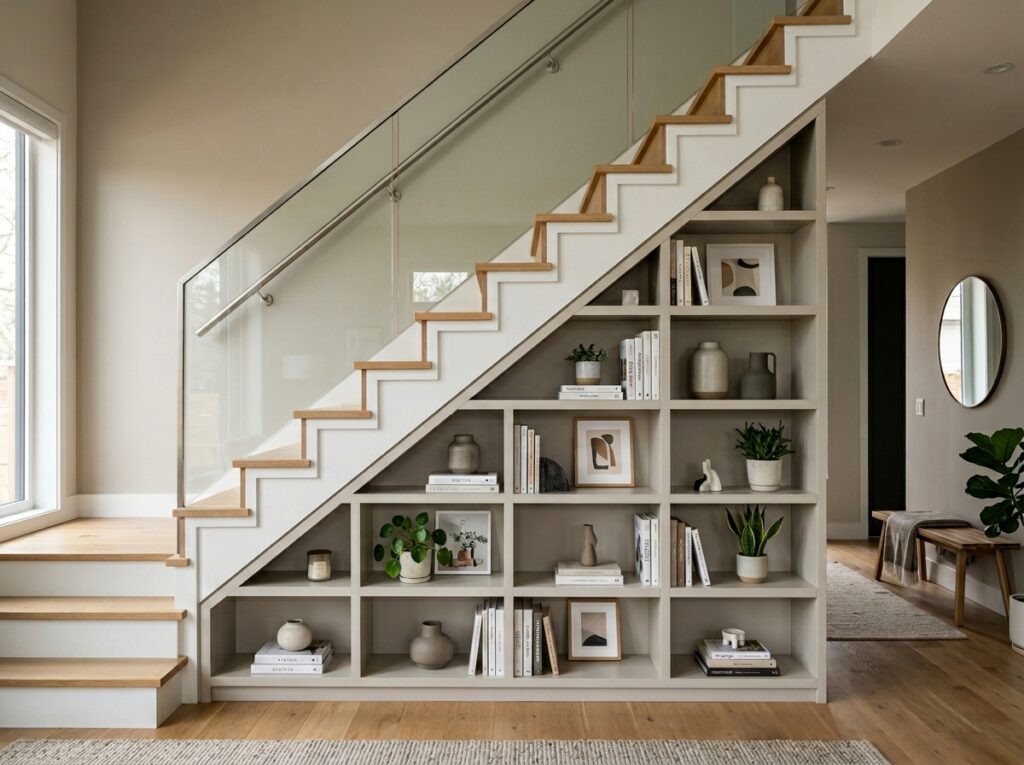
Build each shelf to a depth that matches the tread depth of the stair above it, typically 10 to 11 inches, and a height from the floor that increases by one riser height, typically 7 to 8 inches, for each shelf from front to back. The result is a staircase-shaped shelf configuration that uses the geometry of the structure above as its organizing principle. Style the stepped shelves with plants, books, ceramics, and objects at each level so the display reads as intentional rather than incidental. This application suits an open under-stairs space visible from the living area where the display quality matters as much as the storage capacity.
22. Under Stairs Storage Ideas That Save Space Use Labeled Bins Consistently
Any under-stairs storage system, regardless of how well it is built, fails to maintain its organization over time if the items stored inside it are not labeled and categorized from the start. Labeled bins in a consistent size and material throughout the under-stairs storage are the difference between a system that holds its organization for years and one that reverts to chaos within a few months of the initial setup.
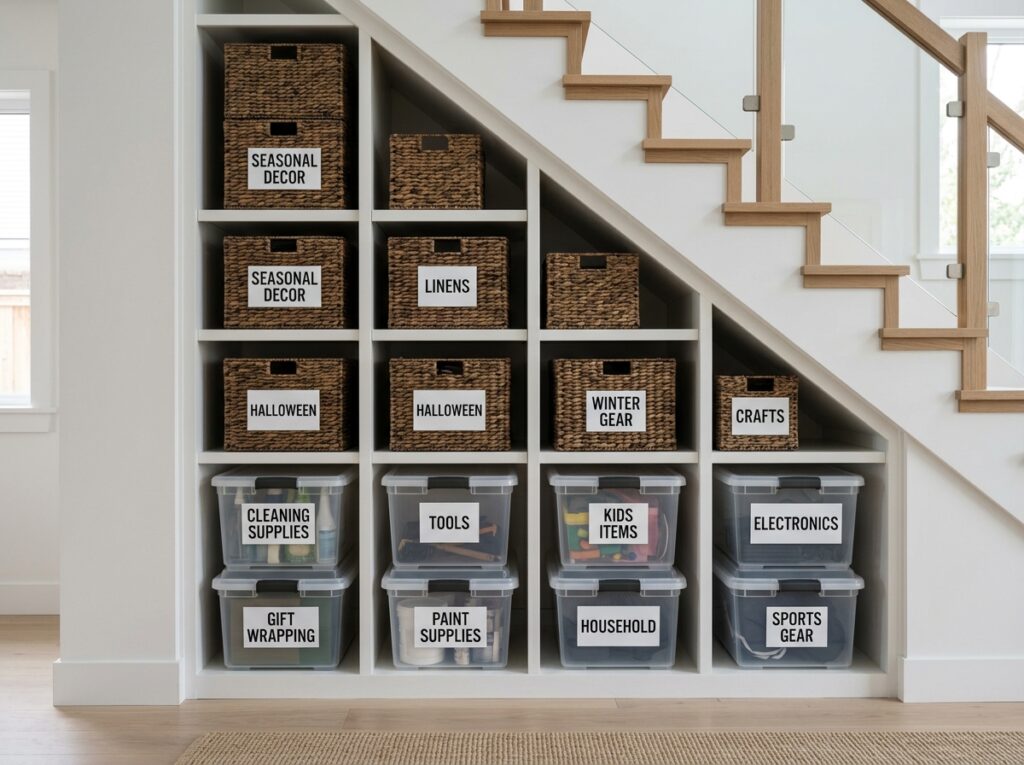
Use the Threshold Lidded Woven Storage Basket from Target or the Rubbermaid Cleverstore Tote in a single consistent size throughout the entire under-stairs storage area. Label every bin on the front face with a Brady Label Maker using a large, readable font that is visible from standing height. Assign one category per bin and enforce the rule that everything in that category lives in that bin exclusively. The organizational quality of the under-stairs space is determined more by this labeling discipline than by the quality of the shelving it sits on.
23. Install Interior Lighting in Every Under-Stairs Storage Zone
Under-stairs storage spaces are naturally dark because the staircase blocks overhead light from reaching the interior of the space. A storage area without adequate lighting gets used less, gets organized less, and accumulates clutter faster because the darkness makes it feel like a space where things go to be forgotten rather than a space designed for organized storage.
Install LED strip lighting along the ceiling perimeter of the under-stairs space using the Govee Smart LED Strip Light or the Feit Electric LED Tape Light from Costco. Both adhere directly to the ceiling surface with the included adhesive backing and connect to a standard outlet. Set the strips to a warm white at 3000K for a welcoming quality rather than the cool blue-white that makes storage spaces feel clinical. Add a motion sensor switch so the light activates automatically when the storage area is accessed and turns off after a set period without motion, which eliminates the need to reach for a switch in a space where both hands are typically occupied.
Conclusion
The under-stairs space in most homes is the last area to get organized and the first to reflect how the household actually functions when nobody is paying attention to it. A space that holds random boxes and a forgotten vacuum cleaner communicates that the house has run out of ideas. A space that holds organized pull-out drawers, a built-in office, a proper pantry, or a reading nook communicates the opposite.
Start with the measurement. The ceiling height at the tallest point and the total depth of the space are the two numbers that determine which ideas on this list are actually available to you. From there, these under stairs storage ideas give you 23 specific directions, and the right one is the direction that solves the biggest daily storage problem the household currently has.