
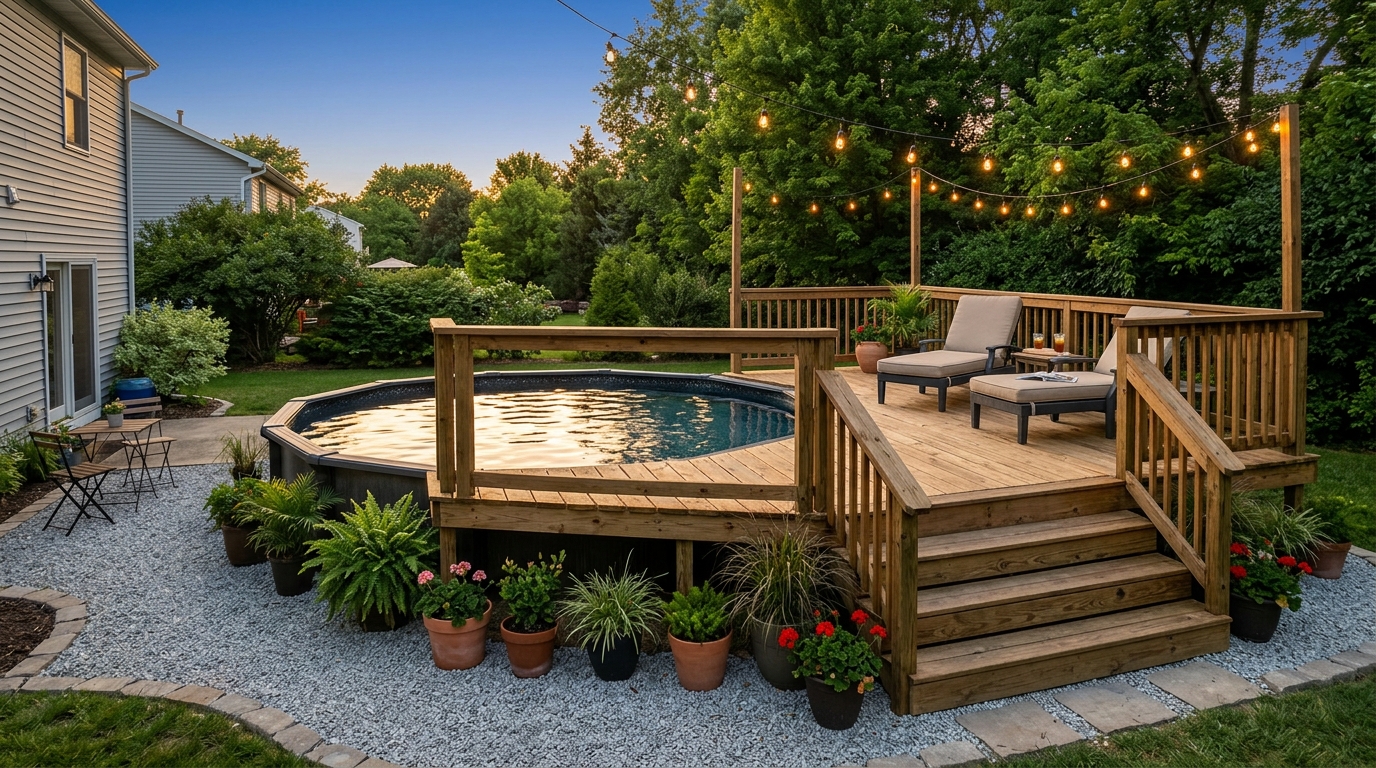
An above ground pool without a deck looks exactly like what it is: a temporary structure sitting in the backyard waiting for someone to do something with it. An above ground pool with a proper deck around it looks like a backyard that was designed for summer. The difference in how much time the pool actually gets used is significant, because a deck gives the whole setup a reason to stay outside even when you are not in the water.
These above ground pool deck ideas on a budget focus on the three things that make a pool deck work: the deck materials that hold up to water, sun, and bare feet, the furniture that turns the deck surface into a place to actually be, and the lighting that makes the pool usable after dark. No pergola builds, no fire pit projects, no garden ideas. Just the deck, the furniture on it, and the lights around it.
You will find 18 ideas here, each one a distinct decision about the deck itself or what goes on it. Some require a full weekend of building. Some require an afternoon of furniture arrangement and a box of solar lights. All of them make the pool feel like a proper backyard feature rather than an inflatable embarrassment.
Build a Simple Platform Deck Around One Side of the Pool
A platform deck does not need to wrap the entire pool to make a difference. A single platform section on the entry side of the pool, the side where the ladder is, gives people a proper surface to stand on when getting in and out and creates an organized zone beside the pool without requiring the lumber and labor cost of a full wrap-around deck.
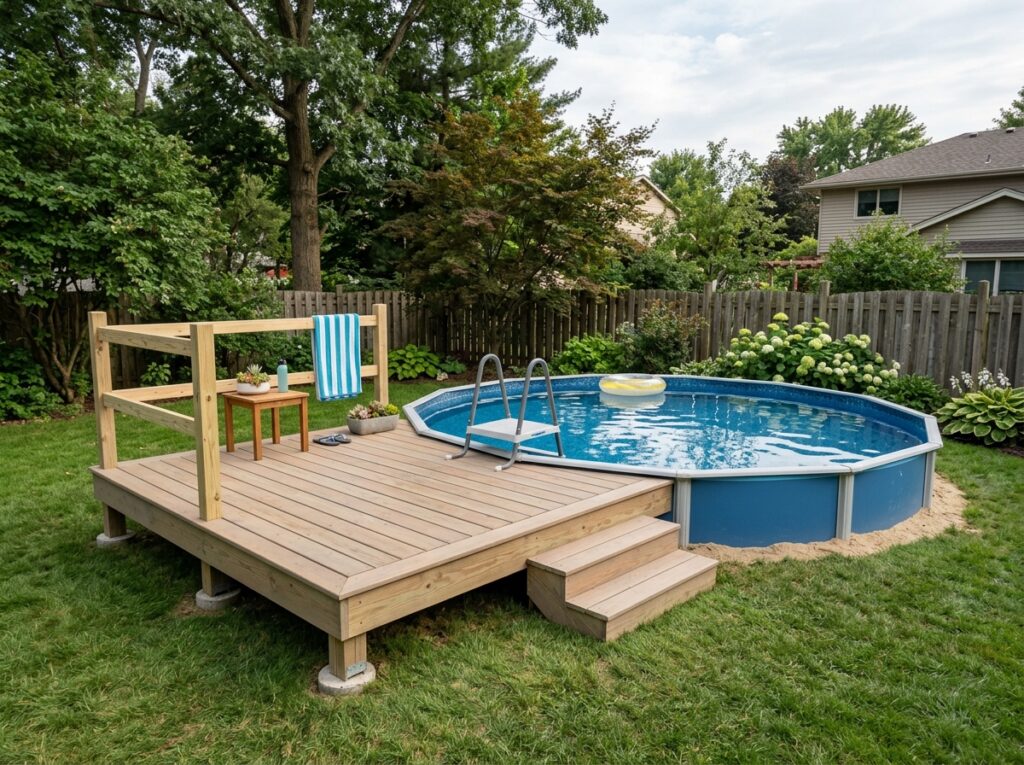
Build the platform from pressure-treated 4 by 4 posts as footings, 2 by 8 joists as the frame, and 5/4 by 6 inch composite or pressure-treated deck boards as the surface. A 10 by 12 foot platform beside a standard 15-foot round pool costs between 400 and 700 dollars in materials depending on whether composite or pressure-treated wood is used and gives the pool area a foundation that makes everything else feel anchored. Apply Defy Extreme Wood Stain in a natural cedar or driftwood tone to pressure-treated lumber for a finished look and UV protection that extends the life of the wood significantly beyond unstained pressure-treated surfaces.
Use Composite Decking Boards for Low-Maintenance Durability
Pressure-treated wood is the less expensive material choice for a pool deck but it requires annual sealing, occasional sanding, and replacement of individual boards as they split and warp over years of pool water exposure. Composite decking boards cost more upfront but require almost no maintenance, never need sealing, do not splinter underfoot, and look as good after five years as they did on installation day.
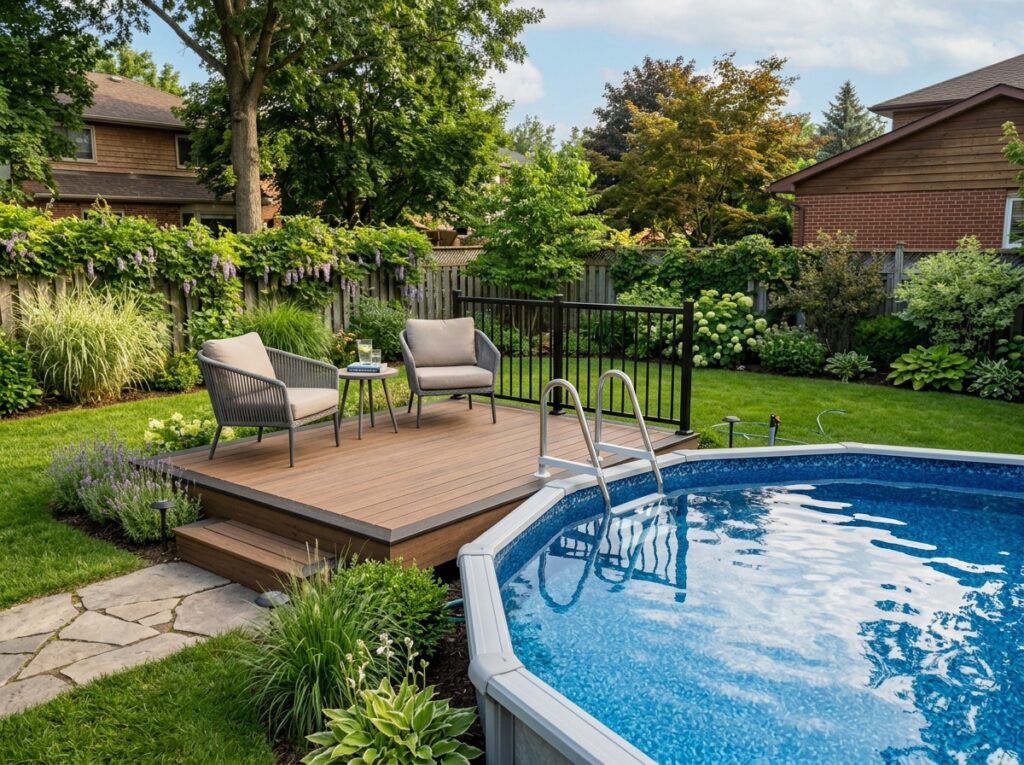
Trex Select and TimberTech AZEK are the two most widely available composite decking brands at Home Depot and Lowe’s. Trex Select in Woodland Brown or Pebble Grey runs about 3 to 4 dollars per linear foot and comes with a 25-year limited warranty against fading, staining, and structural damage. The initial cost difference between composite and pressure-treated for a 10 by 12 foot platform is typically 200 to 400 dollars, which the elimination of annual sealing costs recovers within three to four seasons. For a pool deck that will see daily use through every summer, composite is the material that holds its quality.
Lay Interlocking Deck Tiles Around the Pool Base
Interlocking deck tiles that snap together on a flat surface require no posts, no joists, no framing, and no concrete. They lay directly on level ground or an existing concrete surface and create an instant deck appearance in a single afternoon. Around the base of an above ground pool on level ground, a perimeter of interlocking tiles gives the entire pool a finished, intentional look without any construction work at all.
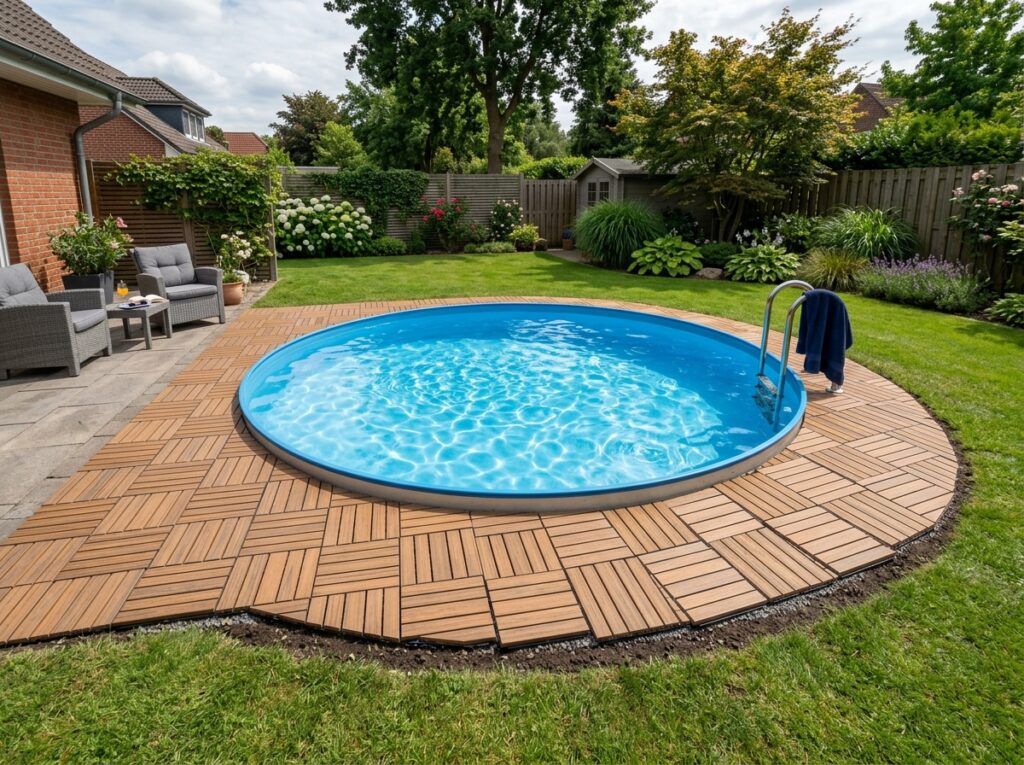
Vifah Miramar Wood Composite Deck Tiles, the IncStores Outdoor Patio Tiles in teak, and the NATCO Port-a-Floor Deck Tiles all snap together in a 12 by 12 inch grid that can be arranged in any configuration and expanded or reconfigured as needed. A 10-pack of 12 by 12 inch tiles covers about 10 square feet and costs between 30 and 60 dollars depending on the material. Use teak or acacia wood composite tiles for the warmest, most natural look or gray composite for something more contemporary. The tiles float above the ground surface and drainage gaps between them prevent standing water from pooling under the deck surface.
Above Ground Pool Deck Ideas on a Budget Include a Pallet Wood Deck
Shipping pallets repurposed as deck panels cost almost nothing in materials and create a rustic, warm-toned deck surface around an above ground pool for the price of some fasteners and a weekend afternoon. Each pallet sits flat on level ground or on short footings and the gaps between the deck boards provide natural drainage that prevents water from pooling on the surface after splashing or rain.
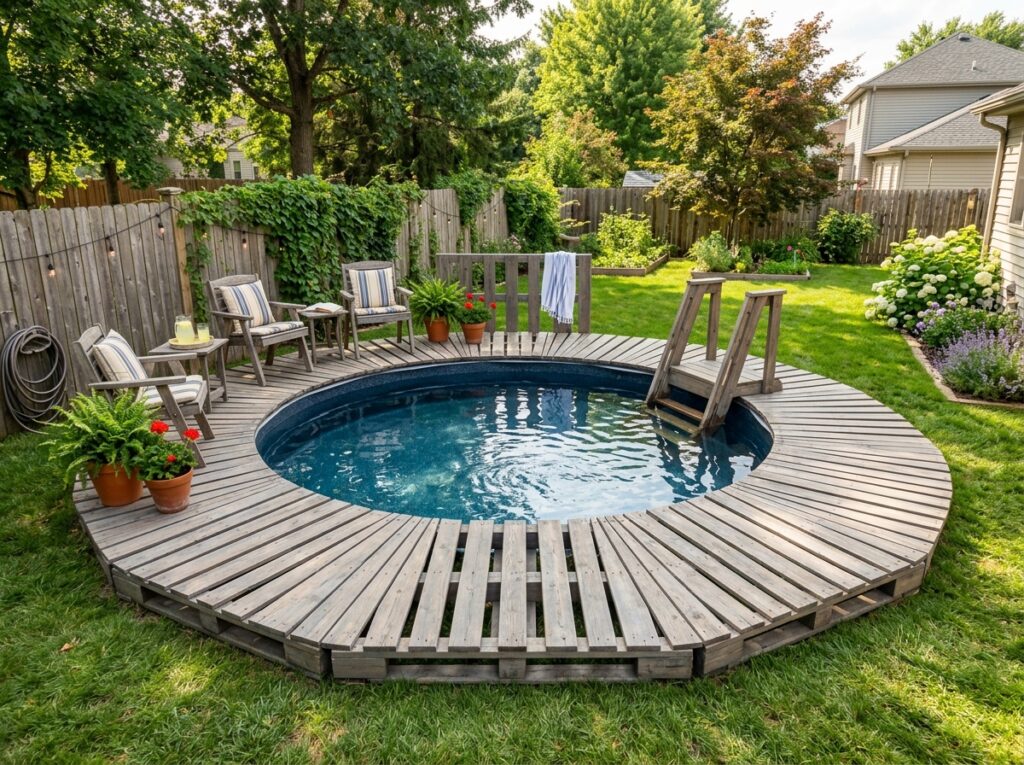
Source heat-treated pallets stamped HT from local hardware stores, garden centers, or the Facebook Marketplace free section. Sand all surfaces thoroughly with 80-grit sandpaper to remove splinters, then 120-grit for a smoother finish, and apply a coat of Rust-Oleum Deck and Concrete Restore in a weathered gray or natural cedar tone for UV protection and water resistance. Arrange the pallets in a configuration that fits the pool shape and secure adjacent pallets to each other with deck screws through the side framing to prevent shifting. The finished deck costs the price of stain and fasteners.
Choose Pressure-Treated Lumber for the Frame and Cedar for the Surface
A hybrid deck using pressure-treated lumber for the structural frame and cedar boards for the visible surface gives the best combination of structural longevity and surface quality at a cost that stays well below full cedar construction. The pressure-treated frame handles ground contact and moisture from below without the decay risk that untreated wood faces. The cedar surface boards provide a naturally splinter-resistant, warm-toned walking surface that looks and feels significantly better underfoot than pressure-treated boards.
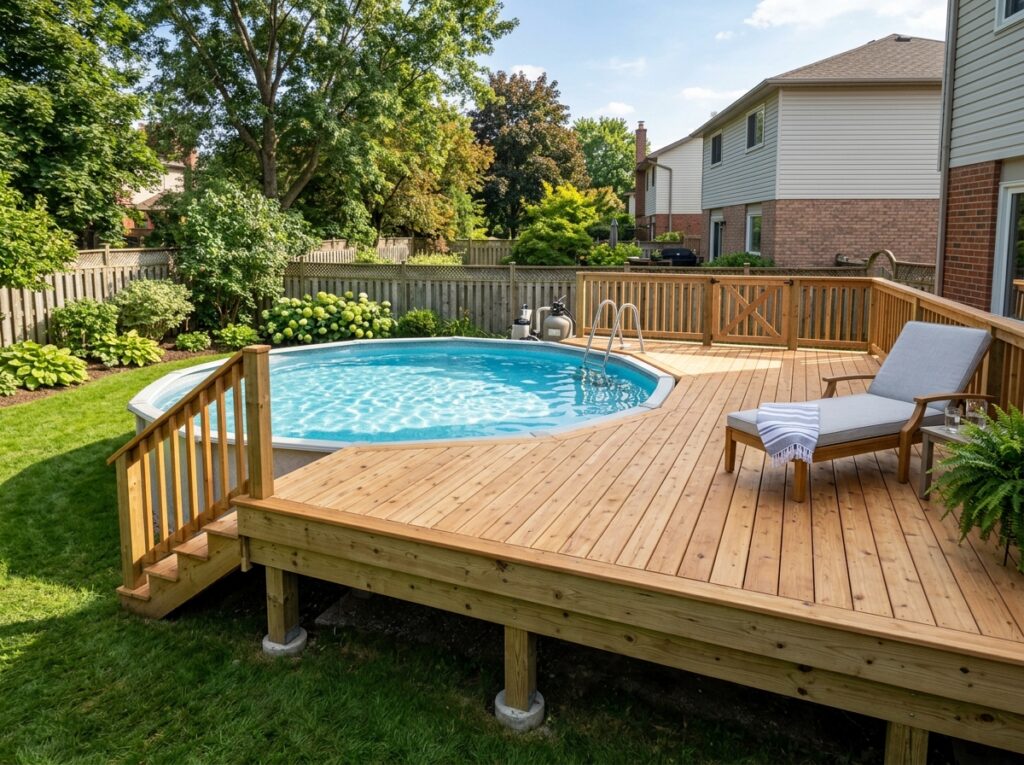
Use 4 by 4 pressure-treated posts as footings, 2 by 8 pressure-treated lumber for joists and beams, and 1 by 6 or 5/4 by 6 cedar boards for the deck surface. Space the cedar boards 1/8 to 1/4 inch apart for drainage. Cedar requires no sealing to hold up outdoors but benefits from one coat of Cabot Australian Timber Oil in a natural finish to maintain its warm color tone rather than allowing it to silver-gray over time. The surface oil costs about 40 dollars per gallon and covers approximately 150 square feet of deck boards in a single coat.
Add Outdoor Furniture That Stays Wet Without Degrading
The furniture on an above ground pool deck gets wet. Every single day. Cushion covers absorb pool water and chlorine, wood frames swell and split with repeated wetting and drying, and anything with metal components that is not properly powder-coated will show rust within a single season. The furniture decision for a pool deck is different from any other outdoor furniture decision because the material requirements are stricter.
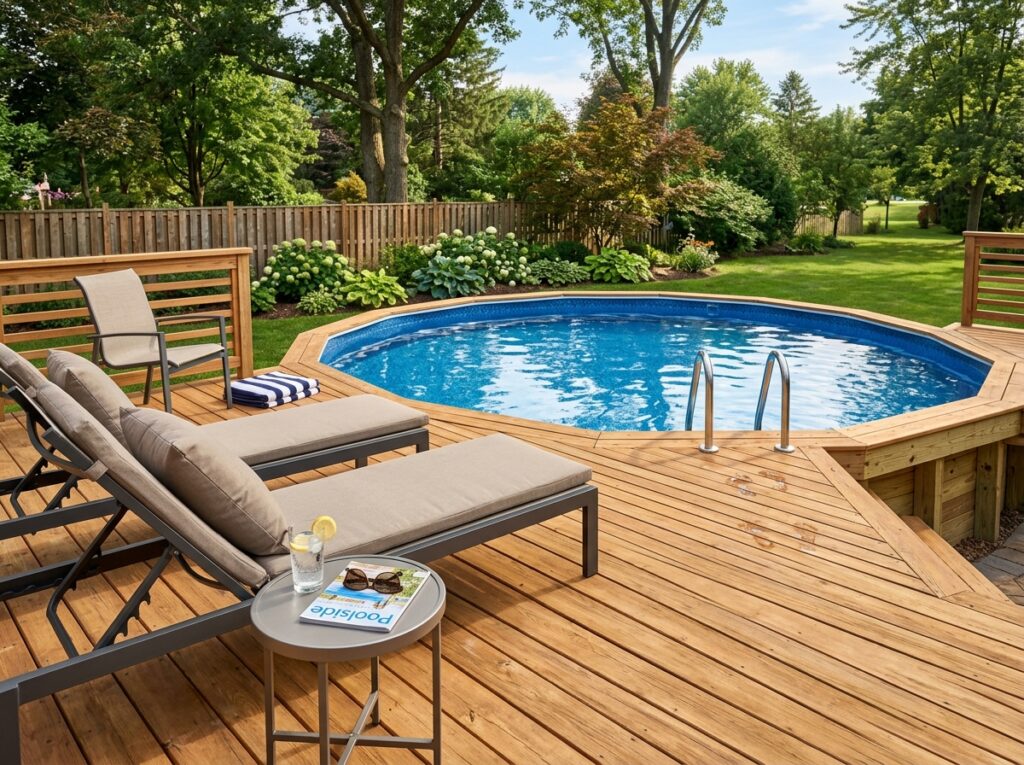
Aluminum-framed furniture is the best material for a pool deck because it is naturally rust-proof, lightweight enough to move around the deck easily, and available in styles from casual to refined at a range of prices. The Threshold Aluminum Sling Chair at Target, the Hampton Bay Statesville Aluminum Patio Chair at Home Depot, and the Telescope Casual Marine Grade Polymer Chair all hold up to daily pool water exposure without any material degradation. Use Sunbrella fabric for any cushions on pool deck furniture because Sunbrella is solution-dyed, which means the color runs through the entire fiber rather than sitting on the surface, making it genuinely resistant to chlorine fading.
Above Ground Pool Deck Ideas on a Budget Work Best with Solar Lighting
Pool lighting after dark makes the pool usable for a significantly longer portion of the evening and changes the backyard atmosphere completely from functional to genuinely enjoyable. Solar lighting is the most accessible lighting option for a pool deck because it requires no wiring, no electrician, and no ongoing electricity cost. The quality of solar outdoor lighting has improved substantially and the better products now provide reliable brightness through a full evening on a single day’s charge.
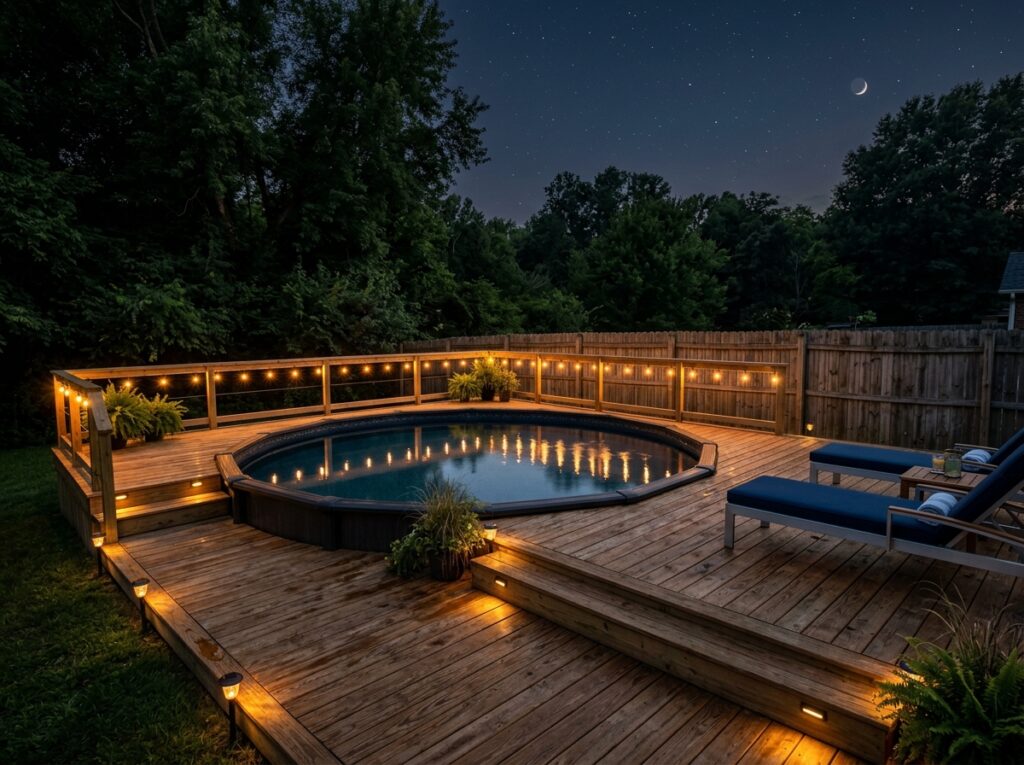
Place solar pathway stakes along the edges of the deck perimeter so the deck border is visible after dark and the pool edge is clearly defined for safety. The Ring Solar Steplight and the Mainstays Solar LED Post Light from Walmart both produce consistent warm-toned output through a full evening. Solar string lights strung along the pool fence or railing add an ambient layer of light above the deck level that makes the pool area feel festive rather than utilitarian after dark. The Brightech Ambience Pro Outdoor Solar String Lights charge fully in a day of direct sun and produce 6 to 8 hours of warm amber light at night.
Install a Gate in the Pool Fence for Safety and Accessibility
An above ground pool deck without a proper gate in the pool fence creates a situation where people climb the pool wall or the fence to enter and exit the pool, which is both unsafe and hard on the pool structure over time. A proper self-closing, self-latching gate installed in the pool fence gives clear, safe, designated access to the pool and satisfies the safety requirements that most municipalities impose on residential pools.
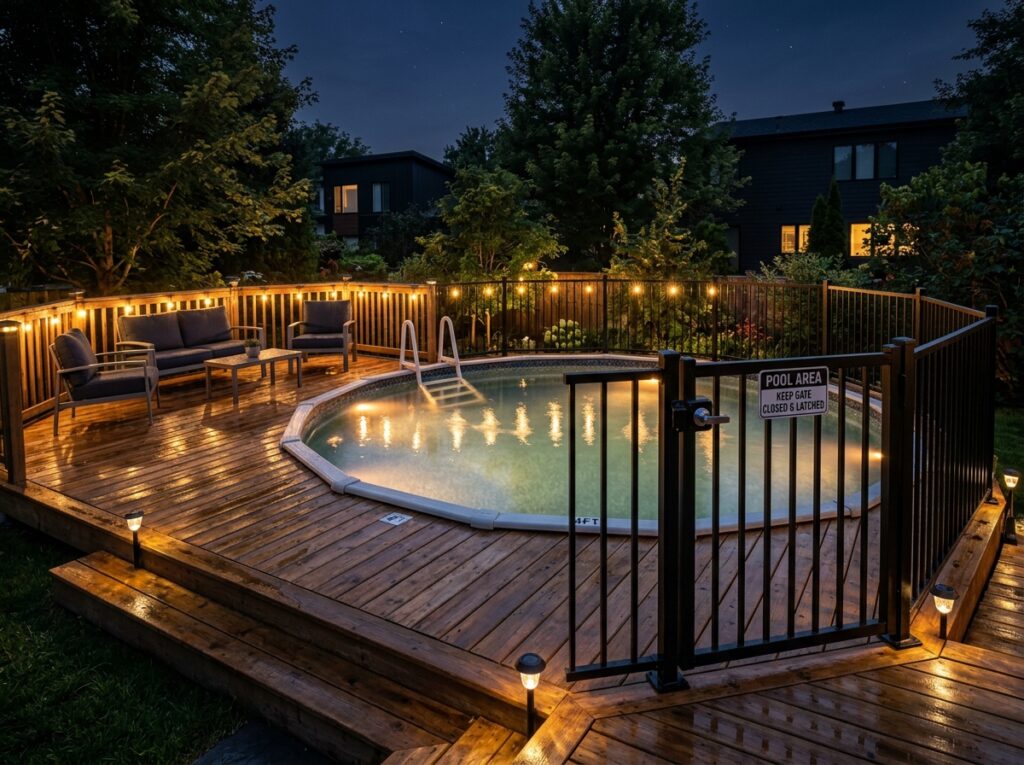
The D&D Technologies TruClose Self-Closing Gate Hinge converts any existing fence panel into a self-closing gate in under 30 minutes with a drill and the included hardware. The D&D LokkLatch Magnetic Gate Latch completes the installation and positions the latch above child height when properly installed. Most above ground pool fences run 48 to 54 inches in height, which meets the minimum height requirements in most US states. Check the specific pool fencing requirements for your municipality before building or modifying any pool fence because requirements vary significantly by location.
Use a Wooden Privacy Screen on the Deck Perimeter
A pool deck visible from the street, neighboring properties, or adjacent houses loses some of its appeal as a place to relax when the feeling of being watched is present. A wooden privacy screen along one or two sides of the deck perimeter creates visual enclosure without requiring a full fence installation and gives the pool area a defined, contained quality that reads as a proper outdoor space rather than a pool sitting in an open yard.
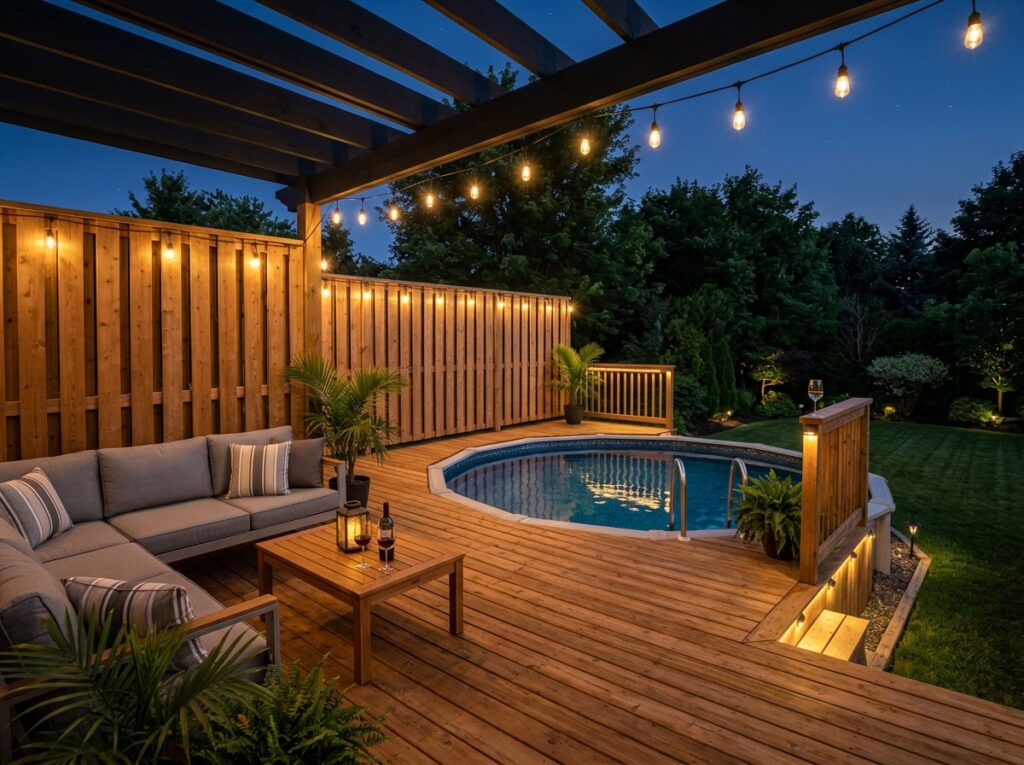
Build privacy screens from 1 by 6 cedar boards spaced 1/2 inch apart on a simple 2 by 4 frame, which provides partial privacy without completely blocking airflow. Or use lattice panels in cedar or composite at 4 by 8 foot dimensions for a quicker installation that provides the visual privacy while adding a structure for climbing plants if the screen is intended as a permanent fixture. Mount the screens on 4 by 4 posts set in quick-set concrete or in surface-mount post bases bolted to the deck surface. Stain to match the deck boards for a cohesive look.
Lay a Outdoor Rug on the Deck Surface for Comfort and Style
Bare deck boards underfoot are functional but not comfortable during extended pool use when people are walking back and forth, sitting in chairs, and spending hours in and out of the water. An outdoor rug on the deck surface adds cushioning underfoot, reduces heat absorption on composite or wood surfaces in direct sun, and gives the deck area a defined, styled center that reads as intentionally furnished rather than simply built.
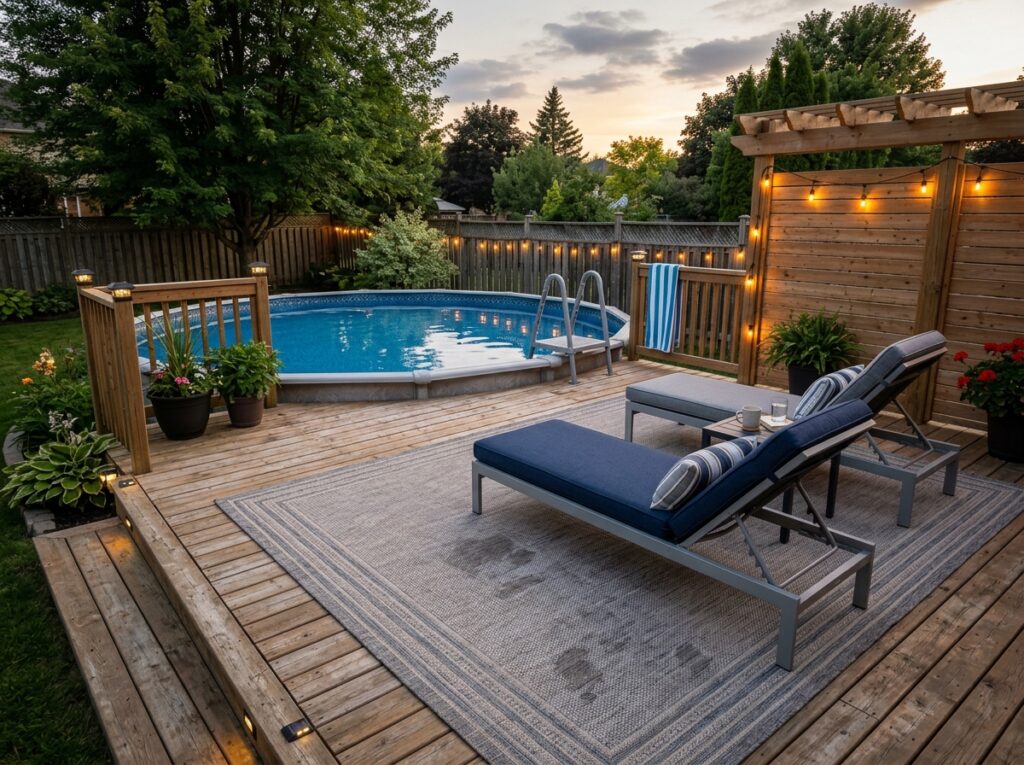
Choose an outdoor rug in a fade-resistant, quick-dry material sized to the main seating zone of the deck. Polypropylene outdoor rugs dry within hours of getting wet, resist chlorine fading, and hose clean completely. The Safavieh Courtyard Indoor-Outdoor Rug in a geometric pattern, the Artistic Weavers Alfresco Collection in a neutral stripe, and the Ruggable Outdoor Rug in a washable flat-weave construction all perform well in a pool deck environment where wet foot traffic is constant. Choose a rug with a non-slip backing or add a non-slip rug pad underneath to prevent movement on wet deck boards.
Build a Pool Entry Stair System from Pressure-Treated Lumber
The standard above ground pool ladder that comes with most pools is functional but narrow, steep, and provides no landing space at either the top or the bottom. A custom stair system built from pressure-treated lumber beside the pool ladder gives a proper entry and exit with a comfortable tread depth, a stable handrail, and a landing platform at pool height that makes getting in and out of the pool significantly easier for children and adults alike.
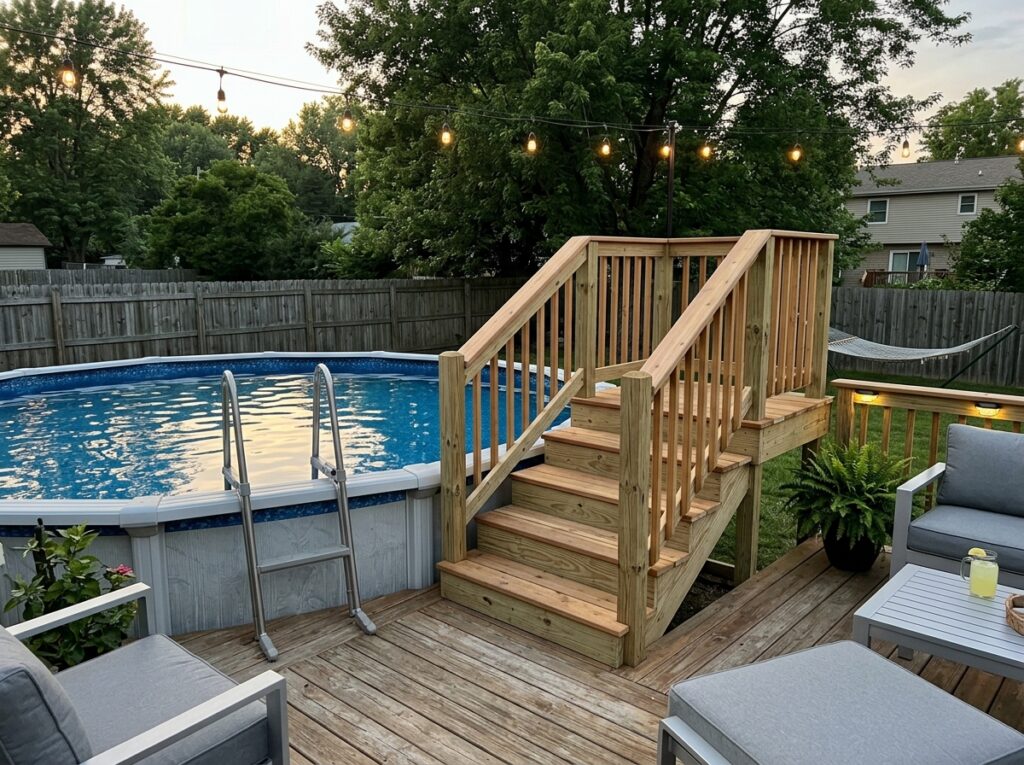
Build the stair system from 2 by 10 stringers cut at the correct angle for a comfortable rise-to-run ratio of approximately 7-inch rise to 11-inch run. Frame three or four steps up to the pool wall height and cap each step with 5/4 by 6 deck boards in the same material as the main deck surface. Add a 36-inch handrail on at least one side using 4 by 4 posts and 2 by 4 rails secured with carriage bolts through the stringer. The stair system costs about 100 to 200 dollars in materials and makes the pool significantly more accessible for everyone who uses it.
Above Ground Pool Deck Ideas on a Budget Include a Poolside Serving Cart
A serving cart on the pool deck gives everyone a surface for drinks, sunscreen, towels, and pool toys without requiring any permanent structure and without putting these items on the deck boards where they get wet, get knocked over, or create tripping hazards. A weather-resistant cart on locking casters positions exactly where needed and moves out of the way when the deck needs to be hosed down.
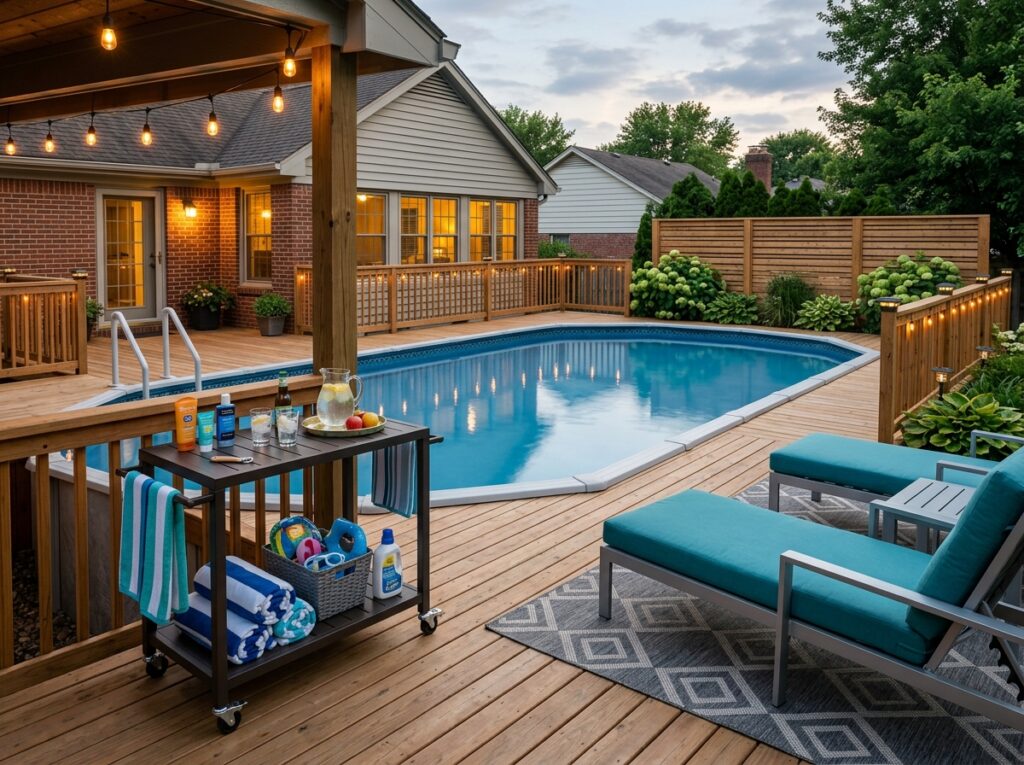
The Sunjoy Rolling Service Cart in powder-coated steel, the Hampton Bay Outdoor Bar Cart at Home Depot in rust-resistant aluminum, and the Threshold Outdoor Metal Bar Cart at Target all hold up to poolside conditions reliably. Choose a cart with a lower shelf for extra pool supplies, a top surface for active use, and towel bar attachments if available. Position the cart at the end of the deck closest to the house entry so the trip from the kitchen to the poolside cart is minimal and the cart stays in the shade when the sun is at its peak.
String Lights on the Pool Fence for Overhead Atmosphere
Pool lighting that comes from above rather than from ground level changes the atmosphere of the entire pool area after dark because overhead light makes the space feel larger and more enclosed simultaneously, which is the quality that turns a pool deck into an actual destination. String lights strung across the pool fence perimeter at the fence top rail height accomplish this at a very low cost and with a single afternoon of installation.
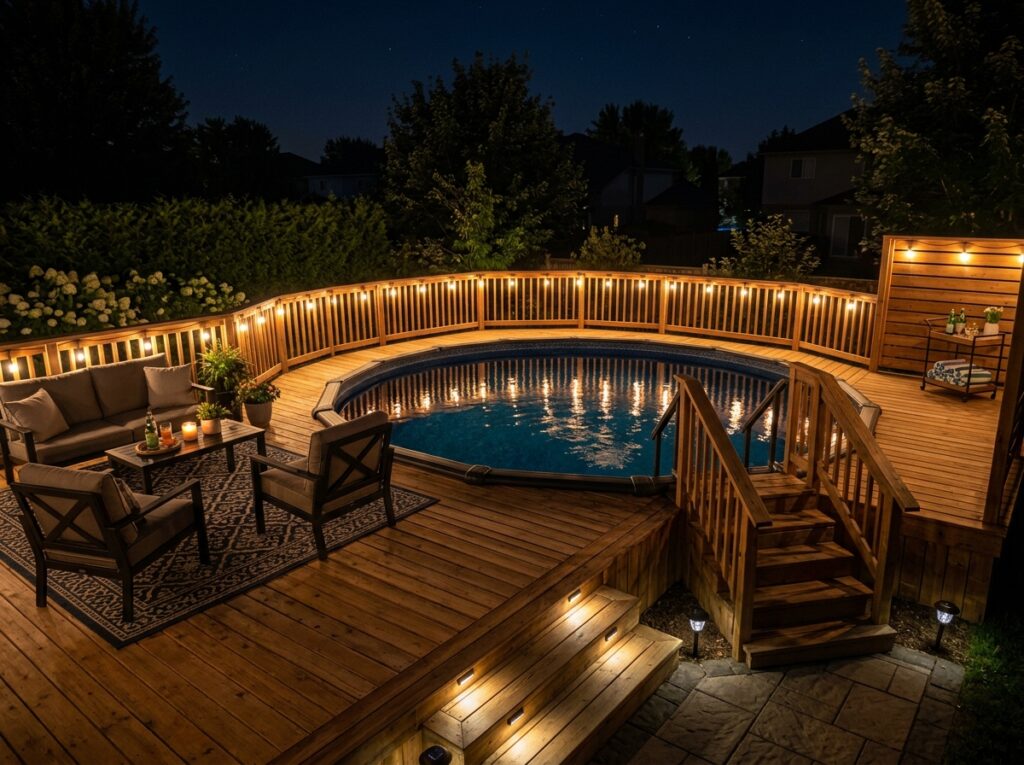
Use outdoor-rated string lights with G40 or S14 bulbs on a rubber-coated wire rather than lightweight copper wire sets that degrade quickly in outdoor exposure. Run the string from one fence post to the next around the perimeter, securing the wire to each post with a staple or a small screw-in eye hook. The Enbrighten Cafe Lights in warm white, the Newhouse Heavy-Duty String Lights, and the Feit Electric Outdoor String Lights all produce a consistent warm amber glow that makes a pool area look established and well-designed at night regardless of how recently the deck was built.
Use Outdoor-Rated Furniture Covers When the Pool Is Not in Use
Pool deck furniture that stays out through the full outdoor season takes a significant beating from UV exposure, chlorine overspray, rain, and morning dew that accumulates daily. Outdoor furniture covers keep the cushions dry, protect the frame finishes from UV fading, and reduce the cleaning required at the start of each season by keeping the furniture in the condition it was in when the season ended.
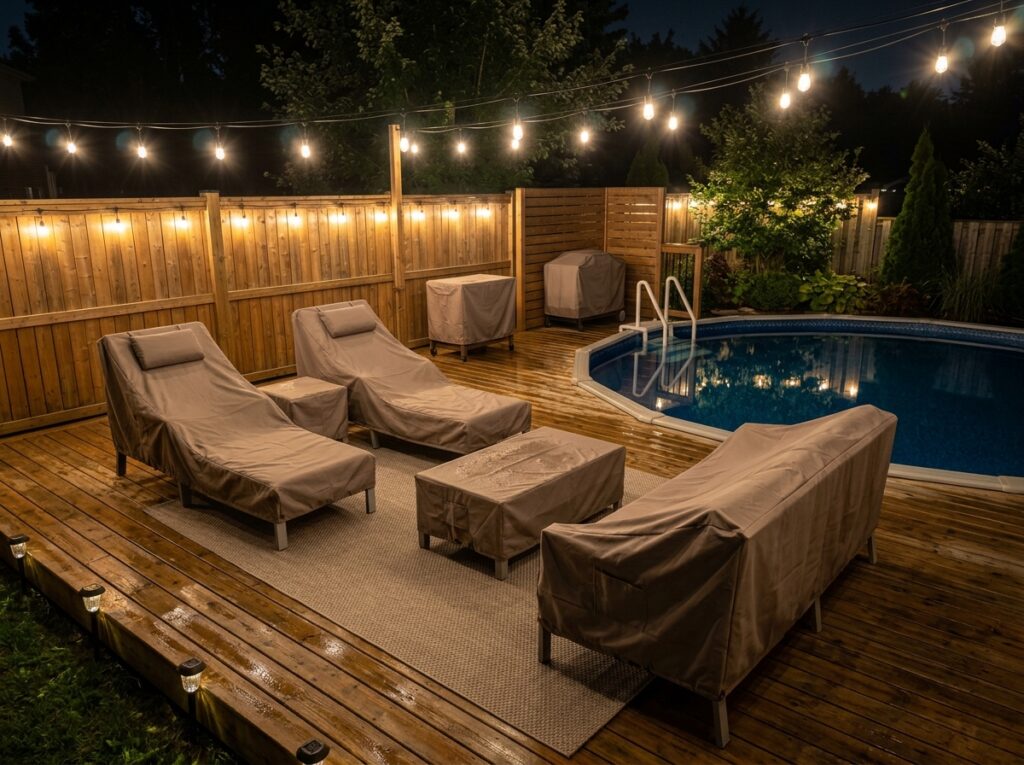
Use covers that fit the specific furniture dimensions rather than generic oversized covers that collect water in sagging sections. Classic Accessories Ravenna Patio Chair Covers, Duck Covers Elite Patio Furniture Covers, and the Covermates Riplock series all produce fitted covers in durable polyester with weighted hem corners that stay in place during wind. Buy covers sized for the actual furniture pieces rather than the next size up. A cover that fits properly sheds water cleanly while a loose cover collects it.
Add a Towel Bar Station Beside the Pool Entry
The towels-on-the-railing problem happens at every pool. Wet towels draped over fence rails and deck furniture look messy and stay wet longer than they need to because they are bunched rather than spread. A simple towel bar station mounted beside the pool entry holds towels spread flat so they dry faster, keeps them off the furniture, and gives the pool deck a small but visually significant organizational element that reads as intentional.
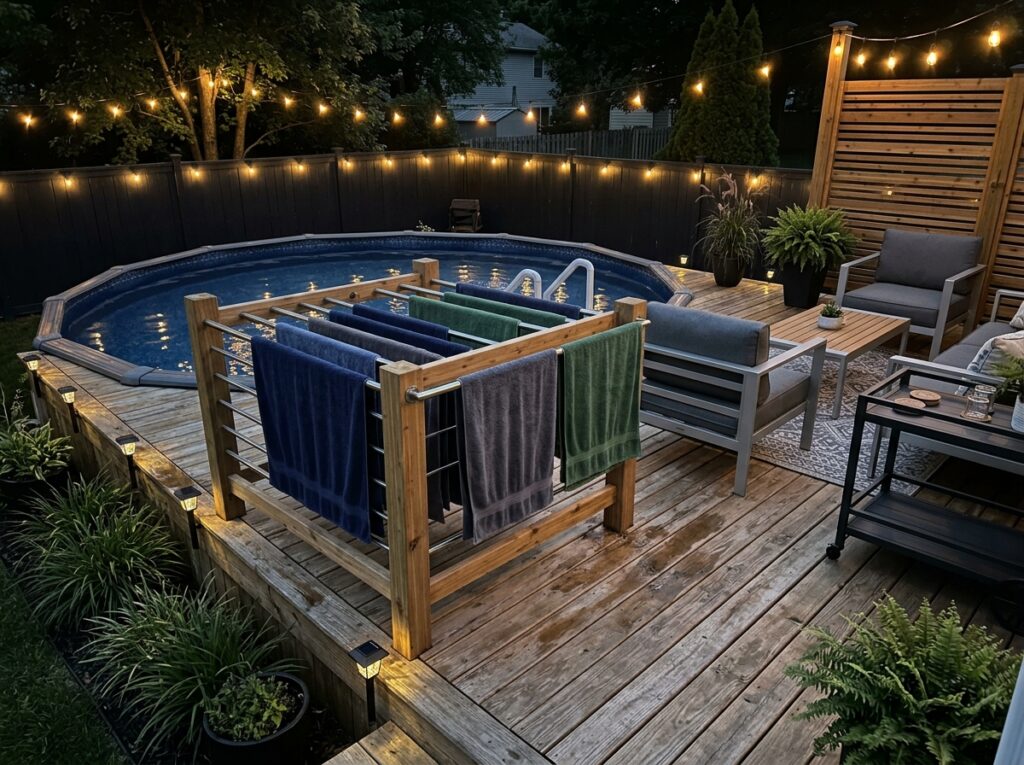
Mount three to five horizontal 1-inch diameter stainless steel or powder-coated aluminum towel bars on a simple 2 by 6 cedar post frame, spaced 12 inches apart vertically so each towel hangs at full length without touching the one below it. The whole structure mounts on two 4 by 4 posts set into surface-mount post bases or quick-set concrete at the deck perimeter. Stainless steel bar stock from a hardware store costs about 5 to 8 dollars per linear foot and the total material cost for a four-bar towel station runs under 60 dollars.
Create a Defined Seating Zone with Outdoor Sectional Furniture
A pool deck where chairs are scattered without a defined arrangement reads as a deck where people can happen to sit. A pool deck with a defined seating zone, a sectional sofa or a grouping of chairs around a low table, reads as a deck where people are expected and welcome. The seating arrangement creates the social function of the pool area independent of the pool itself.
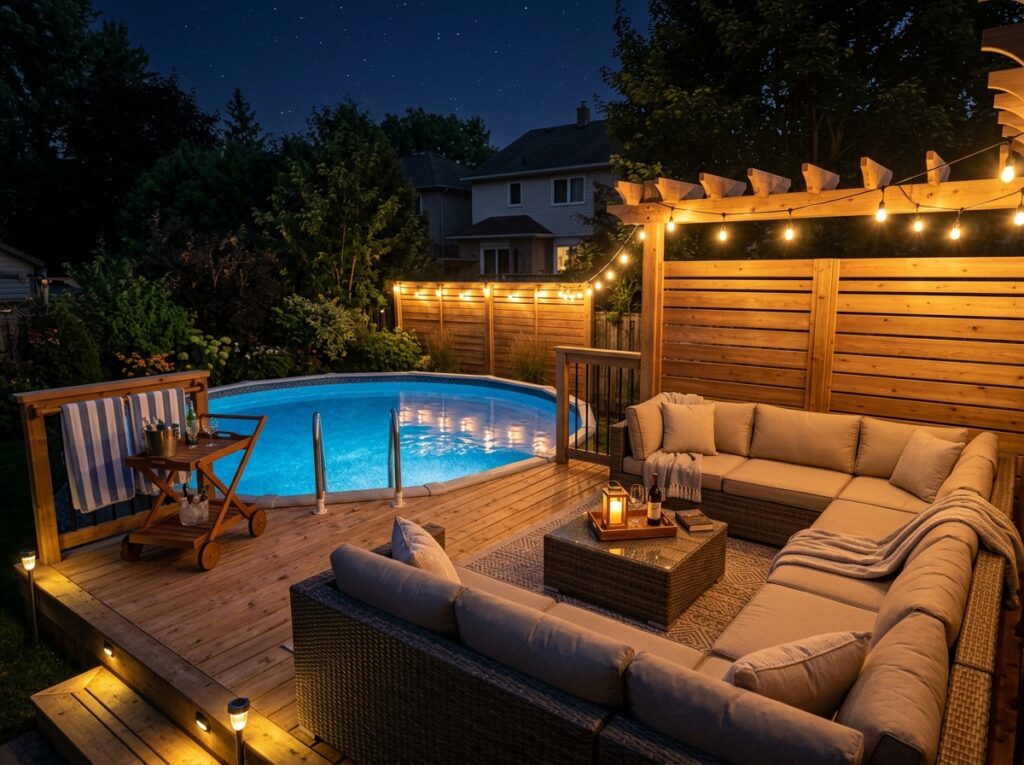
Position the seating zone on the section of deck with the most shade, either natural from trees or created by the pool fence itself, since a seating area in direct sun goes unused during peak afternoon hours regardless of how good the furniture is. The Hanover Outdoor Sectional Sofa in all-weather wicker from Wayfair, the Hampton Bay Statesville 4-Piece Sectional at Home Depot, and the Sunvilla Aluminum Outdoor Sectional from Costco all deliver pool-appropriate durability in configurations that suit a standard pool deck size. Leave at least 36 inches of clear deck space between the seating zone and the pool edge for comfortable movement between the chair area and the pool.
Paint the Pool Deck a Light Color to Reduce Surface Heat
Dark-colored deck boards and composite surfaces in direct summer sun reach surface temperatures that are genuinely uncomfortable for bare feet, particularly for children who spend the most time on the deck surface. Painting or staining an existing deck in a light sand, light gray, or off-white tone reduces the surface temperature measurably by reflecting rather than absorbing solar radiation.
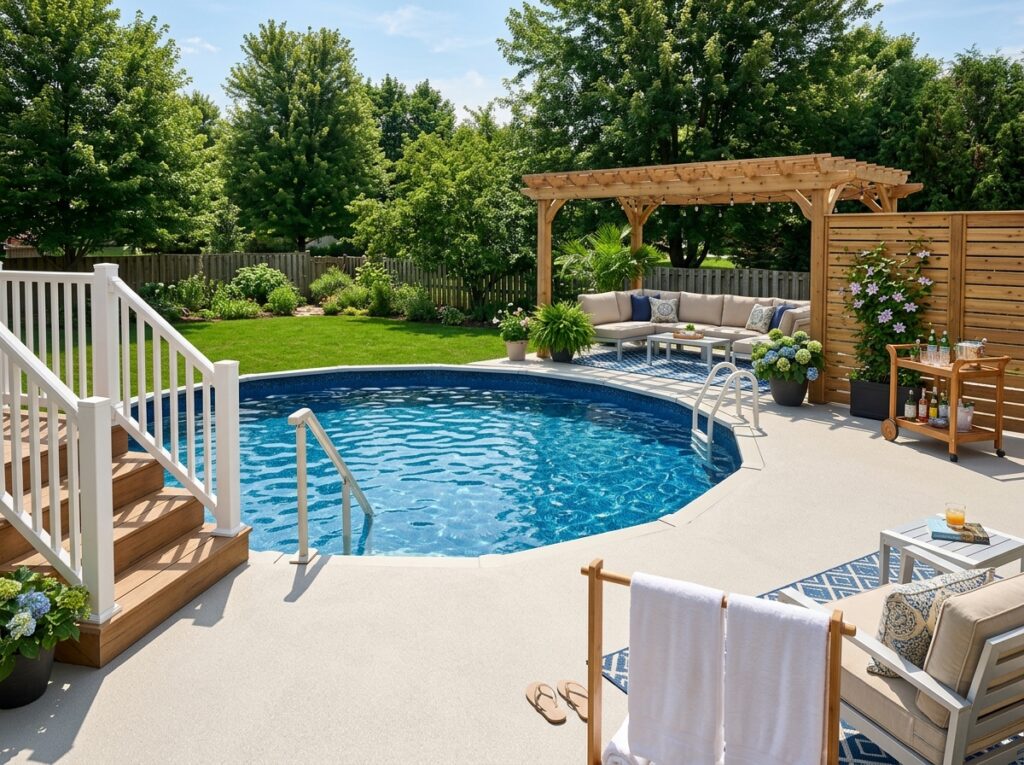
Apply Rust-Oleum RockSolid Deck Coating in a light tone like Desert Sand or Pebble Gray over an existing deck surface for a resurfacing finish that also provides slip resistance when the deck gets wet. The textured grit in the coating makes the surface safer underfoot at the pool entry where splashing water creates slippery conditions on smooth deck boards. One gallon of RockSolid covers approximately 75 square feet of deck surface and the light-tone options keep surface temperatures noticeably cooler than the same deck in a dark stain.
Above Ground Pool Deck Ideas Come Together with a Cohesive Color Story
A pool deck that looks designed rather than assembled shares one consistent color story across the deck stain, the furniture finish, the umbrella color, and the lighting fixtures. None of these elements need to match exactly, but they need to relate to each other in a way that reads as chosen rather than collected from different shopping trips over several seasons.
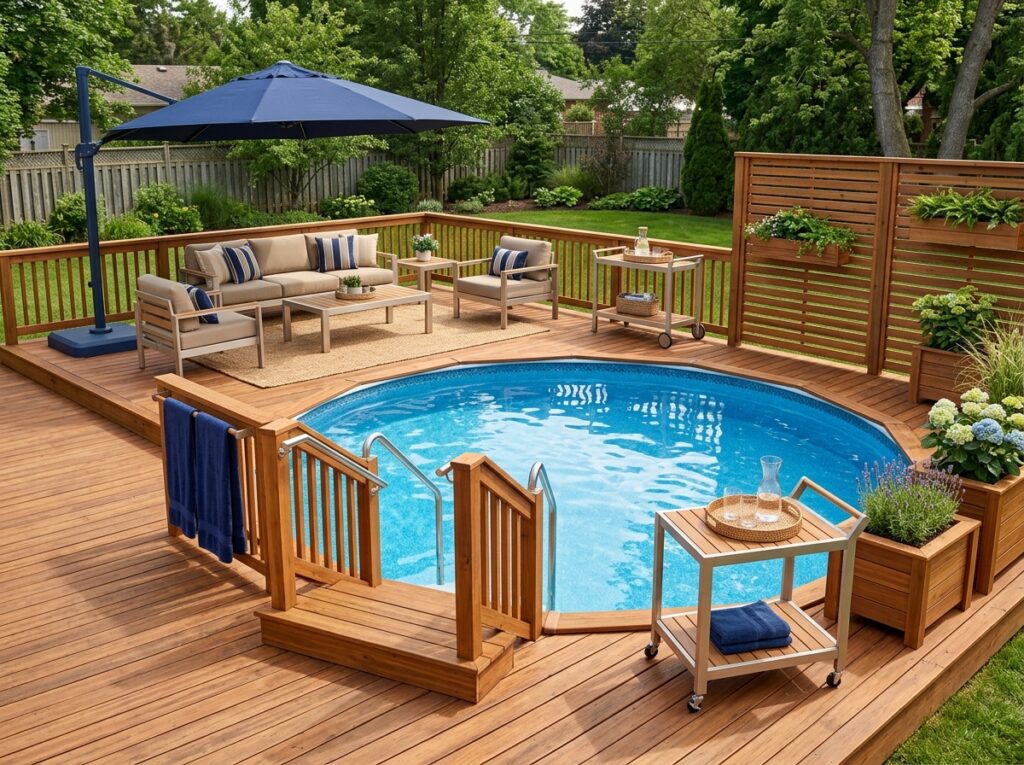
Pick one anchor color for the deck surface, either the natural tone of the lumber, a stained wood color, or a composite color, and build the furniture and accessory selections around it. A warm cedar-toned deck reads well with natural aluminum furniture in a sand or tan finish, navy or green umbrella fabric, and warm amber string lights. A gray composite deck reads well with charcoal or black aluminum furniture, neutral or white fabric, and cool white lighting. The coordination does not require anything beyond making the decisions in relation to each other rather than independently, and the above ground pool deck ideas that work best are the ones where every element was considered as part of the same picture.
Final Thoughts
An above ground pool with a proper deck stops being an inflatable pool in a yard and starts being a backyard feature that the whole house orients itself around in summer. The deck does not need to be large or expensive to produce that shift. It needs to be level, solid, and finished with enough intention that people want to stay on it even when they are not in the water.
Start with the deck surface because that single decision establishes the quality of everything that follows. Get the material right, get the surface treatment right, and the furniture, the lighting, and the furniture arrangement all become easier decisions to make well. These above ground pool deck ideas on a budget give you the full picture from structure to atmosphere, and the pool that always seemed like a temporary setup will start looking like the permanent backyard centerpiece it was always supposed to be.