
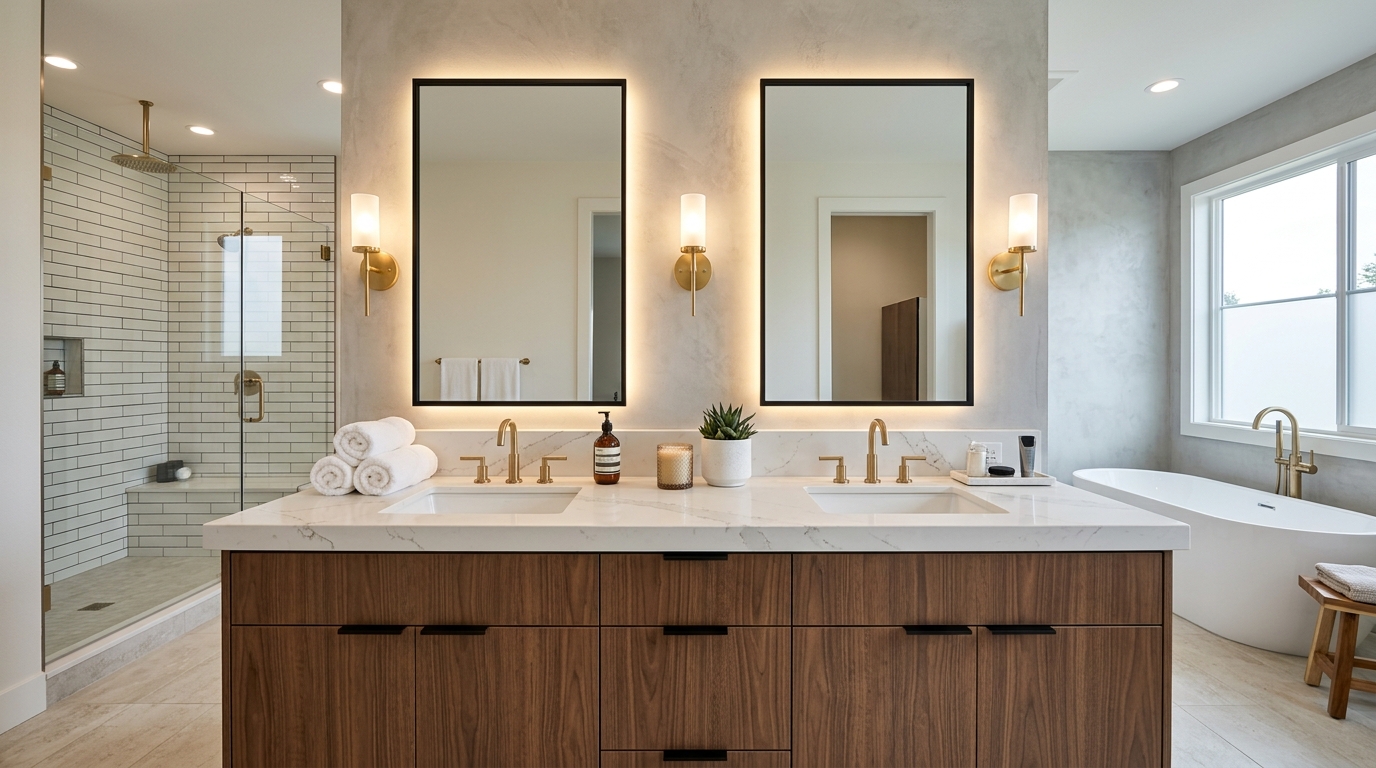
A double sink vanity solves one of the most common bathroom bottlenecks, two people trying to get ready at the same time using a single basin. But beyond just adding a second sink, there are a lot of layout and design decisions that affect how well a double vanity actually functions for two people with potentially different routines and preferences.
This article focuses specifically on double sink vanity ideas, the layouts, storage divisions, and small details that make a shared vanity work better for everyone using it.
Below are twenty three ideas for designing or choosing a double sink bathroom vanity.
1. Side by Side Sinks with a Shared Countertop
The most common double vanity layout places two sink basins on a single continuous countertop, with enough space between them for both people to use the vanity at once without bumping elbows. The shared surface keeps the overall footprint compact while still providing two distinct washing areas.
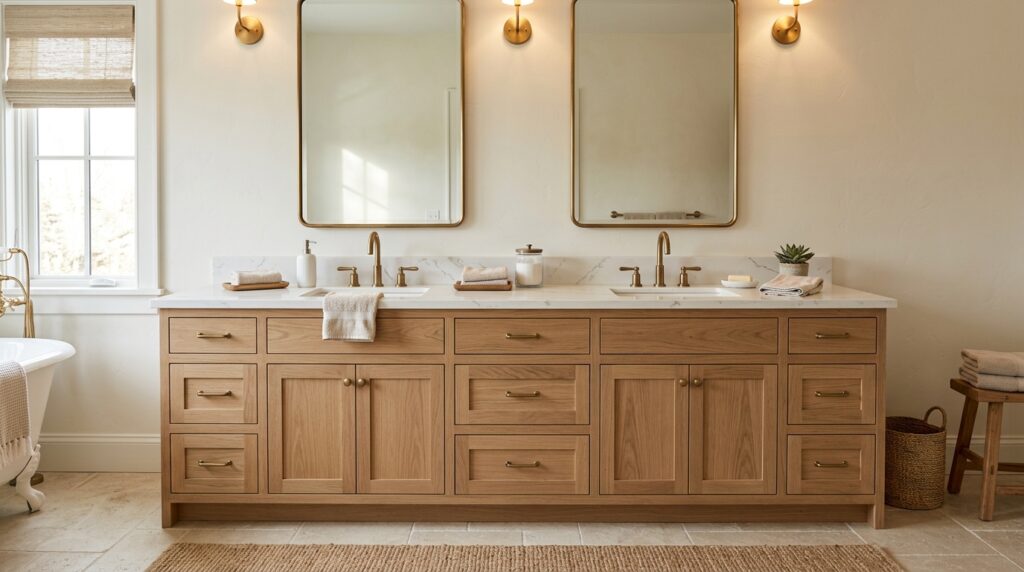
This layout works best when there is enough total width to leave a meaningful gap between the basins, since sinks placed too close together can make the shared counter feel cramped even with two separate basins. A width of at least a few feet between the centers of each sink tends to feel comfortable for two people standing side by side.
2. Bridge Cabinet with a Drop-Down Prep Shelf
A narrow cabinet between the two sinks with a hinged, drop down front panel creates an extra flat surface when needed, for setting down a hairdryer, a small basket, or styling tools, then folds back up flush with the cabinet when not in use. This adds temporary surface area without permanently widening the countertop.
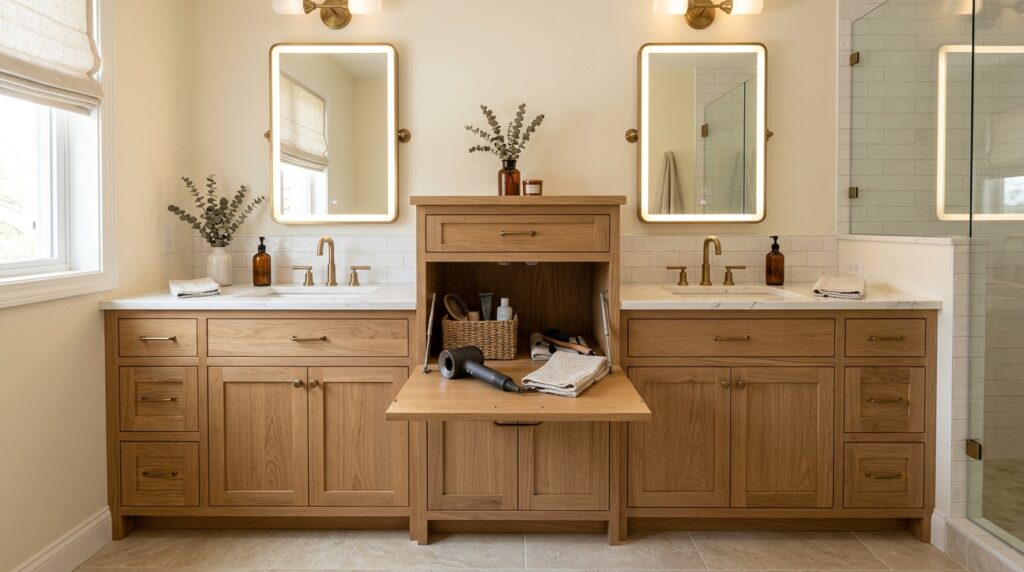
This works well for households where occasional extra space matters more than constant storage. When folded down, the panel can also double as a small tray, catching anything that might otherwise sit directly on the countertop between the two sink areas.
3. Two Separate Mirrors Instead of One Large Mirror
Hanging two individual mirrors, one above each sink, rather than a single mirror spanning the entire vanity, reinforces the idea of two separate stations even when the countertop and cabinetry below are shared. Each mirror can also be sized and positioned specifically for the person using that sink.
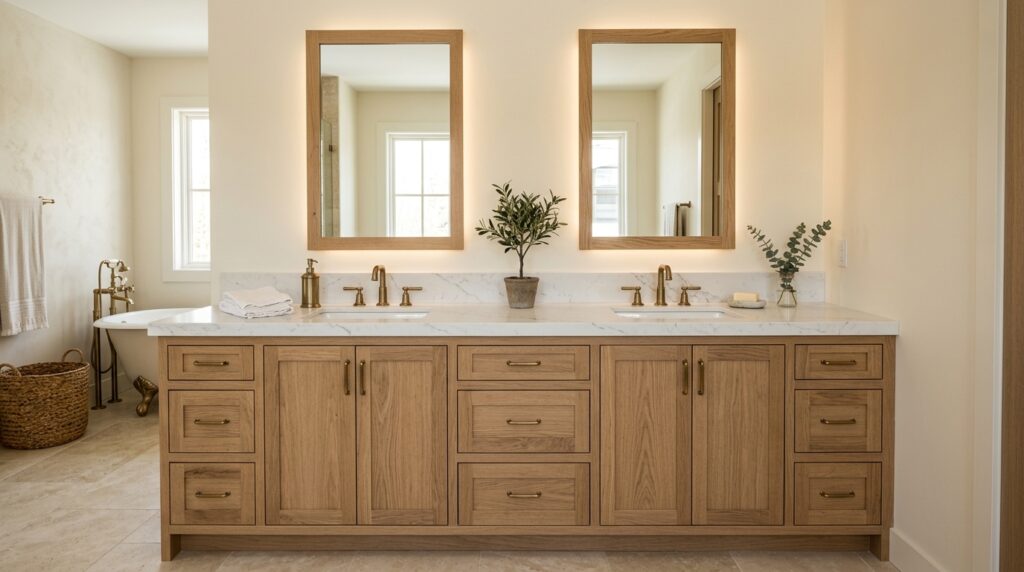
This approach works particularly well when the two sinks are positioned with some distance between them, since a single large mirror across that span might leave an awkward blank stretch in the middle. Two smaller mirrors with a bit of wall space between them can actually look more intentional than one oversized mirror trying to cover the whole width.
4. Individual Pendant Lights Above Each Sink
A pendant light positioned above each sink, rather than a single fixture centered over the whole vanity, provides focused lighting exactly where each person needs it. This setup also reinforces the sense of two distinct areas within one vanity.
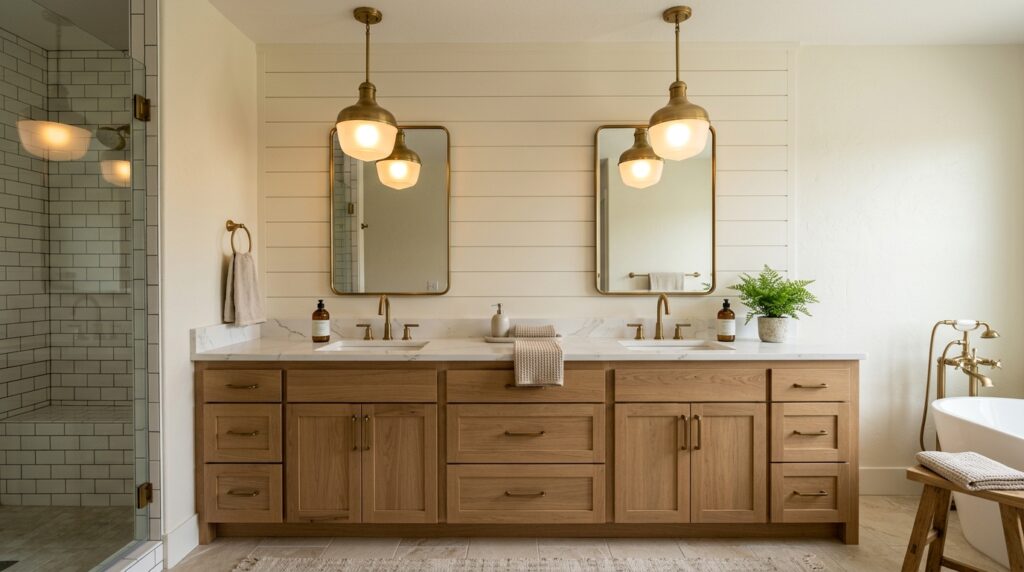
Choosing pendants that hang at the same height and in a matching style keeps the overall look cohesive, even though each one technically lights its own zone. This lighting approach works especially well with two separate mirrors, since each pendant and mirror pair becomes its own self contained station.
5. His and Hers Color Zones Within One Vanity
Within a single vanity, subtle differences in color, whether through cabinet hardware, towel colors, or small accessories, can personalize each side without requiring two completely different vanity designs. The cabinetry itself stays consistent, while smaller details shift from one side to the other.
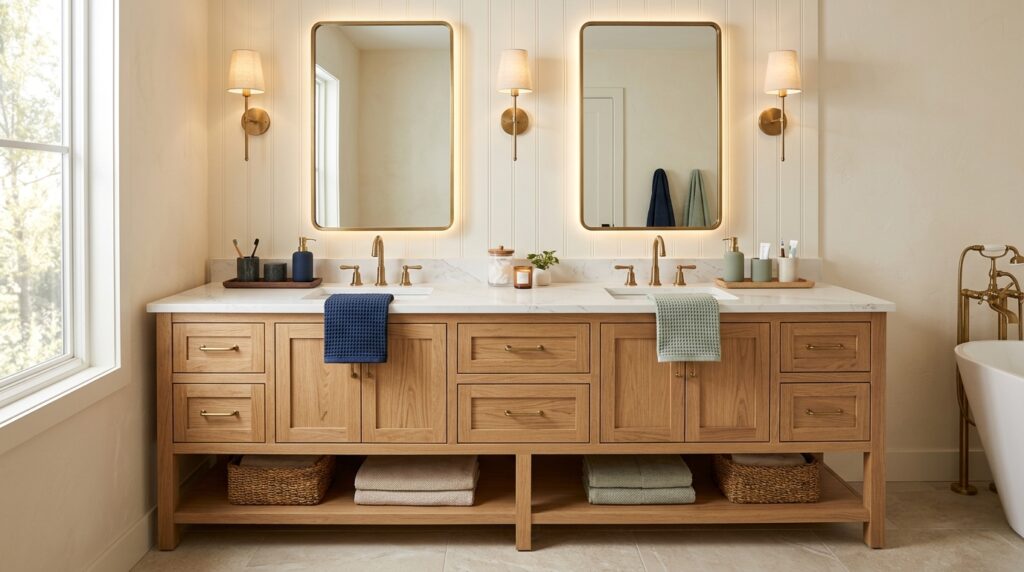
This approach works well for couples who want some personalization without the cost or complexity of fully separate vanity units. Keeping the differences subtle, one or two details per side rather than a complete color change, maintains a cohesive overall look while still giving each person their own small sense of ownership over their half.
6. Symmetrical Cabinet Layout with Matching Drawers
A vanity where both sides mirror each other exactly, matching drawer counts, matching cabinet doors, and matching sink placement, creates a balanced, formal look that suits more traditional bathroom designs. Each person gets an identical amount and type of storage.
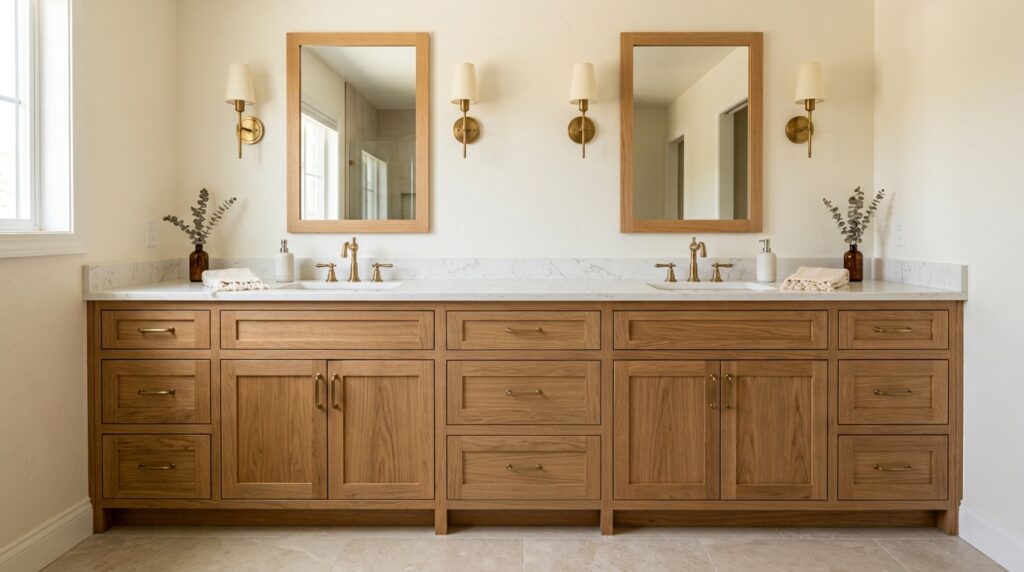
This symmetry also simplifies planning, since whatever storage solution works for one side automatically works for the other without needing separate consideration. This layout tends to suit households where both people have similar storage needs and routines, since the identical setup does not favor one person’s habits over the other’s.
7. Asymmetrical Layout with One Larger Storage Side
Rather than identical halves, an asymmetrical double vanity gives one side more storage, perhaps a tall cabinet or additional drawers, while the other side stays more minimal. This works well when one person genuinely needs more storage than the other, whether for skincare products, hair tools, or other routine items.
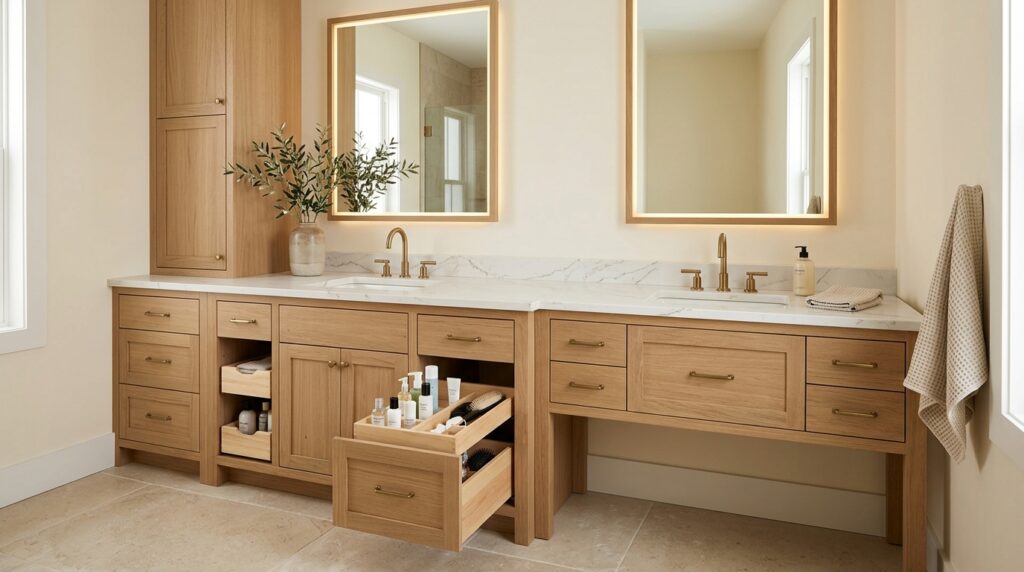
This layout requires more upfront planning than a symmetrical one, since the two sides are not simply mirrored versions of each other. The result, when done well, feels tailored rather than mismatched, with each side sized appropriately for how it will actually be used.
8. Open Knee Space Between the Two Sinks
Leaving an open, cabinet free section between the two sink areas, rather than filling that space with storage, creates a spot where someone could sit on a stool, similar to a makeup area, but positioned centrally between both sinks rather than off to one side.
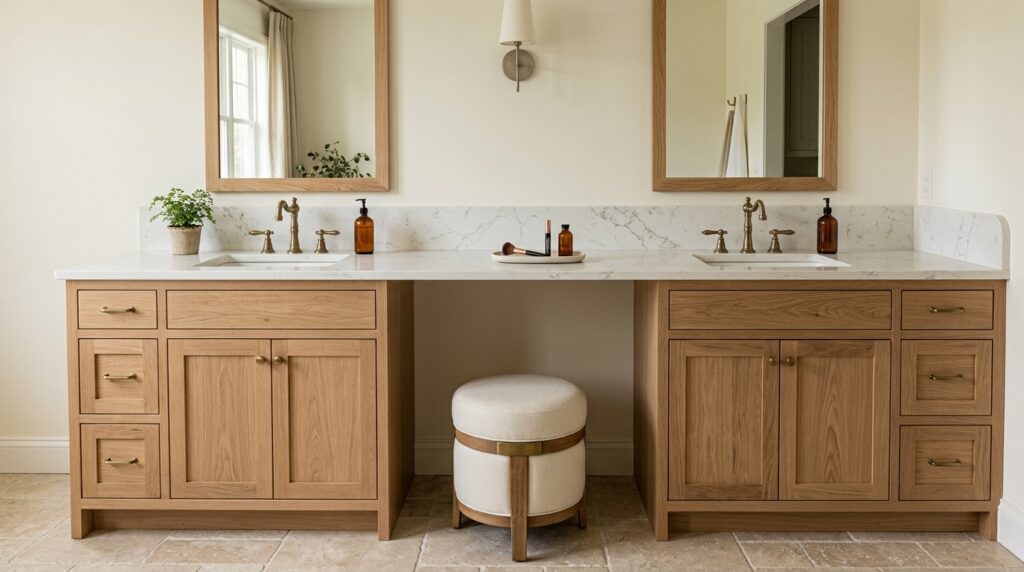
This works well in households where the vanity occasionally needs to accommodate three people, two standing at the sinks and one seated in between, even if that is not the everyday use case. The open space also breaks up what could otherwise be a long, uninterrupted run of cabinetry.
9. Matching Undermount Sinks for a Streamlined Look
Undermount sinks, installed beneath the countertop rather than on top of it, create a smooth, continuous surface across the vanity with no visible rim around either basin. This streamlined look works particularly well for double vanities, since it keeps the wide countertop from feeling visually broken up by two separate rims.
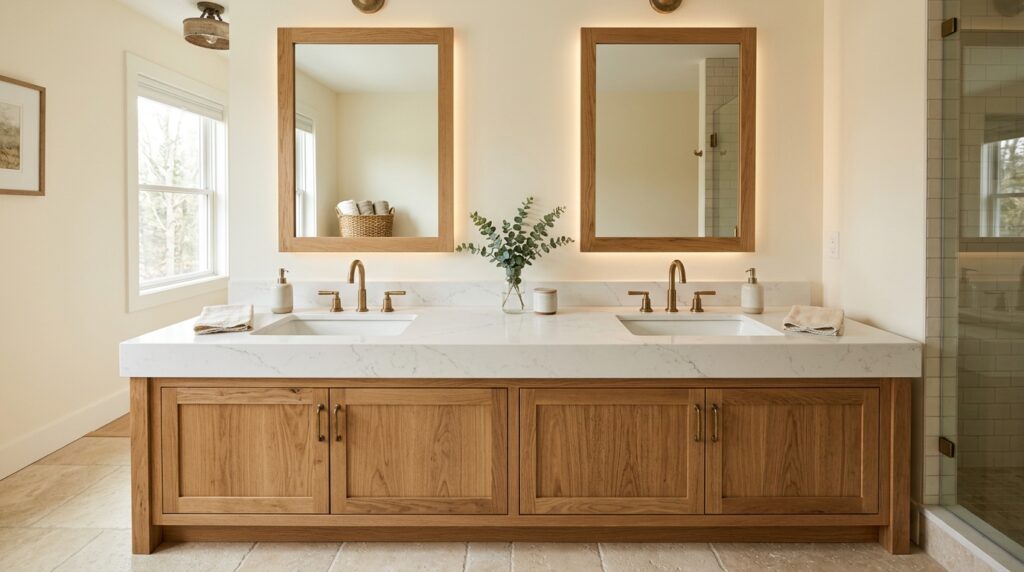
Matching the sink shape and size exactly on both sides reinforces the sense of a unified vanity, even with two basins. This option also tends to make cleaning easier, since there is no rim edge on either sink to collect water or grime.
10. Two Vessel Sinks on a Long Console
Rather than undermount or drop-in sinks, two vessel sinks sitting on top of a long console style vanity create a more furniture forward look, with each vessel acting almost like a decorative object on a shared surface. This works well in bathrooms aiming for a less built-in, more decorative aesthetic.
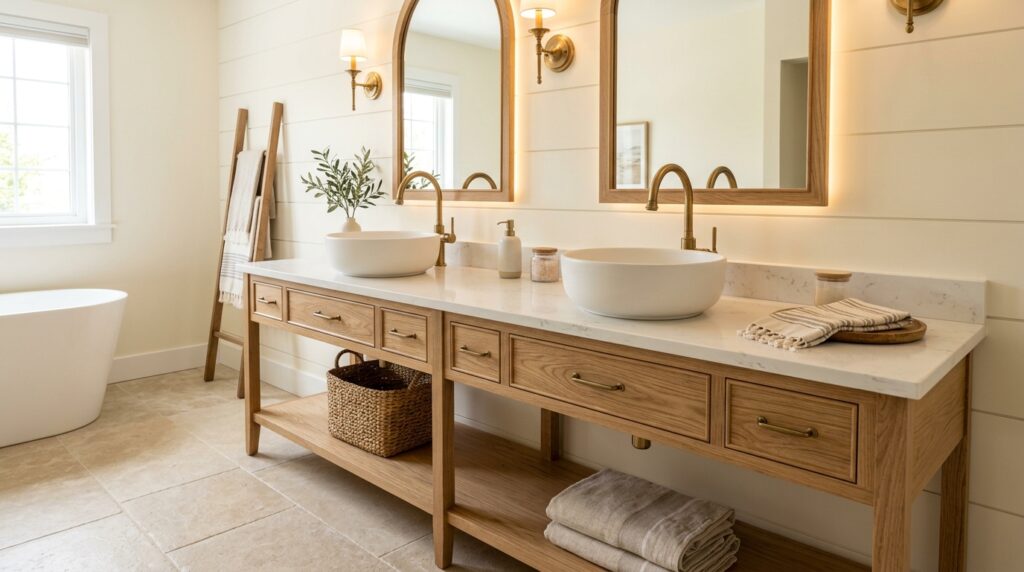
The added height of vessel sinks does mean faucets need to be positioned or chosen accordingly, often wall mounted or with a taller profile, to work properly with the raised basin height on both sides.
11. Separate Faucet Styles for Each Person
While the sinks and countertop remain shared, choosing two different faucet styles, perhaps different finishes or shapes, for each side adds a small amount of personalization without affecting the overall cohesion of the vanity.
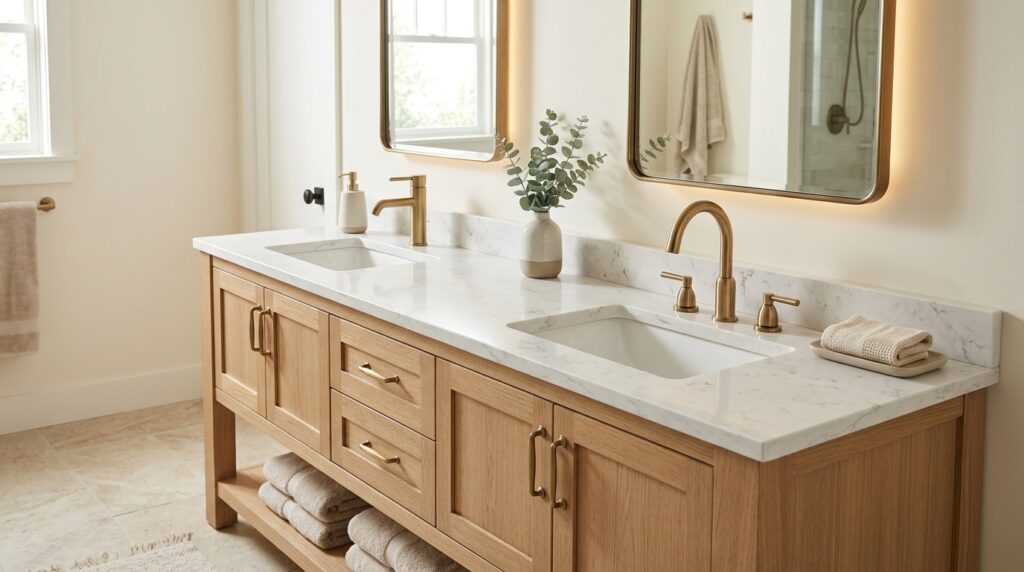
This works best when the two faucet choices share some common element, like the same finish in two different shapes, or the same shape in two different finishes, rather than being completely unrelated. That shared element keeps the variation feeling intentional rather than mismatched.
12. Long Single Mirror Spanning Both Sinks
As an alternative to two separate mirrors, one large mirror running the full width of the vanity creates a unified look and can make the whole wall above the vanity feel more expansive. This works particularly well in bathrooms where the vanity itself is the main visual feature of the room.
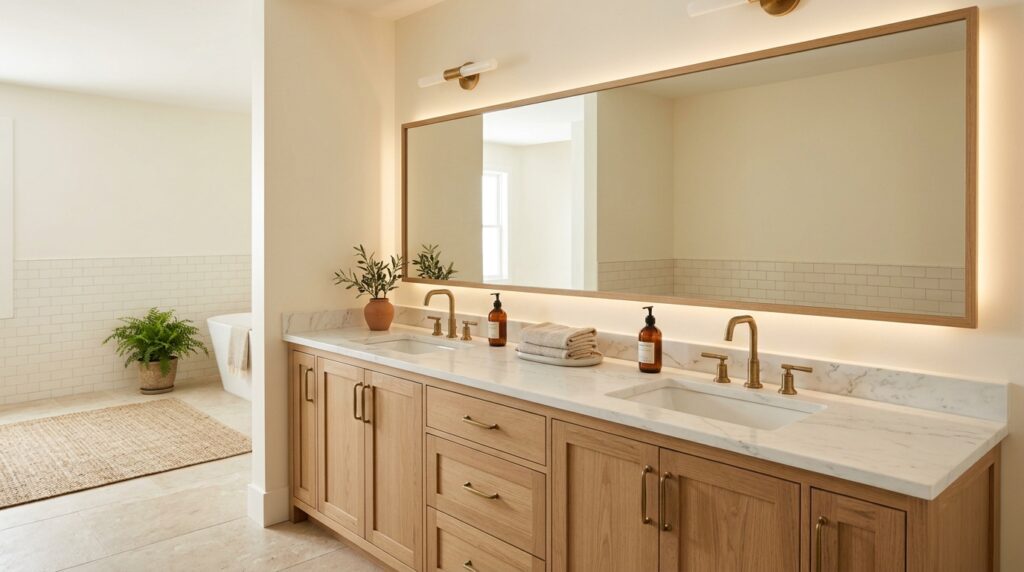
A single long mirror also reflects more of the room’s lighting and space, which can be useful in bathrooms that otherwise feel a bit closed in. This option suits double vanities where the two sinks are positioned closer together, since a single mirror spans the gap between them more naturally than it would across a wider layout with significant empty wall space in the middle.
13. Divided Drawer Sections for Two Users
Within the cabinetry beneath each sink, dividing drawers into sections specifically intended for each person, rather than treating all storage as shared, helps keep items from getting mixed together. This can be as simple as designating left and right sides of a drawer to each person.
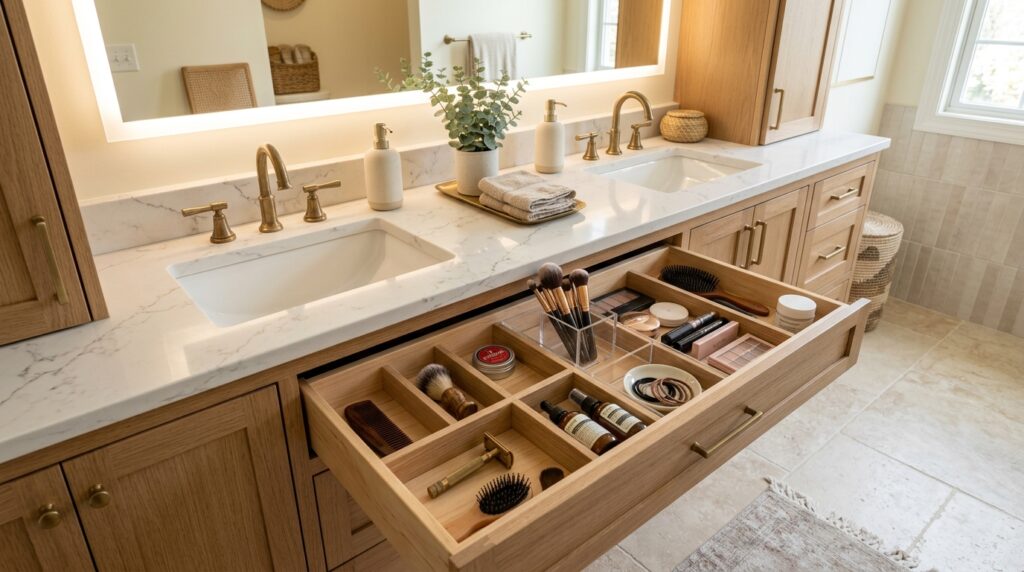
This approach works particularly well for couples who each have their own routines and products, since it reduces the daily friction of searching through a shared, undivided drawer. Labeling is not necessary, simply establishing which side belongs to whom is often enough once the habit forms.
14. Open Display Niches Beside Each Mirror
Rather than enclosed cabinets, a small recessed niche beside each mirror, left open rather than behind a door, gives each person a spot to display a candle, a small plant, or a few personal items at eye level. The open design keeps these spots feeling like decor rather than storage.
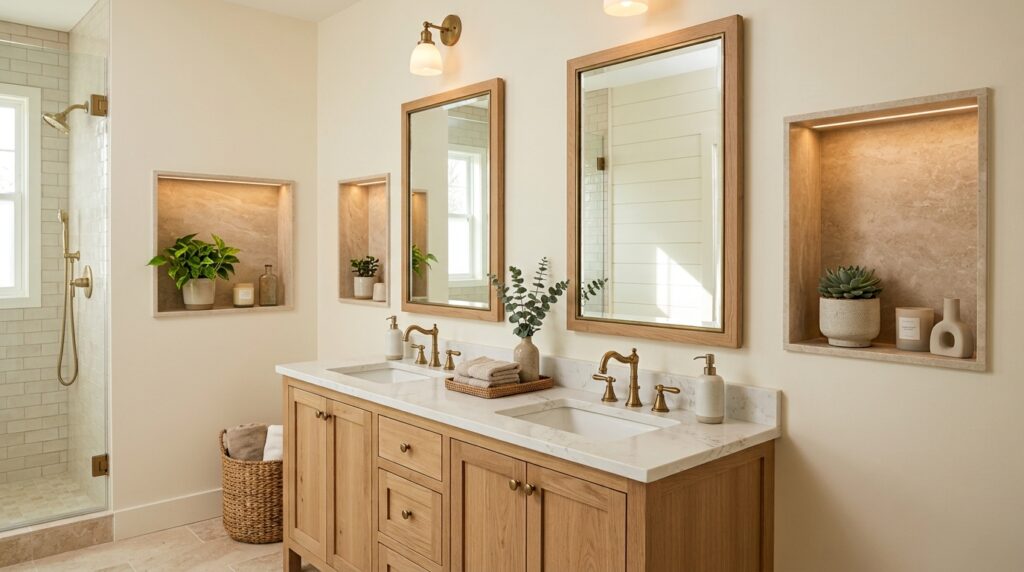
This works particularly well in bathrooms with a tile or stone wall, where the niche can be lined in a contrasting material. Each niche becomes a small personal touch within an otherwise shared vanity wall.
15. Furniture Style Base with Tapered Legs
A double vanity built on a base with slim tapered legs, similar to a piece of standalone furniture rather than built-in cabinetry, gives a wide vanity a lighter, less boxy presence in the room. The legs lift the visual weight of the cabinet off the floor, making even a long run of cabinetry feel less like a solid block against the wall.
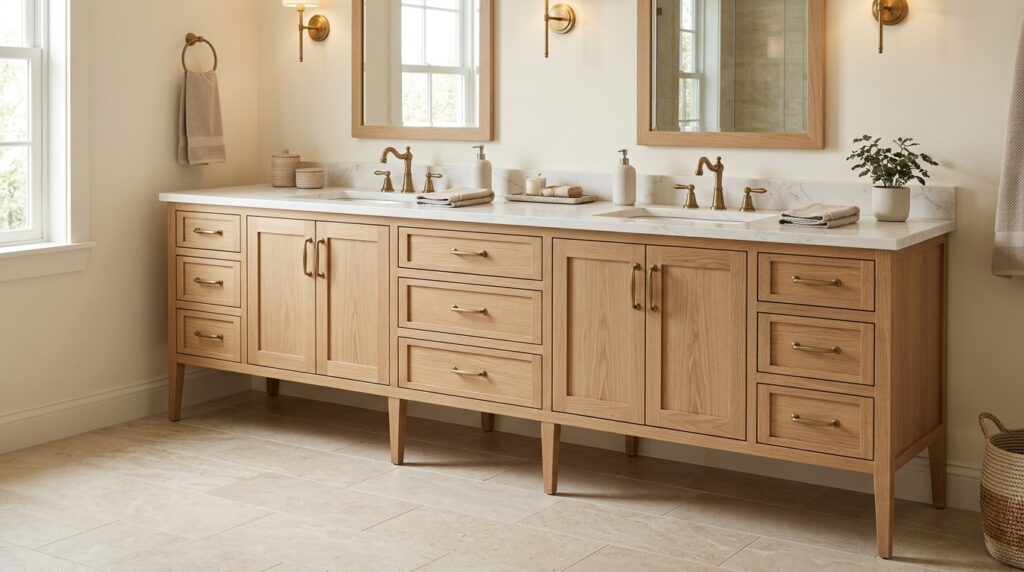
This style works particularly well in bathrooms with a more traditional or transitional design, where built-in cabinetry might feel too modern or heavy for the rest of the room. The slight gap beneath the cabinet also makes the floor easier to clean across the full width of the vanity, since there is no flush base collecting dust along its length.
16. Different Cabinet Hardware on Each Side
Small hardware differences, like a round knob on one side and a bar pull on the other, while keeping the cabinet color and style identical, give each person a tiny visual marker for their own space without any major design changes.
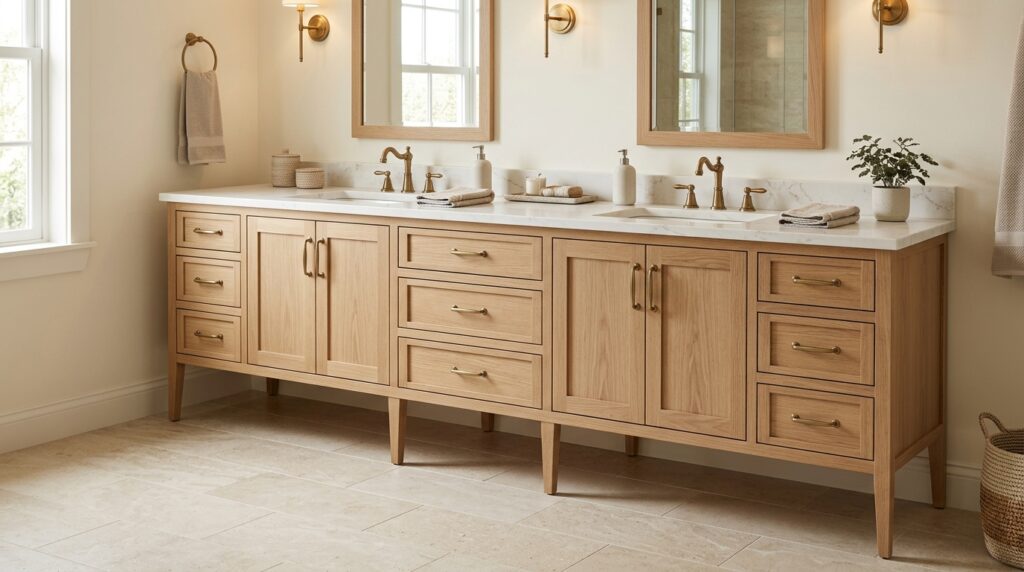
This is one of the simplest and least expensive ways to introduce personalization into a double vanity, since it involves swapping hardware rather than changing cabinetry, countertops, or sinks. Choosing hardware that still shares a finish, like both in brushed nickel but different shapes, keeps the overall look from feeling mismatched.
17. Recessed Soap Dish Built Into the Countertop at Each Sink
A small recessed dish, carved or inset directly into the countertop beside each sink, gives each person a built-in spot for soap, a ring, or a small item they take off before washing up, without needing a separate dish that can slide around or get knocked over.
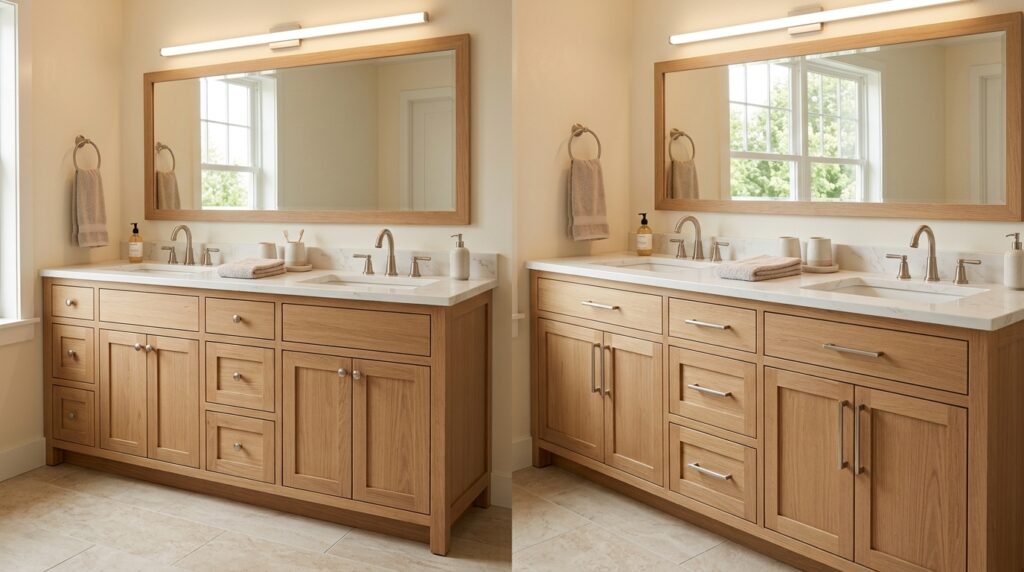
This detail works especially well with stone or solid surface countertops, where the recess can be shaped during fabrication to match the material seamlessly. Having one on each side means neither person needs to share or search for a place to set down small items during their routine.
18. Towel Hooks or Bars Positioned at Each Sink
Rather than a single shared towel bar somewhere on the vanity, positioning a hook or small bar near each sink gives each person their own designated spot for a hand towel, reducing the likelihood of towels getting mixed up or one person’s towel disappearing.
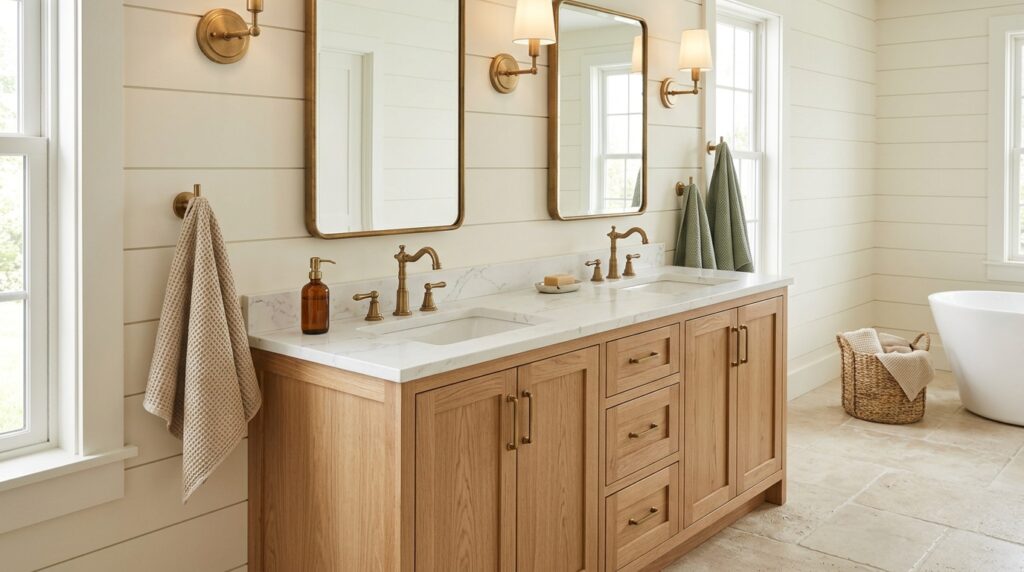
This small detail addresses a common minor frustration in shared bathrooms, and it requires very little additional space, often just a hook mounted to the side of the vanity or the adjacent wall near each sink.
19. Stone Slab Countertop with Continuous Veining Across Both Sinks
A countertop cut from a single slab of natural stone, with the veining pattern flowing continuously across the full width including both sink cutouts, creates a striking visual effect that ties the two sides of the vanity together as one cohesive surface.
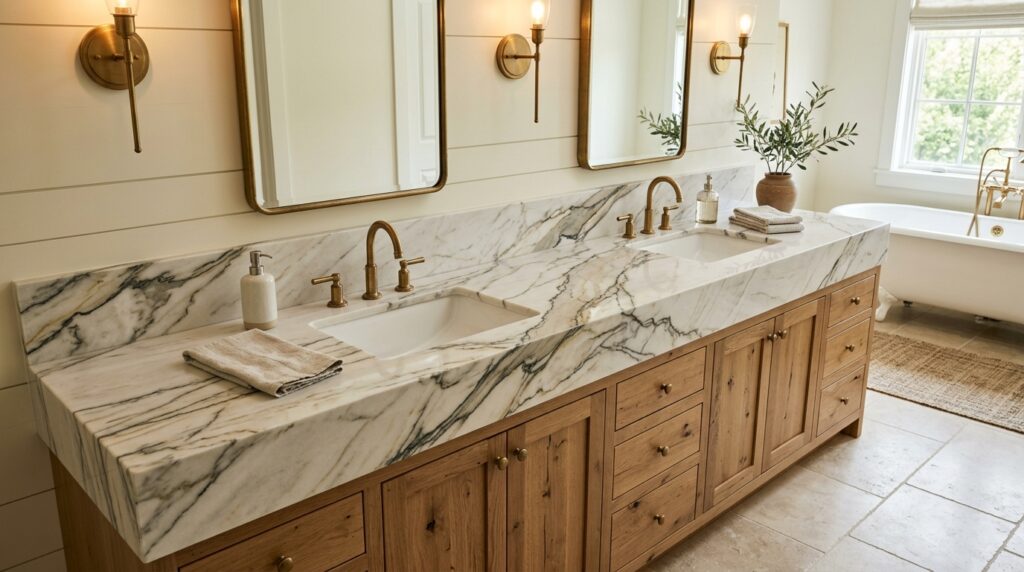
This option tends to be a higher investment than standard countertop materials, but the continuous pattern is something that cannot be replicated with separate pieces or engineered materials cut without matching the natural flow of the stone. This works especially well as a focal point in larger bathrooms where the vanity countertop is highly visible.
20. Lower Cabinet Height on One Side for Accessibility
In households where one person uses a wheelchair or has mobility considerations, building one side of the double vanity at a lower height, with open knee space beneath, allows that person to use their sink comfortably while the other side remains at standard height for everyone else.
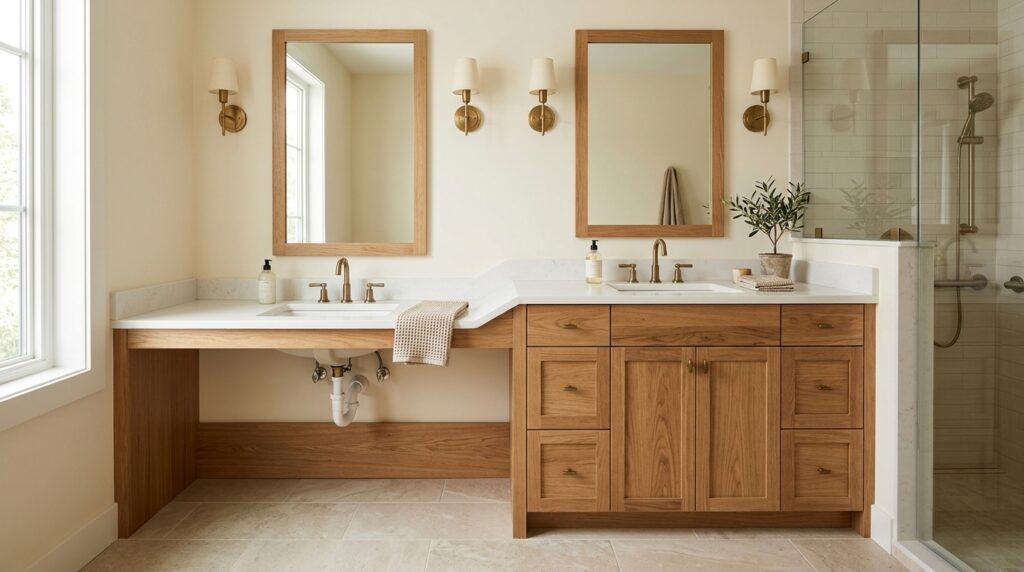
This approach requires planning the plumbing and cabinetry to accommodate two different heights within one vanity unit, but it allows a shared space to genuinely work for everyone using it, rather than compromising on height for one person or excluding accessibility considerations entirely.
21. Open Shelving Between the Two Sink Cabinets
Instead of a solid storage tower or open knee space between the sinks, open shelves in that center section provide a spot for shared items, extra towels, decor, or baskets, that both people can access without it belonging specifically to either side.
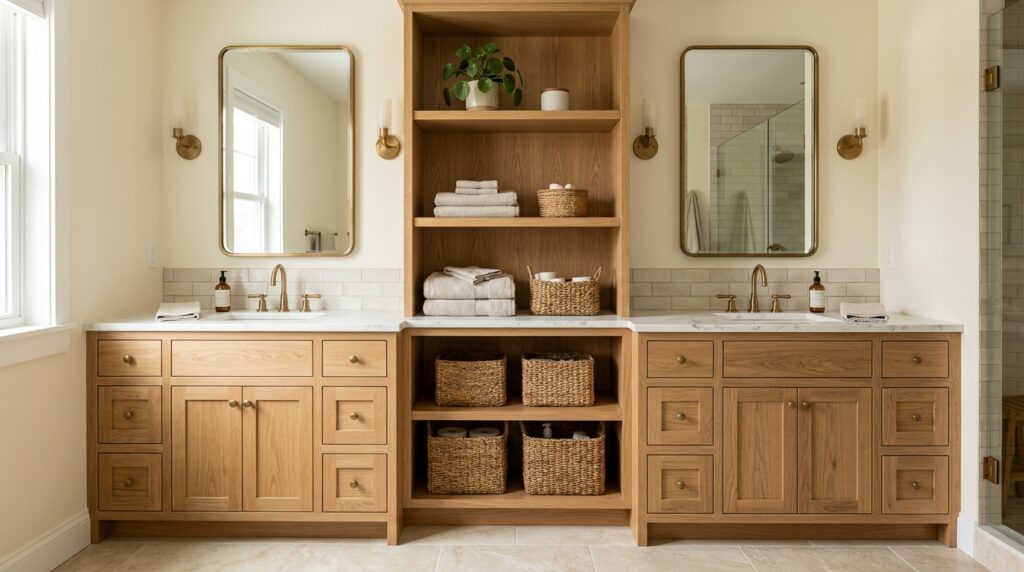
This works well for items that genuinely get used by both people, rather than personal items that belong to one person or the other. The open shelving also adds a display element to the center of the vanity, which can otherwise be a purely functional, undecorated section.
22. Coordinated Stool Seating at Each End
A small stool positioned at each end of a long double vanity, rather than in the center, gives each person their own seated spot without those spots competing for the same central space. The stools can be identical or subtly different, depending on whether personalization matters to the household.
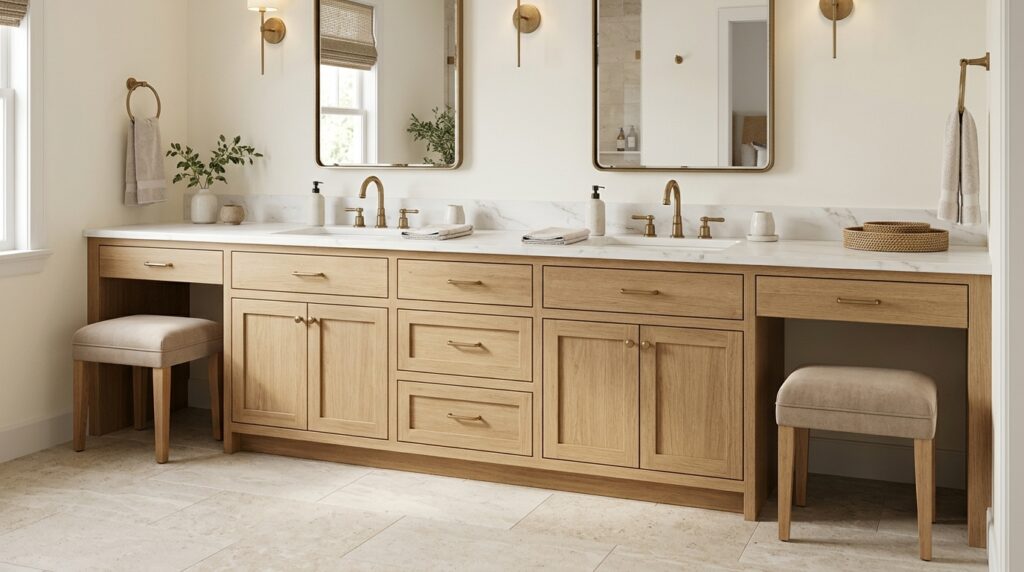
This layout works particularly well for longer vanities where the ends might otherwise feel like unused space, turning them into functional seating areas instead. Positioning the stools at the ends also keeps the center of the vanity clear for shared activities or simply for walking past.
23. Vertical Divider Panel Between the Two Sink Areas
A thin vertical panel, extending from the countertop up to the mirror or a shelf above, creates a physical division between the two sink areas without fully separating them into two vanities. This panel can be finished in a material that contrasts with the rest of the vanity, adding a design detail as well as a functional break.
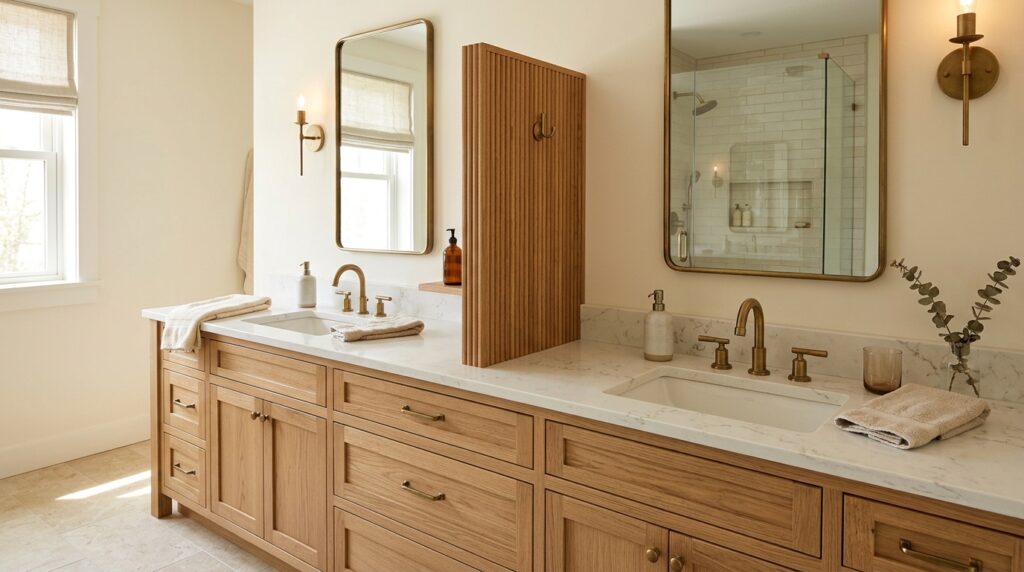
This works well for households where a stronger sense of separate space matters, even within a shared vanity, without going as far as installing two completely independent units. The panel also gives each side a small additional surface, its own face, for a hook, a small shelf, or simply as a backdrop for items placed nearby.
Conclusion
A double sink vanity is rarely just two single vanities placed side by side. The way the two sides relate to each other, whether through shared countertops, mirrors, lighting, or storage, determines how well the vanity actually serves two people with their own routines and preferences.
Some households benefit most from a fully symmetrical, identical setup, while others do better with small personalized touches or even genuinely different storage and seating on each side. Either way, thinking through how two people will actually use the space, at the same time, with their own products and habits, leads to a double vanity that works in practice rather than just on paper.