
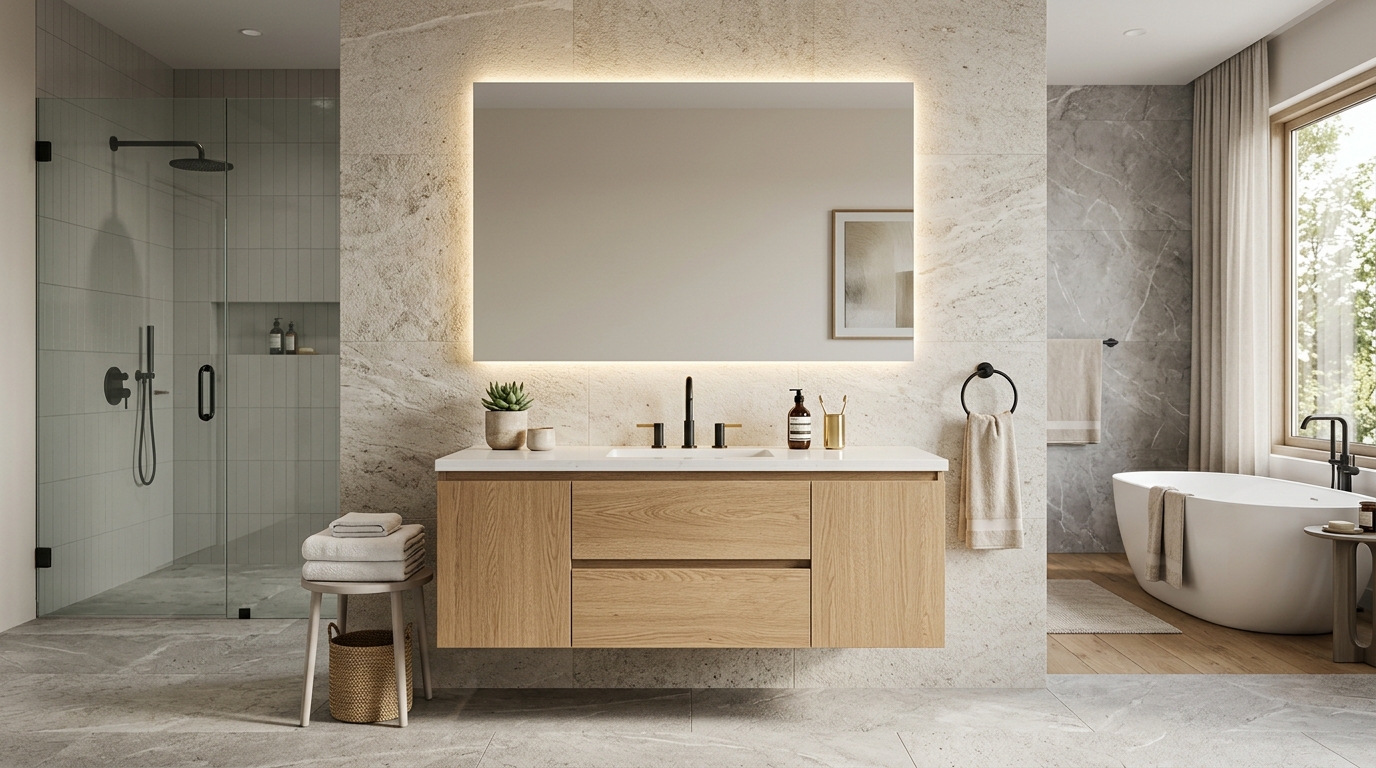
Modern bathroom design tends to favor clean lines, minimal visual clutter, and materials that feel intentional rather than decorative for its own sake. A modern vanity is often less about adding details and more about removing them, letting shape, material, and proportion carry the design.
This article focuses on the materials, finishes, and design choices that define a modern vanity, covering the kinds of details that separate a contemporary look from a more traditional one.
Below are twenty five ideas for designing or choosing a modern bathroom vanity.
1. Flat Panel Cabinet Doors With No Visible Hardware
Flat, smooth cabinet doors with no raised panels or trim create a clean, uninterrupted surface across the vanity. Removing visible knobs and pulls in favor of integrated finger grooves or push mechanisms continues that clean look from the door surface to how it opens.
This approach works best when the cabinet material itself has enough visual interest, through grain, color, or texture, since there is nothing else on the door to draw attention. The result is a vanity that reads as a single solid block rather than a collection of separate parts.
2. Push To Open Drawers and Doors
A push to open mechanism lets drawers and cabinet doors release with light pressure rather than a pull, removing the need for any external hardware entirely. This keeps the cabinet faces completely smooth, which suits the flat panel look common in modern vanities.
This mechanism does require slightly more deliberate pressure to open compared to a handle, and it can take some adjustment for anyone used to grabbing a pull. Over time, most people adapt quickly, and the visual payoff of a hardware free cabinet face is significant.
3. Integrated Sink and Countertop in One Seamless Piece
A countertop and sink basin molded or formed from a single material, with no seam where the two would normally meet, creates a smooth, continuous surface that is one of the clearest signals of a modern vanity. Materials like solid surface or certain concrete formulations allow this kind of integration.
Beyond the visual effect, a seamless sink and countertop has no joint where grime or moisture can collect, which makes daily cleaning simpler. This option tends to suit vanities with a single sink rather than double configurations, since the molding process is more straightforward for one basin.
4. Matte Black Fixtures Throughout
Faucets, drains, and any visible hardware finished in matte black create strong contrast against lighter cabinet and countertop materials, a combination that has become closely associated with modern bathroom design. The matte finish in particular avoids the reflective shine that chrome or polished finishes have.
Carrying the same matte black finish across every fixture at the vanity, rather than mixing finishes, reinforces the cohesive look. This works especially well against white, light wood, or light stone surfaces, where the dark fixtures stand out clearly as intentional accents.
5. Concrete Look Countertop for an Industrial Edge
A countertop made from or designed to resemble concrete brings a raw, slightly industrial quality to a vanity, with subtle texture and color variation that differs from the smoother finish of most stone or solid surface materials. The slightly imperfect look is part of the appeal.
This option pairs well with matte black fixtures and simple cabinet fronts, since the countertop itself becomes the main textural element in an otherwise streamlined design. Sealing concrete countertops properly matters for durability in a wet environment.
6. High Gloss Lacquer Cabinet Finish
A cabinet finished in high gloss lacquer reflects light strongly, giving the vanity a sleek, almost wet looking surface that contrasts with the matte finishes common elsewhere in modern design. This finish works particularly well in bold colors, where the gloss intensifies the saturation.
Because the surface is so reflective, any imperfections in installation or daily fingerprints tend to show more readily than on matte finishes, so this option suits households comfortable with slightly more frequent wiping down to keep the surface looking its best.
7. Geometric Shaped Mirror
A mirror in a shape other than a standard rectangle or oval, hexagon, arch, or another defined geometric form, adds a distinct focal point above the vanity without needing additional decor. The shape itself becomes the design statement.
This works particularly well when the rest of the vanity stays simple, letting the mirror’s silhouette stand out against plain walls or cabinetry. Choosing a shape that echoes another element in the room, like an arched doorway or window, ties the mirror into the broader space.
8. Mixed Material Cabinet Fronts
Combining two materials across the cabinet fronts, wood paired with metal panels, or stone paired with a matte painted surface, adds depth without relying on pattern or color alone. The contrast between materials does the visual work.
This approach requires some planning to avoid the combination feeling random, usually by repeating the same two materials in a consistent ratio or pattern across the cabinet faces. The result feels considered rather than like two unrelated finishes placed side by side.
9. Minimalist Single Lever Faucet
A faucet with a single lever controlling both temperature and flow, in a slim, simple silhouette, suits the reduced visual language of modern design better than faucets with separate hot and cold controls or more ornate shapes.
Choosing a faucet with a low profile, rather than a tall arched neck, keeps the overall vanity looking grounded and proportionate, particularly on narrower countertops where a taller faucet might dominate the available space.
10. Monochrome Color Scheme Throughout the Vanity
Keeping the cabinet, countertop, and wall behind the vanity within a single color family, even if the exact shades vary slightly, creates a calm, unified look that lets shape and texture become the main sources of visual interest rather than color contrast.
This approach works particularly well with grays, off whites, or warm beiges, where small variations in tone between materials still feel connected. A single accent color or material introduced elsewhere in the room can provide contrast without disrupting the vanity’s cohesive palette.
11. Exposed Plumbing as a Design Feature
Rather than concealing pipes behind a cabinet or wall, leaving plumbing visible, often in a matching metal finish, turns a typically hidden element into part of the vanity’s design. This works particularly well with wall mounted or floating vanities, where the plumbing is naturally more visible.
Choosing a finish for the exposed pipes that matches or complements the faucet and other fixtures keeps the look intentional rather than appearing unfinished. This approach suits a more industrial leaning take on modern design.
12. Countertop With a Waterfall Edge
A countertop that wraps down the side of the cabinet in a single continuous piece, rather than ending at the cabinet’s top edge, creates what is often called a waterfall edge. This treatment makes the countertop material feel like it is flowing over the cabinet rather than simply sitting on top of it.
This effect works especially well with materials that have a strong pattern or veining, since the continuous wrap shows off the material from multiple angles. The cabinet side beneath the waterfall typically stays plain, letting the countertop material be the focus.
13. Terrazzo Countertop for a Playful Modern Look
Terrazzo, made from chips of stone or glass set into a base material, brings color and texture variation to a countertop while still fitting within a modern aesthetic, particularly when the base color is kept neutral and the chips provide subtle pops of color.
This material works well as a way to introduce some personality into an otherwise restrained vanity design, without relying on pattern in the traditional sense. Terrazzo countertops pair especially well with simple, flat panel cabinetry, letting the material carry most of the visual interest.
14. Slim Profile Cabinet With Minimal Depth
A vanity cabinet built shallower than standard, often just deep enough to accommodate the sink and basic plumbing, takes up less floor space while maintaining the flat, simple lines associated with modern design. The reduced depth also makes the cabinet feel less bulky overall.
This option works well in bathrooms where floor space is limited but a built in cabinet, rather than a pedestal or open shelf, is still preferred. Storage inside a slim cabinet tends to favor shallow drawers over deep ones, which suits smaller, flatter items.
15. Floating Drawer Stack Without a Full Cabinet Box
Rather than a complete cabinet box, a stack of two or three drawers mounted directly to the wall, with open space visible around the sides and beneath, creates a minimal storage solution that reads more like a piece of art than furniture.
This works particularly well as a secondary storage element alongside a simple sink area, rather than as the primary vanity structure. The open space around the drawer stack reinforces the sense of lightness that runs through much of modern design.
16. Curved Cabinet Edges for Softness
Introducing gentle curves at the corners or edges of an otherwise rectangular cabinet softens what could be a very hard edged, boxy look, without abandoning the overall simplicity that defines modern design. The curve is subtle rather than decorative.
This detail works well paired with rounded mirrors or curved fixtures elsewhere in the bathroom, creating a consistent softness that balances the straight lines of walls, floors, and countertops surrounding the vanity.
17. Two Tone Cabinet With Contrasting Sections
Splitting the cabinet into two sections finished in different colors or materials, often a darker lower section with a lighter upper section, or vice versa, adds visual interest through contrast while keeping each section simple on its own.
This approach works particularly well when the split aligns with a functional change, like a closed cabinet below and open shelving above, so the color change reinforces a difference in function rather than feeling arbitrary.
18. Sculptural Standalone Basin
A sink basin with a distinct, sculptural shape, rather than a standard rectangular or oval bowl, becomes a focal point on its own, particularly when paired with a simple console or slim countertop that does not compete for attention.
This option suits bathrooms where the vanity is meant to feel like a single statement piece rather than blending into the background. Choosing a basin shape that complements the room’s other curves or angles ties it into the overall design rather than feeling like an isolated object.
19. Frosted Glass Cabinet Fronts
Cabinet doors made from frosted glass, rather than solid wood or laminate, let some light pass through while obscuring the contents inside, adding a sense of lightness to the cabinetry without making the storage fully visible.
This works particularly well in vanities with built in lighting inside the cabinet, since the glow becomes visible through the frosted panels even when the doors are closed, adding a subtle ambient element to the room.
20. Brass Accents Against a Dark Cabinet
A small amount of brass, on a faucet, drawer pulls, or a mirror frame, against a dark cabinet finish creates warmth and contrast that prevents the dark color from feeling flat or heavy. The brass catches light in a way that draws the eye to specific details.
Keeping the brass limited to a few elements, rather than spreading it across every fixture, maintains the sense of it as an accent rather than a dominant material. This combination has become a recognizable pairing within modern design specifically because of that contrast.
21. Wood Grain Finish in a Minimalist Shape
Using wood grain, whether real wood or a convincing laminate, on a simply shaped cabinet brings warmth to a modern vanity without relying on ornate details or traditional cabinet styling. The grain itself provides texture, while the shape stays restrained.
This combination works well as a counterpoint to the cooler materials, like concrete or matte black, that often appear elsewhere in modern bathrooms, giving the space a more balanced feel between hard and warm elements.
22. Vanity Integrated Into a Full Wall of Cabinetry
Rather than a standalone vanity unit, building the sink area into a continuous wall of cabinetry that also includes storage for towels, linens, or other bathroom items creates a single unified structure rather than separate pieces of furniture.
This approach works best in larger bathrooms where there is enough wall length to support a full run of cabinetry without it overwhelming the space. The sink area can be visually distinguished through a change in countertop material or a recessed section, even within the continuous run.
23. Square Edged Countertop With Sharp Corners
A countertop with crisp, square edges and corners, rather than rounded or beveled ones, reinforces the geometric, precise quality common in modern design. This detail is subtle but contributes to the overall sense of clean lines throughout the vanity.
This option pairs naturally with flat panel cabinetry and simple fixtures, where every element shares the same sharp, defined quality rather than mixing soft and hard edges throughout the design.
24. Fully Concealed Storage With No Visible Drawers
A vanity where storage exists but is not visually apparent, through hidden compartments, fold down panels, or doors that blend seamlessly with the surrounding cabinet surface, takes the idea of minimal hardware a step further by minimizing visible storage divisions entirely.
This works well for households that prioritize a clean look in the main living spaces of the home and want that same standard carried into the bathroom. The tradeoff is that finding specific items can take a bit more familiarity with where things are stored, since nothing is labeled by an obvious drawer front.
25. Neutral Palette With One Bold Accent Material
A vanity built almost entirely from neutral tones, white, gray, beige, or black, with a single material or surface introduced as a deliberate exception, a colorful tile backsplash, a patterned countertop, or a bold mirror frame, gives the design one clear focal point.
This approach keeps the overall look restrained while still allowing for personality, since the single accent stands out clearly against the neutral background rather than competing with other colors or patterns. This balance between restraint and a single bold choice is a common thread throughout modern design more broadly.
Conclusion
Modern bathroom vanities tend to share a few underlying principles, clean surfaces, intentional materials, and a sense of restraint that lets shape and texture carry the design rather than ornamentation. Many of the ideas in this article can be combined, though the overall effect usually works best when a few key choices, like cabinet finish, countertop material, and fixture color, are decided together rather than independently.
Whether the goal is a fully minimal, hardware free look or a modern design with a few warmer or bolder details mixed in, the consistency between materials and finishes is usually what determines whether a vanity reads as genuinely modern or simply plain.