
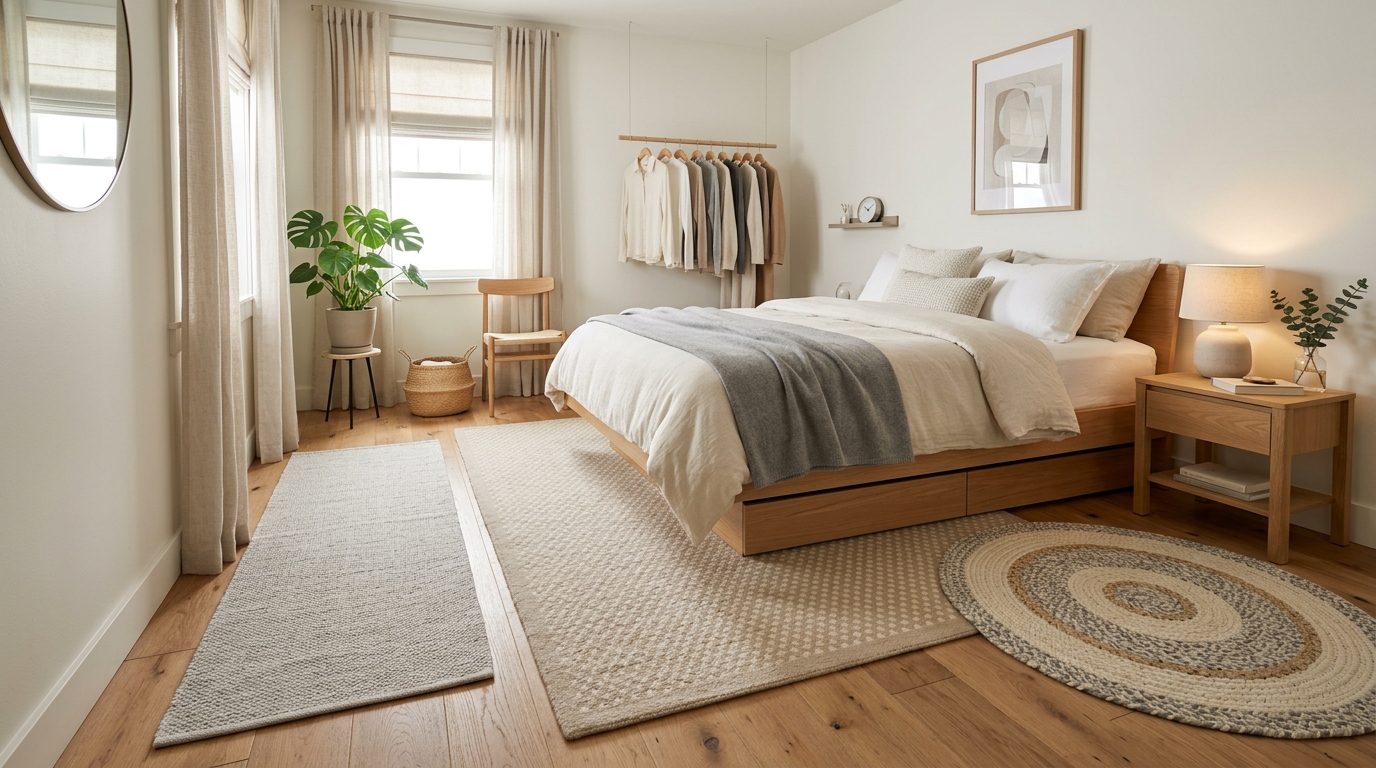
A small bedroom presents a specific challenge when it comes to rugs, since the standard advice to go big and bold often does not translate well when floor space is already limited. The right rug in a small room can make the space feel larger and more put together, while the wrong one makes everything feel cramped and cluttered.
This article focuses on rug ideas specifically for small bedrooms, covering shapes, colors, and placement strategies that work with limited space rather than against it. Below are twenty ideas for choosing and styling a rug in a small bedroom.
1. Light Colored Rug to Open Up the Space
A rug in light tones, cream, pale gray, soft beige, or off white, reflects more light than a dark rug and helps a small bedroom feel brighter and more spacious. The lighter color visually expands the floor, making the room read as larger than it actually is, even when the actual square footage stays the same.
This approach works particularly well when paired with light walls and bedding, since the cohesive lightness throughout the space prevents any single element from making the room feel heavy. Choosing a light rug does require a bit more attention to keeping it clean, especially near doorways, but the visual payoff in a small room is significant enough to justify that small additional effort.
2. Small Accent Rug Beside the Bed Only
Rather than trying to fit a rug underneath the bed, placing a small accent rug along just one side of the bed gives you the comfort of soft footing without dedicating limited floor space to a larger rug. This works particularly well when the room is too narrow to fit a rug under the entire bed comfortably.
This placement focuses the rug on the side most often used to get in and out of bed, making it functional without overwhelming the floor. The small footprint also leaves more visible floor space, which is one of the simplest ways to keep a small room from feeling crowded, since exposed floor reads as breathing room around the furniture.
3. Round Rug to Soften Tight Corners
A round rug in a small bedroom introduces a curved shape that contrasts with the rectangular bed and walls, softening the room’s overall geometry. The lack of corners on a round rug also means it does not visually compete with corners of furniture or the room itself.
This works particularly well placed beside the bed or in a small reading corner, where the round shape defines a specific zone without occupying as much visual space as a rectangular rug would. A round rug also tends to feel less formal than a rectangular one, which can suit a smaller, more casual bedroom better than a more structured layout would.
4. Narrow Runner Along the Length of the Bed
A long, narrow runner placed along one side of the bed provides soft footing exactly where it is needed without taking up much floor width. This is especially useful in bedrooms where the bed is pushed against one wall, leaving only a single side accessible.
The narrow shape of a runner also draws the eye along its length, which can make a small room feel longer or more defined. Choosing a runner in a slightly bolder pattern or color than you might choose for a larger rug works in a small space, since the limited size means the pattern stays visually contained rather than dominating the room.
5. Vertical Stripe Pattern to Add Length
A rug with vertical stripes running the length of the room visually extends the space, drawing the eye along the stripes and making the room feel longer than it is. This is a similar visual effect to the way vertical lines on clothing can make a person look taller.
This works particularly well in small bedrooms that feel boxy or short, where adding visual length helps the room feel more proportioned. Choosing stripes in soft, subtle tones rather than high contrast colors keeps the effect from feeling too busy or graphic, which can be overwhelming in a confined space where there is little room for the eye to rest.
6. Single Solid Color for a Calm Foundation
A rug in a single solid color, without any pattern at all, creates a calm visual foundation that does not compete with anything else in the room. In a small space where every element is closer together, reducing visual noise helps the room feel less chaotic.
This approach works particularly well when other elements in the room, bedding, curtains, or art, provide the pattern or color interest, letting the rug serve as the quiet base beneath them. A solid rug in a tone that complements the wall color creates a sense of cohesion, making the floor and walls feel like they belong to the same overall palette rather than competing surfaces.
7. Rug Just at the Foot of the Bed
Placing a rug only at the foot of the bed, rather than underneath or beside it, defines that small zone and provides a soft spot for stepping out of bed at the very front while leaving the sides and middle of the room more open.
This placement works particularly well in small bedrooms where furniture is tightly arranged on either side of the bed, leaving little room for a rug to extend out from those sides. A rug at the foot also creates a small visual moment that draws the eye to the front of the bed, making that area feel more intentional rather than simply empty floor space.
8. Cotton Flatweave for a Low Profile
A cotton flatweave rug sits low to the floor, which matters in a small bedroom where furniture clearance can be tight. A thick rug can cause doors to drag or make it difficult to push chairs or stools under low surfaces, while a flatweave keeps everything moving smoothly.
The flat construction also tends to feel less visually heavy than a plush rug, which suits a small room where lightness is important. Cotton flatweaves are also typically machine washable and easy to maintain, which adds a practical benefit to their visual lightness, making them a strong all around choice for tight spaces.
9. Rug Tucked Under Just the Foot of the Bed
Sliding a rug just a few inches under the foot of the bed, with most of its length extending out into the open floor in front, anchors the bed to the rug while leaving most of the rug visible. This placement makes the rug feel like part of the bed’s footprint without requiring the larger size needed to extend under the entire bed.
This approach works well in small rooms where a full sized rug would feel oversized, but where you still want the rug to feel connected to the bed rather than floating separately on the floor. The visible portion of the rug becomes the focal point of the floor space, while the small portion tucked under the bed creates a sense of continuity.
10. Soft Pastel Colors for a Gentle Look
A rug in soft pastel tones, blush, dusty blue, sage, or pale yellow, adds a touch of color without overwhelming a small bedroom. The muted versions of these colors stay calming rather than energizing, which suits a small space designed for rest.
This approach works particularly well when one or two pastel tones appear elsewhere in the room, in throw pillows or curtains, so the rug feels connected rather than isolated. Pastels also tend to feel light and airy, which contributes to the overall sense of openness that small rooms benefit from, while still adding enough color to keep the space from feeling completely neutral.
11. Geometric Pattern in Small Scale
A geometric rug with a small scale repeating pattern adds visual interest without overwhelming a small bedroom. Larger geometric patterns, like oversized chevrons or massive diamonds, can dominate a tiny room, but small scale geometry stays visually contained.
This works particularly well when the geometric pattern is in subtle two tone colors, rather than high contrast or multi color combinations, since restraint in color amplifies the calming effect of restraint in scale. The small pattern provides enough texture to keep the rug from looking flat, while still functioning as a quiet background element in the room.
12. Sheepskin Rug as a Soft Layer
A small sheepskin rug, placed beside the bed or in front of a chair, adds a touch of plush softness in a limited footprint. The natural shape and soft texture make even a small sheepskin feel like a deliberate, cozy addition rather than just a tiny mat.
This works particularly well when other rugs in the room are flat or low profile, since the sheepskin provides a contrasting texture that adds depth without adding much size. Real or faux sheepskin both work depending on personal preference, and either option brings the same soft, warm feel underfoot, which is especially nice in a bedroom where bare feet land regularly.
13. Rug Color Matched to Bedding for Continuity
Choosing a rug in a color that matches or closely echoes the bedding creates a sense of visual continuity that helps a small bedroom feel more cohesive. The matching tones flow from the bed down to the floor, making the space feel unified rather than chopped up by contrasting colors.
This works particularly well in very small rooms where competing colors can make the space feel busier than it is. The continuity between the rug and bedding draws less attention to the small size of the floor space, since the eye does not constantly bounce between different colored surfaces, instead taking in the room as one connected whole.
14. Two Mini Rugs on Either Side of the Bed
Instead of one large rug, two small matching rugs on either side of the bed give you soft footing on both sides without committing floor space to a full sized rug. This works especially well when the bed is centered in the room rather than pushed against a wall.
The symmetry of two matching small rugs reinforces a sense of order and intentional design, which can make a small room feel more deliberately arranged. Choosing rugs in a color or pattern that connects to the bedding helps tie the whole sleeping area together, while the two separate rugs leave the area beneath the bed clear and easy to clean.
15. Bordered Rug to Define Edges
A rug with a distinct border around its perimeter, in a slightly different color or pattern from the center, creates clear visual edges that define the rug’s space within the room. This definition helps a rug feel like a deliberate placement rather than something floating on the floor.
This works particularly well in small bedrooms where every element needs to feel intentional, since the border draws attention to where the rug starts and ends. The framing effect of a bordered rug also makes the floor space within it feel like its own defined zone, which can help a small room feel more organized and considered.
16. Multi Functional Mat Near the Door
A small functional mat near the bedroom door, in addition to a rug elsewhere in the room, defines the entry zone and catches dust or dirt before it spreads through the rest of the space. This kind of two rug approach works in small rooms because each rug serves a specific purpose.
This works particularly well when the entry mat coordinates in color or material with the main rug, even if it is a different size and shape. The functional rug at the doorway also makes the small room feel more thoughtfully organized, with distinct zones for entering and for the main sleeping area, both clearly defined by their respective rugs.
17. Warm Toned Rug to Add Coziness
A rug in warm tones, terracotta, mustard, deep rust, or warm brown, brings a sense of coziness and intimacy to a small bedroom. Small rooms can sometimes feel utilitarian, and a warm colored rug counteracts that by adding richness underfoot.
This approach works particularly well in bedrooms designed for relaxation and rest, where warmth is part of the overall feeling the room is meant to create. Pairing the warm toned rug with similarly warm accents, like a wood toned headboard or amber lighting, reinforces the cozy atmosphere, making the small space feel like a deliberate retreat rather than just a tight room.
18. Synthetic Rug for Durability in a Tight Space
In a small bedroom where the rug gets concentrated use, a durable synthetic rug holds up better than more delicate natural fiber options. Synthetic rugs resist staining, fading, and wear, which matters when the same rug is walked on and stepped onto multiple times every day.
These rugs have come a long way in appearance and now closely resemble natural fiber options at a fraction of the cost. Choosing a synthetic rug in a small bedroom makes practical sense because the rug’s exposure to wear is concentrated, meaning a more durable material extends its useful life significantly compared to a delicate alternative in the same conditions.
19. Rug Layered Over Carpet for Definition
In a small bedroom with wall to wall carpet, layering a rug on top of the carpet adds definition and visual interest that plain carpet alone cannot provide. The rug creates a focal area within the larger carpeted space, anchoring the bed and defining the sleeping zone.
This approach works particularly well when the layered rug has a distinct color, pattern, or texture compared to the underlying carpet, so the contrast is clear. Layering also brings the option of changing the rug seasonally or as styles evolve, without needing to replace the carpet beneath, which adds flexibility to a permanent flooring choice.
20. Hide Style Rug for an Irregular Shape
A hide style rug, whether real, faux, or simply a rug designed in an organic, non rectangular shape, breaks up the geometry of a small bedroom in a way standard rectangular rugs cannot. The irregular outline adds visual interest while still anchoring the floor.
This works particularly well as a single accent rug rather than a primary one, placed beside the bed or at the foot, where the unusual shape can be seen and appreciated rather than hidden beneath furniture. The unexpected outline draws the eye and adds personality to the room, which can be especially valuable in a small space where there is less room for multiple decorative elements.
Final Thoughts
A rug in a small bedroom does not need to be small itself, but it does need to be chosen with the space in mind, in color, scale, and placement. The general principle is that lighter colors, smaller patterns, and intentional placement work harder for a small room than oversized statement pieces would.
Beyond visual choices, practicality matters more in a tight space, since every element gets noticed and gets used more concentrated than in a larger room. Whatever rug fits both the look and the function of your bedroom best, the right one underfoot can make a small room feel larger, calmer, and more like the cozy retreat it is meant to be.