
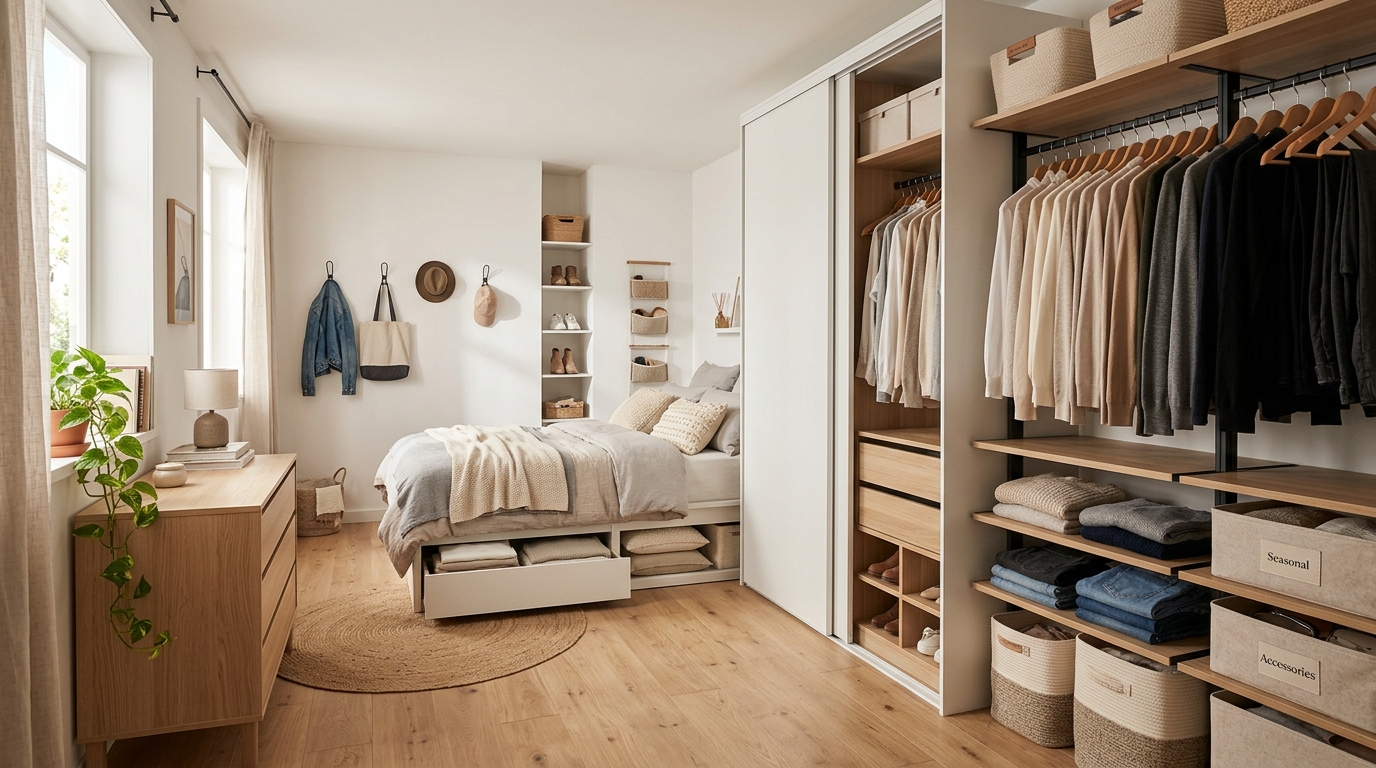
Clothes take up more bedroom storage space than almost anything else, and the standard closet plus dresser combination often falls short within a year or two of moving in. A growing wardrobe, seasonal rotations, and the need to actually see what you own all push against the limits of conventional clothing storage.
This article focuses specifically on clothing storage solutions for bedrooms, the kinds of setups and systems that handle clothes well regardless of how much closet space you start with. Below are eighteen ideas for organizing and storing clothes in a bedroom.
1. Open Garment Rack as Visible Wardrobe Storage
An open garment rack along one wall of the bedroom turns clothing storage into a visible, almost boutique style display, where pieces hang in view rather than hidden behind closet doors. This works particularly well when the clothes themselves are organized by color or category, creating a curated look out of everyday wardrobe items.
This setup forces a level of editing that closed storage does not require, since everything is on display and disorganization is immediately visible. Choosing a sturdy metal or wood rack that holds significant weight without bowing in the middle is important, and adding a shelf above or below the hanging area provides spots for folded items, bags, or shoes, completing the wardrobe in a single piece of furniture.
2. Double Hanging Rods to Maximize Closet Height
Installing a second hanging rod beneath the existing one in a closet doubles the hanging capacity for shirts, pants, and shorter items. Most closets only use the top portion of the hanging space, leaving the area below clothing largely unused, which is where the second rod fits perfectly.
This works particularly well for wardrobes heavy on shirts, blouses, and folded length pants, since those items hang shorter than dresses or full length pieces. A simple add-on second rod, which clips onto the existing one, can be installed without any permanent changes, making this approach especially friendly for renters who want significant storage gains without altering the closet structure.
3. Pull Out Pants Rack Inside a Wardrobe
A pull out pants rack mounted inside a wardrobe or closet provides dedicated horizontal storage for pants, allowing them to hang side by side without folding. Each pant fits on its own arm of the rack, keeping wrinkles out and pairs easy to grab.
This works particularly well for dress pants, slacks, and other items that benefit from being kept flat or hung by the cuff rather than folded over a hanger. The pull out mechanism makes the entire rack accessible without removing anything, and the dedicated space for pants frees up regular hanging space for shirts, jackets, and other items that have different storage needs.
4. Slim Velvet Hangers to Fit More in Less Space
Replacing bulky plastic or wooden hangers with slim velvet ones can increase closet hanging capacity by twenty to thirty percent simply through space savings on each hanger. The non slip texture also keeps clothes from sliding off, which solves a separate problem at the same time.
This works as one of the simplest, lowest cost storage improvements available, since the change requires only purchasing new hangers and rehanging clothes. The visual improvement of consistent hangers throughout the closet also makes the storage feel more organized, even before any other changes are made, with the slim profile letting more items fit comfortably without crowding.
5. Vacuum Sealed Bags for Off Season Storage
Vacuum sealed storage bags compress bulky off season clothing, like winter coats, sweaters, or heavy bedding, to a fraction of their original size. The compressed bags then slide into under bed storage, the top of a closet, or anywhere else with limited space.
This works particularly well for items that take up significant space but are not needed for half the year, since the compression frees up regular storage areas for current season clothing. The bags also protect contents from dust, moisture, and pests during long term storage, making them practical for keeping seasonal items in good condition between uses without dedicating prime storage real estate to them.
6. Drawer Organizers for Folded Clothes
Adjustable fabric or plastic drawer organizers divide a drawer into sections sized for specific items, like socks, underwear, t-shirts, or undergarments. The dividers prevent items from sliding around and let you see everything at a glance rather than digging through a jumbled drawer.
This works particularly well combined with file folding, where clothes are folded into rectangles that stand upright in the drawer rather than stacking horizontally. This method, popularized by organization experts, makes every item visible from above and prevents the typical pile that builds up over time, with the dividers maintaining the organization even after items are taken out and replaced repeatedly.
7. Hanging Sweater Shelves
Sweater shelves that hang from a closet rod provide vertical storage for folded sweaters, jeans, and other bulky items that take up too much drawer space when stored flat. The fabric shelves stack on top of each other vertically, with each compartment holding several folded items.
This works particularly well for clothes that lose their shape when hung on hangers, like heavy knits and sweaters, which stretch out at the shoulders when hung. The hanging system uses vertical closet space that would otherwise go unused, and the soft fabric construction means the shelves are gentle on delicate items while still providing organized, accessible storage.
8. Wardrobe with Internal Drawers and Hanging Space
A standalone wardrobe with a combination of internal drawers and hanging rods provides complete clothing storage in a single piece of furniture, useful in bedrooms without built-in closets. The drawers hold folded items while the hanging area accommodates shirts, dresses, or jackets.
This works particularly well in older homes or apartments where the original closet is small or nonexistent, since the wardrobe essentially adds a self contained closet to the room. Choosing a wardrobe with adjustable internal components allows the proportions of drawer to hanging space to change as your wardrobe evolves, providing flexibility that a fixed closet structure does not offer.
9. Foldable Travel Cubes for Organizing Drawers
Foldable fabric cubes, originally designed for packing suitcases, work just as well inside drawers to subdivide and organize clothing by type or category. The cubes stack within drawers or sit side by side, with each one holding a specific group of items.
This works particularly well for travel oriented organization where you can pack directly from labeled cubes when packing for a trip. The cubes also keep different categories from mixing together, so socks stay with socks and shirts stay with shirts, even when the drawer is heavily used. Because they collapse flat when empty, the cubes do not waste space, making them efficient for both storage and travel use.
10. Tilted Shoe Rack on a Closet Floor
A tilted shoe rack on the floor of a closet stores shoes at an angle that lets you see each pair clearly without bending or rummaging. The angled storage takes less depth than flat shoe storage, freeing up valuable closet floor space.
This works particularly well for everyday shoes that need to be accessed quickly, since the visible display makes choosing a pair fast and easy. Stacking multiple tilted racks vertically uses the full height of a closet floor area, while specialty shoes like boots or heels can stay in their boxes or on dedicated upper shelves, with the tilted rack handling daily rotation items efficiently.
11. Clear Boxes for Specialty Items
Clear acrylic or plastic boxes for shoes, hats, or other specialty items keep contents visible while protecting them from dust. Stacking the boxes on closet shelves or under a wardrobe creates organized storage where every item is identifiable without opening boxes.
This works particularly well for items like dress shoes worn infrequently, where the protection of a box matters but the contents need to be findable without searching. The visual clarity of clear boxes also encourages keeping the items inside organized and clean, since dirty or disorganized contents are immediately visible, which tends to discourage the gradual disorder that opaque boxes hide.
12. Tie and Belt Racks Mounted to Closet Wall
Wall mounted tie and belt racks, installed inside a closet, organize accessories that would otherwise tangle together in a drawer or on a hook. Each tie or belt hangs on its own peg, making selection quick and keeping the items in good condition.
This works particularly well for anyone with a collection of ties or belts large enough to warrant dedicated organization, since the wall mounted approach takes essentially no horizontal space while displaying every item clearly. Mounting the rack near the back of the closet or on a side wall puts these accessories within easy reach while not taking up hanging or shelf space needed for clothing.
13. Pull Out Hamper Inside the Closet
A pull out hamper built into the closet or a nearby cabinet keeps laundry hidden but easily accessible, freeing up bedroom floor space where a standalone hamper might otherwise sit. The pull out design makes adding clothes simple, while sliding it back conceals the contents.
This works particularly well when the hamper is sized to match how much laundry typically accumulates between wash days, since an undersized hamper leads to overflow piles on the floor. Some pull out hampers also include separate compartments for sorted laundry, lights, darks, and delicates, which streamlines the wash day process by reducing the need to sort everything just before washing.
14. Closet Lighting to Find Items Easily
Adding light inside a closet, whether through battery operated puck lights, motion sensor LED strips, or wired fixtures, transforms how usable the space actually is. Most closets are dim, making it difficult to identify clothing colors or find specific items without taking everything out into the room’s lighting.
This works particularly well in walk-in closets or deep reach in closets where natural light barely reaches, since the lighting makes the back of the closet as usable as the front. Motion sensor lights that turn on automatically when the door opens add convenience, while warmer color temperature bulbs render clothing colors more accurately than cooler white lights, which matters for matching outfits.
15. Use the Top of a Wardrobe for Storage Baskets
The space above a wardrobe or tall dresser often sits empty, but a row of matching storage baskets up there provides hidden storage for off season clothing, accessories, or items used infrequently. The baskets keep items dust free while creating an intentional decorative element above the furniture.
This works particularly well when the baskets are uniform in size and color, since the matching set looks like a deliberate design choice rather than random storage. Choosing baskets that are easy to lift down, with handles or lower profile shapes, ensures the storage remains usable, while the height keeps these items out of the way during daily routines but still accessible when needed.
16. Garment Bags for Special Occasion Pieces
Fabric garment bags protect special occasion clothing, like suits, dresses, or formal wear, from dust and damage between uses. The bags hang in the closet like regular clothes but keep delicate items in pristine condition for occasions that may be months apart.
This works particularly well for items that would be costly or difficult to replace, since the small effort of bagging them prevents wear from accumulating between rare uses. Choosing breathable fabric garment bags rather than plastic prevents moisture buildup that can damage natural fibers, while clear panels on some bags let you identify the contents without opening, combining protection with practical accessibility.
17. Drawer Inserts for Jewelry and Watches
Velvet or felt lined drawer inserts designed for jewelry and watches keep small accessories organized and protected from scratching. Each compartment holds a specific type of item, rings in one section, earrings in another, watches in a third, with the soft lining preventing pieces from rubbing against each other.
This works particularly well in a top dresser drawer or a vanity drawer used for daily accessories, since the organized storage makes the morning routine smoother. Stackable jewelry trays can fit on top of each other within a deeper drawer, multiplying the storage capacity vertically while keeping different categories of jewelry separated and easy to find.
18. Seasonal Rotation Between Visible and Hidden Storage
A seasonal rotation system, where current season clothes occupy the most accessible storage spots and off season items move to less accessible spots, makes a finite amount of storage work harder than a static setup. As the weather changes, the categories of clothing simply swap places.
This works particularly well in bedrooms where both kinds of storage exist, accessible hanging space, drawers, or open shelves for current items, and less accessible spots like the top of a wardrobe, under the bed, or the back of a deep closet for stored items. The rotation prevents clothes from being permanently buried while ensuring that everything you actually wear right now stays easy to grab, keeping the system functional throughout the year.
Final Thoughts
Clothing storage in a bedroom comes down to using vertical space well, dividing storage spots by category, and rotating items based on actual use rather than treating all clothes as equally important to keep within reach. A wardrobe that fits comfortably in the available space tends to feel more like a curated collection than a chaotic pile, regardless of how much square footage is actually available.
Starting with whatever feels most disorganized right now, the closet floor, the dresser drawers, or the accessories that scatter everywhere, and addressing that one area with a focused solution usually creates more lasting improvement than trying to overhaul everything at once. A bedroom that handles clothes well makes daily routines smoother and the room itself feel calmer, which is what good storage is really meant to do.