
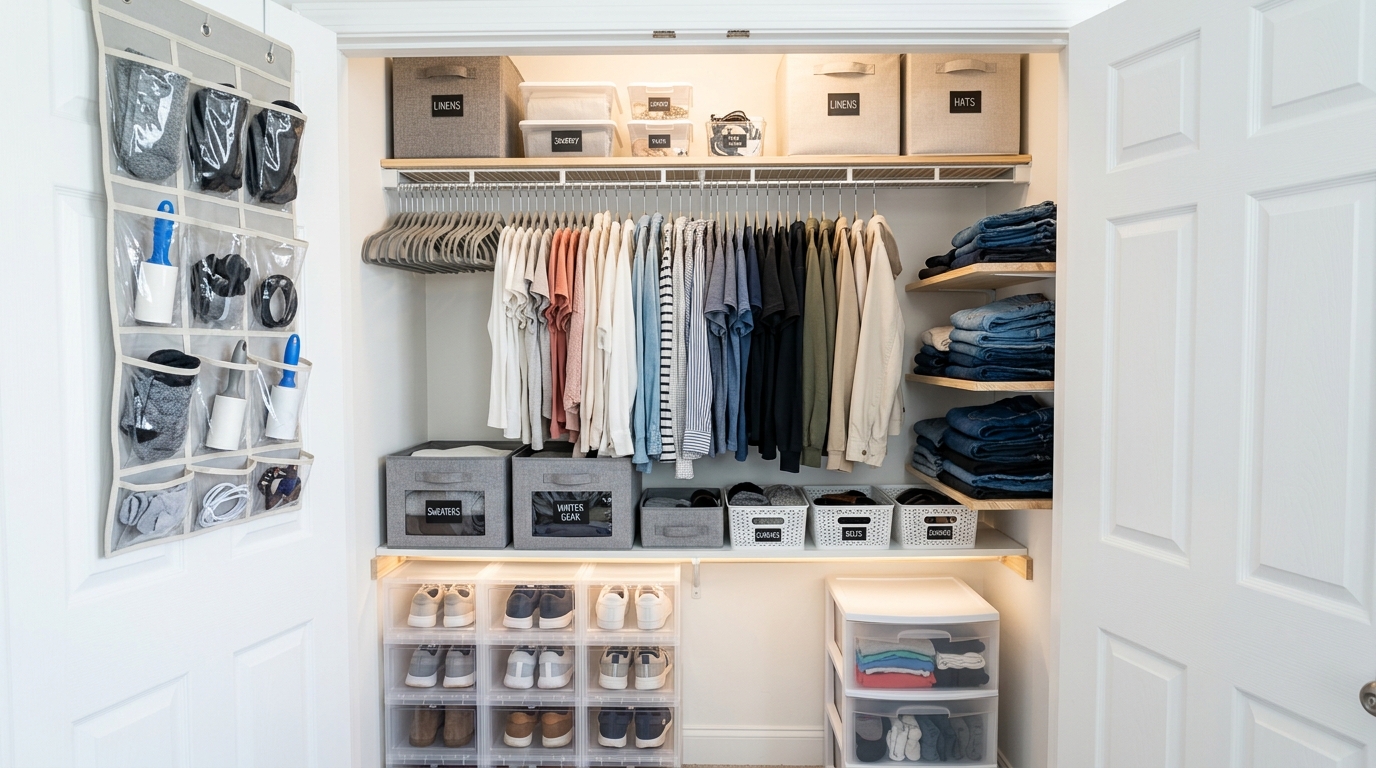
Closet organization does not require expensive custom systems or professional installers, yet most people assume that creating order in their closet demands either hiring someone or spending hundreds of dollars on premium storage products. The truth is that some of the most effective organization strategies cost almost nothing and rely instead on creativity, repurposing items already at hand, and simple solutions that work just as well as expensive alternatives.
This article focuses on budget friendly closet organization ideas, the kinds of approaches that create real organization without requiring a significant financial investment. Below are nineteen ideas for organizing a closet on a tight budget.
1. Tension Rods to Create Vertical Dividers
A tension rod mounted horizontally between two closet shelves creates a divider that keeps stacks of folded clothes from sliding or tumbling together. The rod costs only a few dollars but prevents the common problem of neat stacks collapsing into a jumbled pile every time something is removed.
This approach works particularly well in drawers or on shelves where items need to stay separated and upright without requiring custom dividers. The tension rod is completely removable, making it ideal for renters or anyone unwilling to make permanent changes, and the simple mechanism requires no tools to install, just a slight spreading action to fit it snugly between the two vertical surfaces on either side.
2. Over the Door Organizer for Accessories
An over the door shoe organizer, which costs less than fifteen dollars at most retailers, holds far more than shoes, working equally well for accessories, small items, scarves, or anything else that fits in the pockets. The organizer hangs on the back of the closet door, using space that would otherwise remain empty.
This works particularly well in small closets where shelf or drawer space is limited, since the door organizer does not compete for existing storage. Clear pocketed organizers let you see contents at a glance without opening anything, while the hanging design keeps items within easy reach during the getting ready routine, eliminating the need to rummage through a box or drawer to find something.
3. Shower Curtain Rings for Hanging Scarves
Shower curtain rings, available at dollar stores for just a few dollars, hang from an existing closet rod and hold scarves, belts, or other items looped through the rings. The rings create an organized vertical display of items that would otherwise tangle together in a drawer or bunch on a shelf.
This works particularly well for items that naturally fold or loop, with the shower rings keeping each piece separate and visible. The rotating rings allow easy access to whatever is underneath without needing to remove other items first, and the simple setup requires only a few minutes and a tension rod or existing hanging rod to implement.
4. Cardboard Boxes as Drawer Dividers
Cardboard boxes from product packaging, cut to size and placed in drawers, create free dividers that organize clothing into categories without requiring purchase of dedicated organizers. Small boxes hold socks, underwear, or accessories, while larger boxes organize folded pants or sweaters.
This works particularly well for anyone with a supply of boxes from recent purchases, turning waste into functional organization. The boxes take up no additional space beyond what the clothing already occupies, with the division simply organizing existing contents more effectively, and the simple construction means boxes can be adjusted or replaced as needs change without any permanent modifications to the closet or dresser.
5. Cereal Boxes as Upright Drawer Dividers
Empty cereal boxes, cut on the diagonal to create two upright dividers, organize clothing by category in a drawer using completely free materials. The lightweight cardboard provides enough structure to keep folded items separated and upright without toppling over.
This approach works for anyone who buys breakfast cereal regularly, with the boxes heading to the trash eventually anyway. The organizing happens through file folding, where clothes stand upright in the boxes rather than stacking horizontally, a method that lets you see every item at a glance and prevents the typical situation where items at the bottom disappear beneath newer ones placed on top, forgotten until they resurface months later during drawer reorganization.
6. Adhesive Hooks for No Drill Installation
Adhesive hooks that stick to walls require no drilling or permanent installation, making them ideal for renters or anyone hesitant about damaging walls. A few strategically placed hooks inside the closet cost only a few dollars but provide spots for hanging bags, belts, or lightweight items.
This works particularly well in closets with limited hanging rod space, where additional hooks on the walls can provide supplemental storage. The adhesive bond is typically strong enough for moderate weight, though heavier items need traditional screwed hooks instead, and the removable nature means hooks can be repositioned or removed entirely without leaving damage that would concern a landlord or prevent future sale of the home.
7. Magazine Holders for Vertical Organization
Inexpensive magazine holders, often available in dollar stores or clearance sections of office supply stores, stand upright on shelves to organize folded sweaters, jeans, or other items vertically. The magazine holder structure, designed to hold stacked magazines, works equally well for clothing stacks that would otherwise topple or slide.
This approach costs just a few dollars per holder but creates surprising storage capacity through vertical organization. The holders also make accessing items at the bottom of a stack unnecessary, since every piece stands at the same height and width, with items in the middle of the stack just as accessible as those on either end, solving a significant problem of closet organization where buried items get forgotten.
8. Hanging Cascading Hangers
Cascading clip hangers, which hang multiple items from a single hanger through a series of clips, multiply hanging capacity without requiring additional rod space. A ten dollar set of cascading hangers can hold several pairs of pants or skirts in the space one standard hanger occupies.
This works particularly well for items like pants and skirts that benefit from being hung flat rather than folded. The cascading design keeps items separated and visible, with each piece accessible without moving others out of the way, and the simple clip mechanism means items can be switched out quickly without needing to remove and rehang entire outfits.
9. Using Existing Furniture as Closet Organizers
A small dresser, nightstand, or shelving unit already owned but not being used elsewhere in the home can be repurposed inside a large closet to add storage without purchasing anything new. The piece brings its existing drawers and shelves directly into the closet organization system.
This works particularly well in walk in closets with enough floor space to accommodate a piece of furniture, since the existing piece costs nothing to relocate. The repurposed furniture often works better than buying dedicated closet organizers because the pieces were designed for general storage and accommodate irregular items more flexibly than specialized closet products might.
10. Basket Collection for Shelf Organization
Baskets already owned, or gathered from thrift stores for just a few dollars each, organize items on closet shelves by category. Woven baskets, plastic bins, or even small crates create organized zones without requiring custom installation.
This approach works by gathering baskets of various sizes into a cohesive collection, then assigning each basket a category like scarves, gym clothes, or winter accessories. The baskets also make shelves easier to clean, since an entire basket can be lifted out and replaced rather than rearranging individual items, while the consistent material choice across baskets keeps the closet looking intentional rather than chaotic.
11. Tension Rod Across Shelves for Hanging Items
A tension rod mounted horizontally across a closet shelf creates a hanging space for lightweight items like scarves, belts, or thin garments without adding any permanent structure. The rod costs a few dollars and requires no tools beyond the ability to spread it to fit snugly.
This works particularly well for utilizing the vertical space between shelves, which typically sits empty even though it could hold hanging items. The tension rod approach is particularly useful for items that would wrinkle or compress if folded on the shelf below, giving them dedicated hanging space within the existing shelf framework while keeping the overall closet structure unchanged.
12. Command Hooks for Lightweight Items
Command brand adhesive hooks or similar removable hooks organize lightweight items throughout the closet without requiring drilling. Hooks hung on the inside of the closet door, on walls, or even on existing shelving provide spots for bags, jewelry, or accessories.
This approach costs just a few dollars for a multi pack of hooks, with each hook providing a dedicated spot for an item that might otherwise scatter or tumble. The removable adhesive means hooks can be repositioned or removed without damage, and the variety of hook styles available means nearly any item can find a hanging spot without requiring a custom solution or permanent installation.
13. PVC Pipe for DIY Shoe Storage
PVC pipe cut into sections and mounted horizontally on closet walls creates a simple shoe rack that costs just a few dollars in materials. Each pipe section holds one pair of shoes, with the pipes arranged in rows to create a visible, organized display.
This DIY approach works particularly well for athletic shoes or casual shoes that do not require the formality of a purchased shoe rack. The simple construction means the shoe storage can be customized to fit the closet’s specific dimensions, with pipes added or removed as the shoe collection grows or shrinks, and the open design displays every pair clearly while allowing quick selection and easy cleaning of the shoes themselves.
14. Repurposed Hanging Photo Organizers
Hanging shoe organizers designed for shoes can be repurposed to hold small items like accessories, belts, jewelry, or socks, with the transparent pockets showing contents at a glance. These organizers cost ten to twenty dollars but provide remarkable storage density for small items.
This approach works by repurposing the organized pocket structure for its organization benefits rather than specifically for shoes. The hanging organizer attaches to any closet rod, taking up minimal horizontal space while organizing surprising numbers of small items vertically, with each pocket holding a specific category or item so nothing gets lost in a tangle of accessories or forgotten at the bottom of a drawer.
15. Door Hooks for Lightweight Storage
Simple over the door hooks, which cost just a few dollars, provide hanging spots for bags, light jackets, or belts without requiring installation on the walls themselves. The hooks hang on the inside or outside of the closet door, using space that would otherwise remain empty.
This works particularly well for items grabbed frequently on the way out the door, since the door mounted location puts those items within immediate reach. The simple hook mechanism requires no installation beyond hanging the hook on the existing door frame, making this one of the easiest, fastest closet improvements available for minimal cost.
16. Coordinate and Declutter Before Buying Anything
Organizing existing clothes by color, type, or season before purchasing any storage solutions often reveals that much less storage is actually needed than initially thought. Removing items no longer worn frees up space naturally without requiring new organizers.
This approach costs nothing and typically solves more closet problems than purchasing expensive systems, since the real issue in most closets is often too many items rather than poor organization. Taking time to honestly evaluate what is worn regularly versus what hangs unworn often results in donating or discarding enough items that the closet suddenly feels spacious, with existing rods and shelves suddenly adequate for what remains, eliminating the need to purchase anything at all.
17. Hanging Clothes Vertically in Drawers
File folding clothes vertically in drawers, rather than stacking them horizontally, allows every item to be visible without removing what is on top. The method costs nothing but organization time and transforms how effectively drawer space actually functions.
This approach works by folding clothes into rectangles that stand upright in drawers, similar to filing papers in a filing cabinet. Every item becomes visible at a glance, with nothing hidden beneath other items, and removing one piece does not disturb the rest of the stack, making this simple folding method one of the most effective organizational improvements possible without purchasing anything.
18. Clear Plastic Boxes From Discount Retailers
Clear plastic storage boxes from dollar stores or discount retailers cost just a few dollars each and let contents remain visible while protecting items from dust. The clear construction eliminates the problem of forgotten items hidden in opaque boxes.
This approach works by choosing uniform box sizes that stack neatly on closet shelves, with each box holding a specific category of items. Labels on each box make finding contents easy, and the stackable design lets multiple boxes occupy the same shelf space, with the clear plastic making it obvious what is inside without opening anything, so the right box can be selected immediately during the getting ready routine.
19. Utilize Vertical Space by Hanging Everything Possible
Hanging items that are typically folded and stored in drawers, like t shirts, sweaters, or jeans, creates surprising storage capacity in closets that have unused hanging rod space. The hanging approach works for any item strong enough to support its own weight on a hanger.
This method costs nothing beyond using existing hangers differently and multiplies closet capacity by turning underutilized vertical space into productive storage. The hanging approach also makes clothes more visible, which tends to increase the likelihood they get actually worn rather than forgotten in a drawer, with the combination of increased capacity and increased usage making this simple approach one of the most effective closet improvements possible.
Final Thoughts
Closet organization on a budget relies far more on creativity, repurposing items, and smart use of existing space than on purchasing expensive systems or professional installation. Most of the most effective closet improvements cost nothing beyond time, relying instead on simple approaches like vertical organization, decluttering, and maximizing existing rod and shelf space before assuming more storage is needed.
Starting with whatever seems most disorganized and addressing that area with an inexpensive solution, whether that is a tension rod, some hooks, or simply refolding clothes vertically, typically makes a bigger difference than planning a complete closet overhaul that requires purchasing dozens of products. A closet that has been organized thoughtfully using free or nearly free solutions functions just as well as one that cost hundreds of dollars, with the real difference lying not in how much was spent but in how intentionally the available space was used.