
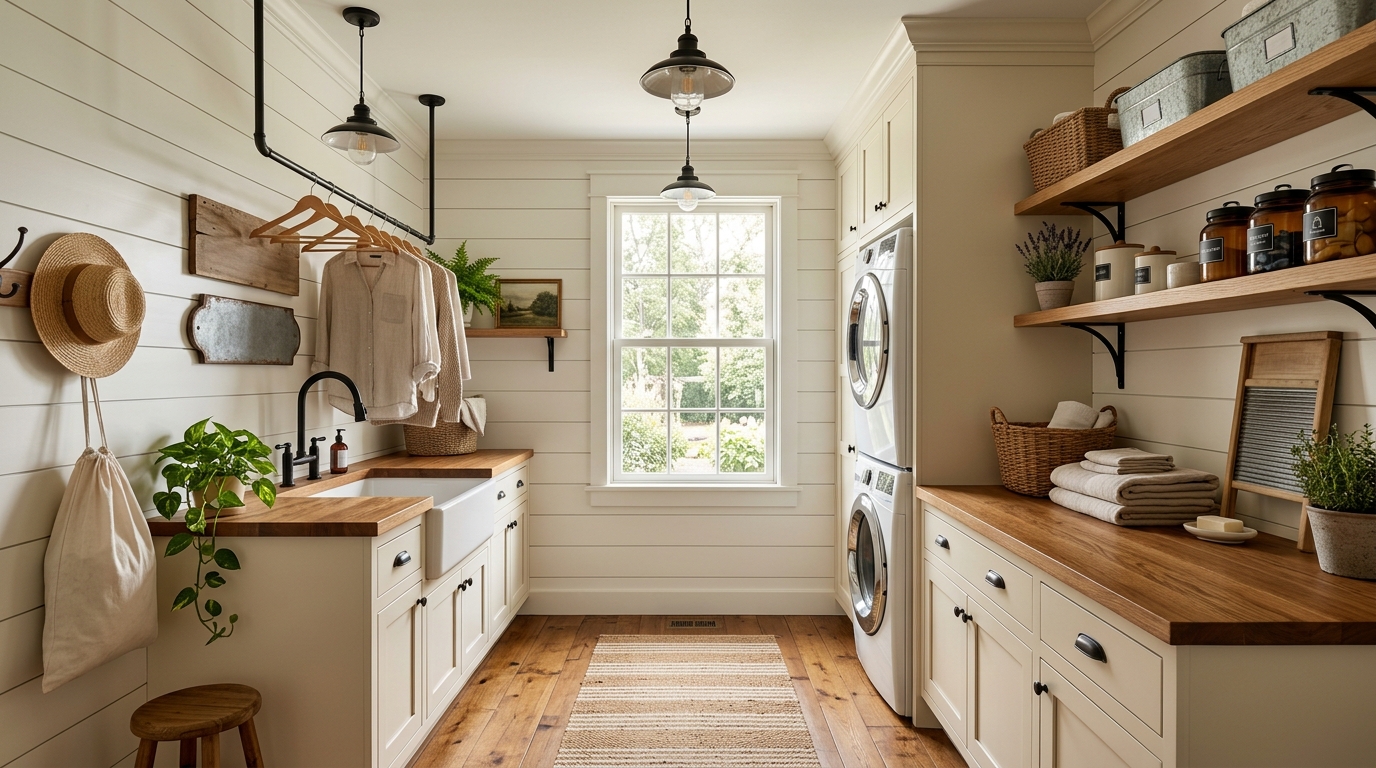
A farmhouse laundry room should feel like one of the most honest rooms in the house. It is a working space and the decor should lean into that rather than apologize for it. The best farmhouse laundry rooms look like they have been doing real work for years and the natural materials, the simple typography, and the unpretentious details that define the farmhouse aesthetic suit that working quality better than any other decorating style. These 17 farmhouse laundry room decor ideas will show you how to bring that warm, practical character to your laundry space without overcomplicating it.
The ideas here work in dedicated laundry rooms, closet conversions, and laundry alcoves alike. Below are 17 ideas that bring genuine farmhouse personality to a laundry room of any size.
1. Install Shiplap on One or All Walls
Shiplap paneling in a laundry room brings the most immediately recognizable farmhouse architectural detail into the space at a very reasonable cost. A single shiplap accent wall behind the washer and dryer, painted in a warm white or a soft cream, creates a backdrop with texture and character that drywall painted the same color cannot approach. The horizontal lines of the shiplap add visual width to a narrow laundry room and the material itself references the practical wood paneling of historic farm outbuildings in a way that resonates naturally with the working quality of the space.
Paint the shiplap in Benjamin Moore White Dove or Sherwin Williams Alabaster for a warm white that suits farmhouse laundry rooms better than a stark bright white. If the room has enough natural light, painting the shiplap in a soft sage green, a muted navy, or a warm gray creates a laundry room with more visual depth and personality than white shiplap while maintaining the same authentic farmhouse material reference. The shiplap can be installed as a DIY project using pine boards from Home Depot with a simple nail gun and the cost per wall is modest compared to the visual impact it delivers.
2. Use a Farmhouse Style Utility Sink with Exposed Legs
A white fireclay or enamel utility sink on simple exposed metal legs brings the same apron front farmhouse sink aesthetic that defines the farmhouse kitchen into the laundry room in the format most appropriate to the working character of the space. The exposed leg configuration, whether in black iron, brushed nickel, or raw steel, references the freestanding utility furniture of historic farm interiors where function was the primary consideration and the honest exposure of structural elements was a natural consequence of that priority.
Sinkology and American Standard both carry farmhouse style laundry sinks in white fireclay and cast iron at prices accessible for a laundry room application. Pair the sink with a simple bridge or gooseneck faucet in an oil rubbed bronze or matte black finish that suits the farmhouse material vocabulary of the room. The exposed leg sink also provides open storage beneath it for laundry baskets or cleaning supplies in a simple woven basket that slides under the sink between uses.
3. Add Open Wood Shelving with Vintage Style Labels
Open wood shelves above the washer and dryer or along a laundry room wall styled with organized supplies in consistent containers and labeled with simple hand lettered or printed vintage style labels bring the practical, visible storage aesthetic of the farmhouse kitchen directly into the laundry room. The labels do the organizational work while also functioning as a typography based decor element that reads as characteristically farmhouse. A row of glass jars or white ceramic containers labeled Detergent, Stain Remover, Dryer Sheets, and Fabric Softener in a simple serif or block letter font looks both functional and genuinely considered.
Use thick solid pine or oak shelves on simple black iron brackets rather than thin painted MDF shelves that look insubstantial at farmhouse scale. The wood shelf with black iron bracket combination is one of the most consistently used and most reliably effective farmhouse decor details available and it suits the laundry room as naturally as it suits the farmhouse kitchen because the working context of both rooms makes the honest, practical quality of the combination feel appropriate rather than merely stylistic.
4. Hang a Vintage Style Sign Above the Appliances
A simple wooden sign above the washer and dryer in a farmhouse laundry room adds a typography based focal point that personalizes the space without requiring any structural change or significant investment. A sign reading Laundry Co., Wash Dry Fold, or simply a family name in a simple serif or block letter style on a reclaimed wood board communicates the farmhouse aesthetic clearly and gives the wall above the appliances a finished, considered quality that bare wall or a standard shelf does not provide.
Make your own with a piece of reclaimed pine from Home Depot, a stencil, and white or black paint for a cost of under ten dollars. Purchased versions on Etsy range from fifteen to forty dollars in a wide variety of sizes and typography styles. The sign does not need to be large to be effective. A piece twelve to eighteen inches wide centered above the appliances reads clearly from across the room and provides exactly the kind of simple, honest typography that the farmhouse laundry room aesthetic calls for.
5. Use Black Matte Hardware and Fixtures Throughout
Matte black hardware on shelving brackets, cabinet pulls, faucets, towel bars, and light fixtures in a farmhouse laundry room creates the material consistency that ties all the individual decor elements of the room together into a cohesive whole. Black iron and matte black metal are among the most historically appropriate hardware finishes for a farmhouse context because they reference the working iron hardware of genuine farm buildings and the black finish suits the warm whites, creams, and natural wood tones of the farmhouse palette better than chrome or brushed nickel alternatives.
Apply the matte black finish to every metal element in the room without exception. A single chrome element in an otherwise fully matte black hardware scheme introduces an inconsistency that breaks the visual coherence the consistent finish achieves. Replace any existing chrome or brushed nickel fixtures with matte black alternatives during the laundry room decor update and the room immediately reads as more considered and more authentically farmhouse than the same room with mixed metal finishes.
6. Bring in a Wooden Drying Rack
A traditional wooden drying rack, either a freestanding folding frame or a ceiling mounted pulley style rack that raises and lowers on a rope mechanism, brings a domestic tool with genuine historical roots into the farmhouse laundry room in a form that reads as both functional and decorative. The wooden pulley rack in particular, which hangs from the ceiling on ropes and lowers for loading before being raised to allow air circulation and save floor space, is one of the most authentically farmhouse laundry room elements available because its design has not changed meaningfully since the nineteenth century when it was standard equipment in the laundry rooms of farmhouses throughout Europe and North America.
Ceiling mounted wooden pulley racks are available from specialty home goods retailers and Etsy shops that produce reproduction versions of the traditional design. The installation requires ceiling joists for secure mounting and a cleat on the wall for the rope tie off. In a laundry room with enough ceiling height the pulley rack adds a vertical element of genuine farmhouse character that no wall mounted alternative replicates and the functional value of drying garments at ceiling height where warm air naturally accumulates makes it as practical as it is visually appropriate.
7. Use a Galvanized Metal Tub or Bucket as a Decor Accent
A galvanized metal tub, bucket, or watering can used as a decor accent in the farmhouse laundry room brings the most quintessentially farmhouse material into the space in a form that requires no installation, no commitment, and no significant expense. A large galvanized tub beside the utility sink holding extra laundry supplies, a medium galvanized bucket on a shelf holding wooden clothespins, or a small galvanized watering can used as a vase for a few dried stems on the folding counter all read as naturally farmhouse because the material has such deep roots in the working life of actual farm environments.
Home Depot and farm supply stores carry galvanized containers at very low prices and the material requires no maintenance in a laundry room environment because the natural oxidation of galvanized metal looks better over time rather than worse. A cluster of two or three galvanized containers in different sizes grouped together on the laundry room counter or shelf creates a farmhouse vignette that looks collected and purposeful rather than arranged for effect.
8. Add Woven Baskets for Sorting and Storage
Woven baskets in natural seagrass, rattan, or water hyacinth used throughout the farmhouse laundry room for sorting laundry, storing supplies, and organizing folded items bring an organic warmth and a natural texture to the room that the hard surfaces of the washer, dryer, and shelving cannot provide on their own. The natural fiber material of woven baskets relates to the organic material vocabulary of farmhouse decor, the wood, the linen, the cotton, in a way that plastic bins and wire baskets do not and the visual warmth of natural fiber in a predominantly white and black farmhouse laundry room keeps the space from feeling clinical.
Use large flat woven baskets for folded items waiting to be put away, medium baskets on lower shelves for sorting darks and lights, and small baskets on upper shelves for accessories like clothespins, dryer balls, and small laundry tools. Keep the basket material and weave style consistent across the room so the collection reads as a coordinated set rather than as an accumulation of individual purchases made at different times and different stores.
9. Install a Beadboard Backsplash Behind the Sink
Beadboard paneling installed as a backsplash behind the utility sink in a farmhouse laundry room adds a traditional architectural detail to the most active work area of the room in a material that is both practical and visually appropriate to the farmhouse context. The vertical tongue and groove strips of beadboard create a washable, durable surface behind the sink that handles splashes and moisture better than painted drywall and the period association of the beadboard material reinforces the farmhouse character of the utility sink it backs.
Paint the beadboard backsplash in a crisp white or cream that complements the sink color and provides a clean backdrop for the hardware and accessories in the sink area. A beadboard backsplash panel extending from the counter height to the upper shelf or cabinet bottom creates a complete sink wall treatment that reads as finished and considered in a way that a partial or arbitrarily terminated beadboard application does not. Keep the beadboard consistent with any other beadboard or shiplap elements elsewhere in the laundry room so the paneling reads as a deliberate material choice throughout the space.
10. Hang Linen or Cotton Curtains Under Open Shelving
A simple linen or cotton curtain hung on a tension rod or a simple iron rod below open shelving or below the folding counter creates concealed storage in a format that suits the farmhouse aesthetic perfectly. The soft fabric curtain references the simple textile treatments of historical farmhouse interiors where linen curtains concealed storage under kitchen work tables and utility shelves in a practical and unpretentious way. Behind the curtain, cleaning supplies, extra detergent, and laundry room miscellany can be stored without the visual clutter that open storage beneath a counter or shelf typically creates.
Use a natural linen, a classic ticking stripe, or a simple cotton muslin for the curtain fabric. The fabric itself becomes a decor element that adds warmth and softness to a laundry room otherwise dominated by hard surfaces and the simple rod and curtain installation costs under twenty dollars in materials. A curtain in a ticking stripe in black and cream or navy and cream suits a farmhouse laundry room particularly well because the stripe pattern is one of the most historically associated textile patterns with the farmhouse and working kitchen context the aesthetic draws from.
11. Display Vintage Laundry Accessories as Decor
Vintage laundry accessories displayed on the shelf or counter of a farmhouse laundry room serve the dual purpose of genuine functional decor objects that also communicate the working history of the space. A collection of wooden clothespins in a ceramic crock, a vintage washboard leaned against the shiplap wall, a glass washboard soap holder mounted beside the utility sink, or a set of antique linen smoothing irons used as bookends on the detergent shelf all bring genuine domestic history into the laundry room in a form that reads as collected and considered rather than purchased as a set from a home decor store.
Antique stores, estate sales, and Etsy shops that specialize in vintage domestic items are the best sources for these kinds of pieces. None of them need to be expensive to be effective because the farmhouse aesthetic values the character of the object rather than its monetary worth and a five dollar wooden washboard from an estate sale carries more authentic farmhouse character than a forty dollar reproduction from a home decor boutique.
12. Use a Chalkboard Wall or Panel for Laundry Notes
A chalkboard wall in a farmhouse laundry room, whether a full wall painted with chalkboard paint or a framed chalkboard panel mounted at eye level, serves the practical function of a notes and reminders surface while adding a farmhouse decor element with genuine domestic roots. Chalkboards in working household spaces, laundry rooms, mudrooms, and kitchens have a long history in farmhouse domestic life where they served as menu boards, task lists, and communication surfaces before digital alternatives existed. That historical context gives the laundry room chalkboard an authenticity that purely decorative alternatives lack.
Write the current week’s laundry schedule, care instructions for special garments, or a simple motivational phrase in chalk on the board. Change it regularly so the board remains a living, used element of the room rather than a static display with a permanent chalk marker message. The changeable quality of genuine chalk writing is part of what gives a real chalkboard its farmhouse character and distinguishes it from a sign with a printed or painted message.
13. Add a Small Plant or Herb Pot
A single small plant in a terracotta pot or a small galvanized container on the laundry room shelf or windowsill brings living quality to a room that without it would contain only manufactured objects and synthetic materials. Even a laundry room with no natural window can support a pothos, a snake plant, or a small ZZ plant that tolerates artificial light and the humidity of a laundry environment. A small lavender plant on a windowsill with good light adds fragrance to the laundry room in a natural form that suits the farmhouse aesthetic and the context of a clean laundry environment better than any synthetic air freshener.
Keep the pot simple and farmhouse appropriate. A plain terracotta pot, a small galvanized tin, or a simple white ceramic pot all suit the farmhouse laundry room palette better than a brightly colored or highly decorative planter. The plant itself is the decorative element and the pot should support rather than compete with the natural character of the greenery it contains.
14. Use Rope or Jute Accents Throughout
Natural rope and jute accents in a farmhouse laundry room add organic texture in a material that costs almost nothing and works in a wide variety of applications throughout the space. Wrap a section of galvanized pipe with jute twine secured with dots of hot glue for a textured towel bar. Use a length of natural cotton rope as a curtain tie back. Mount a rope wrapped wreath on the laundry room door. Attach rope handles to wooden or wire storage baskets for a natural fiber grip that suits the farmhouse material vocabulary of the room.
The applications for rope and jute accents in a farmhouse laundry room are almost unlimited and the material cost for any individual application is minimal because rope and jute are available at craft stores and hardware suppliers for just a few dollars per roll. The cumulative effect of rope and jute accents throughout the room adds a layer of natural texture that woven baskets begin and that rope extends to surfaces and objects where woven fiber is not a practical primary material.
15. Hang Framed Botanical or Laundry Prints
Simple framed prints on the laundry room wall add a personal, finished quality to the room that makes it feel genuinely designed rather than merely functional. In a farmhouse laundry room, botanical prints in black and white or muted earth tones, vintage laundry advertisement prints from the early twentieth century, or simple typographic prints with laundry related text in a classic serif font all suit the aesthetic appropriately. The framing should be in a simple wood or black metal frame that complements the hardware finish throughout the room.
A pair of matching frames hung symmetrically above the folding counter or a small grouping of three frames in coordinating sizes on the shiplap wall creates a display that gives the room a sense of intentional decoration without the complexity of a full gallery wall arrangement. Source vintage laundry prints from Etsy or free printable sites that offer public domain vintage advertising imagery at no cost. Print them at a local print shop and frame them for a total cost of under twenty dollars per print for a display that looks far more considered than that investment suggests.
16. Use a Wooden Peg Rail for Hanging Items
A wooden peg rail mounted at shoulder height on the laundry room wall provides hanging storage for reusable shopping bags, garment bags, extra hangers, ironing spray bottles, and any other laundry room item that is easier to access from a hook than from a shelf or drawer. The Shaker peg rail, a long wooden board with turned wooden pegs at regular intervals, is one of the most historically appropriate farmhouse storage elements available because it references the genuine Shaker furniture tradition of simple, functional hanging storage that appears throughout historical Shaker domestic interiors.
A simple Shaker style peg rail from an Etsy maker or a DIY version using a pine board and purchased wooden pegs from a craft store costs under thirty dollars and installs in minutes. Paint it white to match the shiplap behind it or leave it in a natural wood finish for a warm contrast against a white or painted wall. The peg rail in a farmhouse laundry room is a storage solution with genuine historical roots that looks exactly right in the context of the aesthetic rather than like a decorative object chosen for appearance alone.
17. Finish with a Linen or Cotton Hand Towel Display
A small collection of linen or cotton hand towels folded or rolled and displayed in a simple basket or hung on a wooden peg rail near the utility sink completes the farmhouse laundry room with a textile softness that the hard surfaces of the rest of the room need to feel genuinely warm and hospitable. The hand towels do not need to be decorative in the traditional sense. Simple linen towels in a natural undyed color, a classic stripe, or a simple embroidered initial in a matching thread are all appropriate for a farmhouse laundry room and all communicate the same values of honest, quality textile that the farmhouse aesthetic consistently draws on.
Fog Linen, Coyuchi, and simple linen options from Target all carry hand towels appropriate for a farmhouse laundry room display at a wide range of price points. Keep two or three towels on display rather than a full stack and refresh them regularly so the display always looks clean and full. The hand towel display in the laundry room is one of those small finishing details that completes the room in a way that is only fully appreciated in its absence and that costs almost nothing to add.
Final Thoughts
A farmhouse laundry room works best when the decor decisions reinforce the working character of the space rather than attempting to disguise it. The shiplap, the galvanized metal, the wooden shelving, and the simple typography all lean into the honest, practical quality of a room dedicated to real domestic work and that alignment between the function of the space and the aesthetic it expresses is what gives a farmhouse laundry room its genuine appeal.
Start with the shiplap or the open wood shelving and build the farmhouse character of the room outward from that material foundation. A laundry room that feels genuinely farmhouse is one where the decor looks like it belongs to a working room rather than being applied over one and these 17 farmhouse laundry room decor ideas give you everything you need to achieve that quality with honesty and intention.