
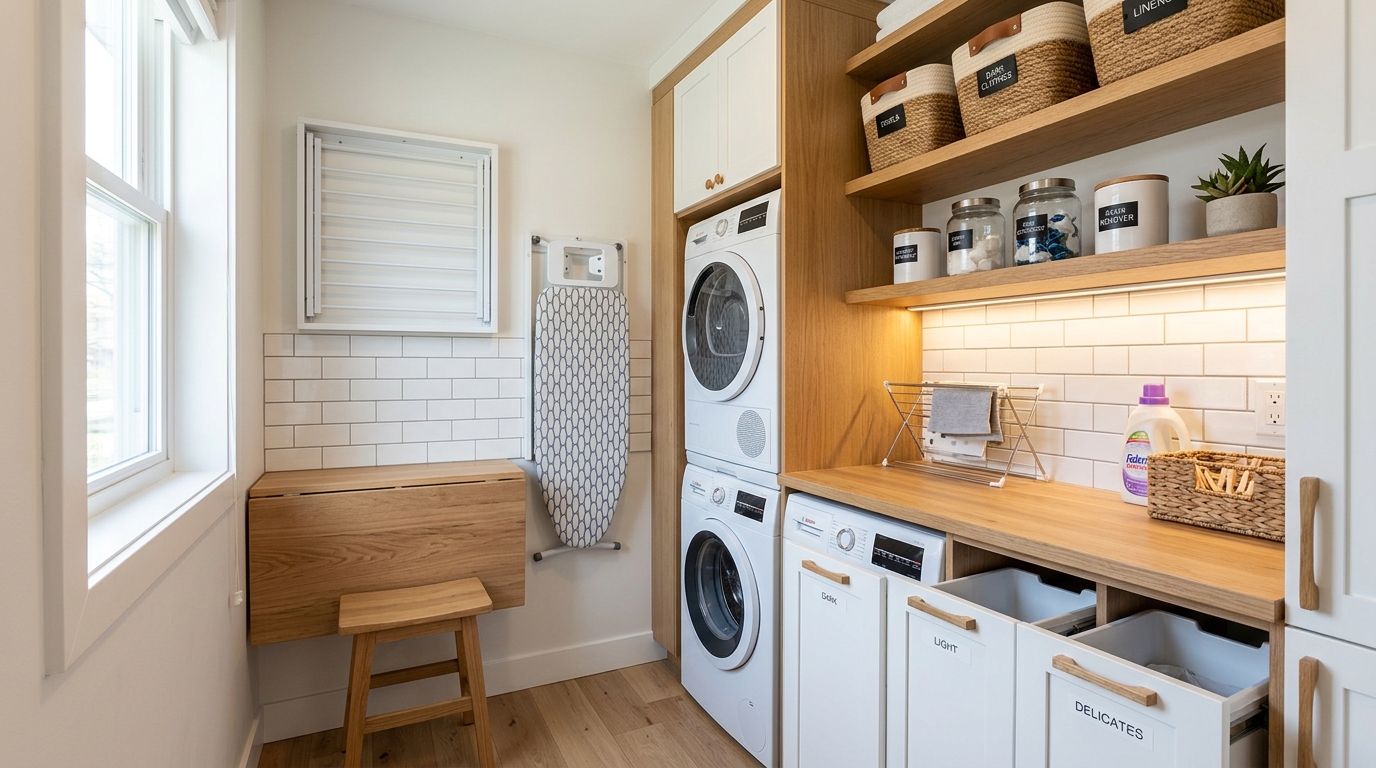
A small laundry room is one of those spaces that most people tolerate rather than design and that is exactly the wrong approach. The laundry room is used multiple times a week by every person in the household and a space that works well, that has the right storage, the right workflow, and even a little visual personality, makes a genuinely repetitive chore feel significantly less tedious. These 20 small laundry room ideas will show you how to make the most of a limited footprint without compromising on function or on how the room feels to be in.
The ideas here work in every kind of small laundry situation, from a dedicated narrow room to a closet conversion to a laundry alcove tucked behind bifold doors. Below are 20 ideas that transform a small laundry room into a space that actually works.
1. Stack Your Washer and Dryer
Stacking the washer and dryer is the single most impactful space saving move available in a small laundry room because it converts the two largest appliances in the room from a horizontal footprint into a vertical one, immediately doubling the floor space available for storage, folding, and movement. A stacked washer and dryer pair occupies roughly the same floor area as a single appliance while delivering the full functionality of both and the floor space recovered on one side of the room can accommodate a cabinet, a folding counter, or additional storage that a side by side configuration has no room for.
Use a manufacturer approved stacking kit rather than simply placing the dryer on top of the washer unsecured. Most major appliance brands including LG, Samsung, and Whirlpool produce matching washer and dryer pairs with dedicated stacking kits that secure the units safely and often include a pull out shelf between the two appliances for detergent or small items. The stacked configuration works in any room with a ceiling height of at least seven feet and suits a closet laundry conversion particularly well where the vertical space is available but the horizontal footprint is extremely limited.
2. Add a Folding Counter Above a Front Load Washer
A front load washer with a dryer stacked above it or positioned beside it leaves the top surface of the washer available as a folding counter, but a countertop installed at the same height and continuous with the washer top creates a proper folding surface that extends the usable work area significantly beyond the appliance top alone. A laminate, butcher block, or quartz countertop mounted on simple brackets at washer height across the full width of one wall gives the small laundry room a dedicated folding zone that a top load washer configuration cannot provide.
Size the countertop to extend past the washer and dryer footprint on at least one side to create a genuine work surface rather than merely covering the appliance top. A counter that extends to the wall on both sides creates a continuous surface that suits the small laundry room better than a floating counter that stops at the edge of the appliance. Mount cabinets above the countertop and below it if the configuration allows for a complete storage and work zone in a single wall section.
3. Install Floor to Ceiling Shelving on One Wall
A full wall of floor to ceiling open shelving in a small laundry room creates more storage capacity than any cabinet configuration of the same footprint because the shelving uses every inch of available wall height without the overhead wasted space that standard upper cabinet installation leaves above the cabinet top. Adjustable wire shelving systems from ClosetMaid or Rubbermaid, or simple painted wood shelves on heavy duty brackets, both work well in a laundry room environment where moisture and humidity make adjustability and easy cleaning important qualities in a shelving system.
Use the upper shelves for items accessed infrequently, bulk detergent supply, seasonal table linens, and spare cleaning supplies, and reserve the lower accessible shelves for daily use items. Label each shelf section clearly so the organization system is visible and self maintaining. A full wall of organized shelving in a small laundry room communicates that the space has been thought about and the visual organization it provides makes the room feel larger and more purposeful than the same wall covered with closed cabinet doors.
4. Use a Slim Rolling Cart for Flexible Storage
A slim rolling cart positioned in whatever gap exists between the appliances and the wall, between the washer and dryer and the door frame, or beside the shelving unit provides additional storage in a footprint so narrow that no fixed cabinet can occupy it. Rolling laundry carts in widths as narrow as six inches are available from Amazon and The Container Store and can hold detergent bottles, dryer sheets, stain removers, and small laundry accessories in a column of storage that rolls out for access and tucks back into its gap when not in use.
The rolling quality of the cart also makes it useful beyond its fixed position since it can be rolled to wherever it is needed in the room during use and parked out of the way when the laundry is done. In a small laundry room where every inch of floor space is valuable the rolling cart occupies the most awkward and least usable spaces in the room, the narrow gaps that exist between fixed elements, and turns them into functional storage without claiming any of the clear floor area needed for movement.
5. Mount a Drying Rack on the Wall
A wall mounted retractable drying rack that folds flat against the wall when not in use and extends into the room when needed provides hang drying capacity in a small laundry room without a permanent floor footprint. Items that cannot go in the dryer, delicate fabrics, wool knitwear, and structured garments, need somewhere to hang dry and a floor standing drying rack in a small laundry room occupies a significant portion of the available floor area for the duration of the drying cycle. A wall mounted retractable version solves the same problem using wall space rather than floor space.
Wall mounted drying racks from brands like Hafele and Brabantia mount on a single wall bracket and extend outward with multiple wooden or steel arms that hold garments individually at a spacing that allows air circulation for effective drying. Choose a position on the wall that allows the extended rack to clear the open door of the washer or dryer so the drying and washing functions can operate simultaneously without interference.
6. Paint the Room a Bold Color
A small laundry room that is going to be small regardless of what is done to it benefits enormously from a bold wall color that gives the space a deliberate character rather than the apologetic neutrality of a room that knows it is too small to be interesting. A deep navy, a warm terracotta, a rich forest green, or a saturated teal on the laundry room walls transforms the space from a utility room that is merely functional into one that has a genuine personality and that makes the time spent in it feel less like a chore location and more like a designed room in the house.
The bold color approach works particularly well in laundry rooms with white or light cabinets and white appliances because the contrast between the dark wall color and the light fixtures and appliances makes both read more clearly and more confidently than either would against a neutral wall. Sherwin Williams Anchors Aweigh, Benjamin Moore Hale Navy, and Farrow and Ball Mole’s Breath are all bold laundry room wall colors that have been used to great effect in small utility spaces where the scale of the room actually suits the enclosing quality of a dark wall better than a larger room would.
7. Add a Sink for Pre Treating and Hand Washing
A small utility sink in a small laundry room transforms the room from a place where clothes are washed by machine into a complete laundry facility where hand washing, pre treating stains, rinsing delicates, and cleaning shoes and sports equipment can all happen without using the kitchen or bathroom sink for tasks they are not designed for. Even a very compact utility sink in a 12 to 15 inch basin mounted on a simple cabinet base or on wall brackets takes up minimal floor space while adding a genuine functional capability that a machine only laundry room lacks.
A wall mounted sink with exposed plumbing in a black iron or chrome finish suits a more industrial or modern laundry room aesthetic and eliminates the cabinet base footprint entirely. A drop in sink in a small base cabinet suits a more traditional or finished laundry room where the exposed plumbing would conflict with the overall design approach. Either configuration requires a cold water supply, a hot water supply, and a drain connection which makes adding the sink most cost effective during a broader laundry room remodel when the wall is open and plumbing access is straightforward.
8. Install Upper Cabinets All the Way to the Ceiling
Upper cabinets in a small laundry room that stop at a standard height of seven feet leave a gap above them that accumulates dust and visual clutter while wasting a meaningful volume of vertical storage capacity. Extending upper cabinets to the full ceiling height, whether through taller cabinet boxes or through a stacked second cabinet unit above the standard uppers, captures that unused volume for storage and eliminates the visual break at cabinet top that makes a small room feel lower and more compressed than it actually is. Ceiling height cabinetry makes the walls read as taller and the room as more generously proportioned.
Use the highest ceiling height cabinets for items accessed infrequently, bulk supply storage, spare linens, and seasonal items, since the height makes these cabinets less accessible for daily use. A small step stool stored inside the lower cabinets or on a hook inside a cabinet door keeps the upper storage accessible when needed without permanently occupying floor space. The visual benefit of ceiling height cabinetry in a small laundry room is immediate regardless of how frequently the top cabinets are accessed.
9. Use Peel and Stick Wallpaper for Personality
A small laundry room is the ideal location for a bold wallpaper pattern that would be too much in a larger, more prominent room. The limited wall area means the cost of good quality peel and stick wallpaper is modest and the impact of a strong pattern in a small enclosed space is significant because the pattern surrounds you rather than appearing on a single distant wall. A graphic floral, a geometric stripe, a botanical print, or a maximalist pattern in colors you love makes the laundry room into a room that actually feels good to spend time in rather than one you move through as quickly as possible.
Peel and stick wallpaper from Chasing Paper, Spoonflower, and Tempaper removes cleanly from most wall surfaces without damage, making it ideal for a laundry room where moisture over time might require the wallpaper to be replaced or where a future owner might prefer something different. Apply it to all four walls for a fully immersive effect or to a single accent wall behind the appliances for a more restrained approach that still delivers significant personality.
10. Add a Rod for Hanging Freshly Ironed or Air Dry Items
A hanging rod mounted above the washer and dryer or along one wall of the laundry room at a height that clears the appliance tops gives you a place to hang freshly ironed shirts, air dry items immediately after washing, and hang garments as they come out of the dryer to prevent wrinkling during the folding cycle. The rod requires no floor space and occupies wall space at a height where no storage shelving could practically function anyway.
A simple stainless steel or iron rod mounted between two wall brackets costs around ten to fifteen dollars in materials and installs in under thirty minutes. Alternatively, a ceiling mounted rod on adjustable chains provides even more flexibility since the height can be adjusted and the rod can be positioned over any section of the room regardless of wall configuration. A laundry room with a dedicated hanging rod eliminates the need to carry garments to another room for hanging and makes the laundry workflow genuinely more efficient from washing through to finished garments ready to wear.
11. Use Baskets and Bins for Sorting
Labeled baskets or bins for sorting laundry by type, whites, colors, delicates, and darks, built into a shelving unit or stacked on a lower shelf in the laundry room, eliminate the separate laundry hamper that most bedrooms contain and consolidate the sorting function into the laundry room itself where it belongs. When dirty laundry goes directly to the sorted bins in the laundry room rather than to a bedroom hamper that then needs to be carried to the laundry room, the sorting step of the laundry process is already complete when it is time to run a load.
Wicker baskets, canvas bins, and fabric lined wire baskets all work well in a laundry room sorting system. Choose a size that holds approximately one full machine load of each category so the visual prompt to run a load is built into the system itself. When a bin is full it is ready to wash. Label each bin clearly with a simple tag or a chalk label so the system is intuitive for every member of the household who uses the laundry room.
12. Mount the Iron and Ironing Board on the Wall
A floor standing ironing board stored in a small laundry room occupies a surprising amount of floor space even when folded and leaned against the wall, because its length makes it difficult to position without it protruding into the walking area of the room. A wall mounted ironing board that folds flat against the wall when not in use and pulls down into a horizontal ironing position when needed eliminates the floor storage problem entirely and provides a proper ironing surface at a comfortable working height without any permanent floor footprint.
Wall mounted ironing board systems from brands like Hafele and Sektion mount on a single wall section and fold out to a full size ironing surface in seconds. Some models include an iron rest and a small shelf for spray starch and other ironing accessories within the same wall mount system. The iron itself can be stored on a dedicated hook or bracket beside the mounted board so the complete ironing setup occupies a single section of wall rather than a floor area that the small laundry room cannot afford to spare.
13. Install a Pocket Door or Barn Door
A standard swing door on a small laundry room claims a significant amount of floor space in its swing arc, space that in a small room is needed for standing, moving, and accessing the appliances and storage on the walls. A pocket door that slides into the wall cavity requires zero floor space in its operation and gives the full floor area of the room back to functional use when the door is open. A barn door on a surface mounted rail requires no wall cavity and achieves the same floor space benefit by sliding along the wall surface beside the door opening rather than swinging into the room.
The pocket door is the cleaner architectural solution when the wall adjacent to the laundry room door opening has enough depth to accommodate the door panel within it. The barn door is the simpler retrofit option that works in any configuration without wall modification and suits laundry rooms where the aesthetic of the visible hardware rail and door panel is appropriate to the overall style of the home. Either option recovers the swing arc floor area of a standard door which in a small laundry room is enough space to add a slim storage unit, a folding step stool, or simply to make the room feel less cramped during use.
14. Add Under Shelf Lighting
Under shelf lighting in a small laundry room illuminates the work surfaces and the storage areas without requiring additional light fixtures on the ceiling or the walls. A LED strip mounted to the underside of each shelf level provides targeted illumination directly onto the surface below it and makes the contents of each shelf visible at a glance without opening cabinet doors or leaning in to see what is stored on a lower shelf. The lighting also makes the room feel more finished and more considered than an overhead light alone achieves in a small enclosed space.
Govee and Brilliant Evolution both produce adhesive LED strip lights that install without wiring by plugging into a standard outlet or running on rechargeable batteries. Warm white strips at 2700K suit a laundry room environment better than cool white options that make the space feel clinical and institutional. The combination of organized shelving with consistent under shelf lighting is the detail that most reliably makes a small laundry room look designed rather than merely functional.
15. Use a Countertop Across Both Appliances
A continuous countertop installed at the same height across the top of both a side by side washer and dryer creates a long folding surface that is more useful than the combined tops of the two appliances alone because the continuous surface allows a full sized garment to be spread flat without draping over the gap between the machines. The countertop can be a simple laminate panel cut to size, a section of butcher block from a home center, or a custom fabricated quartz surface depending on the budget and the desired finish quality.
Support the countertop on the appliances themselves at the center and on wall brackets or a simple frame at the wall end so the surface does not flex when weight is applied during folding. Trim the front edge of the countertop with an edge profile that prevents items from sliding off during use. A continuous countertop across both appliances is one of those laundry room additions that seems simple but produces a meaningful improvement in how functional and how finished the room feels every time laundry is folded there.
16. Organize Detergents in Decanted Containers
Laundry detergent bottles, fabric softener jugs, stain remover sprays, and dryer sheet boxes in their original packaging on a laundry room shelf create visual clutter that makes even a well organized room look chaotic because retail packaging is designed to attract attention on a store shelf rather than to look calm and organized in a domestic setting. Decanting detergents into uniform glass or clear acrylic dispensers with pump tops, storing dryer sheets in a lidded ceramic or glass jar, and keeping stain remover in a simple labeled spray bottle transforms the detergent shelf from a collection of competing packages into an organized, calm display.
Simple glass pump dispensers from Amazon, ceramic jars with cork lids, and matching acrylic canisters all produce a consistent detergent organization system that makes the laundry room look considered and intentional. Label each container with a simple printed or handwritten label so the contents are identifiable without opening each one. The decanting process takes thirty minutes to set up and the result makes every subsequent visit to the laundry room feel more organized and more pleasant than the same shelf with original packaging.
17. Add a Small Chalkboard or Whiteboard for Notes
A small chalkboard or whiteboard mounted on a laundry room wall is a practical addition that serves multiple functions in a household laundry context. Use it to note garments with special care instructions, to list laundry tasks in progress, to record which load is in which machine, or simply to leave notes for other household members about garments that need attention. The chalkboard or whiteboard also adds a small personal touch to the laundry room that gives the space a sense of being a real, used room rather than a purely functional utility space.
A small framed chalkboard from Hobby Lobby costs under fifteen dollars and mounts with two screws or a single adhesive strip. Position it at eye level beside the appliances where it is visible and accessible during the laundry workflow without requiring movement to a different part of the room. The chalkboard in a laundry room is one of those small additions whose practical value justifies its presence and whose visual contribution to the room’s personality makes it worth including even if the practical value were less clear.
18. Use Vertical Space Above the Door
The wall space above the laundry room door is one of the most consistently overlooked storage opportunities in a small room because it is above eye level and therefore invisible during most of the time spent in the room. A shelf mounted above the door frame at ceiling height provides storage for items accessed infrequently, extra hangers, a spare ironing board cover, seasonal table linens, and other low frequency items that take up valuable lower shelf space when stored there. The above door shelf uses space that no other storage configuration can access and its height keeps infrequently accessed items out of the way without making them inaccessible.
A simple floating shelf above the door requires only two brackets and a board cut to the width of the door frame and its installation is straightforward in any laundry room with standard wall construction. Keep the shelf depth shallow, no more than ten to twelve inches, so it does not create a head height obstacle when passing through the doorway. Label any bins or baskets stored on the above door shelf so their contents are identifiable from below without needing to retrieve each one.
19. Choose Light Reflective Flooring
A light colored or glossy flooring surface in a small laundry room reflects the available light back into the space and makes the room feel larger and brighter than a dark or matte floor covering achieves in the same square footage. Large format white or light gray porcelain tile, a light colored luxury vinyl plank in a pale wood tone, or a white painted concrete floor all work well in a laundry room context where durability, moisture resistance, and ease of cleaning are functional requirements that the flooring must satisfy alongside its visual contribution to the room.
Avoid small format floor tiles with multiple grout lines in a small laundry room because the visual busyness of the grout grid makes the floor look smaller and the grout lines collect detergent and lint that requires specific cleaning attention. A large format tile in a light color with minimal grout lines or a seamless luxury vinyl plank floor are both easier to maintain and more visually appropriate for a small laundry room than a small format tile regardless of the tile pattern or color chosen.
20. Make It Feel Like a Real Room
The most important small laundry room idea on this list is the simplest and the most frequently overlooked: treat the laundry room like a real room in the house rather than like a utility space that happens to be indoors. Hang a small piece of art on the wall. Put a small plant on the shelf if the light allows. Choose cabinet hardware that you actually like rather than whatever was cheapest. Paint the ceiling a color rather than leaving it white. Add a small rug if the floor configuration allows.
These small investments in the personality of the laundry room pay returns that are completely disproportionate to their cost because they change how the room feels to be in rather than merely how it functions. A laundry room that feels like a real room makes the work that happens there feel less like an obligation and more like a manageable part of domestic life and that shift in feeling, however small it might seem, is genuinely worth pursuing in a space that most households use every single day.
Final Thoughts
A small laundry room that works well is one of the most undervalued improvements available in any home. The ideas above address every dimension of the small laundry room challenge, the storage, the workflow, the visual quality, and the feeling of the space, and all of them are achievable without a significant structural remodel or a large budget.
Start with the organizational foundations, the stacked appliances if the configuration allows, the wall mounted drying rack, and the sorting bins, and add the personality details from there. A small laundry room that functions well and looks considered makes one of the most routine household tasks feel significantly more manageable and these 20 small laundry room ideas give you everything you need to get it there.