
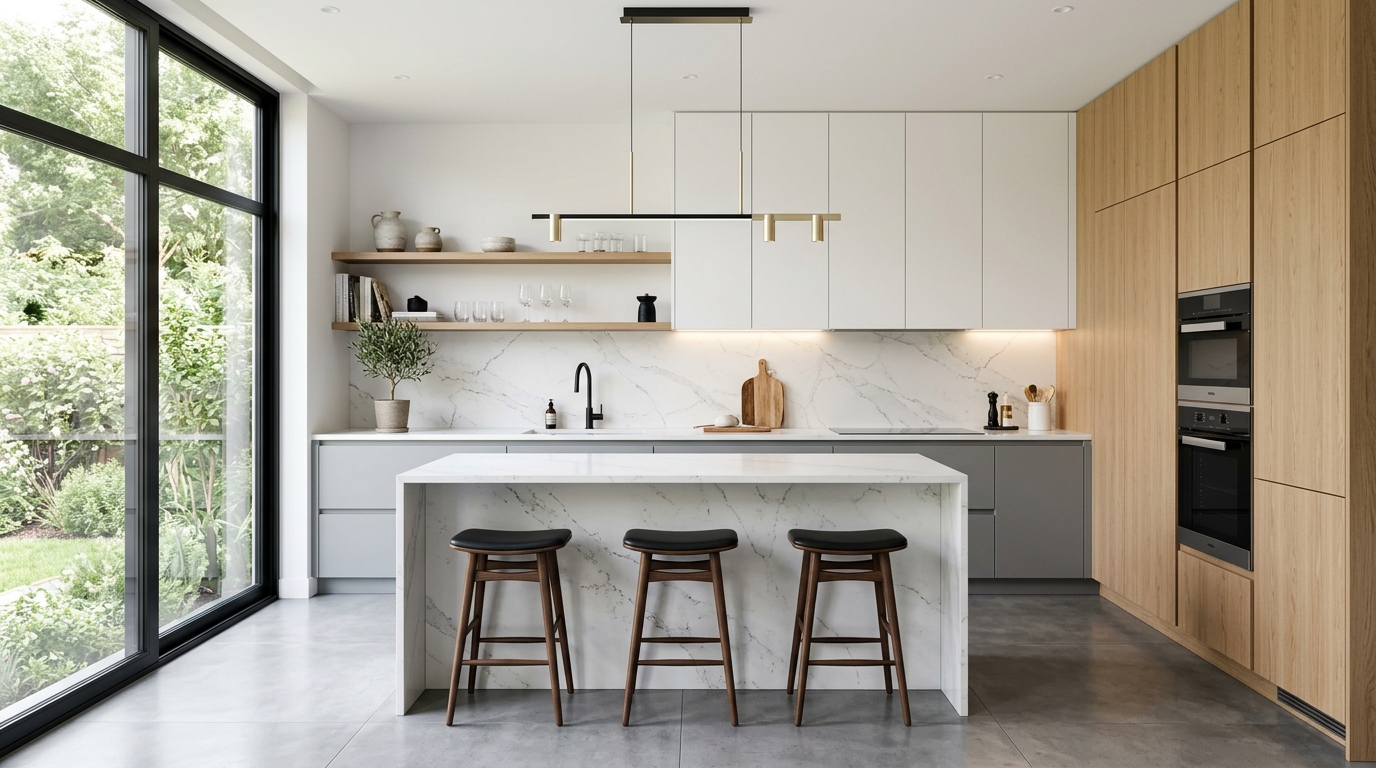
A modern kitchen remodel is built on a different set of values than any other kitchen style. Where farmhouse leans into warmth and history and traditional leans into symmetry and ornament, modern leans into precision, material honesty, and the elimination of everything that does not serve a clear purpose. The result when it is done well is a kitchen that feels simultaneously calm and highly functional, a space where the quality of each material and each detail is apparent because nothing is competing with it for attention. These 25 modern kitchen remodel ideas will show you how to achieve that quality across every decision in the remodel.
The ideas here cover structure, materials, appliances, lighting, and the finishing details that make a modern kitchen feel genuinely considered rather than simply stripped back. Below are 25 ideas that bring real modern character to a kitchen remodel.
1. Go Flat Front on Every Cabinet Door
Flat front cabinet doors with no recessed panel, no raised profile, and no decorative detail of any kind are the foundational cabinet choice of a modern kitchen remodel. The completely flat surface reads as precise and intentional in a way that any profiled door, however simple, cannot approach because the profile introduces a decorative element that modern design philosophy explicitly rejects. A flat front door in a matte lacquer finish, a wood veneer, or a high gloss two pack paint creates a cabinet surface that is purely about the material and the color rather than about the form of the door itself.
The quality of execution matters enormously with flat front cabinetry because there is nothing in the door design to conceal imperfection. Gaps between doors, inconsistent reveals, and surface blemishes that would disappear in the shadow lines of a profiled door are fully visible on a flat front. Commission flat front cabinetry from a supplier with the manufacturing precision to deliver consistent door flatness and consistent reveals and the result is a cabinet installation with the clean, resolved quality that modern kitchen design demands.
2. Choose Handle Free Cabinets with Push to Open Mechanisms
Eliminating visible hardware from a modern kitchen cabinet installation removes every interruption from the flat cabinet surface and produces a wall of cabinetry that reads as a continuous material plane rather than a collection of individual door and drawer units. Push to open mechanisms, either spring loaded touch latches or servo drive systems that open the door with a light touch, keep the cabinet fully functional without any protruding handle or pull that would break the surface continuity.
Blum Tip On and Grass Tiomos are both well engineered push to open drawer and door systems used by quality cabinet manufacturers for handle free modern installations. The servo drive systems from Blum, which open doors and drawers automatically when touched, represent the highest level of handle free cabinet technology and suit the most precise and most considered modern kitchen installations. The handle free cabinet wall is the modern kitchen detail that most immediately distinguishes the space from any other kitchen aesthetic and its effectiveness depends entirely on the precision of the installation.
3. Extend Cabinetry from Floor to Ceiling Without Interruption
Floor to ceiling cabinetry with no visible toe kick at the base and no gap at the ceiling creates a wall of storage that reads as architectural rather than furniture. The absence of the toe kick, achieved through a plinth base cabinet design where the cabinet sits directly on the floor rather than on a recessed base, makes the cabinetry appear to float slightly and eliminates the horizontal shadow line at floor level that standard toe kick cabinetry creates. Combined with ceiling height upper cabinets that meet the ceiling without a gap, the result is a continuous vertical surface from floor to ceiling that defines the wall rather than sitting against it.
This floor to ceiling approach requires precise installation against a truly level floor and a truly flat ceiling and any deviation in either surface becomes visible against the straight lines of the cabinetry. Address floor levelness and ceiling flatness before the cabinetry installation rather than attempting to accommodate them through scribing and filler panels after the fact. The investment in preparation produces a cabinet installation with the precision that the floor to ceiling modern approach requires to read correctly.
4. Install a Waterfall Quartz or Stone Countertop
A countertop in a large format quartz or stone that continues vertically down one or both ends of the island or peninsula in a waterfall configuration is one of the most recognizable modern kitchen details available. The continuous material plane from horizontal to vertical without a visible joint or transition reads as a single sculptural object rather than a surface on a support and that object quality is fundamentally modern in its approach to the kitchen counter. Book matched stone on a waterfall edge, where the natural veining of the material mirrors itself at the fold, elevates the detail further into genuine material artistry.
Silestone Eternal Calacatta, Caesarstone Calacatta Nuvo, and Dekton in large format panels are all appropriate quartz and ultra compact surface materials for a waterfall countertop installation. The joint at the waterfall fold requires precise mitering to achieve a continuous appearance and this fabrication detail is where the quality of the stone fabricator determines the quality of the finished installation. A poorly mitered waterfall fold with a visible gap or a mismatched vein pattern undermines the entire effect regardless of how good the material selection was.
5. Use Integrated Appliances Throughout
Integrated appliances, refrigerator, dishwasher, and any under counter appliances concealed behind cabinet panel fronts that match the surrounding cabinetry, are the modern kitchen remodel investment that most completely achieves the goal of a continuous, uninterrupted cabinet surface. When the refrigerator and dishwasher disappear behind panels that match the adjacent cabinet doors exactly, the kitchen reads as a wall of cabinetry with a cooktop and a sink embedded in it rather than as a collection of cabinets and appliances arranged together. That reading is the defining visual quality of the most resolved modern kitchen installations.
Fisher and Paykel, Miele, and Gaggenau all produce panel ready refrigerator, dishwasher, and oven models designed for integration into custom cabinetry. The cabinet panels are fabricated by the cabinet maker to match the surrounding doors and the hinge and handle configuration matches the adjacent cabinets exactly. The cost of integrated appliances is significantly higher than freestanding alternatives but the visual result, a kitchen where the appliances are present but invisible, is achievable only through genuine integration rather than through any cosmetic alternative.
6. Install an Induction Cooktop Flush with the Countertop
An induction cooktop installed flush with the countertop surface, where the glass cooking surface sits at exactly the same height as the surrounding counter material with no visible frame or lip, creates a countertop that reads as a continuous surface interrupted only by the sink. The flush installation is more technically demanding than a standard drop in installation and requires precise countertop cutout dimensions and a cooktop model designed for flush mounting, but the result is a counter surface with the clean, uninterrupted quality that modern kitchen design requires.
Bora, Gaggenau, and Miele all produce induction cooktop models designed for flush countertop installation. The Bora cooktop with integrated downdraft extraction eliminates the range hood entirely by extracting cooking vapor directly through the cooktop surface, which removes the most visually dominant element above the cooking zone and allows the kitchen ceiling to remain completely uninterrupted above the range. This combination of a flush induction cooktop with integrated extraction represents the most completely resolved modern approach to the cooking zone available in a residential kitchen.
7. Choose a Concealed Range Hood
A standard range hood, whether a chimney style stainless steel hood or a decorative custom surround, introduces a visual element above the cooking zone that interrupts the ceiling plane and draws significant attention to the cooking area. A concealed range hood built entirely within the overhead cabinetry above the range, visible only when the cabinet door is opened to access the extraction mechanism, maintains the continuous ceiling height cabinet line and keeps the cooking zone as visually clean as any other section of the kitchen.
Faber, Miele, and Best all produce concealed under cabinet range hood units designed to be installed within a standard upper cabinet box. The extraction capacity of concealed units is lower than external chimney hoods and they suit kitchen layouts with lower cooking intensity or with supplementary downdraft extraction at the cooktop. For high intensity cooking environments where maximum extraction capacity is required, a ceiling integrated canopy hood in a minimal profile that recedes into the ceiling rather than projecting below it is the most resolved visible hood option for a modern kitchen.
8. Use Large Format Porcelain Tiles on the Floor
Large format porcelain floor tiles in a 24×24, 32×32, or larger format with minimal grout lines create a kitchen floor surface that reads as a continuous plane rather than a tiled surface. The reduction in grout lines as tile format increases is the primary visual effect that large format tiles achieve and in a modern kitchen where continuity of surface is the organizing design principle, the near seamless quality of a large format tile floor suits the aesthetic more completely than any smaller tile format regardless of the quality of the tile material itself.
Porcelain tiles in a concrete look, a stone look, or a large format plain color in a matte finish are all appropriate for a modern kitchen floor. Avoid heavily textured or heavily patterned tiles because the surface variation they introduce conflicts with the smooth material continuity that modern kitchen design depends on. Rectified tiles, which are precision cut to exact dimensions after firing to achieve perfectly consistent sizing, allow the tightest possible grout lines and suit large format modern kitchen floor installations better than non rectified tiles whose dimensional variation requires wider grout joints.
9. Install Recessed Lighting on a Dedicated Circuit
Recessed lighting in a modern kitchen should be planned as a complete system rather than as a collection of individual fixtures placed where they seem convenient. A grid of recessed LED downlights positioned specifically over each work zone, the prep counter, the cooking zone, the sink, and the island, with each zone on a separate dimmer circuit, creates a lighting system that can be adjusted independently for different activities and different times of day. The recessed fixtures themselves are invisible in a modern kitchen ceiling and the light they produce appears to come from the ceiling surface rather than from visible fixtures.
Use LED recessed fixtures with a color temperature of 2700K to 3000K for the warmest and most flattering kitchen light within the LED spectrum. Fixtures with a high color rendering index of 90 or above render food colors accurately which matters in a kitchen context more than in any other room. Trim the recessed fixtures in a white that matches the ceiling exactly so each fixture reads as a circle of light in the ceiling surface rather than as a visible hardware element interrupting the ceiling plane.
10. Add a Statement Island in a Contrasting Material
A kitchen island in a material or color that contrasts deliberately with the surrounding cabinetry creates the single strongest visual focal point available in a modern kitchen remodel. A dark smoked wood veneer island against white lacquer perimeter cabinets, a black stone island against pale gray cabinetry, or a fluted white oak island against flat front painted cabinets all produce an island that reads as the center of the kitchen in both functional and visual terms. The contrast material should be one that the surrounding cabinetry cannot be, adding a texture, a depth, or a material quality that the perimeter cabinets specifically do not have.
The island contrasting material should appear only on the island and nowhere else in the kitchen to maintain its value as a focal point. Using the same contrasting material in multiple locations distributes the visual interest of the material across the kitchen rather than concentrating it at the island where the functional and social center of the space already exists. One material, one location, maximum visual impact is the modern design principle that makes a contrasting island work as effectively as it does.
11. Install Undermount Sinks with No Visible Rim
An undermount sink installed so that the countertop material overhangs the sink basin completely with no visible rim at the counter surface creates a counter to sink transition that reads as a continuous surface interrupted only by a void rather than by a visible fixture. The absence of a rim means counter cleaning is completely uninterrupted since there is no edge for debris to collect against and the visible portion of the sink is purely the basin material rather than any mounting hardware or seal.
Choose a sink basin material that suits the countertop material above it: a stainless steel basin under a quartz countertop, a white composite basin under a white quartz countertop, or a concrete basin under a concrete counter. The basin material should either contrast deliberately with the counter or match it as closely as possible. The mid ground of a slightly different material that is neither a clear contrast nor a close match is the least resolved approach and produces a sink counter transition that reads as a compromise rather than a decision.
12. Use Vertical Grain Wood Veneer on Cabinet Faces
Vertical grain wood veneer on flat front cabinet faces introduces the warmth and the natural material quality of real wood into a modern kitchen without the decorative associations of a profiled wood cabinet door. The straight vertical grain of rift sawn or quarter sawn oak, walnut, or teak veneer applied to a flat MDF door creates a surface that is simultaneously warm and precise, the combination that defines the Scandinavian and Japanese influenced modern kitchen aesthetic that has dominated contemporary kitchen design for the past decade.
The grain direction on vertical grain veneer cabinets should run consistently in the same direction across all cabinet doors and drawer fronts for the most precise and most considered appearance. Matching the grain across adjacent doors so the grain pattern appears continuous from one door to the next, a technique called sequence matching, requires careful planning of the veneer sheets during fabrication and produces a cabinet wall with a material quality that standard veneer cabinets without sequence matching cannot achieve.
13. Install a Single Basin Undermount Workstation Sink
A single large basin workstation sink with integrated ledges that accommodate accessories such as a cutting board, a colander, and a drying rack directly within the sink basin is the most functionally modern approach to kitchen sink design. The workstation sink consolidates multiple counter functions into the sink basin and keeps the countertop on either side of the sink clear of the accessories that typically accumulate around a standard sink. The single basin format suits modern kitchen design better than a divided basin because the continuous single void reads more cleanly as a countertop interruption.
Kraus, Ruvati, and Kohler all produce stainless steel workstation sinks in the single large basin format with a comprehensive range of compatible accessories. Choose a sink with a sound dampening coating on the exterior of the basin to prevent the ringing and the amplification of water noise that thin gauge stainless steel sinks produce. The workstation sink requires a single high arc gooseneck faucet in a complementary modern finish positioned to clear the accessories used within the basin during food preparation.
14. Choose Matte Black or Brushed Gold Fixtures Throughout
A single fixture finish applied consistently across every metal surface in a modern kitchen, the faucet, the pot filler if present, the cabinet hardware if used, the light fixture pendants, and the sink accessories, creates the material coherence that modern kitchen design depends on for its visual resolution. Matte black and brushed gold are the two fixture finishes most associated with contemporary modern kitchen design because both read as deliberate and considered rather than as default choices and both maintain their appearance well in a kitchen environment.
Matte black suits modern kitchens with a cool, graphic quality where the darkness of the fixture finish echoes dark countertop or cabinet elements elsewhere in the space. Brushed gold suits modern kitchens with a warmer palette where the yellow undertone of the gold relates to warm wood veneers, warm stone countertops, or warm wall colors that cool silver or chrome fixtures would conflict with. Choose one and apply it without exception to every metal surface in the kitchen. A single deviation from the chosen finish, a stainless steel sink grid beside a matte black faucet, introduces the visual inconsistency that undermines the coherent modern aesthetic.
15. Use Concrete or Microcement on Walls and Floors
Microcement, a thin cementitious coating applied over existing walls and floors that produces the appearance of poured concrete without the structural requirements of genuine concrete construction, is one of the most impactful surface materials available in a modern kitchen remodel. Applied continuously across the floor and up the walls to counter height or full height, microcement creates a seamless surface without grout lines, without transitions, and without any visible joint that reads as a single continuous material wrapping the kitchen in a way that tile and paint cannot replicate.
The monolithic quality of a microcement surface suits the modern kitchen aesthetic perfectly because it eliminates every surface interruption and lets the kitchen architecture and the objects within it, the cabinets, the appliances, the island, and the countertops, read as elements placed within a continuous material environment rather than as pieces assembled against a collection of different wall and floor finishes. Microcement requires professional application by a trained installer and proper sealing for a kitchen environment but the result is a surface that looks genuinely architectural rather than merely finished.
16. Add Handleless Drawers with Full Extension Soft Close Slides
Full extension soft close drawer slides on every drawer in a modern kitchen are the hardware detail that most directly communicates the quality of the cabinet installation to everyone who uses the kitchen. A drawer that opens to its full depth, reveals its entire contents, and closes with a controlled deceleration to a silent close is a fundamentally different experience from a standard drawer that opens partially and closes with a bump regardless of how good the cabinet door looks from the outside. In a modern kitchen where the interior quality of the cabinetry is as important as the exterior appearance, full extension soft close slides on every drawer are a baseline requirement rather than an upgrade.
Blum Legrabox and Hettich ArciTech are both premium drawer system options that combine the full extension soft close functionality with an aesthetic quality that suits modern handle free cabinetry. The drawer box itself in these systems is a design object with chamfered aluminum sides and a precise appearance when the drawer is open that reinforces the modern quality of the overall kitchen rather than revealing a utilitarian interior behind a considered exterior.
17. Install a Bold Geometric or Textured Backsplash
The backsplash in a modern kitchen is one of the few opportunities for surface texture or pattern in an aesthetic that otherwise tends toward smooth uniformity. A bold geometric tile in a large format hexagon, a long linear brick, or an irregular stacked stone pattern introduces visual interest into the most active wall section of the kitchen without conflicting with the flat surface quality of the surrounding cabinetry and countertops. The backsplash pattern should be confident enough to read as a deliberate design decision from across the room rather than a subtle texture that requires close inspection to appreciate.
Fluted ceramic tiles in a vertical orientation, large format concrete look tiles with a slightly rough surface texture, or a monolithic slab of book matched stone used as a single piece backsplash from counter to hood are all strong modern backsplash approaches that add material interest without introducing the decorative complexity that the modern kitchen aesthetic specifically avoids. The backsplash material should share the color palette of the surrounding kitchen rather than introducing a new color that the rest of the space must then relate to.
18. Create a Hidden Pantry Behind a Flush Door
A hidden pantry behind a door that is flush with the surrounding cabinetry and indistinguishable from the adjacent cabinet panels creates a storage space of significant capacity that disappears completely into the kitchen wall when closed. The hidden door maintains the continuous cabinet surface that modern kitchen design depends on while concealing a fully equipped pantry with shelving, counter space, and storage for appliances and bulk food behind it. When the pantry door opens, the reveal of the organized storage space behind the perfectly flush cabinet surface is one of those design moments that consistently impresses guests.
The hidden door requires a pivot hinge or a concealed hinge system that allows a full height floor to ceiling door panel to open without a visible gap at the hinge side when closed. Hafele and Sugatsune both produce concealed hinge systems appropriate for heavy full height panel doors. The door panel should be fabricated from the same material and with the same finish as the adjacent cabinet panels so the closed pantry is genuinely invisible within the cabinet wall rather than merely close in appearance.
19. Use an Oversized Single Pendant Above the Island
A single large format pendant light centered above the island rather than a row of smaller pendants creates a more confident and more distinctly modern lighting statement over the island zone. The oversized single pendant, whether a large globe in smoked or clear glass, a geometric wire frame in a dark metal, or a sculptural concrete or ceramic form, reads as a considered object rather than a lighting solution and its presence above the island gives the kitchen a focal point that rows of smaller pendants cannot achieve with the same authority.
Scale the pendant to the island dimensions so it feels appropriately sized rather than lost above a large island surface. A pendant with a diameter of 20 to 30 inches suits a standard 4 foot island while a longer island may warrant a larger single pendant or a pair of oversized pendants spaced generously apart rather than a tight row of smaller fixtures. Hang the pendant at 32 to 36 inches above the island countertop surface for the most effective task illumination combined with the visual intimacy that a lower hung pendant creates over the island zone.
20. Install Heated Floors Under the Kitchen Tile
Radiant floor heating installed beneath the kitchen tile surface is a comfort upgrade that operates invisibly and changes the experience of being in the kitchen at every hour of the day regardless of the season. A kitchen floor that is warm underfoot rather than cold, particularly in the early morning when bare feet on cold tile are the most common source of domestic discomfort, is a fundamentally different sensory environment and the quality of that difference is felt rather than seen. In a modern kitchen where the visual environment has been carefully controlled, the sensory quality of the thermal environment is the next dimension of experience to address.
Electric radiant heating mats from brands like Nuheat and Warmup install directly beneath tile on a standard subfloor and connect to a programmable thermostat that can be set to warm the floor before the kitchen is used in the morning. The installation is most efficiently done during the tile installation phase of a remodel when the floor surface is already being replaced. The running cost for kitchen sized radiant floor heating is modest and the improvement in kitchen comfort it delivers is disproportionate to that cost.
21. Choose a Single Deep Neutral Wall Color
Modern kitchen walls in a deep neutral color, a warm charcoal, a cool dark gray, a muted olive, or an almost black navy, create a receding background that makes the cabinetry, the countertops, and the island read as objects placed within a defined space rather than elements assembled against a neutral backdrop. The depth of the wall color gives the kitchen a sense of considered atmosphere rather than the neutral emptiness of a white or light gray wall and the cabinetry appears to stand forward from the wall rather than sitting flush against it.
The wall color in a modern kitchen should relate to the cabinet color without matching it. A dark gray wall behind white cabinets creates the maximum contrast. A warm charcoal wall behind natural wood veneer cabinets relates through shared warmth and depth. A muted green wall behind pale gray cabinets creates a subtle color relationship that rewards close attention. Apply the wall color to the ceiling as well for a fully enveloping modern kitchen environment where the spatial boundary between wall and ceiling disappears into a continuous dark surround.
22. Install a Thin Profile Stainless Steel or Composite Sink
A sink with a minimal rim profile, whether a zero radius stainless steel undermount or a composite granite undermount in a color matched to the countertop, integrates into the modern kitchen counter surface with the least visual disruption of any sink configuration. The zero radius corners of a modern sink, where the sides of the basin meet at a 90 degree angle rather than a curved radius, read as more precise and more contemporary than the rounded corner sinks that have been standard in kitchen design for decades and the right angle internal corner is easier to clean to a satisfying finish because there is no radius to accumulate residue.
Stainless steel in a 16 gauge thickness is the appropriate material for a modern kitchen sink because the material honesty of the steel suits the modern kitchen material vocabulary and the 16 gauge thickness provides enough rigidity to prevent the flexing and the sound amplification that lighter gauge stainless steel sinks produce under water pressure. A brushed rather than polished stainless finish shows water marks and light scratches less prominently than a mirror polished surface and maintains a cleaner appearance with normal daily use.
23. Add a Built In Coffee Station with Plumbed Espresso Machine
A built in plumbed espresso machine integrated into the upper cabinetry of a modern kitchen creates a coffee preparation zone that operates at the same level of considered functionality as the cooking zone without requiring a portable machine on the counter. A plumbed espresso machine connects directly to the water supply and requires no refilling of a reservoir between uses. Combined with a built in coffee grinder in the adjacent cabinet, a dedicated warming drawer below for cup warming, and a concealed waste drawer for spent grounds, the built in coffee station is a complete coffee preparation environment that occupies no counter space and reveals itself only when the cabinet doors are opened.
Miele, Siemens, and Jura all produce built in plumbed espresso machines in standard upper cabinet widths designed for integration into custom cabinetry. The plumbing connection requires roughing in during the remodel phase and the electrical requirements of a built in espresso machine are higher than a standard kitchen circuit in some cases. Address both during the rough in phase of the remodel when walls and ceilings are accessible rather than attempting to add the connections after cabinetry is installed.
24. Use Smoked or Fluted Glass on Selected Cabinet Doors
Smoked or fluted glass inserts on selected upper cabinet doors introduce transparency and texture into the flat front cabinet wall without the full exposure of open shelving. The slight opacity of smoked glass reveals the shapes of what is stored behind it, the silhouettes of stacked glasses and the forms of ceramic vessels, without exposing the full detail of the contents. Fluted glass introduces a vertical texture that catches light and creates visual interest in the cabinet surface while maintaining the privacy of the stored contents behind it.
Use glass inserts on no more than one third of the upper cabinet doors in a modern kitchen to maintain the visual calm of the flat cabinet surface while introducing the material variation that glass provides. A single run of glass fronted upper cabinets above the island or above the sink creates a specific zone of transparency within the larger flat cabinet wall and the contrast between the opaque panels and the glass panels gives the cabinet wall a visual rhythm that a fully opaque flat front installation does not achieve.
25. Treat the Kitchen as a Single Design Object
The most important modern kitchen remodel idea is the one that encompasses all the others: treating the kitchen as a single unified design object rather than as a collection of individually chosen elements. Every decision in a modern kitchen remodel, the cabinet finish, the countertop material, the backsplash, the flooring, the fixtures, the appliances, and the lighting, should be made in relationship to every other decision rather than independently. The material palette should be established first and every subsequent choice evaluated against that palette before it is confirmed.
A modern kitchen designed as a single object with a defined material palette, a defined color range, and a defined set of values about surface quality and detail precision will always feel more resolved and more genuinely modern than one assembled from individually good choices made without a unifying framework. Engage an interior designer or kitchen designer to establish that framework before any purchasing decisions are made if the budget allows it. The investment in design clarity at the beginning of the project produces a kitchen where every element belongs and where the overall result is more than the sum of its individually considered parts.
Final Thoughts
A modern kitchen remodel is an exercise in discipline as much as it is an exercise in design. The ideas above require committing to a level of material quality, installation precision, and editorial restraint that is more demanding than any other kitchen style because the modern aesthetic has nowhere to hide imprecision or inconsistency. Every gap, every material mismatch, and every fixture finish deviation is fully visible in a modern kitchen in a way that the surface complexity of other styles conceals.
The return on that discipline is a kitchen that feels genuinely different from any other domestic space, calm, precise, and completely functional in a way that makes every other kitchen aesthetic feel slightly busy by comparison. Start with the foundational decisions, the cabinet door style, the countertop material, and the fixture finish, establish those three elements in relationship to each other before adding anything else, and build the modern kitchen outward from that resolved core. These 25 modern kitchen remodel ideas give you everything you need to make those foundational decisions and every subsequent decision that follows from them with the same level of clarity and intention.