
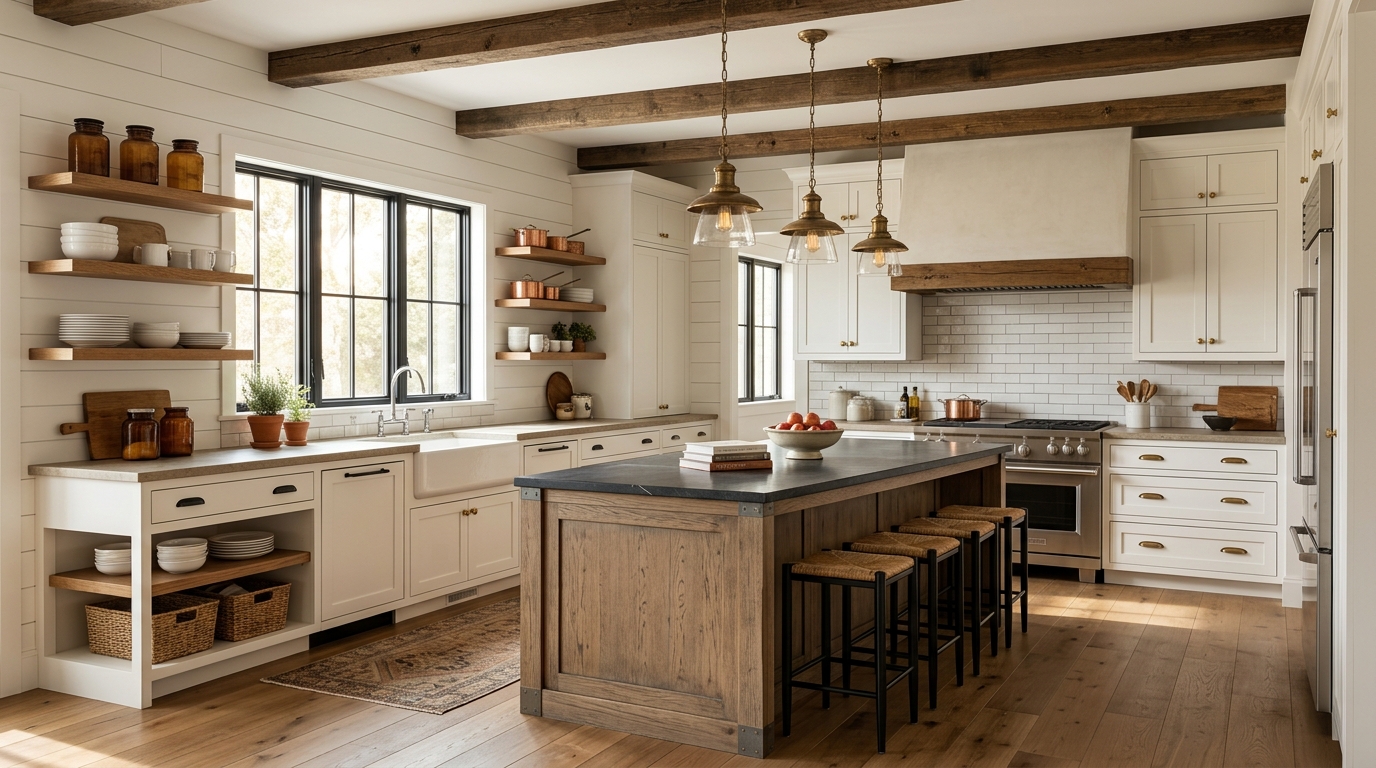
A farmhouse kitchen remodel is one of those projects where the goal is not to make the kitchen look expensive but to make it look honest. The materials are natural, the details are practical, and the overall effect is a kitchen that feels like it has been cooking real food for generations even when it was finished last month. These 22 farmhouse style kitchen remodel ideas cover everything from cabinet choices to structural changes to the finishing details that make the difference between a kitchen that is farmhouse and one that merely has farmhouse elements scattered through it.
Every idea here is grounded in the specific qualities that define the farmhouse kitchen aesthetic: natural materials, functional simplicity, warm color, and the kind of unpretentious craft that ages beautifully. Below are 22 ideas that bring genuine farmhouse character to a kitchen remodel.
1. Install a Farmhouse Apron Front Sink
The farmhouse apron front sink is the single most defining element of a farmhouse kitchen remodel and no other change to the kitchen produces a before and after as immediately recognizable as this one. The exposed apron front in white fireclay or hammered copper is visible from across the room and from the adjacent dining or living space and its presence communicates the farmhouse aesthetic of the kitchen before anyone notices any other detail. A white fireclay apron front sink from Kohler, Rohl, or Shaws Original is the classic choice and the material improves with age in the way that genuine farmhouse materials always do.
The cabinet below the apron front sink requires modification to accommodate the exposed front panel and this work is most efficiently done during a broader remodel rather than as a standalone project. Use the opportunity of the sink cabinet modification to add a pull out drawer below the sink on both sides of the plumbing for cleaning supply storage that makes full use of the base cabinet depth that a standard sink cabinet typically wastes.
2. Choose Shaker Cabinet Doors Throughout
Shaker cabinet doors are the foundational cabinet style of the farmhouse kitchen because the simple recessed panel construction references the honest, functional craft of the Shaker furniture tradition that farmhouse design draws from directly. The shaker door is neither ornate nor completely flat and that middle position between decorative and minimal is exactly what gives the farmhouse kitchen its character. In a painted finish on solid wood or MDF, shaker doors hold paint beautifully and age gracefully in a way that more elaborate door profiles do not.
White, cream, greige, and soft gray are all appropriate shaker cabinet colors for a farmhouse kitchen remodel. Avoid high gloss paint finishes on farmhouse shaker cabinets because the reflective surface reads as too contemporary and too precise for the warm, slightly imperfect quality that farmhouse kitchen cabinetry should have. A matte or eggshell finish in a warm white like Benjamin Moore White Dove or Sherwin Williams Alabaster suits farmhouse shaker cabinets better than any brighter or more reflective alternative.
3. Add Open Shelving on One Wall Section
Open shelving in a farmhouse kitchen is not a styling exercise. It is a reference to the practical, visible storage of a working farm kitchen where everything needed for daily cooking was within immediate reach rather than hidden behind closed cabinet doors. One wall section of open shelving in a farmhouse kitchen remodel, whether floating shelves in solid wood, a set of brackets and boards replacing upper cabinet boxes, or a freestanding open shelf unit, brings that working kitchen quality to the remodel without committing the entire kitchen to open storage.
Use thick solid wood shelves in white oak, pine, or reclaimed wood rather than thin painted MDF shelves that look insubstantial at farmhouse scale. The shelf depth should match the depth of the upper cabinets on the same wall for a consistent counter to shelf relationship. Style the open shelves with a mix of everyday dishes, glass jars, and a few natural objects rather than purely decorative items so the shelving reads as genuinely functional rather than as a display installation.
4. Use Shiplap on the Kitchen Walls or Island
Shiplap paneling applied to a kitchen wall, the kitchen island face, or the range hood surround brings horizontal wood texture into the farmhouse kitchen in the material most associated with the aesthetic. Shiplap is not merely a decorative choice in a farmhouse context. It references the actual wall construction of historic farmhouses where tongue and groove or shiplap boards were used as wall cladding before drywall became the standard. That material history is part of what gives shiplap its authentic farmhouse quality rather than a merely trendy one.
Paint the shiplap in the same color as the surrounding walls to integrate it quietly into the kitchen or paint it a contrasting white against a darker wall color for maximum visual impact. Shiplap on the kitchen island face rather than a painted flat panel gives the island a texture and a character that painted MDF cannot replicate and the horizontal lines it creates at the base of the kitchen visually ground the island and connect it to the farmhouse material language of the rest of the space.
5. Install Subway Tile Backsplash in White or Cream
White subway tile is the backsplash material most naturally associated with farmhouse kitchen design because it references the utilitarian tile work of early twentieth century commercial kitchens, dairies, and farm outbuildings where white ceramic tile was chosen for its cleanability and its honest unpretentious appearance. A 3×6 white or cream subway tile in a classic brick offset pattern with a simple white or light gray grout creates a farmhouse kitchen backsplash that is simultaneously the most practical and the most authentic choice available.
Use a matte or satin glaze rather than a high gloss finish for a farmhouse subway tile installation since the matte surface reads as more aged and more genuinely farmhouse than the bright reflective surface of a commercial grade gloss tile. Extend the subway tile to the full height of the space between the countertop and the upper cabinets including behind the range where a full height tile installation creates a clean, practical surface that handles cooking splatter easily and looks appropriately generous rather than minimal.
6. Choose Butcher Block Countertops for the Prep Zone
Butcher block countertops in maple or walnut bring a warmth and a genuine working kitchen quality to a farmhouse remodel that stone and quartz surfaces, however beautiful, cannot replicate. The surface of a butcher block counter changes with use: it develops knife marks, it absorbs the oils used to condition it, and it acquires a patina over time that makes it look more genuinely farmhouse with every year of use rather than less. That quality of honest aging is the defining characteristic of a truly farmhouse material and butcher block possesses it more completely than any alternative counter surface.
Use butcher block on the primary prep zone of the kitchen and pair it with a different material, a quartz or stone, on the perimeter near the sink where water exposure would make butcher block maintenance demanding. The combination of butcher block and stone countertops in a farmhouse kitchen reads as collected and practical rather than inconsistent because the material choice reflects the functional requirements of each counter zone rather than a desire for visual uniformity across the whole kitchen.
7. Install a Pot Filler Above the Range
A pot filler mounted on the wall above the range is a functional addition that reads immediately as a serious working kitchen feature and carries with it the practical heritage of the farm kitchen where efficiency of movement during large scale cooking was a genuine daily priority. Filling a large pasta pot or a stock pot at the stove rather than carrying it full of water from the sink is a workflow improvement that anyone who cooks regularly appreciates immediately and the pot filler itself, in an aged brass or matte black articulated arm, is a visual feature of the farmhouse kitchen that draws the eye and communicates cooking seriousness.
Choose an articulated double joint pot filler that folds flat against the wall when not in use so the range backsplash reads cleanly between uses. Unlacquered brass and oil rubbed bronze are the most appropriate finishes for a farmhouse kitchen pot filler because both develop a natural patina over time that suits the honest, slightly aged quality of the farmhouse aesthetic better than a bright polished finish that stays permanently new looking regardless of use.
8. Use a Vintage or Reproduction Range as the Kitchen Anchor
A vintage style range in a cream, red, or black finish from brands like Smeg, Big Chill, or AGA is the statement appliance of a farmhouse kitchen remodel and the piece that more than any other single element defines the character of the space. The rounded forms, the chrome accents, the enamel finish, and the visual weight of a vintage style range communicate a completely different set of values about cooking and kitchen life than a stainless steel contemporary range and those values are exactly the ones a farmhouse kitchen remodel is built to express.
Position the range in the most prominent wall of the kitchen where it functions as the visual focal point from the dining area and from the kitchen entry. Build a custom range hood surround in shiplap, painted wood, or painted brick above it that frames the range as the centerpiece it is rather than treating the range hood as a purely functional extraction element. The range and its surround together create the kitchen moment that guests remember and photograph and that makes the farmhouse kitchen feel complete rather than in progress.
9. Install Reclaimed Wood Beams on the Ceiling
Exposed ceiling beams in reclaimed wood bring the most powerful architectural farmhouse element available into a kitchen remodel without changing the floor plan or the cabinet layout. The visual weight of real wood overhead, the grain and the weathering and the occasional nail hole or saw mark visible in genuine reclaimed material, changes the character of the kitchen ceiling from a blank white surface into an architectural feature that references the genuine structural history of farm buildings in a way that manufactured beam covers never quite achieve.
Genuine reclaimed wood beams can be sourced from architectural salvage yards and specialty reclaimed lumber suppliers. The installation requires structural assessment to ensure the ceiling framing can support the weight of solid wood beams and the work is best done during a broader kitchen remodel when the ceiling is accessible. Faux beam covers in a realistic wood finish are a lower cost and structurally simpler alternative that suit kitchens where the beam weight is not feasible but where the visual effect of ceiling beams is desired.
10. Add a Kitchen Island with a Furniture Quality Base
A kitchen island in a farmhouse remodel should look like a piece of furniture that was brought into the kitchen rather than built into it as part of the original cabinetry. A furniture quality island base, whether a repurposed antique dresser or sideboard with a new countertop, a custom built island with turned legs and beadboard panel sides, or a painted island in a contrasting color with furniture feet and bin pull hardware, reads as genuinely farmhouse because it references the period before fitted kitchen cabinetry became standard when freestanding furniture served kitchen storage functions.
Turned legs on the island corners, beadboard or shiplap panel sides, a butcher block or painted wood countertop, and hardware in an aged brass or black iron finish all contribute to the furniture quality that separates a farmhouse island from a standard base cabinet island painted in a farmhouse color. The overall impression should be of a substantial, well made piece of furniture that happened to find its ideal home in the center of the kitchen rather than of a built in element designed and installed as part of a coordinated cabinet scheme.
11. Choose Wide Plank Wood Flooring
Wide plank wood flooring in a farmhouse kitchen remodel references the genuine wide plank floors of historic farmhouses where boards were cut to the full width of the available timber rather than to a standardized narrow dimension. Wide plank floors in white oak, heart pine, or Douglas fir in a matte or satin finish bring a warmth and a material generosity to the kitchen floor that narrow strip hardwood and tile cannot approximate. The knots, the grain variation, and the width of the boards all contribute to a floor that reads as genuinely old even when it is newly installed.
Engineered wide plank flooring in a real wood veneer over a plywood core is the most practical choice for a kitchen installation because it handles the humidity and the temperature variation of a kitchen environment better than solid wide plank without sacrificing the visual quality of a genuine wood surface. Choose a board width of five inches or wider for a genuine wide plank effect and finish with a matte or hardwax oil finish that ages naturally rather than a high gloss polyurethane that reads as too contemporary for a farmhouse floor.
12. Build a Dedicated Baking Nook
A dedicated baking nook within a farmhouse kitchen remodel, a section of counter at a slightly lower height of thirty two to thirty four inches rather than the standard thirty six, surrounded by upper cabinet storage for baking equipment and adjacent to a butcher block or marble prep surface, references the genuine functional specialization of farm kitchens where different work areas served different cooking tasks. The lower counter height of a baking nook suits the physical mechanics of kneading dough and rolling pastry and the dedicated storage around it keeps all baking equipment in a single accessible zone.
Position the baking nook beside the range for efficient movement between prep and baking stages and install a lower shelf at knee height below the baking counter for large mixing bowls and baking sheets that are used frequently but are awkward to store in upper cabinets. The baking nook is one of those farmhouse kitchen features that every serious home baker appreciates immediately and that guests who do not bake still recognize as a sign of a kitchen that was designed for genuine cooking rather than for photographic appeal.
13. Install a Vintage Style Bridge Faucet
A bridge faucet, where the hot and cold water lines are connected by a visible horizontal bridge between the two handles above the deck of the faucet, is the faucet configuration most associated with farmhouse and Victorian kitchen design. The bridge faucet form references the plumbing aesthetic of the late nineteenth and early twentieth century when the exposed connection between hot and cold supplies was a functional feature rather than a retro affectation. In an unlacquered brass, oil rubbed bronze, or matte black finish above a farmhouse apron front sink, a bridge faucet completes the sink area with a period appropriate detail that strengthens the farmhouse narrative of the whole kitchen.
Rohl, Waterworks, and Kohler all produce bridge faucets in appropriate finishes for a farmhouse kitchen application at a range of price points. The bridge faucet requires a three hole sink deck installation, two holes for the handles and one for the spout, which suits the apron front farmhouse sink naturally since fireclay farmhouse sinks are available with the three hole configuration as a standard option. The visual relationship between a white fireclay apron front sink and an unlacquered brass bridge faucet is one of the most photographed details in farmhouse kitchen design for good reason.
14. Use Beadboard on Cabinet Doors or Island Panels
Beadboard paneling applied to cabinet door inserts or island side panels brings a vertical textural detail into the farmhouse kitchen that is distinct from the horizontal quality of shiplap and that references the painted beadboard wainscoting of traditional farmhouse interiors. Beadboard cabinet doors, where the recessed panel of a shaker door is replaced with a beadboard insert of vertical tongue and groove strips, give the kitchen cabinetry a texture and a period character that flat shaker panels approach but do not quite achieve.
Use beadboard on the island panels and on a section of upper cabinet doors while keeping the remaining cabinet doors in standard shaker panels to prevent the beadboard detail from becoming repetitive across the whole kitchen. The selective use of beadboard creates the layered, collected quality that characterizes the best farmhouse kitchen remodels where not every surface is treated identically but all surfaces share a consistent material language and a consistent set of values about craft and honesty of construction.
15. Choose Oil Rubbed Bronze or Black Iron Hardware Throughout
Hardware finish is the detail that most consistently distinguishes a genuinely farmhouse kitchen from one that merely has farmhouse cabinetry. Oil rubbed bronze and black iron are the hardware finishes most appropriate for farmhouse kitchen remodel because both reference the working metal of historical farm buildings, the iron hinges, the black iron handles, and the bronze fittings of kitchens built in the late nineteenth and early twentieth century when these finishes were chosen for their durability and their material honesty rather than for their decorative quality.
Apply the hardware finish consistently across every metal element in the kitchen: cabinet pulls, cabinet hinges, faucet, pot filler, light fixture, and any other metal surface in the room. Mixing hardware finishes in a farmhouse kitchen produces a result that reads as indecisive rather than eclectic and the single consistent finish is what gives the kitchen its unified, designed quality. Cup pulls, bin pulls, and simple bar pulls in oil rubbed bronze or matte black all suit farmhouse shaker cabinetry and each produces a slightly different visual character within the same general farmhouse material language.
16. Install a Brick or Stone Range Hood Surround
A range hood surround clad in brick, stone, or painted plaster in an arched or rectangular form is one of the most architectural elements available in a farmhouse kitchen remodel and the one that most decisively separates a farmhouse kitchen with genuine character from one that achieved the farmhouse look through cabinet and hardware choices alone. The mass and the material weight of a brick or stone hood surround references the genuine masonry construction of the historic farmhouse kitchen hearth from which the modern range and hood evolved.
Thin brick veneer applied over a standard range hood framing is the most cost effective approach to a brick hood surround and the result is visually indistinguishable from genuine solid brick construction in a kitchen context. A painted plaster hood in a smooth finish is the alternative that suits farmhouse kitchens with a more refined or European farmhouse influence and produces a hood surround with its own architectural character distinct from the brick version. Either approach makes the range wall of the farmhouse kitchen into a genuine focal point that no stainless steel or painted drywall range hood achieves.
17. Add a Built In Bench Seat in the Kitchen Eating Area
A built in bench seat in the kitchen eating area, whether a full banquette along two walls with a fixed table, a single bench against one wall with chairs on the opposite side, or a window seat beneath a kitchen window that doubles as additional seating, brings a fixed, furniture quality seating element into the farmhouse kitchen that references the built in seating of historical farm kitchen dining areas. The built in quality of the bench gives the eating area a permanence and a considered architectural character that freestanding chairs alone cannot achieve.
Build the bench seat with storage drawers underneath accessed from the seat front for a practical addition that adds hidden storage to the farmhouse kitchen without any additional footprint. Upholster the seat cushion in a durable fabric with a farmhouse appropriate pattern, a ticking stripe, a simple check, or a plain linen, and add back cushions in the same or coordinating fabric for comfort during extended meals. The bench seat eating area is one of the most used and most appreciated elements of a farmhouse kitchen remodel because it makes the kitchen a place where people want to stay rather than a space dedicated exclusively to the work of cooking.
18. Use Vintage or Antique Light Fixtures
Lighting in a farmhouse kitchen remodel should reference the working light fixtures of historical kitchens: the galvanized metal pendants of dairy farms, the enamel shaded utility lights of early twentieth century commercial kitchens, and the simple iron lantern forms of rural domestic interiors. Genuine vintage light fixtures sourced from antique dealers and architectural salvage yards bring an authenticity to the farmhouse kitchen lighting scheme that reproduction fixtures approximate without quite matching and the slight imperfection of aged finishes on genuine vintage pieces suits the farmhouse aesthetic more naturally than the perfect consistency of a new reproduction.
Source vintage pendants for the island zone, a vintage or vintage inspired flush mount for the main kitchen ceiling, and simple wall sconces in a period appropriate form for any wall sections that benefit from additional ambient light. Rejuvenation, Schoolhouse Electric, and Hudson Valley Lighting all produce reproduction fixtures with sufficient historical authenticity for a farmhouse kitchen application when genuine vintage pieces are not available or not practical for a specific installation.
19. Install a Walk In Pantry with Open Shelving
A walk in pantry adjacent to the farmhouse kitchen is the storage solution most consistent with the genuine farm kitchen tradition where a separate larder or pantry room off the main kitchen held the bulk food storage, the preserves, and the equipment needed for the seasonal cooking and preserving activities of a working farm household. Converting an adjacent closet, a small bedroom, or an underused utility space into a walk in pantry during a farmhouse kitchen remodel adds a storage capacity and a kitchen organization quality that no amount of additional base cabinet storage can match.
Line the walk in pantry walls with open shelving in white painted wood or in a natural pine finish and organize the contents by category with consistent containers and clear labeling. The open shelving in the pantry, visible through a glass panel door from the kitchen, becomes a display of organized abundance that reads as genuinely farmhouse and that makes the kitchen function more efficiently by keeping bulk storage and everyday pantry items in a dedicated space rather than competing for cabinet space with dishes, cookware, and kitchen equipment.
20. Use Unlacquered Brass Plumbing Fixtures
Unlacquered brass plumbing fixtures throughout a farmhouse kitchen remodel, the faucet, the pot filler, the soap dispenser, and any visible plumbing connections, develop a natural patina over time that makes the kitchen feel more established and more genuine with every year of use. The patina of unlacquered brass is not uniform or predictable and that variability is precisely what gives it its farmhouse quality because it records the history of use rather than maintaining a factory applied appearance indefinitely.
Unlacquered brass requires acceptance of the aging process rather than resistance to it and homeowners who want their fixtures to maintain a consistent bright gold appearance should choose lacquered brass or satin brass alternatives instead. For those willing to embrace the patina development, unlacquered brass produces a fixture finish that improves with age in a way that no other metal finish available for kitchen plumbing applications can claim and that genuine farmhouse quality of aging gracefully is worth more than the factory perfection of a finish that never changes.
21. Add Wainscoting to the Lower Kitchen Walls
Wainscoting on the lower section of kitchen walls below the counter height level brings a traditional architectural detail into the farmhouse kitchen that references the painted wood paneling of historic domestic interiors. Beadboard wainscoting at a height of thirty two to thirty six inches capped with a simple chair rail molding creates a lower wall treatment that suits farmhouse kitchen cabinetry naturally because the vertical texture of the beadboard and the horizontal line of the chair rail both reinforce the architectural language of the shaker cabinets and the wide plank flooring in the same space.
Paint the wainscoting in the same color as the kitchen cabinetry for a unified, monochromatic lower kitchen treatment or paint it white against a colored upper wall for a traditional two tone wall treatment that is as appropriate in a farmhouse kitchen today as it was in the original farmhouse interiors it references. The wainscoting also provides a more durable surface in the lower kitchen where chair backs, kicked feet, and cleaning activity subject the wall to more physical contact than any paint application handles gracefully over years of family kitchen use.
22. Finish with Vintage Inspired Ceramic or Porcelain Hardware Knobs
Ceramic or porcelain hardware knobs in a white, cream, or transfer print pattern on a selection of upper cabinet doors add a vintage domestic detail to the farmhouse kitchen that metal hardware alone cannot provide. The white ceramic knob is one of the oldest and most consistently used hardware forms in domestic kitchens because its material, its simple form, and its scale suit kitchen cabinetry at every period from the late nineteenth century through the present day. Used selectively on upper cabinet doors alongside metal pulls on the base cabinet drawers and doors, ceramic knobs add a layer of collected, slightly eclectic character to the farmhouse kitchen hardware scheme.
Source vintage ceramic knobs from antique dealers and estate sales for genuine period pieces with the slight glaze variation and the minor imperfections that new reproduction knobs cannot replicate. Anthropologie, Hobby Lobby, and specialty hardware retailers carry ceramic knob reproductions in appropriate farmhouse patterns when genuine vintage pieces are not available. The combination of black iron or oil rubbed bronze pulls on the base cabinets and white ceramic knobs on the upper cabinet doors creates the layered, collected hardware quality that gives the best farmhouse kitchens their sense of having been assembled thoughtfully over time rather than specified and installed in a single coordinated sweep.
Final Thoughts
A farmhouse kitchen remodel succeeds when every decision, from the cabinet style to the floor material to the hardware finish, is made in service of the same set of values: natural materials, honest construction, practical function, and a warmth that comes from genuine craft rather than decorative application. The ideas above give you a complete vocabulary for those decisions across every element of a kitchen remodel.
Start with the foundational elements, the apron front sink, the shaker cabinets, and the wide plank floor, and build the farmhouse character of the kitchen outward from those anchors. A farmhouse kitchen remodel done with patience and with genuine attention to the material quality of each individual decision will always produce a kitchen that feels more authentic and more complete than one assembled quickly from the most recognizable farmhouse elements without the underlying commitment to the values those elements represent.