
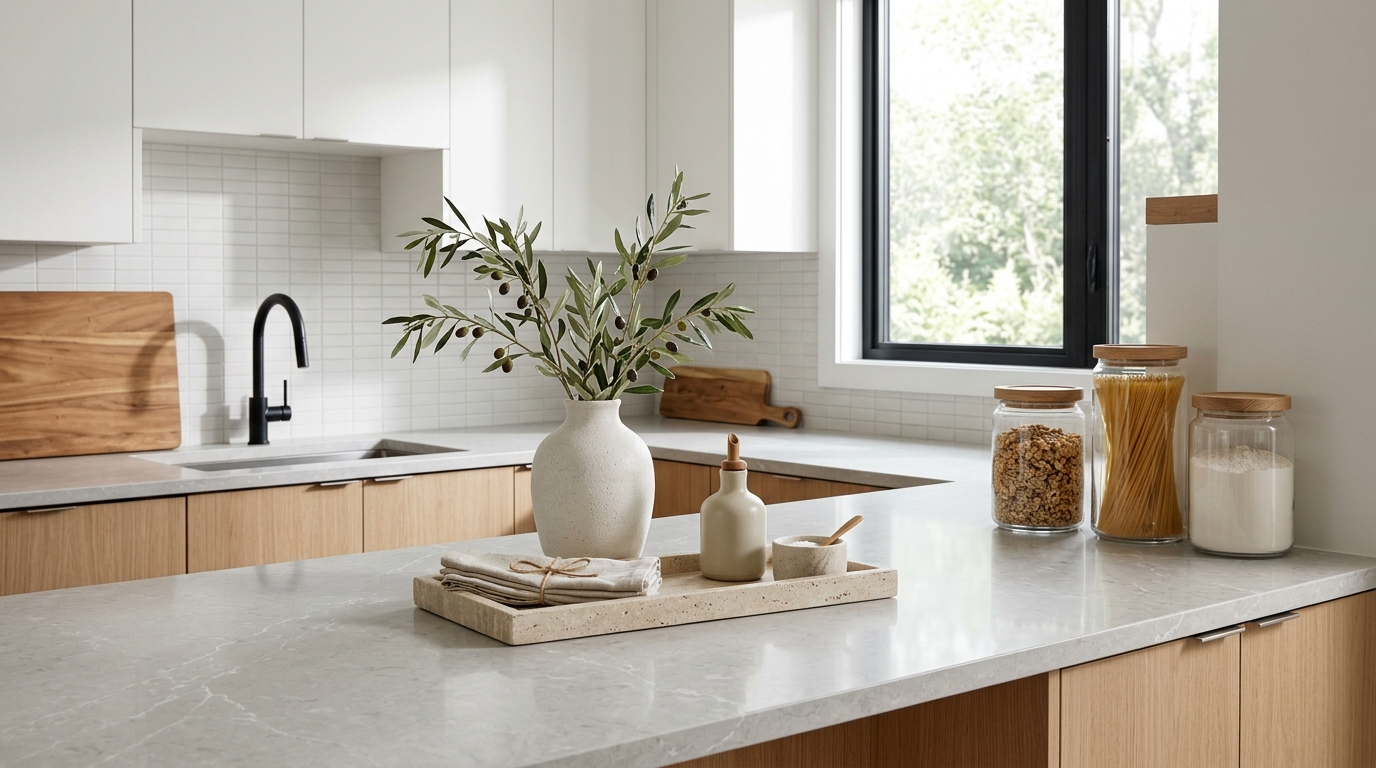
A minimalist kitchen counter is not a bare counter. There is a difference between empty and intentional and the best minimalist kitchens understand that distinction completely. Every object on the counter has earned its place through a combination of beauty and genuine daily use and nothing sits there simply because there was room for it. These 25 minimalist kitchen counter decor ideas will show you how to build a counter that feels considered, calm, and completely functional without looking sterile or unfinished.
The ideas here work in every kitchen size from a galley apartment kitchen to a large open plan space. Below are 25 ideas that bring genuine minimalist character to your kitchen counters.
1. Choose One Material and Commit to It
The fastest way to make a minimalist kitchen counter look chaotic is to mix too many materials across the objects that live on it. Choose one primary material, matte ceramic, natural stone, brushed steel, or light wood, and let it run through every object on the counter from the soap dispenser to the utensil holder to the fruit bowl. The visual coherence of a single material family across the counter creates a calm that no amount of careful arrangement achieves when the materials themselves are competing.
This does not mean everything needs to be identical. A matte white ceramic soap dispenser, a white ceramic bowl, and a white ceramic bud vase are three different objects that read as a cohesive material decision. The consistency of material is what creates the minimalist quality and the variety of form within that consistency is what keeps it from feeling monotonous.
2. Keep Only What You Use Every Single Day
The most important minimalist counter decision is not aesthetic, it is editorial. Everything on the counter should be something you reach for every single day without exception. The coffee maker stays. The toaster that gets used twice a week goes into a cabinet. The decorative bowl that holds nothing goes somewhere else. What remains after that honest audit is a counter that looks minimalist because it genuinely is, not because objects were arranged to create the impression of minimalism over a cluttered foundation.
Repeat this audit every few months because counters accumulate objects gradually and the accumulation is rarely noticeable until the counter has crossed back into clutter. The discipline of the regular edit is the maintenance practice that keeps a minimalist kitchen counter looking the way it should throughout the year rather than only immediately after a deliberate clear out.
3. Use a Single Large Ceramic Bowl as the Sole Centerpiece
One large ceramic bowl in a matte neutral glaze placed at the center or end of the counter serves as the singular focal point of a minimalist counter arrangement. Fill it with a few pieces of the same fruit, six lemons, a handful of green apples, or a cluster of figs in season, and the bowl reads as a still life rather than a storage solution. The single object approach is more powerful in a minimalist context than any grouping because it asks the eye to stop rather than travel.
Choose a bowl with genuine visual weight and a form that is interesting from multiple angles. A hand thrown ceramic bowl with a slight irregularity in the rim, a matte black glaze with natural variation in the surface, or a simple cream bowl with a raw unglazed foot all have the quality of craft that makes a single object carry a counter. The bowl should feel substantial enough to anchor the space it occupies.
4. Install a Magnetic Knife Strip on the Wall
Moving knives from a counter block to a wall mounted magnetic strip immediately clears significant counter space and improves the functionality of the kitchen simultaneously. A knife block takes up a meaningful footprint on a counter and the visual busyness of multiple handle shapes and sizes at different heights creates a counter clutter that is difficult to design around. A magnetic strip mounted on the wall keeps the knives equally accessible while returning their counter footprint to clear usable surface.
Stainless steel or matte black magnetic knife strips from Ikea, Amazon, and specialty kitchen retailers cost around twenty to forty dollars and mount with two screws. The knives displayed on the wall also look considered and professional in a way that a counter block rarely achieves. The counter below gains clear space and the wall gains a functional installation that reads as intentional kitchen design.
5. Choose Appliances in a Single Finish
Mixed appliance finishes are one of the primary visual sources of counter clutter in an otherwise well edited kitchen. A stainless steel kettle beside a black toaster beside a white coffee maker creates a counter that looks assembled from whatever was available rather than considered as a whole. Choosing appliances in a single finish, all matte black, all brushed steel, or all white, creates an immediate visual coherence that makes the counter read as designed even when multiple appliances are present.
This does not require replacing everything at once. Prioritize the most visible and most used appliances first, typically the kettle, coffee maker, and toaster, and replace others in the same finish as they reach the end of their useful life. The transition toward a single finish finish happens gradually but the improvement at each step is immediately noticeable and cumulative.
6. Display a Single Stem in a Bud Vase
One stem in one bud vase on a minimalist kitchen counter is more effective than a full flower arrangement and significantly more in keeping with the aesthetic. A single eucalyptus stem, one branch of cherry blossom, a single white tulip, or a sprig of fresh rosemary in a simple glass or ceramic bud vase provides the organic living element the counter needs without the visual weight and complexity of a full arrangement. The single stem says enough without saying too much.
Replace the stem weekly or whenever it begins to fade so the bud vase always holds something fresh and living. A single stem from a grocery store bunch costs almost nothing and lasts longer when displayed alone than when competing for water with a full arrangement. The restraint of the single stem is itself a minimalist statement and one that is more difficult to execute well than it appears.
7. Use a Slim Stainless Steel or Matte Black Utensil Holder
A slim cylindrical utensil holder in stainless steel or matte black holding only the three or four utensils used daily keeps the most essential cooking tools on the counter without the visual excess of a full crock overflowing with every utensil in the kitchen. Edit the contents ruthlessly: one wooden spoon, one silicone spatula, one pair of tongs, and one ladle is typically enough for daily cooking. Everything else goes in a drawer.
The holder itself should be as simple as possible in form. A seamless cylinder without decorative detail, a handle, or a pattern suits a minimalist counter far better than a decorative crock with surface texture or a pattern. Joseph Joseph, OXO, and simple stainless steel options from Amazon all carry appropriately minimal utensil holders at reasonable prices.
8. Let the Backsplash Breathe
A minimalist kitchen counter gains much of its visual calm from the clear, uninterrupted backsplash behind it. Every object pushed against the backsplash reduces the visible surface area of the tile or stone and reduces the sense of space and light that the backsplash provides. Pulling objects slightly forward on the counter and keeping the back three to four inches of counter clear allows the backsplash to read as a complete surface rather than a backdrop for accumulated objects.
This is a simple repositioning rather than a removal exercise and it costs nothing to implement. The effect of a fully visible backsplash on the perceived spaciousness of a kitchen counter is significant and immediate. The counter appears wider, the backsplash appears larger, and the whole kitchen feels more open simply because a few inches of surface behind the objects has been cleared.
9. Use a Paper Towel Holder with a Minimal Profile
A wall mounted or under cabinet paper towel holder removes one of the most common counter objects from the surface entirely. The standing paper towel holder that most kitchens default to takes up a small but meaningful footprint on the counter and its cylindrical form at mid counter height creates a visual interruption that breaks the horizontal calm of a minimalist surface. A wall mounted holder positioned beside the sink or under an upper cabinet puts the paper towels exactly where they are needed without the counter footprint.
Simple wall mounted paper towel holders in brushed steel or matte black cost around fifteen to twenty five dollars at Home Depot and install in minutes. The counter space recovered is modest in absolute terms but the visual improvement of removing an upright object from the counter surface is disproportionate to the size of the object itself.
10. Choose a Streamlined Coffee Setup
Coffee making equipment is often the most visually complex area of a kitchen counter because the category includes so many individual items: the machine, the grinder, the filters, the beans, the mugs, the sugar. A minimalist approach to the coffee counter requires consolidating this collection into its most essential components and storing the rest. A pour over set on a single small tray with a slim glass canister of beans beside it is a complete coffee setup that occupies a quarter of the counter space of a full machine and accessory spread.
If a full espresso machine is non negotiable, choose one in a single color that matches your appliance finish and remove everything else from its immediate vicinity. A coffee machine standing alone with clear counter on all sides looks like a considered addition to a minimalist kitchen. The same machine surrounded by filters, pods, stirrers, syrups, and accumulated mugs looks like the counter was designed around whatever was convenient.
11. Mount a Soap Pump That Matches the Faucet Finish
A soap dispenser beside the sink that matches the finish of the faucet exactly is one of those small minimalist details that has a disproportionate effect on the overall quality of the counter. A brushed nickel faucet beside a white plastic soap bottle looks unfinished. The same faucet beside a brushed nickel soap pump from the same manufacturer or a close match from a specialist hardware retailer looks complete and considered. The material continuity between the faucet and the soap dispenser signals that someone thought about the sink area as a whole rather than as a collection of separate objects.
Simplehuman, Kohler, and several specialty bath and kitchen hardware brands produce soap pumps in finishes designed to coordinate with standard faucet finishes. The investment is modest and the improvement in the overall quality of the sink counter area is immediate and lasting.
12. Clear the Corner Completely
Kitchen counter corners are the area most prone to becoming a dumping zone for objects without a designated home. Mail, keys, chargers, vitamins, and an accumulating collection of miscellaneous items tend to migrate to counter corners because the corner feels like dead space that might as well hold something. In a minimalist kitchen the corner should hold nothing. The empty corner creates breathing room that makes the whole counter feel more spacious and the objects on the non corner sections look more deliberately placed.
Assign every object that currently lives in a kitchen counter corner to a proper home elsewhere in the kitchen or house. A small drawer organizer inside a nearby cabinet can absorb most of the functional items that previously defaulted to the corner. Once the corner is clear and stays clear it becomes one of the most valuable visual elements of the minimalist counter rather than its most problematic area.
13. Use a Thin Profile Cutting Board That Doubles as Decor
A single high quality thin profile cutting board in end grain wood or a large format marble board leaned against the backsplash or laid flat on the counter serves as both a functional kitchen tool and a decorative surface element without requiring any additional styling around it. The material quality of a genuinely beautiful cutting board, the grain pattern of end grain walnut or the natural veining of white marble, provides all the visual interest the counter needs from that object without additional decoration.
End grain cutting boards from brands like Boos and Virginia Boys Kitchens are genuinely beautiful objects whose appearance improves with use and regular oiling. A large marble pastry board from a kitchen specialist brings a material quality to the counter that suits a minimalist aesthetic particularly well because the stone itself is visually interesting without requiring any additional decoration around it.
14. Store Spices Inside a Cabinet
Spice racks and spice jars on the kitchen counter are among the most common sources of visual complexity in an otherwise calm counter arrangement. The variety of container sizes, label designs, and cap colors across a typical spice collection creates a visual busyness that is difficult to resolve through arrangement alone. Moving the entire spice collection into a deep drawer organizer or a pull out cabinet shelf removes the complexity entirely and returns clear counter space while making the spices no less accessible than they were on the surface.
A deep drawer fitted with a tiered spice organizer from a drawer organization brand like Rev-A-Shelf or Lynk Professional keeps every spice visible and accessible without a single jar appearing on the counter. The counter gains clear space and the spices gain a storage solution that displays them more legibly than a counter arrangement typically achieves.
15. Add Under Cabinet Lighting Instead of Counter Lamps
A counter lamp or a portable lighting source placed on the kitchen counter takes up surface space and adds a cord to the counter environment that requires management. Under cabinet LED lighting installed directly to the underside of upper cabinets illuminates the counter surface completely without occupying any counter real estate. The light source is invisible, the counter below it is fully clear, and the illumination quality is typically better than a counter lamp provides because it is distributed evenly across the entire surface rather than concentrated in one spot.
Hardwired under cabinet lighting is the cleanest installation but plug in LED strip options from brands like Brilliant Evolution require no electrical work and mount with adhesive strips. The improvement in counter clarity from removing a counter lamp is immediate and the improvement in counter illumination from properly positioned under cabinet lighting is equally significant.
16. Display Art Above the Counter Instead of On It
A framed print or a small piece of art on the counter takes up surface space and reduces the horizontal calm of a minimalist counter arrangement. Moving the same art to the wall directly above the counter achieves the same visual effect, a moment of color or composition in the kitchen, without any counter footprint. The wall above the counter between the upper cabinets is often an underused surface in most kitchens and a single well chosen piece of art mounted there draws the eye upward and adds visual interest to the kitchen without compromising the counter below.
A single print in a simple frame in a size proportionate to the wall section it occupies is the right scale and approach. Avoid a gallery wall arrangement above a kitchen counter because the visual complexity it creates conflicts with the horizontal calm below it. One piece, one frame, one considered placement above a minimalist counter is the appropriate extension of the counter aesthetic onto the wall above it.
17. Use a Built In or Recessed Power Strip
Charging cables, phone chargers, and small appliance cords are among the most visually disruptive elements on an otherwise clean minimalist counter because they move constantly, coil unpredictably, and resist every organizational approach applied to them. A recessed power strip installed flush into the counter surface or a pop up outlet installed in the counter top keeps the electrical access available without the cord and plug clutter that a standard wall outlet creates when extension cords are run across the counter to reach it.
Pop up counter outlets from brands like Leviton and Legrand install into a standard counter cutout and retract flush with the surface when not in use. The installation requires a licensed electrician in most jurisdictions but the result is a counter that handles the electrical needs of the kitchen without visible cords running across the surface at any point.
18. Choose Integrated Appliances Where Possible
An integrated appliance, one designed to be built flush into the cabinetry with a panel front that matches the surrounding cabinet doors, removes the visual presence of the appliance from the kitchen entirely. An integrated dishwasher, refrigerator, and range hood that all share the same cabinet panel finish create a kitchen where the appliances are present and fully functional but visually absent. The kitchen reads as pure cabinetry and counter surface without the interruption of appliance forms and finishes breaking the visual continuity.
Integrated appliances represent the highest level of minimalist kitchen design investment and they require specific cabinetry designed to accommodate them. For kitchen counter specifically, an integrated under counter refrigerator drawer or a built in coffee machine flush with the upper cabinetry removes the most visually prominent counter appliances completely. The result is a counter that has no upstanding appliance forms interrupting its horizontal plane.
19. Keep the Sink Area as Minimal as the Rest
The sink area of a kitchen counter typically accumulates more objects than any other section: dish soap, hand soap, sponge, dish brush, drying rack, paper towels, and any number of additional items that migrate there because they are used near the sink. A minimalist sink area holds only three objects: a soap dispenser, a dish brush or sponge in a holder, and nothing else. The drying rack goes inside a cabinet or is mounted on the wall. The paper towels go under the cabinet or on a wall mount. Everything else is stored.
The sink itself is a strong visual element in any kitchen and a clear, uncluttered sink area allows its form and material quality to read properly. A beautiful farmhouse sink or a sleek undermount sink surrounded by clear counter makes a stronger design statement than the same sink surrounded by the accumulated objects of daily kitchen use and the clarity is achieved simply by deciding what does and does not belong in the immediate sink environment.
20. Use Vertical Storage to Reclaim Horizontal Space
Anything that can be stored vertically rather than horizontally on a counter surface should be. A slim wall mounted spice rack inside a cabinet door, a magnetic wall strip for measuring spoons, an under cabinet paper towel holder, and hooks inside cabinet doors for measuring cups and small tools all move functional kitchen items off the counter surface and onto vertical surfaces that were previously unused. The horizontal counter surface that these moves reclaim is the most valuable real estate in a minimalist kitchen.
Assess the vertical surfaces in your kitchen systematically, the insides of cabinet doors, the wall sections between cabinets, the sides of the refrigerator, and the undersides of upper cabinets, and ask what currently lives on the counter that could live on one of these surfaces instead. The counter space recovered by a systematic vertical storage approach is typically more than any single organizational purchase achieves.
21. Add One Plant in the Simplest Possible Pot
One small plant in the simplest possible pot is the only plant a minimalist kitchen counter needs and one plant is genuinely better than none because the living quality it brings to the counter is not replaceable by any object. A small snake plant, a compact pothos cutting, or a single succulent in a plain white or unglazed terracotta pot provides that living element without the visual complexity of a plant collection or an elaborate pot. The plant should be small enough that it does not compete with anything else on the counter and the pot should be simple enough that the plant itself is what you notice.
Place it beside the window if one is adjacent to the counter or in whatever spot on the counter receives the most natural light. A single healthy plant in a simple pot beside a clear counter is one of the most quietly effective things you can put in a minimalist kitchen and the restraint of having only one is what makes it work.
22. Eliminate the Paper Pile
Every kitchen counter eventually develops a paper pile. Mail, receipts, school notes, takeout menus, and an accumulation of paper objects that have no designated home. In a minimalist kitchen the paper pile cannot exist because there is no counter space designated for things without a home. A small wall mounted mail sorter beside the kitchen entry, a dedicated basket in a nearby cabinet, or a weekly habit of processing all paper the day it arrives eliminates the paper pile at its source rather than managing it after it forms.
The paper pile is worth addressing specifically because it is the counter clutter category that returns most persistently and most quickly after a counter clear out. Addressing the system that generates the pile rather than the pile itself is the only approach that produces lasting results in a minimalist kitchen counter environment.
23. Use a Counter Compost Bin with a Tight Fitting Lid
A counter compost bin is a functional necessity in most kitchens and in a minimalist kitchen it should be the smallest appropriate size in a material that suits the counter palette, with a tight fitting lid that contains odors and presents a clean silhouette. A small stainless steel or matte ceramic compost bin from Full Circle or OXO holds enough for daily kitchen scraps, has a charcoal filter in the lid that manages odors, and sits cleanly on the counter without visual disruption.
Choose a size that requires emptying every one to two days rather than a large bin that sits on the counter for a week accumulating visual and olfactory presence. The smaller the compost bin the less counter space it occupies and the more frequently it is emptied which keeps the kitchen smelling better and the counter looking more considered simultaneously.
24. Treat the Counter as a Surface Not a Storage Area
The fundamental shift in thinking that makes a minimalist kitchen counter genuinely achievable is treating the counter as a work surface rather than a storage area. Storage belongs in cabinets, drawers, and pantries. The counter is where work happens and where the objects needed for that work live during use. When the work is done the objects return to their storage location and the counter returns to its clear, functional state.
This reframing changes the question from what should I put on my counter to what does my counter need to be clear for and the answer to the second question is always more useful in producing a genuinely minimalist result. A counter treated as a work surface rather than a storage area stays clearer with less ongoing effort because the habit of clearing it after use is built into the understanding of what the surface is for.
25. Let the Counter Material Be Enough
The most confident minimalist kitchen counter statement is one that lets the counter material itself carry the visual weight of the surface without additional decoration. A slab of Carrara marble, a thick butcher block in oiled walnut, a poured concrete surface, or a large format porcelain tile in a dramatic pattern is visually sufficient on its own. Objects placed on a genuinely beautiful counter material compete with it. Clear space on a genuinely beautiful counter material showcases it.
If your counter material is visually interesting enough to carry the surface, the minimalist approach is to clear it as much as functionally possible and let the material do what it was chosen to do. A stretch of clear Carrara marble countertop with a single ceramic bowl at one end and nothing else is a more powerful design statement than the same marble covered with the usual collection of counter objects regardless of how well chosen each individual object might be.
Final Thoughts
A minimalist kitchen counter is a practice as much as it is a design choice. The ideas above give you the framework but the result depends on the ongoing discipline of editing, auditing, and resisting the natural tendency of surfaces to accumulate objects over time. That discipline is not a burden once it becomes a habit and the kitchen it produces, calm, clear, and genuinely functional, makes the effort feel completely worthwhile.
Start with the edit. Clear everything off the counter and put back only what genuinely earns its place. Then apply one or two of these minimalist kitchen counter decor ideas to what remains. The counter you end up with will be better than the one you started with and that improvement will make the next edit easier and the next idea more effective than the last.