
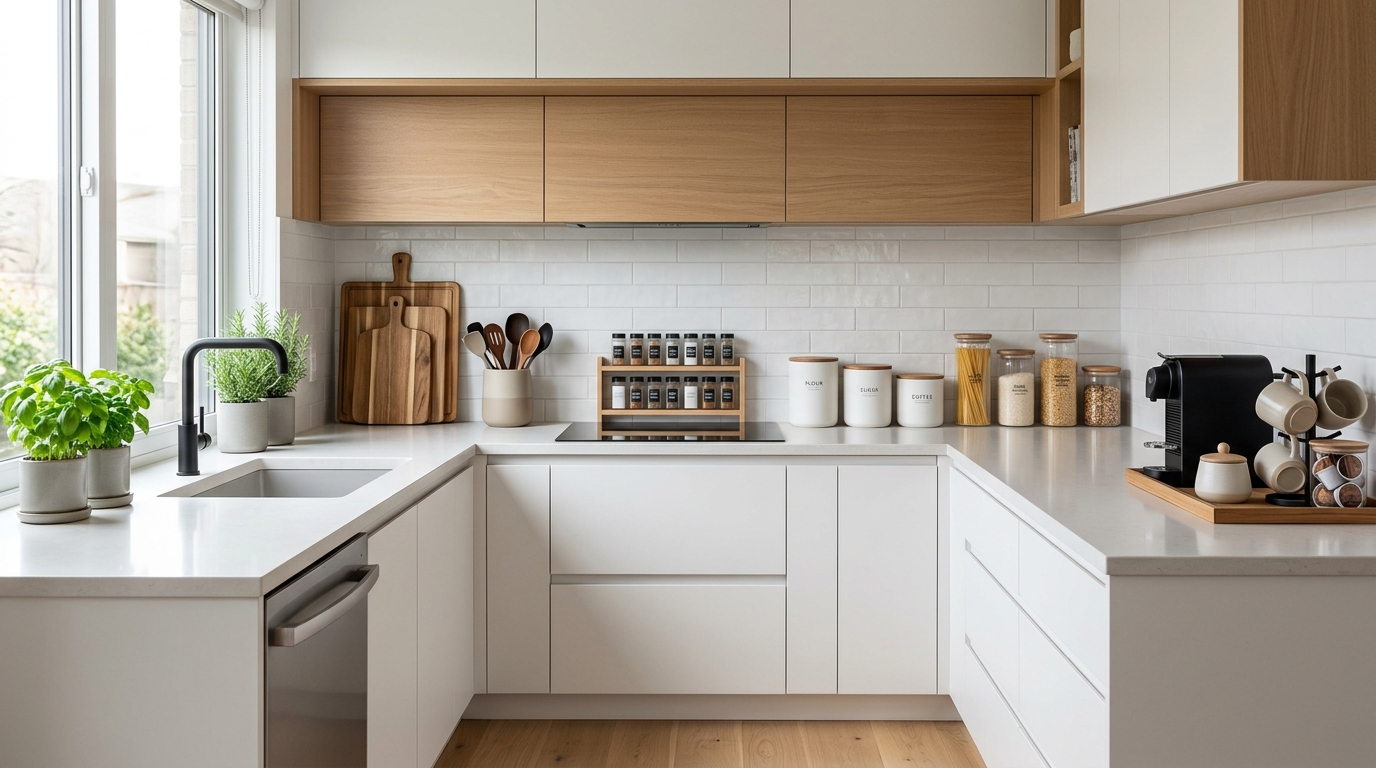
A disorganized kitchen counter is not just an aesthetic problem. It slows down cooking, creates mental noise every time you walk into the kitchen, and makes a room that should feel functional feel chaotic instead. These 22 kitchen countertop organization ideas will help you bring genuine order to your counter without hiding everything away or stripping the space of warmth and personality.
The ideas here are practical, specific, and achievable in a weekend without a full kitchen renovation. Below are 22 ways to organize your kitchen countertop so it works as hard as you need it to.
1. Zone Your Counter by Task
The single most effective countertop organization move is dividing the counter into dedicated task zones before addressing any individual storage problem. A cooking zone beside the stove holds only what is needed for cooking. A prep zone near the sink holds only what is needed for food preparation. A coffee zone in one corner holds only what is needed for making drinks. Once every area has a defined purpose, every object on the counter has a specific zone it belongs to and the counter organizes itself around that structure.
Zoning works because it eliminates the decision fatigue of figuring out where something goes every time you use it. Objects return to their zone after use automatically because the zone is defined and consistent. The result is a counter that stays organized through daily use rather than only immediately after a deliberate tidy up session.
2. Use a Tiered Shelf Riser for Vertical Storage
A tiered shelf riser placed against the backsplash immediately doubles the storage capacity of that section of counter by creating two levels within the same footprint. The back level of the riser sits elevated and holds items used less frequently while the front level at counter height holds daily items within easy reach. Spice jars, small appliances, oil and vinegar bottles, and frequently used pantry items all benefit from the organization that a tiered riser provides.
Bamboo, acrylic, and matte metal shelf risers are all available from Amazon, The Container Store, and IKEA at very accessible prices. Choose a riser in a material that suits your counter palette and a width proportionate to the section of counter where it will live. A well chosen riser makes the counter behind it look considered and organized rather than cluttered with items pushed against the backsplash.
3. Install Pull Out Drawers Inside Lower Cabinets
One of the primary reasons kitchen counters become cluttered is that the cabinets below them are difficult to access and use efficiently. Items pushed to the back of a deep cabinet become invisible and inaccessible which means they migrate to the counter where they can be seen and reached. Pull out drawer inserts installed inside lower cabinets make the full depth of the cabinet accessible from the front and return items that currently live on the counter to their proper storage location below it.
Rev-A-Shelf and Lynk Professional both make pull out drawer systems that fit standard cabinet dimensions and install without professional help in most cases. The investment per cabinet is around thirty to eighty dollars depending on size and the return in counter space recovered is typically several times the footprint of the drawer itself as items find proper homes in the now usable cabinet depth.
4. Use a Lazy Susan for Corner Counter Space
A counter corner is one of the most awkward spaces to organize because items placed there are difficult to reach and tend to accumulate into a pile of objects that are neither stored nor displayed intentionally. A large lazy susan placed in a counter corner transforms that awkward space into the most accessible storage spot on the counter by bringing every item on it within reach with a single rotation. Oils, vinegars, sauces, and frequently used condiments are all ideal lazy susan candidates.
Bamboo lazy susans with a raised lip to prevent items falling off are available from The Container Store and Amazon starting around twenty to thirty dollars for a counter sized version. Choose a diameter that fills the corner without extending into the active work area of the counter. A fully stocked and well organized lazy susan in a counter corner makes the corner feel resolved rather than problematic.
5. Decant Frequently Used Dry Goods into Clear Containers
Keeping frequently used dry goods like coffee, oats, nuts, and pasta in their original packaging on the counter creates visual clutter because packaging is designed to attract attention in a store rather than to look organized on a kitchen counter. Decanting these items into uniform clear containers, whether glass jars, acrylic canisters, or a coordinated container set, immediately organizes the counter visually by replacing a variety of competing package designs with a single consistent container format.
OXO Good Grips POP containers, Oggi stainless steel canisters, and simple wide mouth glass jars all work well for counter dry goods storage. Label each container clearly with a simple label maker or chalk marker so the contents are identifiable at a glance. The uniformity of a set of matching containers on a counter section is one of the most impactful single organization moves available in a kitchen.
6. Mount a Rail System on the Backsplash
A rail mounted organization system on the kitchen backsplash moves a significant number of counter items off the surface and onto the wall directly behind it. Rails with interchangeable hooks, baskets, magnetic strips, and shelf attachments can hold utensils, spice jars, small tools, paper towels, and a wide variety of other counter items in a fully accessible location that uses wall space rather than counter space. The IKEA Kungsfors rail system and the Fintorp rail are both well regarded options at very low prices.
A rail system works best when it is planned as a complete system rather than assembled piece by piece over time. Decide what will live on the rail before installing it and purchase all the necessary attachments at once. A fully equipped rail with every hook and basket in place looks organized and intentional from the first day it is installed rather than growing gradually into an organized state over several weeks.
7. Use a Dedicated Charging Station Off the Counter
Phone chargers, tablets, earbuds, and their associated cables are among the most common sources of counter clutter in a modern kitchen because the kitchen is where many families spend the most time and therefore where devices are most frequently used and charged. A dedicated charging station installed in a nearby drawer with a cut out for cable management, or a small charging organizer mounted inside a cabinet door near a power outlet, removes all charging activity from the counter surface permanently.
Bamboo charging organizer boxes with multiple charging slots and a cable management port on the back are available on Amazon for around twenty to forty dollars and fit inside most standard kitchen drawers with room to spare. Routing the power cable through the back of the drawer to a nearby outlet completes the installation. The counter gains clear space and the charging activity continues uninterrupted in a location that does not affect the visual quality of the counter at all.
8. Add a Wall Mounted Tablet or Recipe Holder
A recipe book or tablet propped on the counter while cooking takes up active prep space and is frequently knocked over or splattered. A wall mounted tablet and recipe book holder mounted at eye level on the wall beside the cooking zone keeps recipes visible and accessible during cooking without occupying any counter surface. Adjustable holders in stainless steel or matte black that accommodate both tablets and open books are available from specialty kitchen retailers and Amazon.
The wall mounting also puts the recipe at a better viewing angle than a counter propped book provides since eye level viewing requires less neck movement and allows you to reference the recipe quickly without bending forward over the counter. The counter space recovered by this single move in an active cooking zone is among the most valuable on the entire counter because prep space is the counter area where additional inches matter most.
9. Use Stackable Containers for Baking Supplies
Baking supplies, flour, sugar, baking powder, baking soda, vanilla, and related items tend to migrate to the counter during baking sessions and stay there between uses because returning them to the cabinet requires multiple trips. Storing baking supplies together in a stackable container set inside a single dedicated cabinet section means all baking supplies travel to the counter and return to the cabinet as a single organized group rather than as a collection of individual items that disperse across multiple cabinet locations and never quite make it back.
OXO, Cambro, and Rubbermaid all make stackable container systems designed for this kind of ingredient organization. A complete baking supply set stored together in one cabinet section can be pulled to the counter as a unit, used, and returned as a unit in a single trip. The organizational improvement this creates in both the cabinet and the counter is immediate and lasting.
10. Hang Measuring Cups and Spoons Inside a Cabinet Door
Measuring cups and spoons are among the most frequently used small kitchen tools and also among the most difficult to store efficiently. In a drawer they tangle. On the counter they take up surface space disproportionate to their size. Mounted on small hooks inside a cabinet door directly above or beside the prep zone they are instantly accessible without occupying any counter or drawer space. A simple set of adhesive hooks or small screw in cup hooks inside a cabinet door costs almost nothing and solves the measuring tools storage problem permanently.
Group measuring cups on one set of hooks and measuring spoons on another so each type is findable at a glance without searching through a tangled drawer. The inside of a cabinet door is one of the most underused organizational surfaces in most kitchens and measuring tools are among the ideal candidates for that location because their ring handles make them perfectly suited to hook storage.
11. Consolidate the Cooking Oil Collection
Multiple cooking oil bottles on the counter represent one of the most common and most visually disruptive forms of counter clutter in an active kitchen. A bottle of olive oil, a bottle of vegetable oil, a bottle of avocado oil, and a bottle of sesame oil take up significant counter real estate and the variety of bottle shapes and label designs creates visual complexity that resists organization. Consolidating to one or two oils kept on the counter and storing the remainder in a cabinet, pulling them out as needed, immediately reduces the counter footprint of the oil collection significantly.
Decant the most frequently used oil into a glass olive oil dispenser bottle with a pour spout for a cleaner counter presentation that is easier to use than a standard bottle. A single beautiful oil dispenser beside the stove takes up the same space as one bottle while looking significantly more considered and organized than a collection of retail packaged bottles in their original labels.
12. Use a Knife Block Alternative That Saves Space
A traditional knife block takes up a significant counter footprint and positions the knives in a way that makes the handles visible from multiple angles, creating a visual prominence that the knife block earns only partially through its utility. In-drawer knife organizers, magnetic wall strips, and countertop knife docks with a minimal profile all provide safe knife storage with a smaller counter footprint or no counter footprint at all. An in-drawer knife organizer is the most space efficient option since it removes the knives from the counter entirely while keeping them safely stored and individually accessible.
Kapoosh in-drawer knife organizers, which use flexible bristles to hold knives of any shape and size in any orientation, fit inside a standard kitchen drawer and organize a full knife collection without any counter presence. The counter space recovered is proportionate to the size of the knife block removed and in most kitchens that represents a meaningful amount of active work surface.
13. Create a Dedicated Snack Zone for Kids
In family kitchens a significant portion of counter clutter consists of snack packaging, snack containers, and food items that children access independently throughout the day. Creating a dedicated low shelf, a small basket on the counter, or a designated lower cabinet section specifically for kid accessible snacks gives children a defined place to find and return their snacks and removes the counter accumulation that results when snack items have no designated location. The snack zone contains the activity rather than allowing it to spread across the counter.
A small woven basket or a simple open bin on a low counter section or the bottom shelf of a pantry cabinet labeled clearly as the snack zone is all the infrastructure required. Stocking it with pre portioned snacks in consistent containers rather than a variety of open packages keeps the zone looking organized even when children are accessing it independently throughout the day.
14. Use a Paper Organizer for Mail and Paperwork
Mail, school papers, bills, takeout menus, and coupons represent the paper clutter category that most persistently defeats kitchen counter organization efforts because paper arrives continuously and has nowhere designated to go. A wall mounted paper organizer with multiple slots beside the kitchen entry point, or a small desktop file organizer inside a nearby cabinet, gives incoming paper a designated landing spot that is not the kitchen counter and routes it away from the counter automatically on arrival.
Designate one slot for action items, one for filing, and one for recycling and process the organizer contents once a week. The weekly processing habit prevents the organizer from becoming as cluttered as the counter it replaced. The key organizational principle is that paper needs a system rather than a surface and building that system outside the counter keeps the counter clear of the paper category entirely.
15. Store Small Appliances in Appliance Garages
An appliance garage is a cabinet section with a roll up or flip up door positioned at counter height that conceals small appliances when they are not in use while keeping them accessible without full cabinet storage. A toaster, a blender, a stand mixer, or any other counter appliance that is used regularly but not continuously is an ideal appliance garage candidate. The appliance lives in the garage between uses and rolls or flips onto the counter for use before returning immediately after.
Appliance garages can be built into new kitchen cabinetry or retrofitted into existing upper cabinet sections that sit above the counter. IKEA cabinet components and custom cabinet shops both offer appliance garage configurations. The counter space an appliance garage recovers is directly proportionate to the size of the appliance it contains and in kitchens with multiple counter appliances the cumulative counter space recovered by a well designed appliance garage system is substantial.
16. Label Everything Inside Cabinets
The organizational problem on the counter is often a symptom of organizational failure inside the cabinets. When cabinets are disorganized and items have no clear designated location inside them, those items migrate to the counter where they are at least visible and accessible. Labeling cabinet shelves and sections with the specific category of item that belongs there creates a system that pulls items off the counter and into the cabinet because there is now a clearly identified place for each item to return to after use.
A simple label maker from Brother or Dymo produces clean, readable labels that adhere to cabinet shelf edges, drawer fronts, and container lids. Label at the category level rather than the individual item level, baking supplies, canned goods, breakfast items, and the organizational structure it creates is flexible enough to accommodate changes in your pantry inventory without requiring relabeling every time a specific product changes.
17. Use a Sink Caddy for Dish Cleaning Tools
A sink caddy that holds a dish brush, a scrubber, and dish soap in a single organized unit beside or over the sink replaces the scattered arrangement of individual cleaning tools that most sinks accumulate and presents them as a contained, organized set rather than a collection of individual items. Over the sink caddies that mount on the sink rim keep cleaning tools directly above the sink where they drain properly between uses and are always immediately accessible without occupying any counter surface beside the sink.
OXO and Full Circle both make well designed sink caddies in materials that hold up well to the wet environment beside the sink. The organizational improvement a sink caddy provides is modest in scale but significant in visual impact because the sink area is one of the most consistently viewed sections of counter in the kitchen and a tidy, organized sink area raises the perceived quality of the entire counter.
18. Organize Lids Separately from Pots and Pans
Pot and pan lids stored inside the pots they belong to in a lower cabinet take up significantly more space than necessary and make accessing both the pot and the lid a two step process that often results in both ending up on the counter rather than returning to the cabinet after use. A dedicated lid organizer mounted inside a lower cabinet door or placed upright inside a deep lower cabinet section stores all lids vertically in a single accessible location and frees the pots and pans in the adjacent cabinet section from the lid storage role.
Vertical lid organizers from Amazon and The Container Store accommodate lids from all standard pot and pan sizes and mount inside cabinet doors with simple screws. The cabinet space freed by separating lid storage from pot storage is typically enough to bring several items that currently live on the counter back into the cabinet where they belong.
19. Use a Fruit and Vegetable Hanging Basket
Fruits and vegetables that ripen best at room temperature, bananas, avocados, tomatoes, garlic, and onions, typically end up on the kitchen counter in bowls or loose on the surface because they need to be accessible and visible. A hanging fruit and vegetable basket mounted from the ceiling or from a ceiling mounted rail above the counter island stores these items in the air above the counter rather than on the counter surface itself, recovering the counter footprint entirely while keeping the produce just as visible and accessible as it was before.
Three tier hanging baskets in woven wire, rattan, or metal from Amazon and kitchen specialty stores hang from a single ceiling hook and hold a substantial volume of room temperature produce. The counter below the hanging basket gains completely clear surface while the produce above it remains visible, accessible, and properly ventilated, which is actually better for produce freshness than sitting on a flat counter surface.
20. Assign Every Counter Item a Specific Location
The organizational problem on most kitchen counters is not too many objects but too many objects without specific assigned locations. When an object has no specific assigned spot on the counter it drifts to wherever space is available which means it ends up in different places at different times and contributes to the visual disorder of a counter that never looks quite organized regardless of how tidy it actually is. Assigning every counter object a specific location and always returning it to that exact spot creates the visual consistency that makes a counter look organized even when it is fully stocked.
Mark the assigned locations with small pieces of tape during the initial organization phase to train the habit of returning objects to their specific spots. Remove the tape markers after two to three weeks once the locations have become habitual. The counter that results from this specific location discipline looks consistently organized rather than organized only immediately after a tidy up session.
21. Do a Counter Reset Every Evening
The organizational ideas above create the structure that makes a kitchen counter organizable. A daily evening counter reset is the habit that maintains that structure through daily use. Spend three to five minutes each evening returning every counter item to its assigned location, clearing any items that accumulated on the counter during the day without a designated spot, and wiping the surface clean. The counter that begins each morning from a reset state stays organized through the day significantly more easily than one that starts each day already partially disordered from the day before.
The evening reset also reveals organizational problems that need structural solutions. Items that return to the counter daily despite having a designated cabinet location indicate that the cabinet location is inconvenient and needs to be moved closer to where the item is used. Items that accumulate without a designated location indicate that a new organizational solution is needed for that category. The reset habit makes these problems visible so they can be addressed with permanent solutions rather than repeated daily tidying.
22. Organize by Frequency of Use
The most frequently used items belong on the counter. The least frequently used items belong at the back of the highest cabinet. Everything else belongs somewhere in between according to how often it is reached for. Applying this frequency of use principle to every object in the kitchen, not just the counter items, naturally produces a counter that holds only the items that genuinely need to be there and a cabinet system that keeps everything else organized according to how often it is needed.
Audit the frequency of use for every current counter item honestly. An item used daily belongs on the counter. An item used weekly belongs in an accessible cabinet. An item used monthly belongs in a deeper storage location. An item used less frequently than monthly should be evaluated for whether it needs to be kept at all. The frequency of use framework makes every organizational decision in the kitchen simpler and more consistent and the counter it produces reflects the actual patterns of how the kitchen is used rather than the accumulated result of objects placed wherever space was available.
Final Thoughts
Kitchen countertop organization is not a one time project. It is a system of decisions about what belongs where and habits that maintain those decisions through daily use. The ideas above give you both the structural solutions and the maintenance practices needed to keep your counter organized beyond the initial setup session.
Start with the zoning idea and the evening reset habit because those two changes address the structural and the behavioral dimensions of counter organization simultaneously. Everything else builds on that foundation and each additional idea you implement makes the counter easier to maintain and more functional to use every day.