
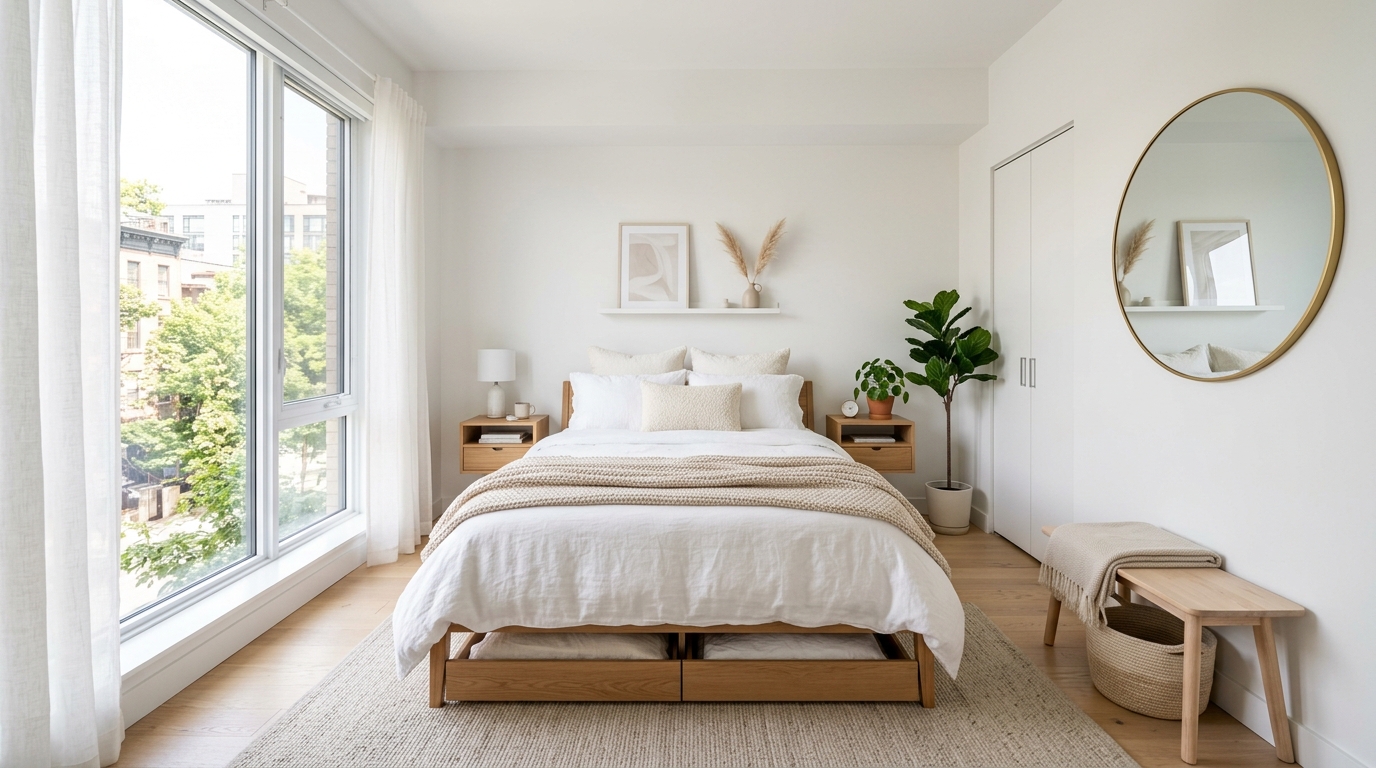
Small bedrooms are not the problem most people think they are. The problem is that nothing inside them is pulling in the same direction. The furniture is too big, the colors are fighting each other, and every surface is doing three jobs badly instead of one job well. The room feels cramped not because of its size but because of its choices.
These bedroom ideas for small rooms focus on one thing only: making the space feel bigger, calmer, and more open than it actually is. No style overhaul, no dramatic paint colors, no furniture you have to special order. Just specific, practical ideas that work with the square footage you have instead of wishing for more.
You will get 18 ideas here, each one distinct, each one focused purely on space. Some take an afternoon. Some cost nothing at all. Start with one and see what happens to how the room feels.
Paint the Walls and Ceiling the Same Warm Neutral
Most people paint the walls and leave the ceiling white. That horizontal line where wall meets ceiling cuts the room visually and makes it feel lower than it is. Paint both surfaces the same shade and that hard edge disappears. The room reads taller without a single structural change.
Choose a warm neutral in the LRV 60 to 75 range. Sherwin-Williams Accessible Beige, Benjamin Moore Pale Oak, or Behr Sculptor Clay all work beautifully. These tones reflect natural light without going cold or clinical, and they make the walls feel further back than they are.
Warm neutrals do something stark white cannot. They wrap the room softly so the eye moves through the space instead of stopping at every corner.
Replace Hinged Closet Doors with a Curtain Panel
A hinged closet door demands a swing arc of about two feet in front of it. In a small bedroom, that is two feet of floor you cannot use for anything else. Remove the doors entirely and hang a floor-length curtain on a ceiling-mounted rod instead.
Use a rod that extends six inches past the closet opening on each side so the curtain can be pushed fully clear when you need access. Choose a fabric in a color close to your wall tone so the closet reads as part of the wall rather than a separate structure.
This one change frees up floor space and visual weight at the same time.
Choose Bedroom Furniture with Visible Legs
Furniture that sits flat on the floor blocks your sightline at ground level and makes the room feel heavy and enclosed. Furniture raised on legs lets you see the floor underneath, and visible floor always reads as open space.
Look for a dresser on hairpin legs, a nightstand on tapered wood legs, or a small chair with slim mid-century legs. Even three to four inches of clearance under a piece makes a measurable difference to how the room reads. The Aiden Lane and Article furniture lines both carry bedroom pieces with this leg detail in the affordable to mid-range price range.
Use a Bed Frame That Sits Low to the Ground
A tall sleigh bed or a heavily upholstered platform with a thick base creates a visual block that dominates a small room. A low-profile bed frame keeps the mass low and lets the eye travel across the room instead of stopping at the headboard.
Look for frames in the 12 to 14 inch overall height range. The Thuma Platform Bed, IKEA MALM low bed frame, and Queer Eye Grayson Platform Bed are all worth considering. Pair any of these with a simple upholstered or solid wood headboard that sits close to the wall.
Hang the Curtain Rod at Ceiling Height
Where the curtain rod sits changes how the entire window reads. A rod mounted just above the window frame makes the window look small and the wall above it look wasted. A rod mounted two to three inches below the ceiling makes the same window look floor-to-ceiling, and the room feel significantly taller.
Let the curtains fall straight to the floor with no break in the fabric. Choose a light, solid color close to your wall shade. Linen in natural or oatmeal, sheer cotton in off-white, or a soft ivory voile all work well. The goal is for the curtain and wall to read as one continuous surface.
Add a Large Mirror on the Wall Opposite Natural Light
A mirror placed opposite a window reflects daylight back into the room and makes the space appear twice as deep as it is. This is not a decorating trick. It is basic physics, and it works every single time when the placement is right.
Go large. A mirror at least 24 by 36 inches does real work. A full-length leaning mirror in the corner does even more. Thin frames or frameless edges keep the look clean. Ornate heavy frames add visual weight that cancels out the benefit of the reflection, so keep the frame simple and let the glass do the job.
Mount Wall Sconces Instead of Using Table Lamps
Table lamps sit on nightstands and take up surface space that could hold other things or nothing at all. Worse, they anchor visual weight at the sides of the bed where the room is already narrow. Wall-mounted sconces solve both problems at once.
Install plug-in swing-arm sconces on each side of the bed at around 56 to 60 inches from the floor. The IKEA Nymane, CB2 Arched Plug-In Sconce, and Pottery Barn Carrie Plug-In Sconce all install without an electrician and look intentional rather than improvised. Choose a bulb around 2700K for warm, soft light that does not make the small space feel interrogated.
Use the Space Under the Bed for Contained Storage
The area under the bed is some of the most underused real estate in any bedroom. The catch is that loose, visible clutter under there makes the room feel messy, which reads as smaller. The solution is contained, uniform storage that looks deliberate.
Bed frames with built-in drawers are the cleanest option. Zinus and IKEA both make platform frames with large under-bed drawers at reasonable prices. If you prefer a bed you already own, use matching fabric or plastic bins in the same color. The IKEA SKUBB boxes in white or the Rubbermaid Cleverstore totes work well. Line them up evenly so the space under the bed looks organized rather than hidden.
Bedroom Ideas for Small Rooms Work Best with a Three-Color Rule
Too many colors in a small bedroom create visual noise. Visual noise makes a small room feel chaotic and even smaller. Limit the palette to three shades: one for the walls, one for the bedding and soft furnishings, and one accent used sparingly in a pillow, a small object, or a plant pot.
A simple combination that works: warm white walls, oatmeal linen bedding, and a single muted terracotta accent. Another option: soft sage walls, ivory bedding, and natural wood tones throughout. When everything in the room shares the same color family, the eye flows around the space without stopping, and the room feels larger because of it.
Swap the Nightstand for a Floating Shelf
A standard nightstand is typically 20 to 24 inches wide and 24 to 28 inches tall. In a narrow bedroom, two nightstands on either side of the bed can eat a significant amount of floor space. A floating shelf mounted at mattress height gives you the same surface without occupying the floor at all.
Mount two matching shelves, one on each side of the bed, at about 26 inches from the floor. The IKEA Lack shelf in white or birch costs very little and holds a lamp, a book, a glass of water, and your phone charger without any problem. Pair it with a wall sconce above and you have a fully functional bedside setup that takes up zero floor space.
Use Vertical Storage to Draw the Eye Upward
When floor space is limited, storage has to go up. A tall bookcase that reaches close to the ceiling does two things at once: it provides real storage capacity and it pulls the eye upward, which makes the room feel taller. A shelf that stops at shoulder height does neither particularly well.
The IKEA Billy bookcase in the 93-inch height gives you excellent vertical reach and fits most standard ceilings. Use the lower shelves for baskets that hide folded items or miscellaneous storage, and keep the upper shelves lighter with books, a small plant, and a few objects. A less cluttered top third makes the whole unit feel intentionally styled.
Choose a Rug That Is Larger Than Feels Comfortable
A small rug in a small bedroom makes the room feel even smaller. It defines a tiny zone within an already limited space and the surrounding exposed floor looks leftover rather than open. A rug that extends beyond the bed on all three sides does the opposite.
For a queen bed, use a rug that is at least 8 by 10 feet. For a full or twin, a 6 by 9 works. Keep the pattern minimal. A solid jute weave, a flat-weave wool in a single tone, or a very subtle texture all read as grounded and calm. The rug should anchor the room, not compete with it.
Replace a Bulky Dresser with a Closet Organization System
A full-size dresser in a small bedroom can take up four to six square feet of floor. If you have a closet, that dresser is almost certainly unnecessary. A proper closet organization system can absorb everything the dresser was holding and give it back to you more accessibly.
The IKEA PAX system and The Container Store Elfa are the two most flexible options. Both let you configure shelves, drawers, and hanging sections to match exactly what you own. Once clothing storage moves inside the closet, the dresser can leave the room entirely. Use the wall space it occupied for a mirror or leave it clear.
Make Small Room Bedroom Ideas Work with Monochromatic Bedding
When the bedding matches the wall color closely, the bed stops reading as a separate large object in the room and starts blending into the background. This is one of the most underused tricks in small bedroom design and one of the most effective.
If your walls are warm white, use ivory or cream bedding. If your walls are soft sage, layer in sage and eucalyptus tones on the bed. The bed physically takes up the same amount of space but visually it takes up far less. Add interest through texture rather than color contrast: a linen duvet over a cotton fitted sheet with a waffle knit throw at the foot works beautifully without adding any visual noise.
Remove Everything from the Top of the Dresser Except Three Items
Dresser tops collect things faster than almost any other surface in a bedroom. Receipts, chargers, perfume bottles, coins, hair ties, things that were supposed to be temporary and never left. Every item on that surface adds visual noise and makes the room feel smaller and less calm.
Keep three items maximum on the dresser top. A tray to corral the small things counts as one item. A plant counts as one. A candle or small dish counts as one. Everything else goes in a drawer, a bin, or out of the room. Clear surfaces feel like breathing room, and in a small bedroom, breathing room is everything.
Use a Slim Writing Desk as a Dual-Purpose Nightstand
A dedicated nightstand on one side of the bed and a separate desk somewhere else doubles the furniture in a room that does not have space to spare. A slim writing desk positioned next to the bed solves both needs at once.
Look for a desk around 20 inches deep and 28 to 30 inches tall, which sits close enough to mattress height to function as a surface for nighttime needs. The IKEA MICKE and the West Elm Parsons Mini Desk both work well in this role. Add a wall sconce above and a small drawer organizer underneath and the desk handles work hours and sleep hours without taking up any extra floor space.
Add One Tall Plant in the Corner with the Most Light
A plant in a small bedroom adds life without adding visual weight the way furniture does. The key is choosing the right plant for the right spot and not overdoing it. One well-placed plant does more for a small room than five scattered around without purpose.
Choose a tall, upright variety rather than a wide, spreading one. A snake plant in a 10-inch matte black or terracotta pot, a tall fiddle leaf fig in the corner, or a pothos trained upward on a small trellis all work well. Tall plants pull the eye upward the same way ceiling-height curtains do, reinforcing the sense of height in the room.
Final Thoughts
A small bedroom starts to feel spacious the moment everything in it is working together rather than competing for attention. It does not need new square footage. It needs light colors that open the walls, furniture that keeps the floor clear, and surfaces that are calm enough for the eye to move through without stopping.
Pick one idea from this list that you can do this week. Move the curtain rod up. Take everything off the dresser top except three things. Swap the nightstand for a floating shelf. Small bedrooms respond quickly to single changes because every inch is visible from everywhere in the room.
The best bedroom ideas for small rooms are not about making the space look bigger in photos. They are about making it feel different the moment you walk in, every single morning. That is the only result worth working toward.